How do you calculate kinetic and potential energy?
Kinetic energy is half the mass times the speed squared, KE = ½mv². Gravitational potential energy is mass times g times height, PE = mgh. A 60 kg skater at the top of a 3 m ramp has PE = 60 × 9.81 × 3 = 1,766 J and no kinetic energy; at the bottom all 1,766 J has become kinetic energy, so ½ × 60 × v² = 1,766 J and v = 7.67 m/s. Energy is in joules when mass is in kg, speed in m/s and height in metres.
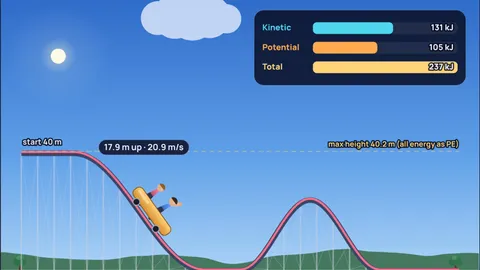
Type your mass, speed and height above, in kg, g or lb, m/s, km/h or mph, and metres or feet. The calculator converts everything, shows every step with your numbers, and draws the rider on a roller coaster: move the slider and watch the kinetic and potential energy bars trade while the total stays the same. For more worked examples read kinetic energy vs potential energy: examples with numbers.
Key results from the calculator
- Skater, 60 kg, 3 m ramp: PE 1,766 J, speed at the bottom 7.67 m/s whatever the skater weighs.
- Coaster car, 600 kg, 40 m drop at 2 m/s: 237 kJ in total and 28.1 m/s (101 km/h) at the bottom.
- Car, 1,500 kg, 50 km/h: KE = 145 kJ, the same as dropping it from 9.83 m. At 100 km/h it is 579 kJ, four times as much, equal to a 39.3 m drop.
- Apple, 100 g, 1 m up: PE = 0.981 J, about one joule. That is a handy feel for the size of a joule.
Six examples, worked
Each example gives the numbers the calculator shows. The button loads it; then move the rider and watch the bars.
A skater dropping in from a 3 m ramp
60 kg, 0 m/s, 3 mAt the top: KE = 0 and PE = mgh = 60 × 9.81 × 3 = 1,766 J. At the bottom all of it is kinetic: ½ × 60 × v² = 1,766, so v = √(2 × 9.81 × 3) = 7.67 m/s, about 27.6 km/h.
The mass cancels. A 40 kg child and a 90 kg adult reach the same 7.67 m/s at the bottom of a frictionless ramp; the heavier skater just carries more joules. Real ramps lose a little to friction and air, so real speeds are slightly lower.
A roller coaster car over a 40 m drop
600 kg, 2 m/s, 40 mThe car crests the lift hill at 2 m/s. KE = ½ × 600 × 2² = 1,200 J and PE = 600 × 9.81 × 40 = 235,400 J, so the total is 236,600 J, 237 kJ. Almost all of it is height.
At the bottom: v = √(2² + 2 × 9.81 × 40) = 28.1 m/s, 101 km/h. The 2 m/s at the top adds only 0.2 m to the effective drop, which is why designers care about the height of the first hill far more than the speed over its top. The second hill on the stage is 60% of the maximum height, so the car clears it with speed to spare.
A car at 50 km/h, and why speed matters so much
1,500 kg, 50 km/h, 0 mConvert first: 50 km/h ÷ 3.6 = 13.89 m/s. KE = ½ × 1,500 × 13.89² = 145 kJ. That is the energy the brakes must turn into heat to stop the car, and the energy a crash has to absorb.
It is also the potential energy of the same car 9.83 m up, about a third-floor balcony. At 100 km/h the kinetic energy is 579 kJ: double the speed, four times the energy, equal to a 39.3 m drop. The same square is why braking distance grows with the square of speed, worked through in SUVAT equations explained.
How high could a runner at 9 m/s rise?
70 kg, 9 m/s, 0 mA 70 kg runner at 9 m/s has KE = ½ × 70 × 9² = 2,835 J. Turn all of that into height and h = v² ÷ 2g = 81 ÷ 19.62 = 4.13 m. Again the mass cancels: the height depends only on the speed.
This is the energy budget of a pole vault. The pole stores the runner's kinetic energy as it bends and gives it back as height. Vaulters clear bars higher than 4.13 m because their centre of mass starts about a metre off the ground and they push up off the pole with their arms.
An apple 1 m above the floor: what a joule feels like
100 g, 0 m/s, 1 mPE = 0.1 × 9.81 × 1 = 0.981 J. Lifting a small apple from the floor to a table takes about one joule, and dropping it gives that joule back as speed: v = √(2 × 9.81 × 1) = 4.43 m/s at the floor.
For scale, a kettle heating water uses about 2,000 J every second, and the energy locked in a single gram of matter is enormous by comparison, as E = mc² for one gram shows.
The same 3 m ramp on the Moon
60 kg, 0 m/s, 3 m, g = 1.62With g = 1.62 m/s², the skater at the top of the ramp has PE = 60 × 1.62 × 3 = 292 J, a sixth of the Earth figure, and reaches only 3.12 m/s at the bottom.
Potential energy depends on g, so the same height stores less energy where gravity is weaker. Kinetic energy does not: 60 kg at 3.12 m/s is 292 J on any world.
Kinetic energy of everyday things
| Object | Mass | Speed | Kinetic energy | Same as a drop of |
|---|---|---|---|---|
| Apple dropped 1 m | 0.1 kg | 4.43 m/s | 0.981 J | 1 m |
| Cricket ball, fast bowling | 0.16 kg | 40 m/s | 128 J | 81.5 m |
| Skater after a 3 m drop | 60 kg | 7.67 m/s | 1,766 J | 3 m |
| Runner | 70 kg | 9 m/s | 2,835 J | 4.13 m |
| Car at 50 km/h | 1,500 kg | 13.9 m/s | 145 kJ | 9.83 m |
| Car at 100 km/h | 1,500 kg | 27.8 m/s | 579 kJ | 39.3 m |
| Coaster car after 40 m | 600 kg | 28.1 m/s | 237 kJ | 40.2 m |
Masses and speeds are round illustrative values. "Same as a drop of" is v² ÷ 2g with g = 9.81 m/s²: the height the object would have to fall, without air, to reach that speed. It does not depend on the mass.
How the calculator works
The inputs are converted to SI units first: grams to kilograms (÷ 1,000), pounds to kilograms (× 0.45359237), km/h to m/s (÷ 3.6), mph to m/s (× 0.44704) and feet to metres (× 0.3048). With mass in kg, speed in m/s and height in m, the energies come out in joules.
Kinetic energy is ½mv² and gravitational potential energy is mgh, measured from the ground (h = 0). The total is their sum. The speed at the bottom comes from setting the total equal to ½mv²: v = √(v₀² + 2gh). The highest point the object could coast up to comes from setting it equal to mgh: h max = h + v₀² ÷ 2g.
On the stage, the rider starts at your height and speed, drops to the ground and climbs a second hill 60% as high as the highest reachable point, then runs out. The slider places the rider anywhere along the track, and the bars show the kinetic and potential energy there: the kinetic bar is always the total minus the potential bar. Play runs the ride at the speed energy conservation gives, sped up or slowed so a run takes a few seconds.
Potential energy needs a reference level. The calculator uses the ground under the track; only differences in height matter for speeds, so moving the zero changes PE but never the answer to "how fast at the bottom".
What the model leaves out
- Friction and air resistance: real coasters and skaters lose energy to both, so they reach the bottom a little slower and cannot climb back to their starting height. The calculator is the frictionless ideal that textbook questions use.
- Rolling wheels: a spinning wheel stores some kinetic energy in its rotation, so a rolling object goes slightly slower at the bottom than a sliding one.
- Changing g: g is treated as constant, which is excellent for heights up to many kilometres. For orbits, use the full form of gravitational potential energy (see the gravitational force calculator).
- Relativity: ½mv² is the low-speed form. It is accurate to better than one part in a billion below about 10 km/s.
Common misconceptions
"Heavier objects reach the bottom faster." On a frictionless slope the mass cancels: every object reaches the same speed from the same height. A heavier one has more energy, not more speed.
"Double the speed, double the energy." Kinetic energy goes with the square of speed. Double the speed and the energy is four times larger.
"Potential energy is stored in the object." It belongs to the object and Earth together, and its value depends on where you put zero height. Only changes in it are physical.
Frequently asked questions
What is the formula for kinetic energy?
KE = ½mv², with m in kilograms and v in metres per second, giving joules. A 1,500 kg car at 13.9 m/s (50 km/h) has about 145 kJ.
What is the formula for gravitational potential energy?
PE = mgh, with m in kilograms, g = 9.81 m/s² on Earth and h in metres above your chosen zero level. A 60 kg person 3 m up has 1,766 J.
How do you find the speed at the bottom of a drop?
Set the potential energy lost equal to the kinetic energy gained: mgh = ½mv², so v = √(2gh). If the object was already moving at v₀, v = √(v₀² + 2gh). The mass cancels.
What is the difference between kinetic and potential energy?
Kinetic energy is energy of motion and depends on mass and speed. Potential energy is stored energy, here from height in a gravitational field, and depends on mass, g and height. Without friction they trade one for the other while the total stays fixed.
Does kinetic energy depend on mass or speed more?
On speed. Doubling the mass doubles the kinetic energy, but doubling the speed quadruples it, because speed is squared.
Keep learning
Kinetic Energy vs Potential Energy: Examples With Numbers
Kinetic and potential energy worked through with real numbers: a skater, a roller coaster, a car at 50 and 100 km/h, a runner and the Moon.

How Much Energy Is in 1 Gram of Matter? E = mc² Worked
One gram of mass is 9 × 10¹³ J, about 21 kilotons of TNT. Why bombs convert under 0.1% of their fuel, plotted from a fitted binding-energy curve.
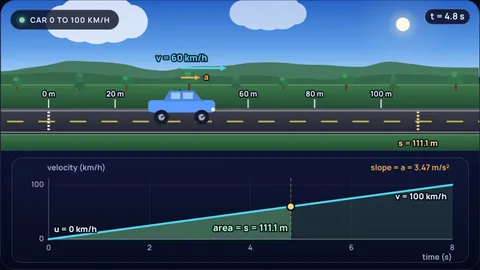
SUVAT Equations Explained, With Worked Examples
The five SUVAT equations, how to pick the right one, where they come from, and four worked examples with real numbers, including two-answer cases.
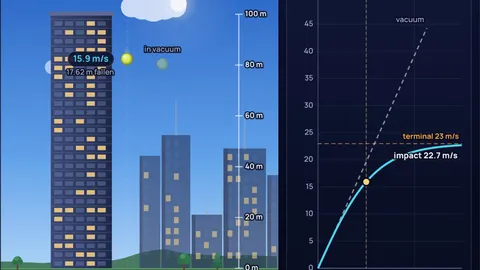
How Long Does It Take to Fall From a Height?
Fall time and landing speed for drops from 1 m to 1 km, the one formula behind them, worked examples, and when air resistance starts to matter.