How Long Does It Take to Fall From a Height?
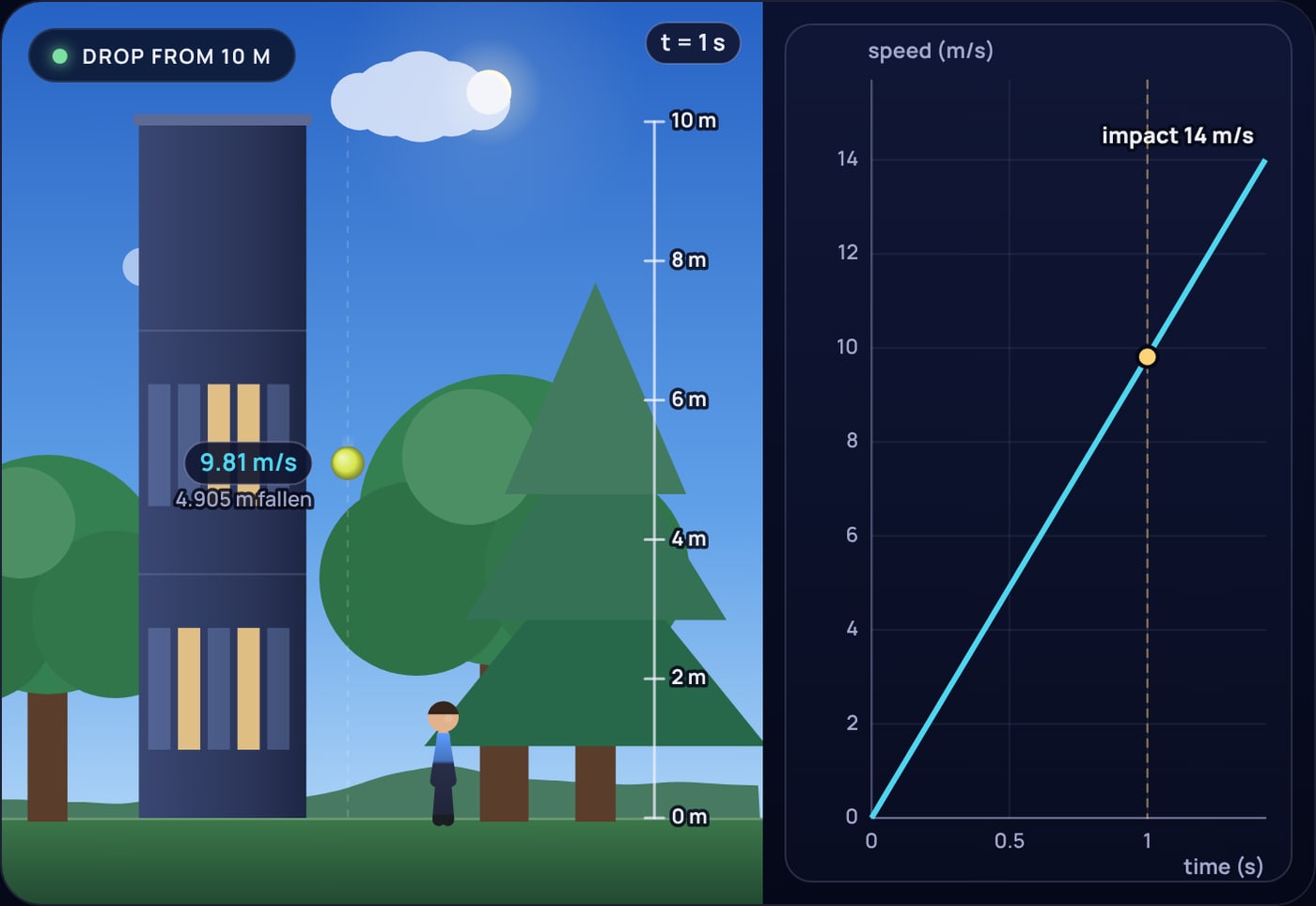
Drop a stone off a 10 m wall and it hits the ground 1.43 seconds later at 14 m/s, about 50 km/h. Drop it from 40 m, four times higher, and it takes 2.86 seconds: only twice as long. That square root is the single most useful thing to know about falling, and it explains why a long drop feels slow at the top and violent at the bottom.
This post gives the fall time and landing speed for heights from 1 m to 1 km, shows the two-line calculation behind each number, and then looks at where air resistance changes the answer. You can run any height yourself in the free fall calculator, which shows the working with your numbers and can switch air resistance on and off.
What is the formula for fall time?
An object dropped from rest accelerates at g, about 9.81 m/s² near Earth's surface (the defined standard value is 9.80665 m/s²). Constant acceleration from rest gives a distance fallen of
Turn it round for the time, and multiply by g for the speed:
Mass does not appear. In vacuum a bowling ball and a marble dropped together land together. Both equations are special cases of the constant-acceleration equations covered in SUVAT equations explained, with the initial velocity set to zero.
Worked example: a ball dropped from 10 m
Halfway through the time, at 0.714 s, the ball has fallen only , a quarter of the height. Three quarters of the drop happen in the second half of the fall.
How long does it take to fall from different heights?
The table uses the vacuum formulas. The last column is a real tennis ball in air, which shows where drag starts to matter.
| Height | Fall time | Landing speed | In km/h | Tennis ball in air |
|---|---|---|---|---|
| 1 m | 0.45 s | 4.43 m/s | 15.9 | 0.45 s, 4.39 m/s |
| 2 m | 0.64 s | 6.26 m/s | 22.6 | 0.64 s, 6.15 m/s |
| 5 m | 1.01 s | 9.90 m/s | 35.7 | 1.03 s, 9.46 m/s |
| 10 m | 1.43 s | 14.0 m/s | 50.4 | 1.47 s, 12.8 m/s |
| 20 m | 2.02 s | 19.8 m/s | 71.3 | 2.15 s, 16.6 m/s |
| 50 m | 3.19 s | 31.3 m/s | 113 | 3.70 s, 21.1 m/s |
| 100 m | 4.52 s | 44.3 m/s | 159 | 5.96 s, 22.7 m/s |
| 381 m | 8.81 s | 86.5 m/s | 311 | 18.2 s, 23.0 m/s |
| 1,000 m | 14.3 s | 140 m/s | 504 | 45.2 s, 23.0 m/s |
Read down the time column and the square root is plain: each hundredfold increase in height multiplies the time by ten. Read down the last column and you see the ball's speed stall near 23 m/s, its terminal speed, from about 100 m onwards.
How far do you fall in a given time?
Sometimes you know the time instead: you drop a stone into a well and count. Use directly.
Worked example: a 3 second drop
The stone falls 4.9 m in the first second, 14.7 m in the second and 24.5 m in the third. The splash then has to travel back up at about 343 m/s, which takes 0.13 s from 44 m, so a counted 3 s really means about 2.9 s of fall and roughly 41 m.
When does air resistance change the answer?
Air pushes back with a drag force that grows with the square of speed:
Here is the air density (about 1.2 kg/m³ at sea level), the drag coefficient, which depends on shape, and A the frontal area. When the drag equals the weight the object stops accelerating. That speed is the terminal velocity:
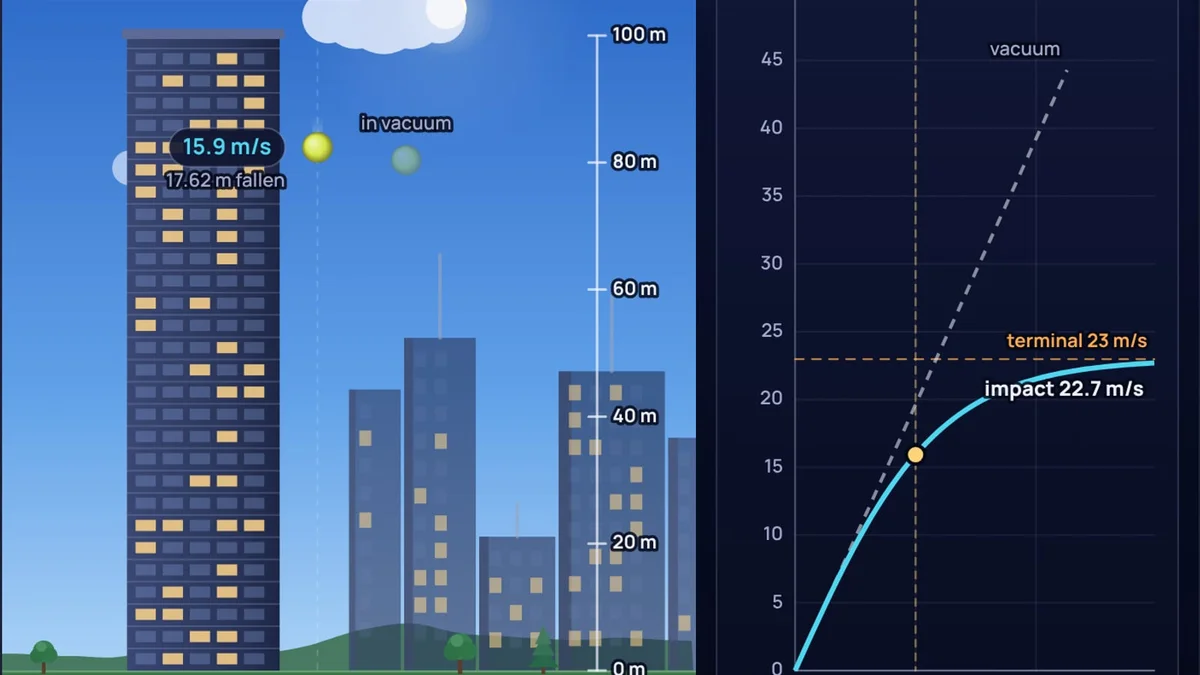
The rule of thumb that follows: air matters once the vacuum landing speed gets anywhere near . Light, broad things (a coin, a leaf, a ping-pong ball) have low terminal speeds and feel the air within a few metres. Dense, compact things (a steel ball, a stone) can fall tens of metres before it matters.
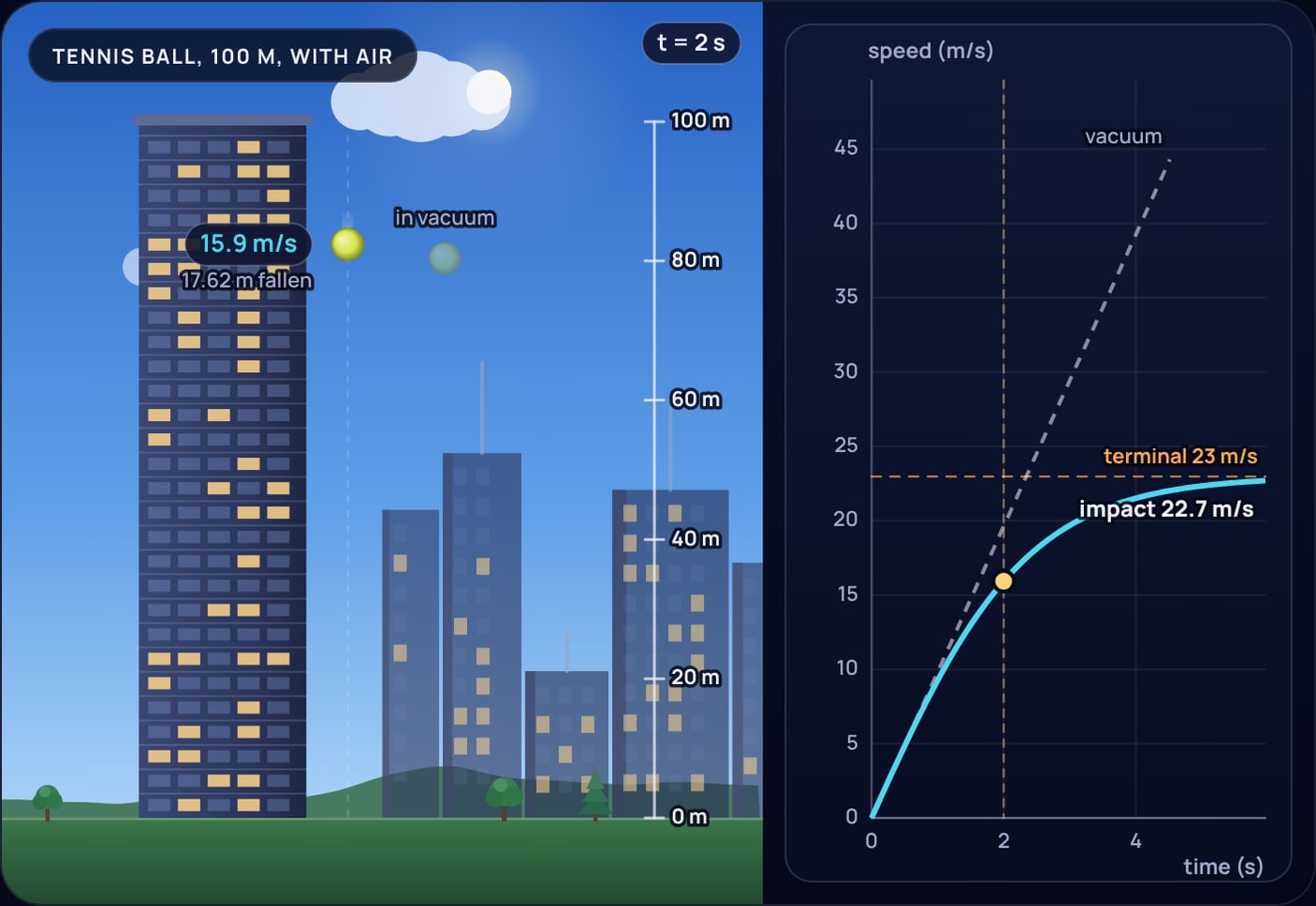
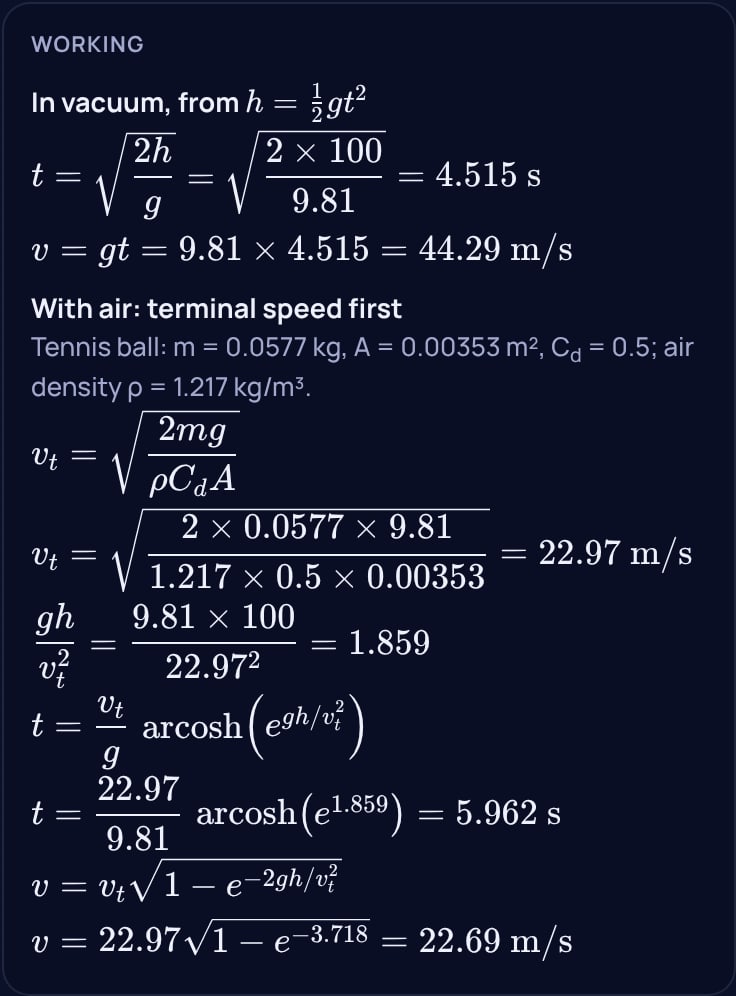
Worked example: a tennis ball from 100 m
A tennis ball is 56.0 to 59.4 g and 6.54 to 6.86 cm across under the ITF rules; take 57.7 g and 6.7 cm, so A = 0.00353 m². With a drag coefficient of 0.5 and air at 1.217 kg/m³:
In vacuum the ball would land at 44.3 m/s after 4.52 s. With drag the exact solution for a fall from rest gives
The air adds 1.4 seconds and halves the landing speed.
Why does a coin fall so slowly?
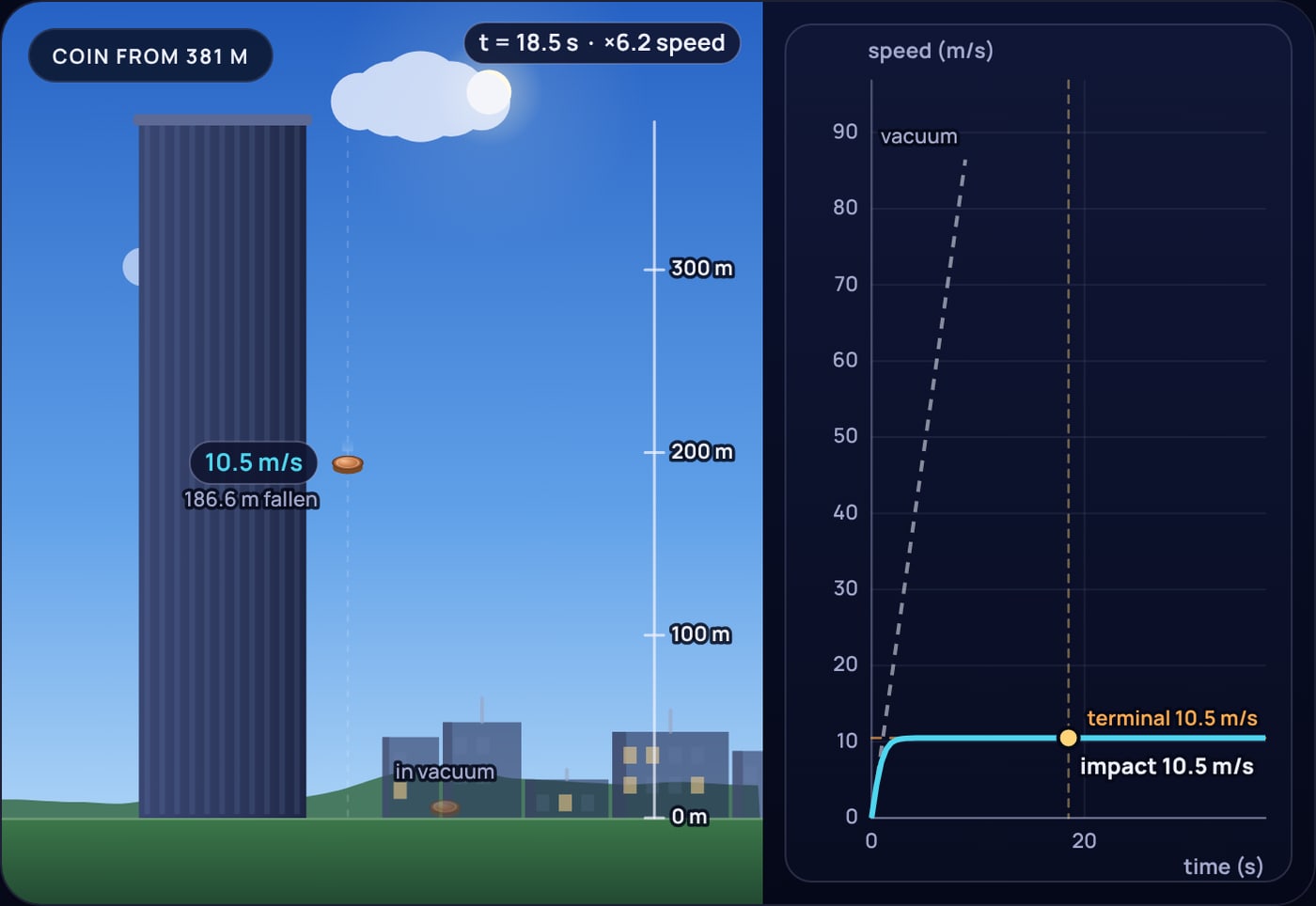
A US cent weighs 2.5 g and is 19.05 mm across. Falling flat, it behaves like a small plate with a drag coefficient around 1.28, which gives a terminal speed of only about 10.5 m/s, close to the 25 mph (11 m/s) measured for tumbling pennies. From the Empire State Building's 381 m roof it takes about 37 s to land instead of 8.8 s, and arrives at about 38 km/h rather than 86 m/s. Whether that could hurt anyone is the subject of can a penny from the Empire State Building kill you?
How long does a skydiver take to fall 1,000 m?
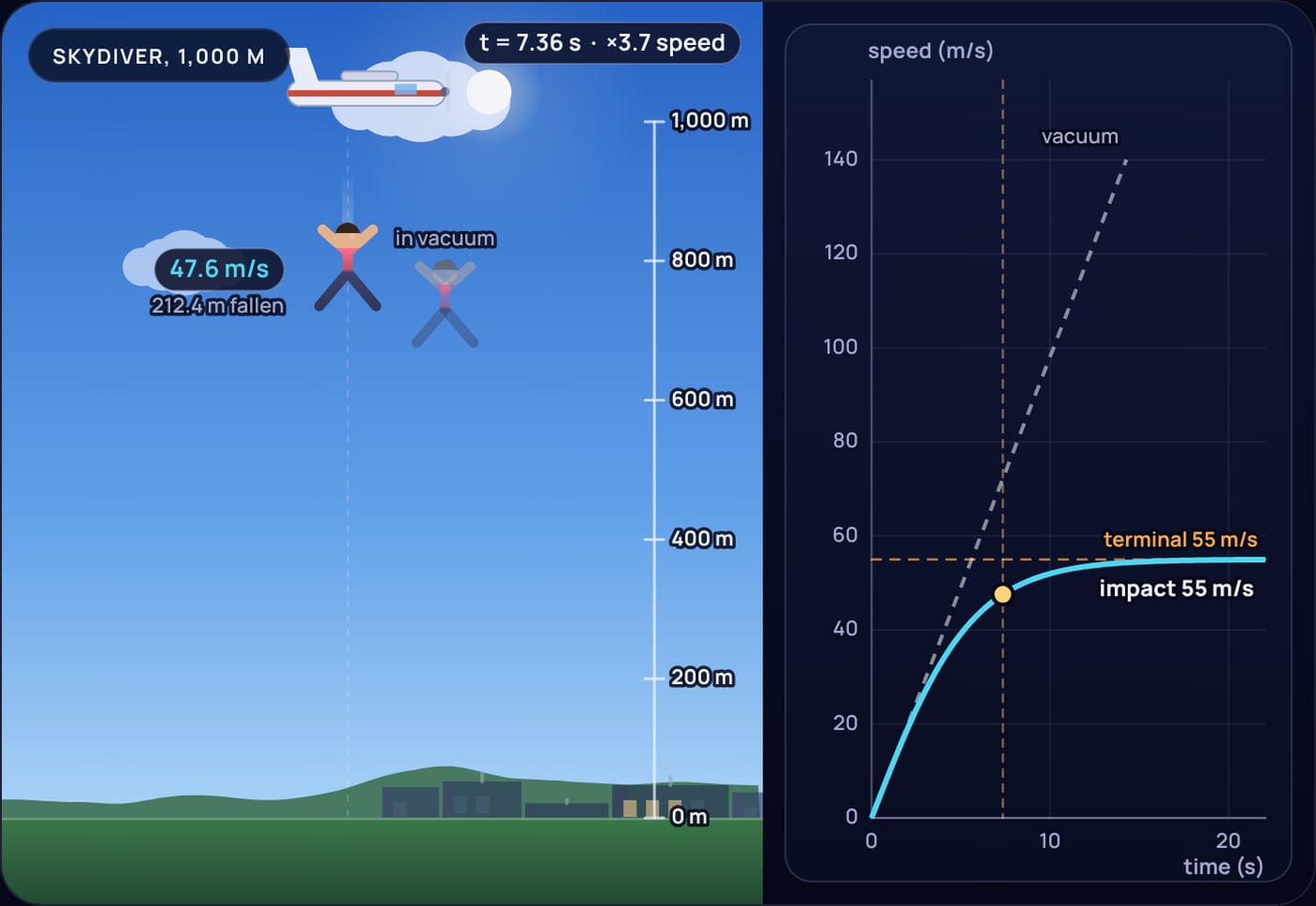
A skydiver in the spread, belly-down position reaches about 55 m/s, roughly 200 km/h. Setting the drag to give that terminal speed, the first 1,000 m below the aircraft take about 22 s. In vacuum the same drop would take 14.3 s and end at 140 m/s. Most of the difference builds up after the first five seconds, when the skydiver is already close to terminal speed and simply stops speeding up. Higher jumps and the thinning atmosphere are covered in the terminal velocity simulation, which follows the real air density all the way down.
How long would a fall take on the Moon or Mars?
Swap the value of g. NASA's fact sheets give 1.62 m/s² for the Moon and 3.73 m/s² for Mars.
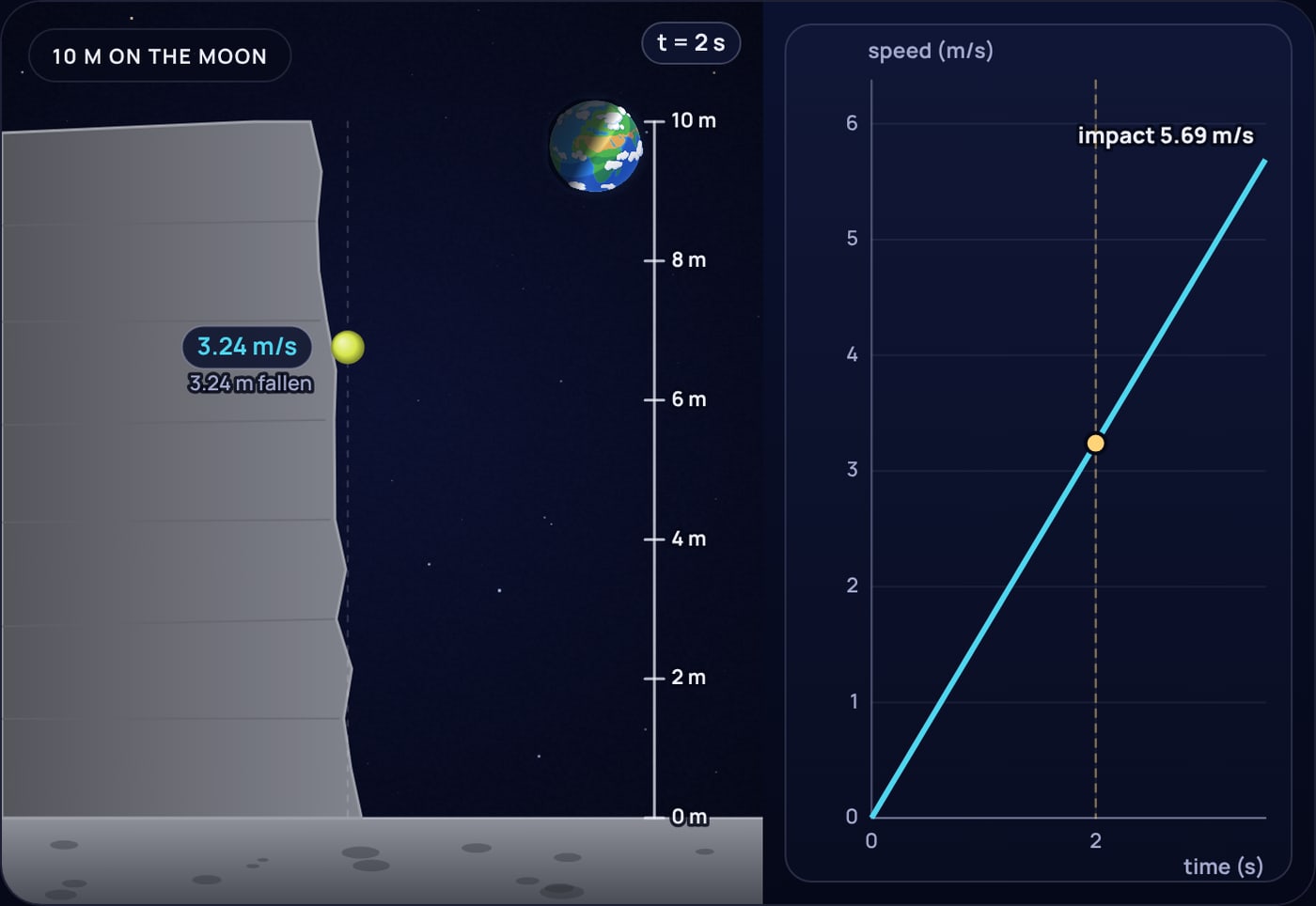
Worked example: 10 m on the Moon
That is 2.46 times as long as on Earth, the square root of 9.81 divided by 1.62. On Mars the same drop takes 2.32 s and lands at 8.64 m/s.
The Moon has essentially no air, so shape stops mattering. At the end of the last Apollo 15 moonwalk, David Scott dropped a 1.32 kg hammer and a falcon feather from about 1.6 m, and they hit the ground together after roughly 1.4 s. The same physics is why astronauts on the space station float: they are falling all the time, as why astronauts float explains.
Does doubling the height double the time?
This is the most common mistake, and the formula settles it. Because , doubling the height multiplies the time by . To double the time you need four times the height: 5 m takes 1.01 s and 20 m takes 2.02 s. The landing speed follows the same square root, so a 20 m drop lands at twice the speed of a 5 m one, and with four times the kinetic energy.
The second most common mistake is the idea that heavier things fall faster. In vacuum they do not. In air they do, but only because drag is a smaller fraction of a larger weight; two balls of the same size, one steel and one rubber, separate only after their speeds approach the rubber ball's terminal speed.
Try it yourself
Open the tennis ball from 100 m in the free fall calculator, then switch the object to the coin and watch the gap to the vacuum twin open up almost at once. Switch the world to Mars and the twin and the ball fall almost together, because the Martian air is about 75 times thinner than Earth's.
Sources
- NIST, standard acceleration of gravity, 9.80665 m/s² (exact).
- NASA Goddard, Earth fact sheet (surface gravity 9.780 to 9.832 m/s², surface air density 1.217 kg/m³), Moon fact sheet (1.62 m/s²) and Mars fact sheet (3.73 m/s², surface density about 0.016 kg/m³).
- NASA Glenn Research Center, shape effects on drag (sphere 0.07 to 0.5, flat plate 1.28) and falling object with air resistance.
- NASA, the Apollo 15 hammer and feather drop.
- International Tennis Federation, Rules of Tennis, Appendix I (ball mass 56.0 to 59.4 g, diameter 6.54 to 6.86 cm).
Frequently asked questions
How long does it take to fall 10 metres?
1.43 seconds if air resistance is negligible, landing at 14.0 m/s, which is about 50 km/h. The formula is t = √(2h ÷ g) with g = 9.81 m/s². A tennis ball with air takes about 1.47 seconds.
How far does an object fall in 1 second?
4.9 metres, from h = ½gt². In 2 seconds it falls 19.6 m and in 3 seconds 44.1 m, because the distance grows with the square of the time.
Do heavier objects fall faster?
Not without air: every object falls with the same acceleration g, so a hammer and a feather land together, as Apollo 15 showed on the Moon. In air, of two objects with the same size and shape, the heavier one falls faster because drag is smaller compared with its weight.
If you double the height, does the fall take twice as long?
No. The fall time grows with the square root of the height, so doubling the height multiplies the time by about 1.41. You need four times the height to double the time: 5 m takes 1.01 s and 20 m takes 2.02 s.
When does air resistance matter for a falling object?
When the speed it would reach in vacuum gets close to its terminal speed. A tennis ball’s terminal speed is about 23 m/s, so air matters noticeably after about 20 m of fall. A coin’s is about 10 m/s, so air matters after only a few metres.