SUVAT Equations Explained, With Worked Examples

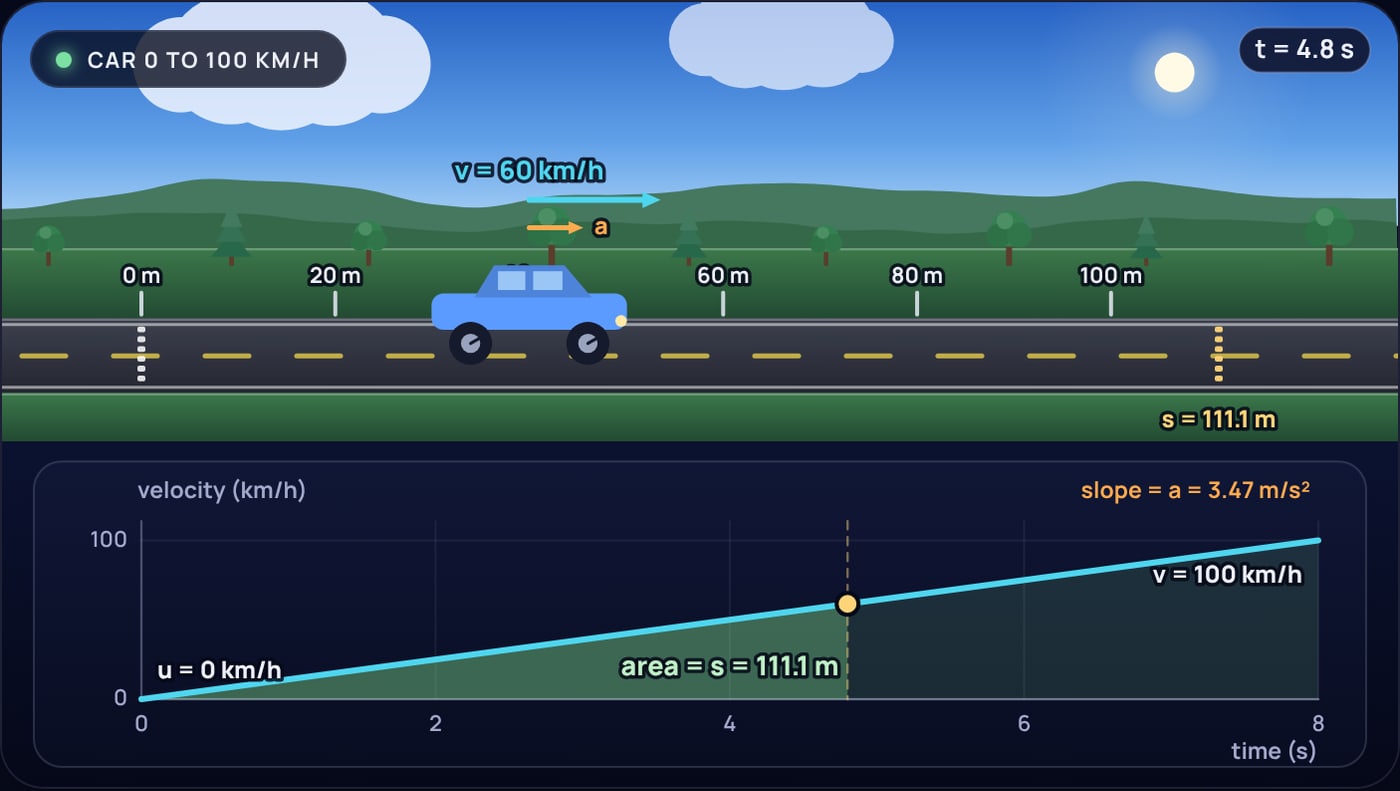
A family car that goes from 0 to 100 km/h in 8 seconds accelerates at 3.47 m/s² and covers 111.1 m while doing it. Two numbers, two lines of working, and you need no calculus at all. That is what the SUVAT equations are for: any straight-line motion with a constant acceleration, from a braking car to a dropped stone, can be solved from any three of five quantities.
This post shows the five equations, the one rule that tells you which equation to use, where the equations come from, and four worked examples, including the two kinds of question that have two answers. Every number here comes from the SUVAT calculator, which shows the same working line by line for whatever three values you type in.
What do s, u, v, a and t stand for?
The letters are just the five things that describe a stretch of straight-line motion:
| Letter | Quantity | SI unit | Notes |
|---|---|---|---|
| s | displacement | m | where you end up relative to the start, with a sign |
| u | initial velocity | m/s | velocity at the start of the stretch |
| v | final velocity | m/s | velocity at the end |
| a | acceleration | m/s² | must be constant; negative means it points backwards |
| t | time | s | length of the stretch, always positive |
Three of them are vectors in disguise. In one dimension a vector is a number with a sign, so you choose a positive direction at the start and stick to it. If a car is moving forwards and braking, u is positive and a is negative. If you take up as positive for a thrown ball, gravity is .
What are the five SUVAT equations?
Many exam formula sheets print only four of them and leave out . You never strictly need it, but it saves a step when the initial velocity is the thing you do not know and do not want.
How do you choose which SUVAT equation to use?
Look at the right-hand column above. Each equation contains four of the five letters. So the method is mechanical:
- Write down the three quantities you know, with signs and SI units.
- Write down the one you want.
- The fifth letter is the one you neither know nor want. Use the equation that does not contain it.
If you need the fifth quantity too, use the equation that leaves out the one you just found. That way both answers come from the numbers you were given, and a rounding slip in the first cannot spoil the second. The calculator follows exactly this rule and says why it chose each equation, which is the part a mark scheme usually wants to see.
Where do the SUVAT equations come from?
Draw velocity against time. With constant acceleration the graph is a straight line from u at time zero to v at time t, and its slope is the acceleration. That slope gives the first equation straight away: , so .
The area under a velocity-time graph is the displacement. The region under the line is a trapezium with parallel sides u and v and width t, so its area is . Substitute into that and you get . Substitute instead and you get the version with no u. Eliminate t between the first and fifth equations and you get . All five are the same straight line, looked at from different directions.
Worked example 1: a car from 0 to 100 km/h in 8 seconds
Known: u = 0, v = 100 km/h, t = 8 s. Wanted: a and s. First convert the speed. One km/h is 1000 m in 3600 s, so divide by 3.6.
Find a with the equation that has no s
Find s with the equation that has no a
As a check, the equation with no v gives , the same answer. The acceleration is about 0.35 g.
Worked example 2: why braking distance grows with the square of speed
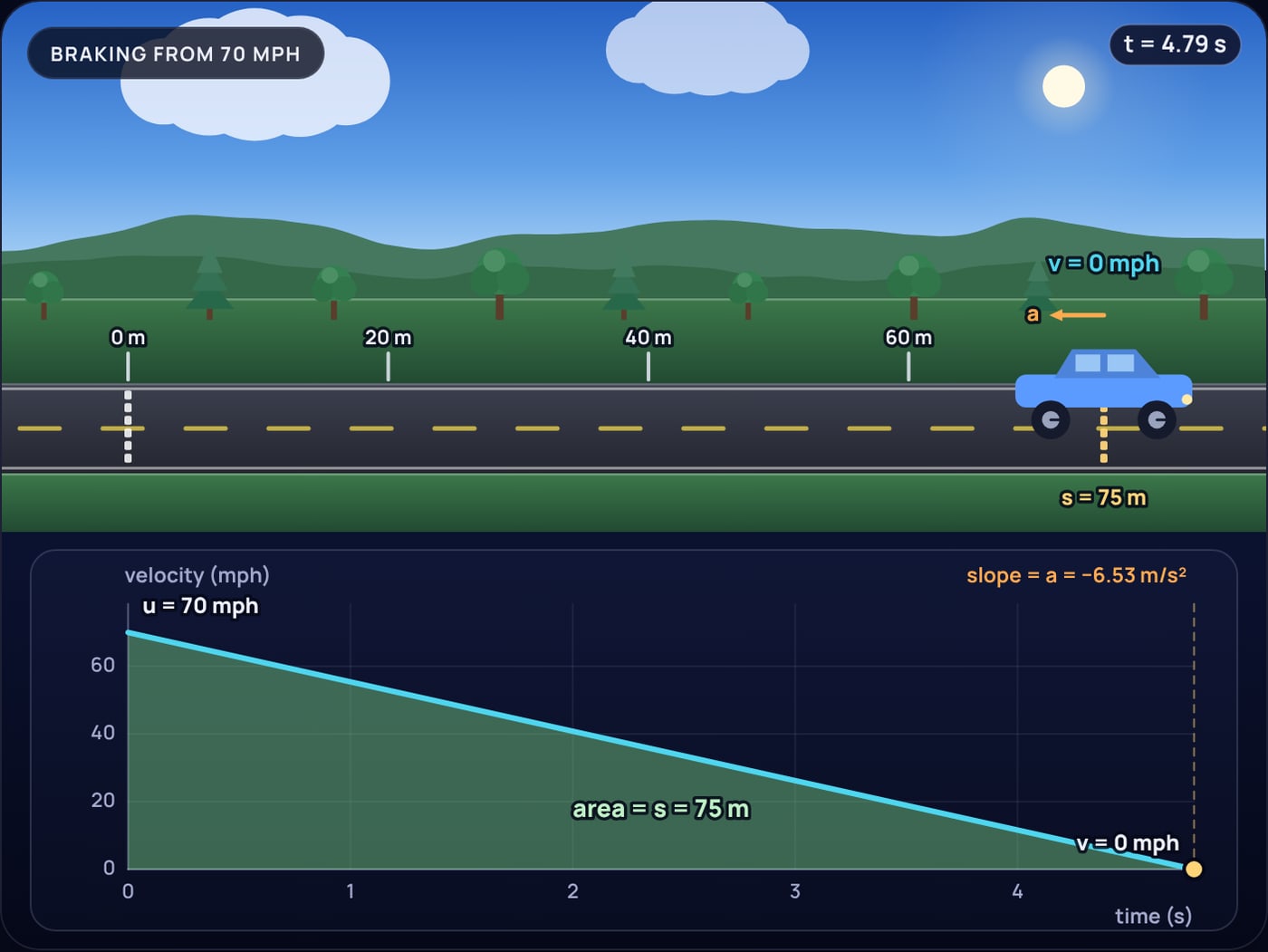
The UK Highway Code gives typical braking distances on a dry road of 14 m from 30 mph and 75 m from 70 mph. SUVAT tells you what deceleration those figures assume. Known: u, v = 0, s. Wanted: a. Time is not involved, so use the equation with no t.
From 70 mph in 75 m
The same sum for 30 mph (13.41 m/s) in 14 m gives . The table assumes roughly the same deceleration at every speed, about two thirds of g.
Rearrange with v = 0 and you get . For a fixed deceleration, braking distance goes with the square of the speed. 70 mph is 2.33 times 30 mph, and 2.33 squared is 5.4, which is why 14 m becomes 75 m. The thinking distance the Highway Code adds on top grows only in proportion to speed, because it is travelled at constant speed before your foot reaches the pedal.
Worked example 3: a ball thrown upwards, and why there are two answers
A ball is thrown straight up at 20 m/s. When is it 15 m above your hand? Take up as positive, so . Known: s = 15 m, u = 20 m/s, a. Wanted: t. The equation with no v is a quadratic in t.
Solve the quadratic
So or . Then gives at the first time (still rising) and at the second (falling).
Both roots are positive, so both are real. The ball passes 15 m on the way up and again on the way down, and which one you want depends on the question. If you had used to get v first, you would have found : the square root carries the same two cases, which is why the calculator finds v from once it has t. The sign then comes out right automatically.
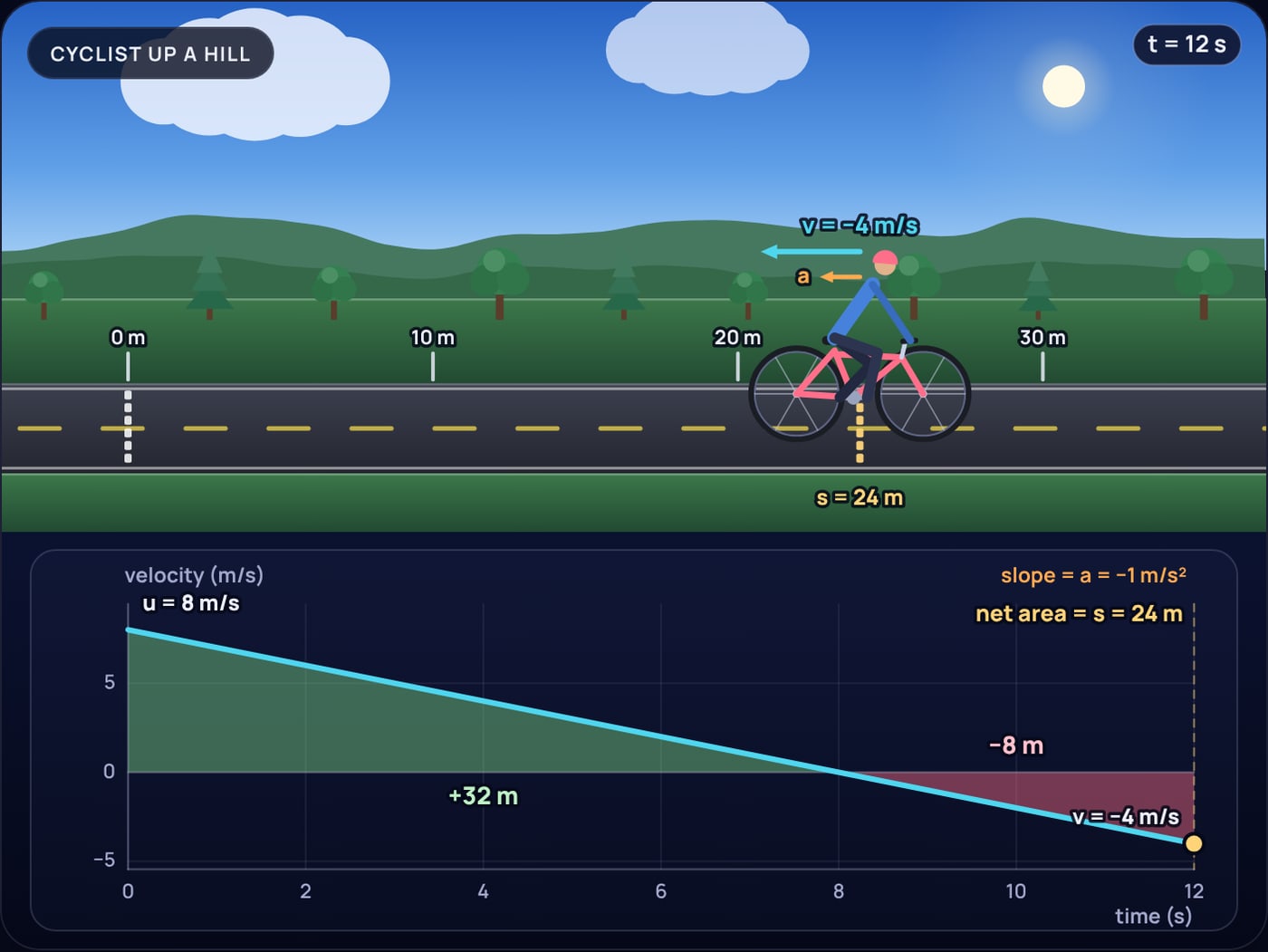
The same thing happens on a road. A cyclist who stops pedalling at 8 m/s on a hill that slows them at 1 m/s² is 24 m up the road after 4 s, climbing, and again after 12 s, rolling back. The velocity-time graph makes it obvious: the line crosses zero at 8 s, the area above the axis is +32 m and the area below is −8 m.
Worked example 4: speed from skid marks, where one root is rejected
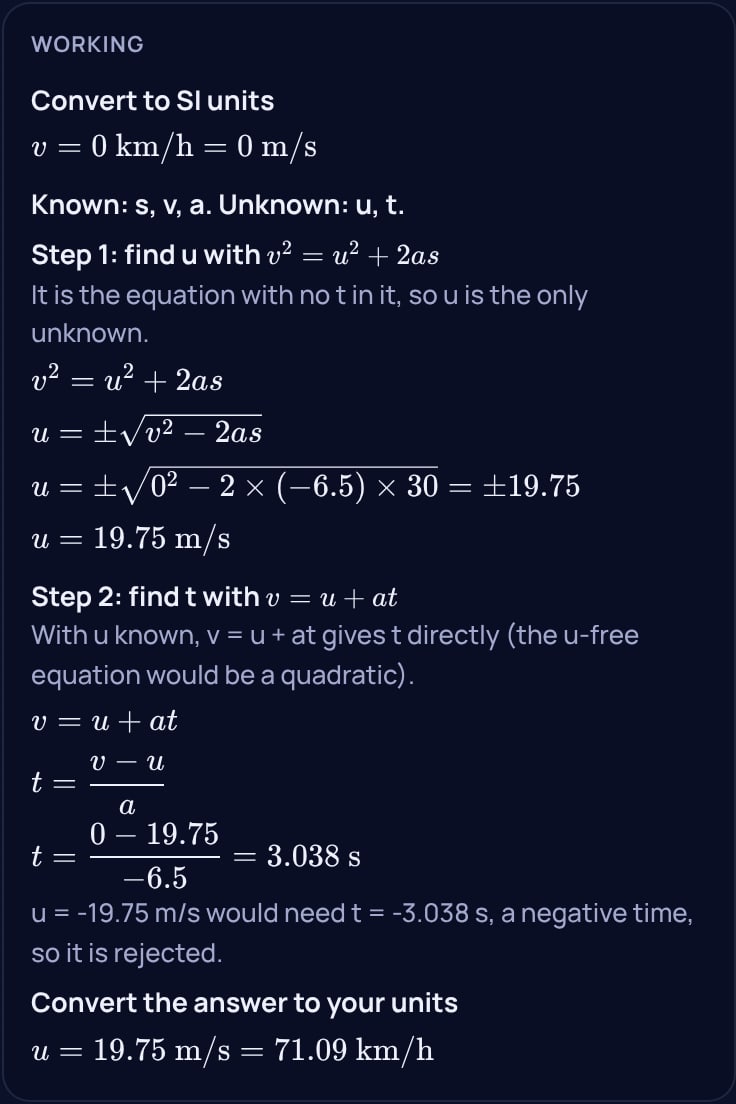
A car leaves 30 m of skid marks before stopping. Taking the deceleration the Highway Code figures imply, about 6.5 m/s², how fast was it going? Known: s = 30 m, v = 0, a = −6.5 m/s². Wanted: u. Time is not involved.
Use the equation with no t
Check each root with . For , . For the time comes out as −3.04 s, which is before the skid began, so that root is rejected. The car was doing 19.75 m/s, which is 71.1 km/h or 44.2 mph.
Real accident investigators measure the grip of the actual road surface, because a wet road can roughly halve the deceleration, and the same 30 m of marks would then mean a much lower speed.
What mistakes do people make with SUVAT?
Mixing units. SUVAT works in any consistent units, but km/h with seconds is not consistent. Convert to metres and seconds first: divide km/h by 3.6, multiply mph by 0.44704 (an exact factor in NIST's conversion tables), feet by 0.3048. The calculator accepts km/h, mph, feet and minutes and shows each conversion in the working.
Dropping the sign. Choose a positive direction and write every vector with its sign. A ball thrown up at 20 m/s with up positive has u = +20 and a = −9.81. Forget the minus and the ball accelerates into the sky.
Treating displacement as distance. This is the most common misconception. s is where the object ends up relative to the start, not how far it went. The cyclist above has a displacement of 24 m after 12 s but has travelled 40 m. A ball thrown up and caught again has s = 0 however high it went.
Using SUVAT where the acceleration is not constant. A falling penny reaches a terminal velocity because drag grows with speed, so its acceleration shrinks towards zero. SUVAT would have it falling forever faster. The penny from the Empire State Building is a good example of where the equations stop working, and the terminal velocity simulation shows the real curve.
When can you use SUVAT for falling objects?
When air resistance is small compared with the weight: a stone dropped a few metres, a ball thrown at walking pace. A stone dropped from rest falls in 3 s and reaches . For a person, drag starts to matter after a couple of seconds. The free fall calculator compares the two, and astronauts on the ISS are in exactly this kind of free fall all the time, as why astronauts float explains.
For thrown objects that move sideways as well, apply SUVAT separately to the horizontal motion (a = 0) and the vertical motion (a = −9.81 m/s²), linked by the same time. That is all projectile motion is, and the projectile motion simulation draws it.
Try it yourself
Load the cyclist on the hill in the SUVAT calculator, then change the displacement from 24 m to 32 m and watch the two answers merge into one at the top of the climb. Change it to 33 m and the calculator tells you there is no answer: the cyclist turns round before getting there, and the number under the square root goes negative.
Sources
- NIST, standard acceleration of gravity, 9.80665 m/s² (exact), CODATA values.
- NIST Special Publication 811, Appendix B.8 conversion factors (mph to m/s 0.44704 exact, foot 0.3048 m exact).
- GOV.UK, The Highway Code, rule 126 and typical stopping distances.
Frequently asked questions
What are the five SUVAT equations?
v = u + at, s = ut + ½at², s = vt − ½at², v² = u² + 2as and s = ½(u + v)t. Here s is displacement, u initial velocity, v final velocity, a acceleration and t time. Each equation leaves out exactly one of the five quantities.
How do you know which SUVAT equation to use?
Write down the three quantities you know and the one you want. The fifth quantity is the one you neither have nor need. Use the equation that does not contain it. If t is not involved, use v² = u² + 2as; if s is not involved, use v = u + at.
Why can a SUVAT question have two answers?
Finding t from s = ut + ½at² means solving a quadratic, which can have two positive roots. Both are real: the object passes the same point twice, once going and once coming back. A negative root means a time before the motion started and is thrown away.
Can you use SUVAT when acceleration changes?
No. Every SUVAT equation assumes constant acceleration. If the acceleration changes, for example a skydiver slowing down as drag builds up, you need calculus or a step-by-step numerical method. You can sometimes split the motion into stages that each have constant acceleration.
Is s distance or displacement in SUVAT?
Displacement: how far the object ends up from where it started, with a sign for direction. It equals the distance travelled only if the object never turns round. A ball thrown up and caught again has a displacement of zero.