How long does it take to fall, and how fast do you land?
Without air, the fall time is the square root of twice the height divided by g, and the landing speed is g times that time. A drop of 10 m on Earth takes √(2 × 10 ÷ 9.81) = 1.43 s and lands at 14 m/s (50.4 km/h). A 100 m drop takes 4.52 s, not ten times longer, and lands at 44.3 m/s. Mass does not appear anywhere: in vacuum a feather and a hammer fall together.
Air changes that for anything light or fast. Switch on air resistance and choose a tennis ball, a coin or a skydiver: the calculator solves the drag equation exactly and runs a faint twin in vacuum beside it, so you can see where the two part company. For the full story with more numbers read how long does it take to fall from a height?, and for falls from aircraft altitude see the terminal velocity simulation.
Key results from the calculator
- 10 m on Earth, no air: 1.43 s, landing at 14 m/s. With air a tennis ball takes 1.47 s and lands at 12.8 m/s.
- A 3 second fall: 44.1 m, landing at 29.4 m/s (106 km/h).
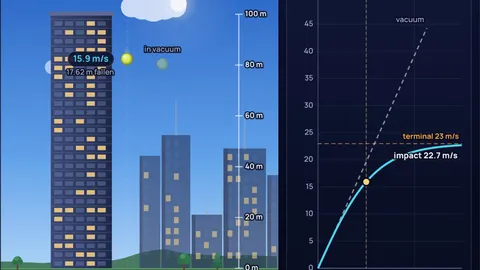
- 100 m with air: a tennis ball takes 5.96 s instead of 4.52 s and lands at 22.7 m/s, just under its 23 m/s terminal speed, instead of 44.3 m/s.
- 10 m on the Moon: 3.51 s and 5.69 m/s. On Mars: 2.32 s and 8.64 m/s.
Seven drops, worked
Each section gives the numbers the calculator shows for that setup. The button loads it so you can read the working line by line and change the height.
A ball dropped from 10 m (about a third-floor window)
Earth, no airWith g = 9.81 m/s² and no air: t = √(2 × 10 ÷ 9.81) = 1.43 s, and v = 9.81 × 1.43 = 14 m/s, which is 50.4 km/h or 31.3 mph. The same answer comes from v = √(2gh) directly.
Notice how the speed builds: halfway through the time (0.714 s) the ball has fallen only a quarter of the height, 2.5 m. Distance grows with the square of time, so most of the height is covered in the second half of the fall. With air, a tennis ball takes 1.47 s, only 3.1% longer.
How far do you fall in 3 seconds?
Earth, time givenThe cliff-edge trick: drop a stone and count. With t = 3 s, h = ½ × 9.81 × 3² = 44.1 m, and the stone is doing 29.4 m/s when it lands. Each extra second adds more than the one before: 4.9 m in the first second, 14.7 m in the second, 24.5 m in the third.
In practice the sound of the splash takes time to come back up, about 0.13 s for 44 m at 343 m/s, so a counted 3 s means a slightly shorter drop. For a stone over a few seconds, air resistance takes off a few percent more.
A tennis ball from 100 m, with and without air
Earth, with airA tennis ball (about 57.7 g and 6.7 cm across, the middle of the ITF ranges) with a drag coefficient of 0.5 has a terminal speed of √(2mg ÷ ρCdA) = 23 m/s in air of density 1.217 kg/m³. In vacuum it would land at 44.3 m/s after 4.52 s.
With air it takes 5.96 s and lands at 22.7 m/s, 98.8% of its terminal speed. The graph shows the two curves agreeing for the first second and then separating as drag catches up with the weight.
A coin from the top of the Empire State Building
Earth, with airA US cent is 2.5 g and 19.05 mm across. Falling flat, like a plate (Cd 1.28), its terminal speed is only 10.5 m/s, close to the 25 mph (11 m/s) measured for tumbling pennies in wind tunnel tests. From the 381 m roof it takes 37 s to land, at 10.5 m/s.
In vacuum it would arrive after 8.81 s at 86.5 m/s, about 311 km/h. The air takes away almost all of that speed. Why it cannot hurt anyone is worked through in can a penny from the Empire State Building kill you?.
A skydiver falling 1,000 m
Earth, with airA skydiver in the spread position falls at about 55 m/s (200 km/h). The calculator sets the drag so that is the terminal speed. The first 1,000 m then take 22.1 s, and by the end the skydiver is at 99.9% of terminal speed.
Without air the same 1,000 m would take 14.3 s and end at 140 m/s, 504 km/h. On Mars, whose air is about 75 times thinner, the same person would have a terminal speed near 296 m/s and fall 1,000 m in 23.3 s, almost as if there were no air at all.
A 10 m drop on the Moon
Moon, no airThe Moon's surface gravity is 1.62 m/s², about a sixth of Earth's. A 10 m drop takes √(2 × 10 ÷ 1.62) = 3.51 s, 2.46 times as long as on Earth (the square root of 9.81 ÷ 1.62), and lands at 5.69 m/s.
There is essentially no air, so the object choice makes no difference. Apollo 15 commander David Scott dropped a 1.32 kg hammer and a falcon feather from about 1.6 m and they landed together, after about 1.41 s compared with 0.571 s for the hammer on Earth.
A 10 m drop on Mars
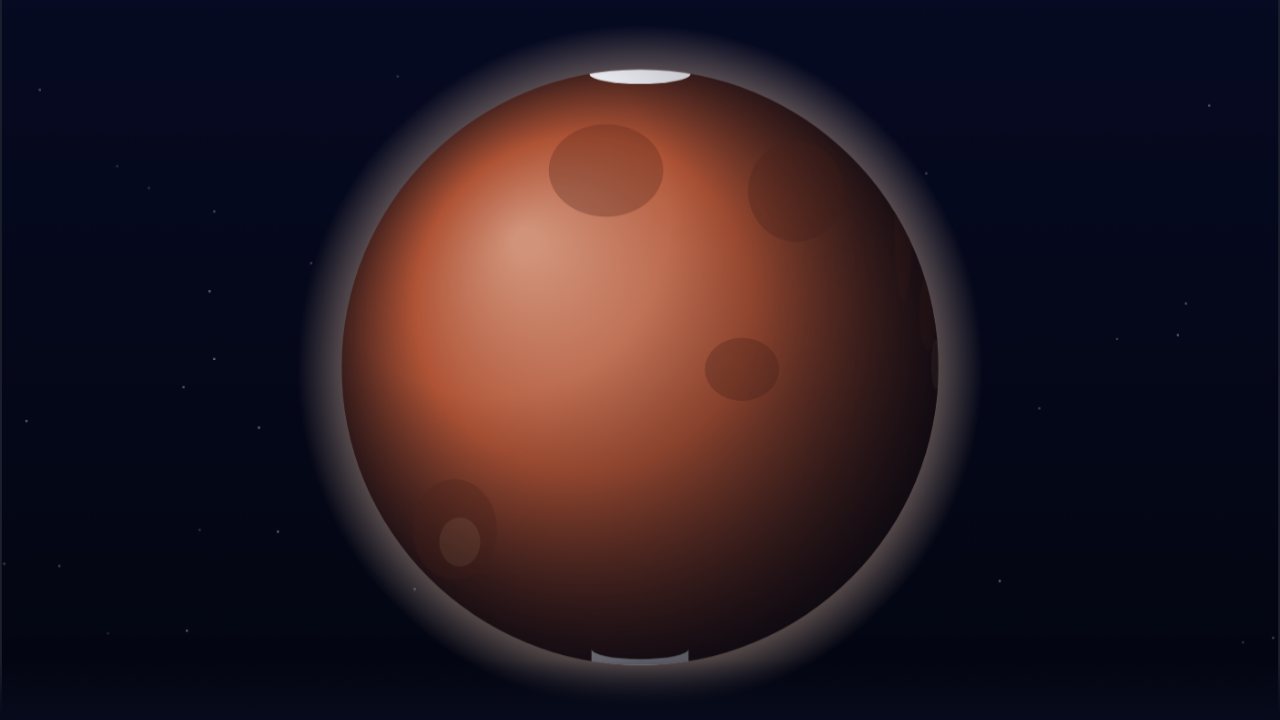
Mars, no airMars has a mean surface gravity of 3.73 m/s², so a 10 m drop takes 2.32 s and lands at 8.64 m/s, about 62% of the Earth speed. The air is thin enough (about 0.016 kg/m³) that switching on air resistance for a tennis ball changes the result by under 1%.
That thin air is a real problem for landing spacecraft: parachutes alone cannot slow a heavy lander enough, which is why Mars missions also use rockets or airbags.
Fall time and impact speed by height (Earth, no air)
| Height | Fall time | Impact speed | In km/h | Tennis ball with air |
|---|---|---|---|---|
| 1 m | 0.452 s | 4.43 m/s | 15.9 km/h | 0.453 s, 4.39 m/s |
| 2 m | 0.639 s | 6.26 m/s | 22.6 km/h | 0.643 s, 6.15 m/s |
| 5 m | 1.01 s | 9.9 m/s | 35.7 km/h | 1.03 s, 9.46 m/s |
| 10 m | 1.43 s | 14 m/s | 50.4 km/h | 1.47 s, 12.8 m/s |
| 20 m | 2.02 s | 19.8 m/s | 71.3 km/h | 2.15 s, 16.6 m/s |
| 50 m | 3.19 s | 31.3 m/s | 113 km/h | 3.7 s, 21.1 m/s |
| 100 m | 4.52 s | 44.3 m/s | 159 km/h | 5.96 s, 22.7 m/s |
Vacuum values use g = 9.81 m/s². The last column is a 57.7 g, 6.7 cm tennis ball with a drag coefficient of 0.5 in air of density 1.217 kg/m³. Up to about 5 m the two agree within a few percent; by 100 m the ball has almost reached its terminal speed.
How the calculator works
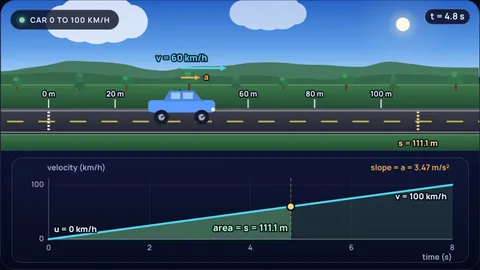
In vacuum the acceleration is constant, so the SUVAT equations apply with u = 0 and a = g: h = ½gt², which gives t = √(2h ÷ g), and v = gt = √(2gh). If you give a time instead, h = ½gt². The working shows each line with your numbers.
With air, the drag force is ½ρCdAv², which grows with the square of speed. The object stops accelerating when drag equals weight, at the terminal speed vt = √(2mg ÷ ρCdA). For a fall from rest at constant air density this has an exact solution: v = vt tanh(gt ÷ vt) and h = (vt² ÷ g) ln cosh(gt ÷ vt). Turned round, the time to fall h is (vt ÷ g) arcosh(egh/vt²) and the landing speed is vt √(1 − e−2gh/vt²).
Objects: a tennis ball of 57.7 g and 6.7 cm (the middle of the ITF ranges) with Cd = 0.5, the top of NASA Glenn’s 0.07 to 0.5 range for a sphere; a US cent of 2.5 g and 19.05 mm (US Mint) falling flat like a plate, Cd = 1.28 (NASA Glenn); and a 75 kg skydiver whose drag is set so the terminal speed is the usual 55 m/s. Gravity is 9.81 m/s² on Earth (standard gravity is 9.80665 m/s²), 1.62 m/s² on the Moon and 3.73 m/s² on Mars, from NASA’s fact sheets.
The stage plays the fall in real time when it lasts 6 s or less, and speeds it up otherwise (the clock shows the factor). The height scale on the right is drawn to scale, and so are the trees and the 1.7 m person when they fit. With air on, the faint twin falls in vacuum from the same height at the same moment.
What the model leaves out
- Changing air density: air thins with height, about 10% less dense 1 km up. The calculator holds it at the surface value, which slightly underestimates speeds for very high drops. The terminal velocity simulation includes the real atmosphere.
- Tumbling and changing shape: a coin flutters and tumbles, a person changes position. The drag coefficients here are single typical values.
- Wind and buoyancy: sideways wind does not change the fall time in this model, and the upward buoyancy of air (about 0.1% of a person’s weight) is ignored.
- What happens on landing: the calculator stops at the ground. How much damage a landing does depends on how quickly the speed is lost, which is a different calculation.
Common misconceptions
"Heavier objects fall faster." Not in vacuum: the time depends only on g and the height. With air, a heavy object of the same size does fall faster, because its weight is larger compared with the same drag.
"Double the height, double the time." The time grows with the square root of the height. Four times the height takes twice as long: 5 m takes 1.01 s and 20 m takes 2.02 s.
"There is no gravity in space, which is why astronauts float." Gravity on the space station is about 90% of its surface value. Astronauts float because they are in free fall together with the station, as explained in why astronauts float.
Frequently asked questions
How long does it take to fall 10 meters?
1.43 seconds with no air resistance, landing at 14 m/s (50.4 km/h). A tennis ball with air takes about 1.47 s. The formula is t = √(2h ÷ g) with g = 9.81 m/s².
What is the formula for free fall time?
t = √(2h ÷ g), where h is the height in metres and g is 9.81 m/s² on Earth. The impact speed is v = gt, or equivalently v = √(2gh). Both ignore air resistance and assume the object starts from rest.
Does mass affect how fast something falls?
Not in vacuum: a hammer and a feather land together, as Apollo 15 showed on the Moon. In air, mass matters through the balance of weight and drag: of two objects the same size and shape, the heavier one falls faster and has a higher terminal speed.
How far do you fall in 1 second?
4.9 m, from h = ½ × 9.81 × 1². After 2 s it is 19.6 m and after 3 s 44.1 m, because distance grows with the square of time.
How long would it take to fall on the Moon?
A 10 m drop takes 3.51 s on the Moon, against 1.43 s on Earth, because lunar gravity is 1.62 m/s². The object lands at 5.69 m/s instead of 14 m/s.
Keep learning
How Long Does It Take to Fall From a Height?
Fall time and landing speed for drops from 1 m to 1 km, the one formula behind them, worked examples, and when air resistance starts to matter.

Can a Penny From the Empire State Building Kill You?
A tumbling penny tops out at 11 m/s and lands with 0.15 J, about 100 times too little to crack a skull. Here is the drag math, and what would be dangerous.

Gravity is still strong at the space station. Why do astronauts float?
The station, crew and loose objects fall together. Weightlessness is about the missing support force, not gravity switching off above the atmosphere.
Is There Gravity on the ISS? Yes: 89% of Earth's
Gravity at the ISS is 89% of Earth's surface value. Astronauts float because they fall 4.35 m every second and keep missing. Here are the numbers.
SUVAT Equations Explained, With Worked Examples
The five SUVAT equations, how to pick the right one, where they come from, and four worked examples with real numbers, including two-answer cases.