Escape Velocity of Every Planet Compared, Plus the Moon, Sun and a Neutron Star
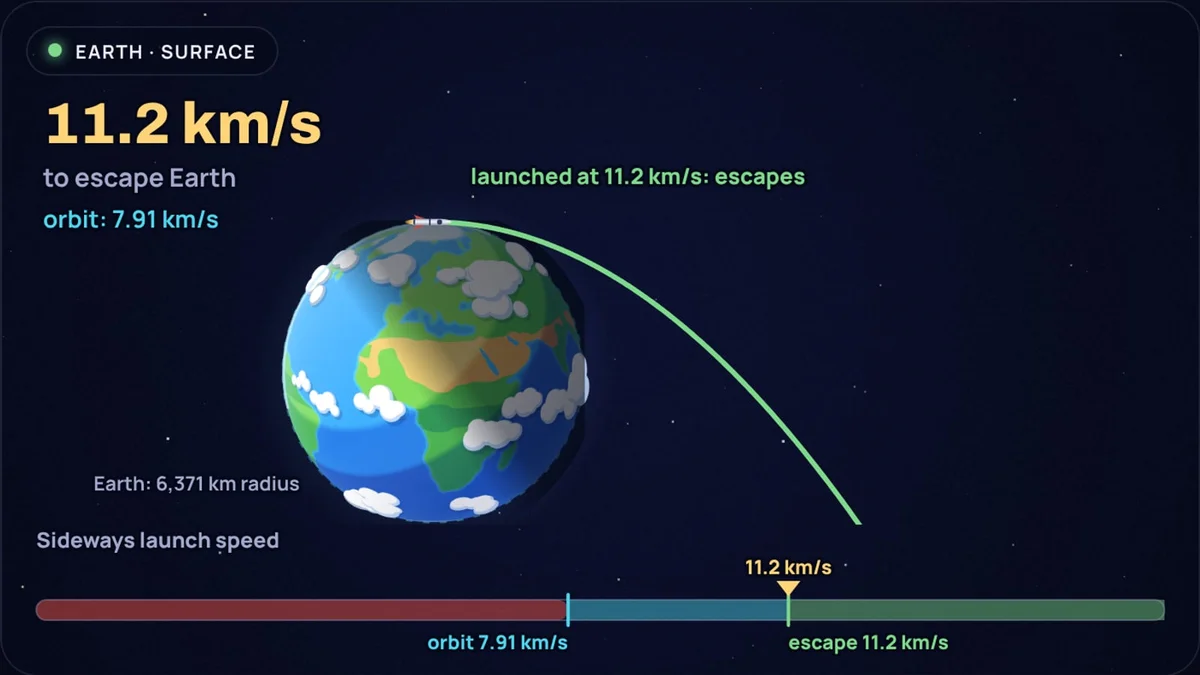
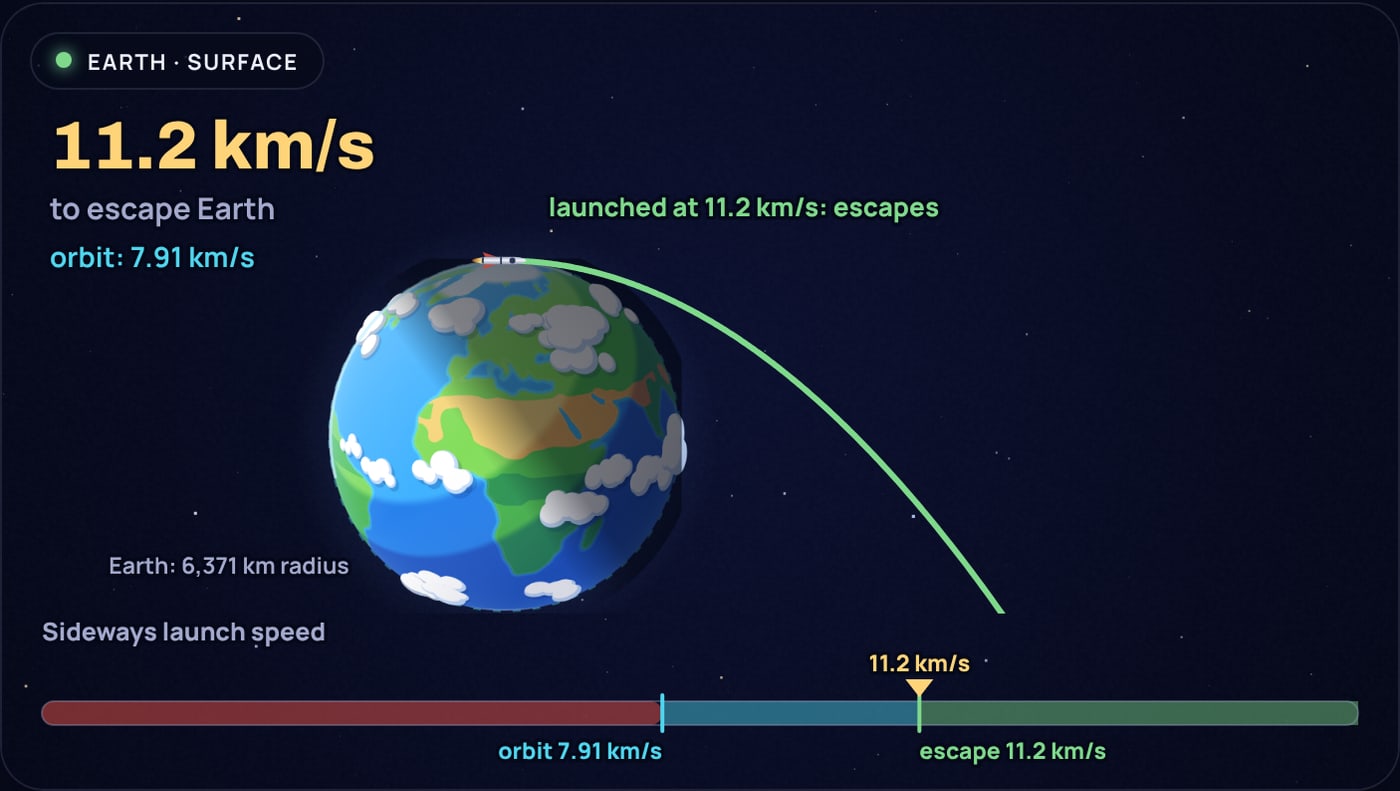
From Earth's surface, a coasting object needs 11.2 km/s to escape for good. On the Moon it needs 2.38 km/s. On Jupiter it needs 59.5 km/s. On a neutron star the same calculation gives more than half the speed of light.
All of these come from one short formula and two numbers per world. The escape velocity calculator works them out for every planet, the large moons, the Sun, a white dwarf, a neutron star or any mass and radius you type, and draws a rocket fired sideways so you can watch it fall back, orbit or leave.
One point before the numbers. Escape velocity is the speed something needs if it is coasting, with no engine running. Rockets never need to reach it at launch, and most spacecraft do not. Why rockets don't need escape velocity covers that in detail; this post is about how the number changes from world to world.
The formula
A coasting object escapes if its kinetic energy is at least the energy needed to climb from distance r to infinity:
The object's own mass m cancels, so a pebble and a space station need the same speed. NASA's fact sheets give GM directly for each planet, which avoids carrying the gravitational constant and the mass separately.
Example 1: Earth and Mars from the surface
NASA: Earth GM = 398,600 km³/s², mean radius 6,371 km; Mars GM = 42,828 km³/s², mean radius 3,389.5 km.
Both match the escape velocities NASA lists, 11.186 and 5.03 km/s.
Escape velocity of every planet
| Body | Escape velocity | Orbital speed at surface | Surface gravity | × Earth's escape |
|---|---|---|---|---|
| Mercury | 4.25 km/s | 3.01 km/s | 3.70 m/s² | 0.38 |
| Venus | 10.4 km/s | 7.33 km/s | 8.87 m/s² | 0.93 |
| Earth | 11.2 km/s | 7.91 km/s | 9.82 m/s² | 1 |
| Mars | 5.03 km/s | 3.55 km/s | 3.73 m/s² | 0.45 |
| Jupiter | 59.5 km/s | 42.1 km/s | 24.79 m/s² | 5.32 |
| Saturn | 35.5 km/s | 25.1 km/s | 10.44 m/s² | 3.17 |
| Uranus | 21.3 km/s | 15.1 km/s | 8.87 m/s² | 1.90 |
| Neptune | 23.5 km/s | 16.6 km/s | 11.15 m/s² | 2.10 |
| Pluto | 1.21 km/s | 856 m/s | 0.62 m/s² | 0.11 |
Giant planets have no solid surface, so NASA measures them from the level where the pressure is 1 bar, at the equator; the calculator does the same, and uses the mean radius for the rocky worlds. Gravity here ignores the planet's spin.
Two pairs are worth a second look. Venus is almost Earth's twin, so its escape velocity is almost the same. Uranus is a little larger than Neptune, but Neptune is about 18% more massive (102.4 against 86.8 × 10²⁴ kg), so Neptune is harder to leave.
Why size and density both matter
Writing the mass as density times volume shows what really sets the number. For a uniform sphere of radius R and density ρ:
Escape velocity grows in proportion to the size and with the square root of the density. Mercury and Saturn's moon Titan show it well. Titan is slightly larger than Mercury, 2,575 km in radius against 2,440 km, yet escaping it takes only 2.64 km/s against Mercury's 4.25 km/s. Titan is mostly ice and rock at 1,880 kg/m³; Mercury, with its huge iron core, averages 5,429 kg/m³ according to NASA.
Example 2: Titan against Mercury
The calculator gives 2.64 ÷ 4.25 = 0.62.
The big moons
| Moon | Escape velocity | Orbital speed at surface | Surface gravity |
|---|---|---|---|
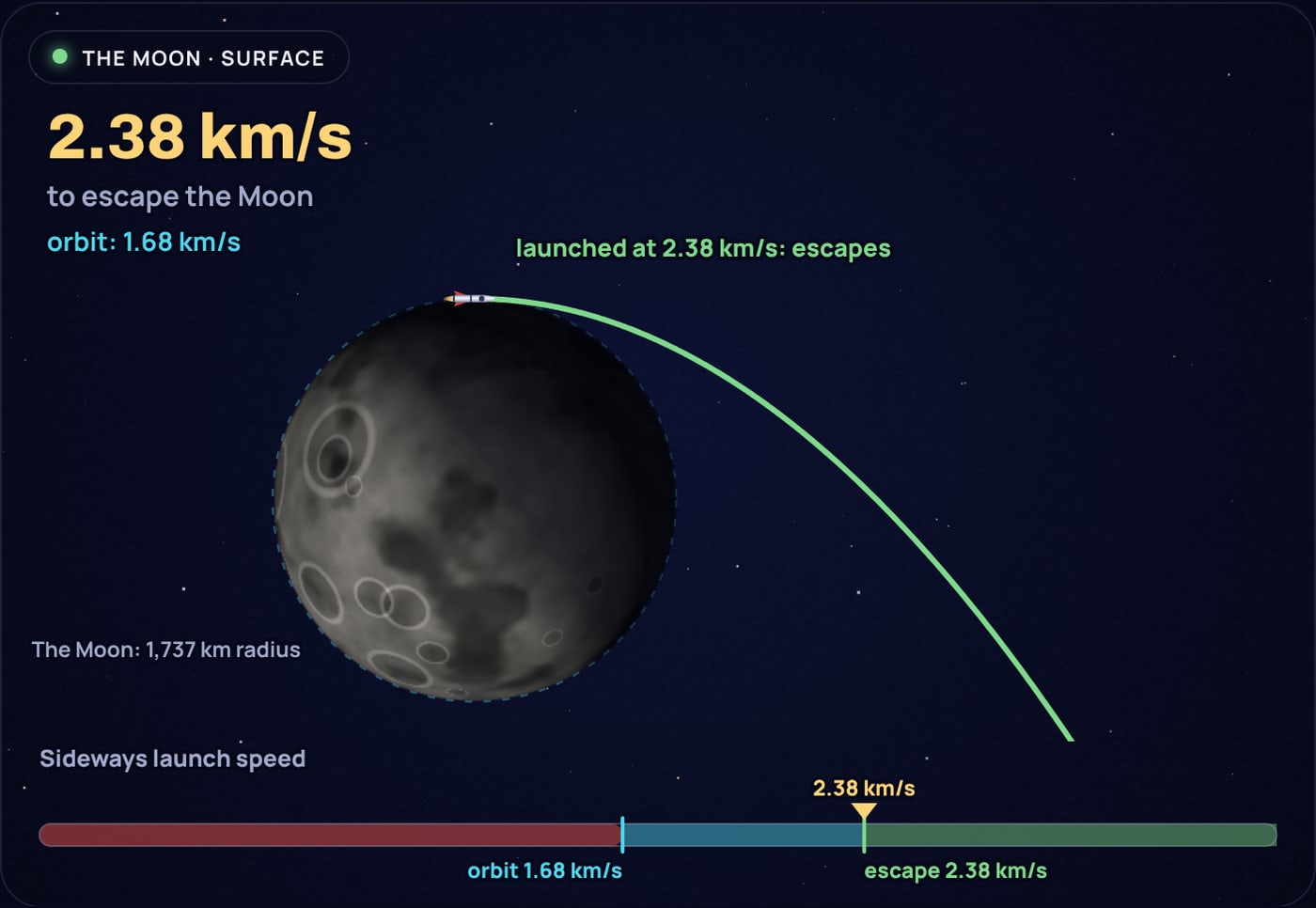
| The Moon | 2.38 km/s | 1.68 km/s | 1.62 m/s² |
| Io | 2.56 km/s | 1.81 km/s | 1.80 m/s² |
| Europa | 2.03 km/s | 1.43 km/s | 1.32 m/s² |
| Ganymede | 2.74 km/s | 1.94 km/s | 1.43 m/s² |
| Titan | 2.64 km/s | 1.87 km/s | 1.35 m/s² |
| Enceladus | 239 m/s | 169 m/s | 0.11 m/s² |
Ganymede, the largest moon in the solar system and bigger than Mercury, is the hardest moon to leave. At the other end, Saturn's Enceladus needs only 239 m/s, a speed that a fast spray of ice from its surface can exceed.
Orbit, escape or fall back
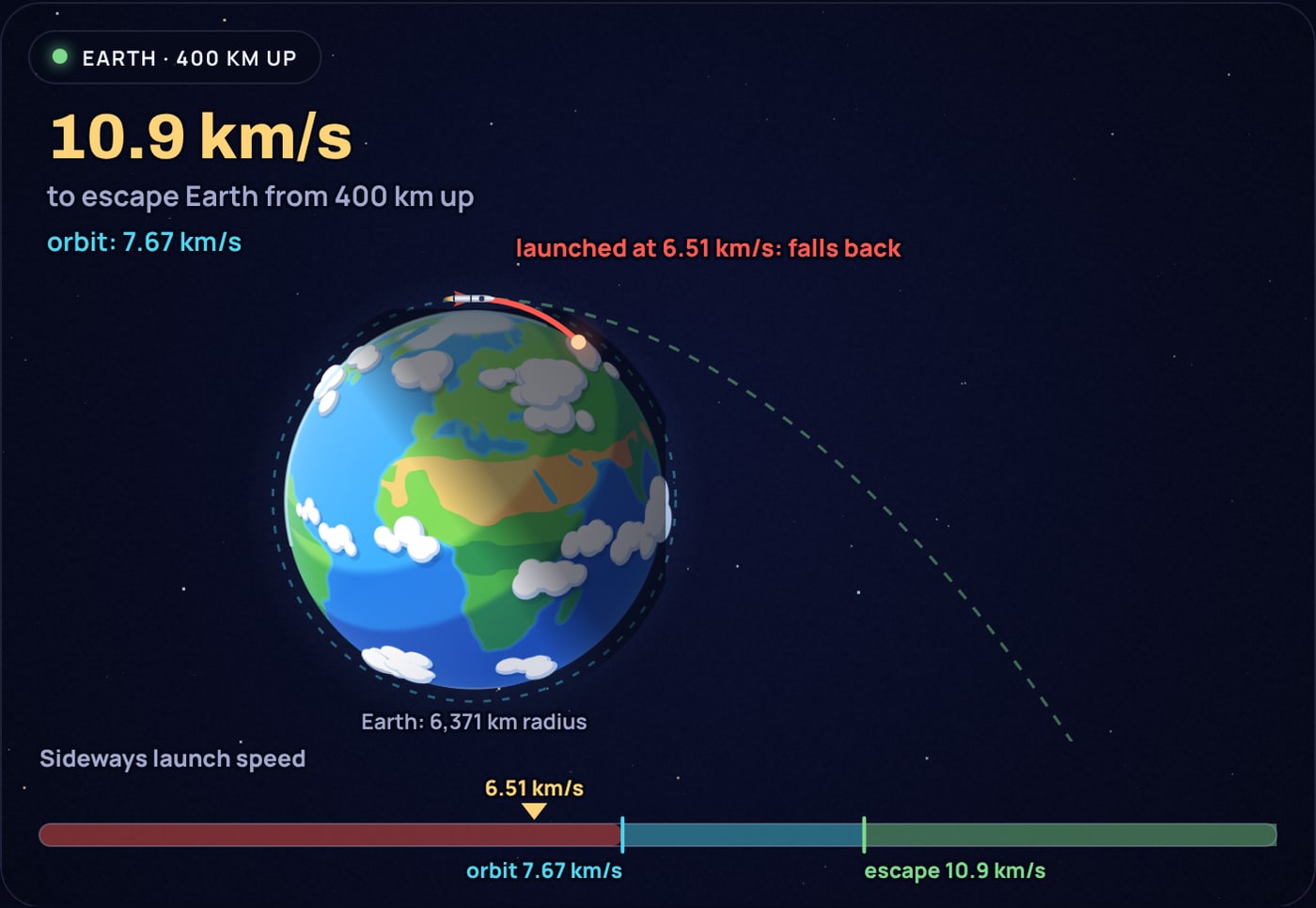
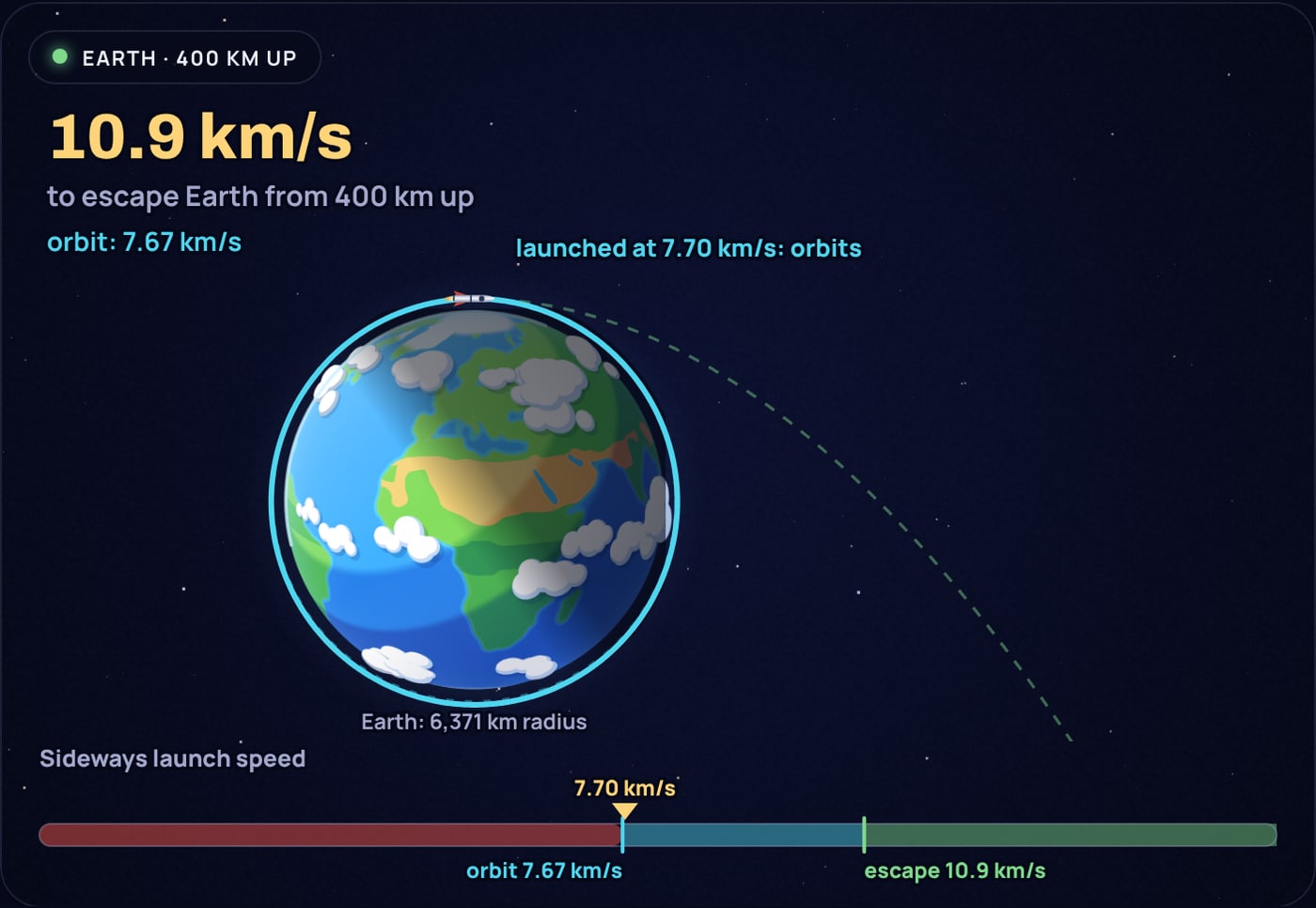
Fire a rocket sideways and coast, and only three things can happen. Slower than the circular orbital speed, it curves down and hits the ground. Between orbital speed and escape speed, it stays in an elliptical orbit. At escape speed or faster, it leaves on a parabola or hyperbola. Orbital speed is always escape speed divided by √2:
Both speeds fall as you start higher, because r is measured from the centre. At the space station's 400 km, orbit takes 7.67 km/s and escape 10.9 km/s. At the 35,786 km height of geostationary satellites, orbit needs only 3.07 km/s and one lap takes 23.9 hours, one turn of the Earth.
The Sun, a white dwarf and a neutron star
From the Sun's visible surface, escape velocity is about 618 km/s (NASA lists 617.6). From Earth's orbit, 149.6 million km out, it drops to √(2 × 132,712 × 10⁶ ÷ 149.6 × 10⁶) = 42.1 km/s. That is the speed, relative to the Sun, that a spacecraft needs to leave the solar system from Earth's distance; Earth's own 29.8 km/s orbital motion provides most of it.
Squeeze a star and its escape velocity soars, because r shrinks while M stays. Sirius B, the white dwarf companion of Sirius, has 98% of the Sun's mass in a ball 12,000 km across, according to Hubble measurements. Escape takes about 6,580 km/s, 2.2% of the speed of light.
Example 3: a neutron star
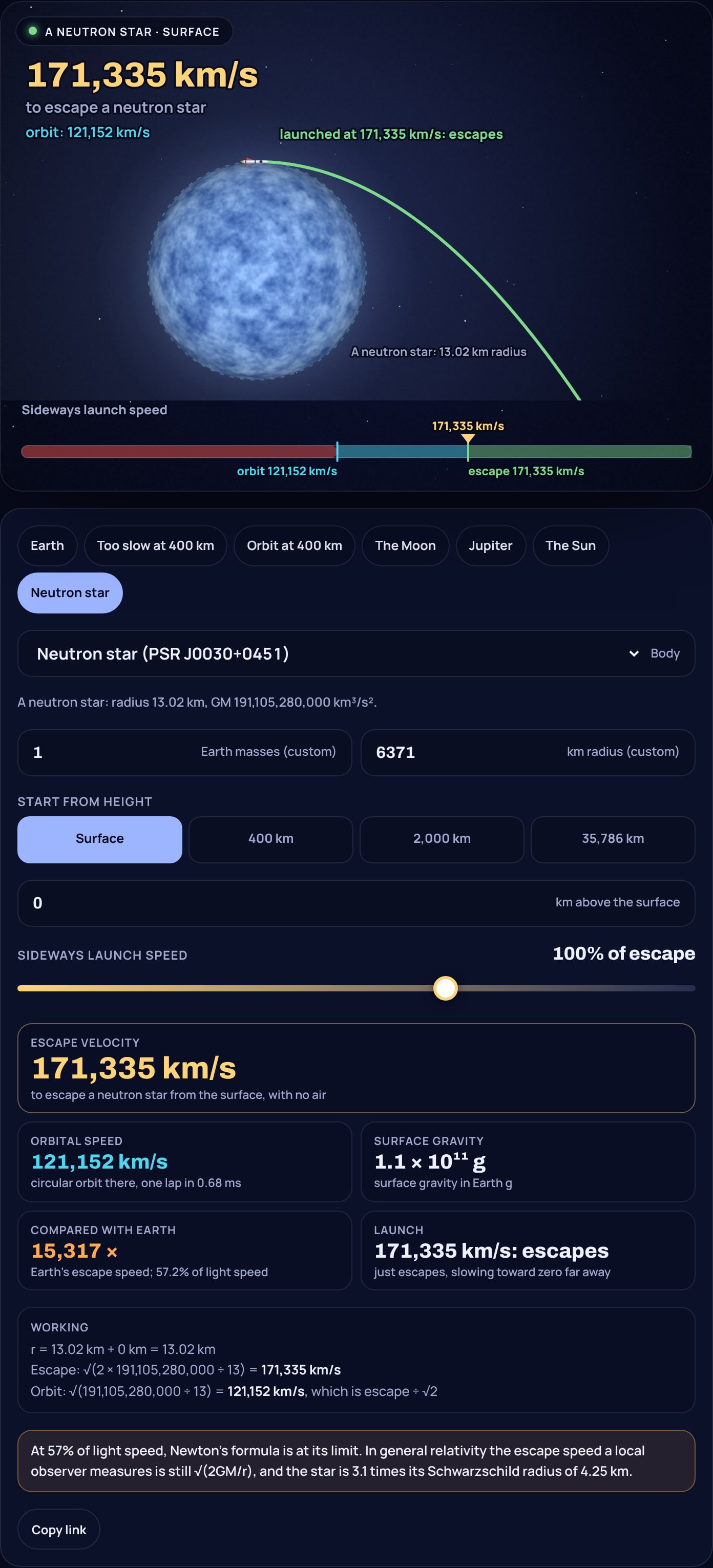
NICER measured the pulsar PSR J0030+0451 at 1.44 solar masses with a radius of 13.02 km.
Newton's formula is stretched here, but in general relativity the escape speed measured by an observer at rest at the surface is still √(2GM/r). The star is only 3.1 times its Schwarzschild radius of 4.25 km. Shrink it to that radius and the escape speed reaches the speed of light: a black hole.
What the numbers leave out
- Air. Nothing could actually coast at 11.2 km/s through Earth's lower atmosphere; drag would slow and heat it enormously.
- Spin. A launch toward the east borrows the ground's speed, about 0.46 km/s at Earth's equator, so less has to come from the rocket.
- Other bodies. Escaping Earth still leaves you orbiting the Sun. Each number is for one body on its own.
- Engines. A rocket that keeps thrusting can leave at any speed. Escape velocity applies to coasting.
To compare any two worlds, or to try a launch from your own chosen height, open the escape velocity calculator. For how long the trips between them take, the space travel time calculator picks up from there.
Sources
- NASA NSSDCA: Planetary Fact Sheet (metric) (masses, diameters, densities and escape velocities of the planets, the Moon and Pluto)
- NASA NSSDCA: Earth Fact Sheet and the matching sheets for each planet and the Sun (GM, volumetric mean and equatorial radius, escape velocity)
- NASA NSSDCA: Jovian Satellite Fact Sheet (Io, Europa, Ganymede mass and radius)
- NASA NSSDCA: Saturnian Satellite Fact Sheet (Titan and Enceladus mass, radius and density)
- ESA/Hubble: Astronomers use Hubble to "weigh" Dog Star's companion (Sirius B: 98% of the Sun's mass, 12,000 km across)
- Miller et al. 2019, PSR J0030+0451 mass and radius from NICER data (1.44 solar masses, 13.02 km radius)
Frequently asked questions
Which planet has the highest escape velocity?
Jupiter, at 59.5 km/s from its 1 bar cloud level, then Saturn at 35.5 km/s, Neptune at 23.5 km/s and Uranus at 21.3 km/s. Earth is fifth at 11.2 km/s.
Which planet has the lowest escape velocity?
Mercury, at 4.25 km/s. Mars is next at 5.03 km/s. The dwarf planet Pluto needs only 1.21 km/s.
Why does Neptune have a higher escape velocity than Uranus?
Neptune is slightly smaller than Uranus but about 18% more massive, so its gravity at the surface is stronger and escape takes 23.5 km/s against 21.3 km/s.
What is the escape velocity of the Sun?
About 618 km/s from its visible surface (NASA lists 617.6 km/s). From Earth’s distance, 150 million km away, escaping the Sun takes about 42 km/s.
Can escape velocity be faster than light?
Only for a black hole. A neutron star such as PSR J0030+0451 needs about 57% of light speed. At the event horizon of a black hole the formula gives exactly the speed of light, which is why nothing gets out.