How long would it take to get to the Moon, Mars or Pluto?
Driving to the Moon at 100 km/h would take 5.3 months without a stop, walking 8.77 years, and a cruising airliner 17.8 days. Apollo 11 did it in about three days. At the same car speed the Sun is 171 years away, Pluto 6,949 years and the nearest star 45.8 million years. The calculator divides the distance by the speed for seven ways of travelling and eleven destinations.
These are straight-line times at a steady speed, a way to feel the size of space. Real missions do not work like that: they coast along curved transfer orbits, launched when the planets line up, so a trip to Mars takes 6 to 8 months whatever the straight-line sum says. For how real trajectories work, read How long does it take to get to Mars? or try the Mars transfer simulation.
Key results
- To the Moon (384,400 km): walk 8.77 years, drive 5.3 months, fly 17.8 days, Apollo 11 3.0 days, light 1.28 seconds.
- To the Sun (1 au): drive 171 years, fly 19.0 years, Parker Solar Probe's top speed 8.9 days, light 8 min 19 s.
- To Mars at its closest: drive 62.3 years, fly 6.92 years, New Horizons' launch speed 38.9 days.
- To Proxima Centauri: even at Parker Solar Probe's 700,000 km/h it would take 6,547 years. Light takes 4.25 years.
Six trips
Each button loads the trip into the calculator. Dates assume you leave on 13 November 2026 and never stop.
Drive to the Moon: 5.3 months
384,400 km at 100 km/hThe Moon's average distance is 384,400 km, centre to centre. At a steady 100 km/h that is 3,844 hours, or 5.3 months of non-stop driving. Leave in mid-November and you arrive in late April. At its closest, 363,300 km, the drive is 5.0 months.
For scale, 384,400 km is about 9.6 laps of the Earth's equator. Driving eight hours a day, with weekends off, the trip would take close to two years.
Related reading: How long would it take to drive to the Moon?
Walk to the Moon: 8.77 years
384,400 km at 5 km/hAt a steady 5 km/h, 384,400 km takes 76,880 hours: 8.77 years of walking with no sleep. Walking eight hours a day stretches it to about 26 years.
Walking to the Sun at the same pace would take 3,413 years.
Fly to the Sun: 19.0 years
1 au at 900 km/hOne astronomical unit, 149.6 million km, at an airliner's 900 km/h is 166,220 hours: 19.0 years of non-stop flying. A child who boarded at birth would land as an adult.
Parker Solar Probe, which reaches about 700,000 km/h close to the Sun, would cover the same straight line in 8.9 days, though its real path is a series of long loops that took years to tighten.
Apollo's speed to Mars: 14.2 months
Mars at its closest, 5,266 km/hNASA's timeline for Apollo 11 has the translunar injection burn ending at 16:22 UT on 16 July 1969 and lunar orbit insertion at 17:21:50 UT on 19 July: a coast of 73.0 hours. Over the Moon's 384,400 km that is an average of 5,266 km/h. At that average, Mars at its closest (54.6 million km) would be 14.2 months away.
Real Mars missions are faster than that and slower than a straight line suggests at the same time: they leave Earth at higher speed but fly a long curve round the Sun, arriving in 6 to 8 months.
Related reading: How long does it take to get to Mars?
New Horizons' speed to Pluto: 11.9 years
58,536 km/hNew Horizons left Earth on 19 January 2006 at 58,536 km/h, the highest launch speed of any spacecraft, NASA says. At that speed in a straight line, Pluto's average distance from Earth is 11.9 years away.
The real trip took nine and a half years, to the flyby on 14 July 2015, helped by a gravity assist from Jupiter that NASA says shortened it by three years.
Parker Solar Probe's speed to Proxima: 6,547 years
700,000 km/hAt closest approach Parker Solar Probe moves at about 700,000 km/h, which NASA notes is fast enough to get from Philadelphia to Washington, D.C., in one second. Pointed at Proxima Centauri, 40.17 trillion km away, it would still need 6,547 years.
Parker only reaches that speed while falling close to the Sun; it slows down again as it climbs back out. Nothing we have launched could hold such a speed on the way to another star.
Straight-line travel times from Earth (average distance)
| Destination | Walk | Car | Airliner | Apollo 11 | New Horizons | Light |
|---|---|---|---|---|---|---|
| Moon | 8.77 years | 5.3 months | 17.8 days | 3.0 days | 6 h 34 min | 1.28 seconds |
| Sun | 3,413 years | 171 years | 19.0 years | 3.24 years | 3.5 months | 8 min 19 s |
| Mercury | 3,546 years | 177 years | 19.7 years | 3.37 years | 3.6 months | 8 min 38 s |
| Venus | 3,879 years | 194 years | 21.5 years | 3.68 years | 4.0 months | 9 min 27 s |
| Mars | 5,811 years | 291 years | 32.3 years | 5.52 years | 6.0 months | 14 min 10 s |
| Jupiter | 17,944 years | 897 years | 99.7 years | 17.0 years | 18.4 months | 43 min 43 s |
| Saturn | 32,717 years | 1,636 years | 182 years | 31.1 years | 2.79 years | 1 h 20 min |
| Uranus | 65,645 years | 3,282 years | 365 years | 62.3 years | 5.61 years | 2 h 40 min |
| Neptune | 102,628 years | 5,131 years | 570 years | 97.4 years | 8.77 years | 4 h 10 min |
| Pluto | 138,973 years | 6,949 years | 772 years | 132 years | 11.9 years | 5 h 39 min |
| Proxima Centauri | 916.6 million years | 45.8 million years | 5.09 million years | 870,295 years | 78,294 years | 4.25 years |
Distance ÷ speed, non-stop. Moon: 384,400 km; Sun: 1 au; planets: average Earth to planet distance over 1800 to 2050 from JPL orbital elements; Proxima: 4.2465 light years. Speeds: walk 5 km/h, car 100 km/h, airliner 900 km/h, Apollo 11 5,266 km/h average, New Horizons 58,536 km/h.
How the calculator works
Travel time is distance divided by speed. The calculator keeps distances in km and speeds in km/h, so the result is in hours, then writes it as minutes, days, months or years.
Distances are shared with the light travel time calculator: the Moon's mean distance and closest approach and the planets' closest distances from NASA's fact sheets, average planet distances worked out from JPL orbital elements over 1800 to 2050, and Proxima Centauri from its Gaia parallax.
Speeds: walking, car and airliner are round everyday values. Apollo 11's is its average from the end of the translunar injection burn to lunar orbit, from NASA's mission timeline. New Horizons' is its launch speed and Parker Solar Probe's its top speed near the Sun, both from NASA's mission pages. Light is 299,792.458 km/s.
What the model leaves out
- Orbits: spacecraft coast on curved paths under the Sun’s gravity and launch in windows when the planets line up. Real trip times can be shorter or longer than the straight-line figure.
- Speeding up and slowing down: a real vehicle has to accelerate and brake. Over these distances the cruise dominates for the everyday vehicles, but not for rockets, whose speed changes all the time.
- Moving targets: the planets move during a long trip. The calculator uses one distance for the whole trip.
- Stops: no sleep, fuel or rest. Driving eight hours a day roughly triples the times for walking and driving.
Common misconceptions
"Rockets fly straight to Mars." They fly half an ellipse round the Sun, launched when Mars is about 44 degrees ahead of Earth, which is why trips take months rather than the days a straight line at full speed suggests.
"Spacecraft keep their launch speed." New Horizons left Earth at 58,536 km/h but the Sun's gravity slowed it as it climbed outward, and Jupiter's gravity gave some back.
"The Moon is a few thousand km away." It is 384,400 km, about 30 Earth diameters. Most pictures of the Earth and Moon side by side shrink the gap.
Frequently asked questions
How long would it take to drive to the Moon?
5.3 months at a steady 100 km/h without stopping, because the Moon is 384,400 km away on average. Driving eight hours a day it would take about a year and four months.
How long did it take Apollo 11 to reach the Moon?
About three days. It launched on 16 July 1969, left Earth orbit about 2 hours 45 minutes later and entered lunar orbit on 19 July after a 73.0-hour coast. The landing was on 20 July.
How long would it take to fly to the Sun in a plane?
19.0 years at 900 km/h, non-stop. The Sun is 149.6 million km away on average.
How long would it take to get to the nearest star?
Proxima Centauri is 40.17 trillion km away. At Parker Solar Probe's 700,000 km/h that is 6,547 years; by car it would be 45.8 million years. Light takes 4.25 years.
How long does it really take to get to Mars?
About 6 to 8 months on a minimum-energy transfer orbit. Perseverance took 203 days in 2020 and 2021. Launch windows open about every 26 months.
Keep learning
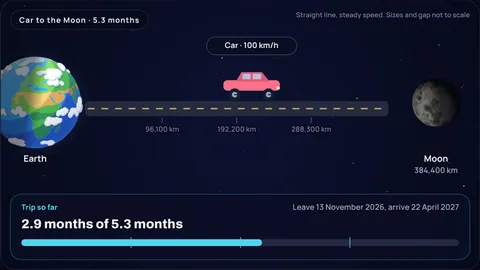
How Long Would It Take to Drive to the Moon?
At 100 km/h, a non-stop drive to the Moon takes 160 days, about 5.3 months. Here are the sums, plus walking, flying and Apollo 11 for comparison.
How Long Does It Take to Get to Mars? The Orbital Math
About 7 months, but why? We derive the 259-day Hohmann transfer, the 26-month launch window and why most real probes arrive in 200 to 230 days.
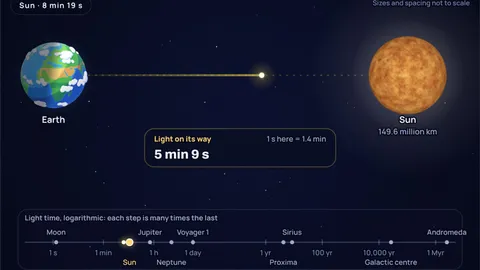
How Long Does Sunlight Take to Reach Earth?
Sunlight takes 8 minutes 19 seconds to reach Earth on average: 8 min 11 s in January, 8 min 27 s in July. The sums, plus light times to planets and stars.
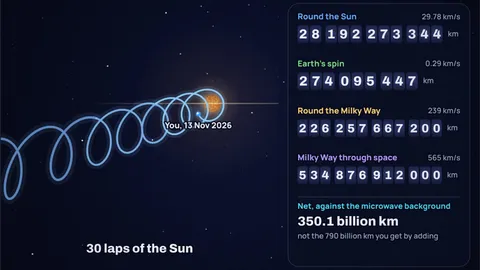
How Many Miles Have You Travelled Around the Sun?
Earth carries you 584 million miles round the Sun every year. Work out your lifetime total, see the sums, and learn why galaxy figures cannot be added.