Which star’s light left the year you were born?
Light takes one year to cross one light year, so a star 25.0 light years away is showing you light that left it 25.0 years ago. If you are 25, Vega is your birthday star: the light from it reaching your eyes tonight set off in 2001. At 17 it is Altair (16.7 light years), at 43 Capella (42.8), and at 67 Aldebaran (66.6). The calculator above matches your age to 84 bright naked-eye stars within about 140 light years.
Every distance comes from a measured parallax, the tiny yearly shift of a star against the far background, taken from the Hipparcos and Gaia space missions as listed in the SIMBAD astronomical database. Each one has an uncertainty, shown next to it, so a "match" means your age falls inside that range or within half a year. The sky on the stage is drawn from real star positions and brightnesses, with your star's constellation outlined. For how parallax is measured, read Stellar parallax: how far away are the stars?.
Key results
- The rule: your birthday star is the one whose distance in light years equals your age. Its light now reaching Earth left it the year you were born.
- Famous matches: Sirius at 8.60 ly, Procyon 11.5, Altair 16.7, Vega 25.0, Fomalhaut 25.1, Pollux 33.8, Arcturus 36.7, Capella 42.8, Castor 50.9, Aldebaran 66.6 and Regulus 79.3.
- Under 4: no star is close enough. The nearest bright star, Alpha Centauri, is 4.39 light years away, so light that left it at your birth arrives a little before your fifth birthday.
- Uncertainty grows with distance: Vega's distance is known to ± 0.07 light years, Aldebaran's to ± 1.0 and Castor's only to ± 3.0, because farther stars have smaller parallaxes.
Six ages, six stars
Each example is worked out for 13 November 2026. The button loads it in the finder, which then uses your own today.
Age 10: Ran (ε Eri)
10.5 light yearsAt 10 the nearest match is Ran, better known as Epsilon Eridani, 10.5 ± 0.01 light years away from its Gaia parallax of 310.58 milliarcseconds. Its light reaching Earth now left in May 2016. It is a Sun-like star, slightly smaller and cooler, at magnitude 3.73, visible without a telescope from a dark site.
Close behind come Procyon at 11.5 and Tau Ceti at 11.9 light years, both birthday stars for 11 and 12-year-olds, and Sirius at 8.60 for an 8 or 9-year-old.
Age 17: Altair in Aquila
16.7 light yearsAltair, the bright star of Aquila and one corner of the Summer Triangle, has a Hipparcos parallax of 194.95 ± 0.57 milliarcseconds, which puts it 16.7 ± 0.05 light years away. For a 17-year-old its light now arriving left in February 2010.
Altair spins so fast that interferometers have measured it as visibly flattened, wider at its equator than through its poles, an unusual fact for a star you can see from a city.
Age 25: Vega in Lyra
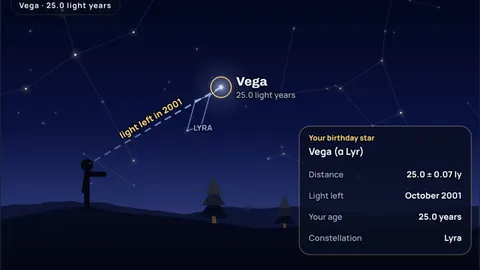
25.0 light yearsVega is 25.0 ± 0.07 light years away and Fomalhaut 25.1, so both are birthday stars for a 25-year-old. Vega's light arriving now left in October 2001. It is the fifth brightest star in the night sky and the reference star that astronomers once used to define magnitude zero.
Fomalhaut is the lone bright star low in the southern autumn sky. The two sit on opposite sides of the sky, so a 25-year-old in the northern hemisphere can see Vega high overhead in summer and Fomalhaut low in the south in autumn.
Born on 1 January 2000: μ1 Her
26.87 years oldSomeone born on 1 January 2000 is 26.87 years old on 13 November 2026. The nearest match is μ1 Her (Mu Herculis) at 27.2 light years, a star of magnitude 3.42 that is easy to see in Hercules on a dark night but has no popular name.
The near-match list in the finder shows the alternatives: χ Dra at 26.3, Tabit at 26.2, Fomalhaut at 25.1 light years. Tap one to move the sky to it.
Age 43: Capella in Auriga
42.8 light yearsCapella is 42.8 ± 0.3 light years away, so for a 43-year-old its light now arriving left in January 1984. It looks like one yellow star but is two giant stars orbiting each other every 104 days, far too close for any amateur telescope to split.
Arcturus, at 36.7 light years, is the match for 36 and 37-year-olds, and Pollux, at 33.8, for 34-year-olds.
Age 67: Aldebaran in Taurus
66.6 light yearsAldebaran, the orange eye of Taurus, is 66.6 ± 1.0 light years away, so for a 67-year-old its light arriving now left in March 1960. The uncertainty of about a year means the match is good to within a birthday or so.
Beyond 60 the uncertainties start to matter. Castor's distance is 50.9 ± 3.0 light years, so it could be the birthday star of anyone from about 48 to 54.
Birthday stars by age
| Age | Nearest bright star | Constellation | Distance (ly) | Parallax source |
|---|---|---|---|---|
| 5 | Alpha Centauri (α Cen) | Centaurus | 4.39 ± 0.01 | Hipparcos 1997 |
| 10 | Ran (ε Eri) | Eridanus | 10.5 ± 0.01 | Gaia EDR3 |
| 15 | Altair (α Aql) | Aquila | 16.7 ± 0.05 | Hipparcos 2007 |
| 20 | δ Pav | Pavo | 19.9 ± 0.01 | Gaia EDR3 |
| 25 | Vega (α Lyr) | Lyra | 25.0 ± 0.07 | Hipparcos 2007 |
| 30 | Rana (δ Eri) | Eridanus | 29.6 ± 0.05 | Gaia EDR3 |
| 35 | Denebola (β Leo) | Leo | 35.9 ± 0.2 | Hipparcos 2007 |
| 40 | Porrima (γ Vir) | Virgo | 39.2 ± 0.2 | Gaia EDR3 |
| 45 | Alshain (β Aql) | Aquila | 44.4 ± 0.09 | Gaia EDR3 |
| 50 | Castor (α Gem) | Gemini | 50.9 ± 3.0 | Hipparcos 2007 |
| 55 | Caph (β Cas) | Cassiopeia | 54.7 ± 0.3 | Hipparcos 2007 |
| 60 | Wasat (δ Gem) | Gemini | 60.7 ± 0.3 | Gaia EDR3 |
| 65 | Hamal (α Ari) | Aries | 65.8 ± 0.3 | Hipparcos 2007 |
| 70 | Aldebaran (α Tau) | Taurus | 66.6 ± 1.0 | Hipparcos 2007 |
| 75 | Sarin (δ Her) | Hercules | 75.1 ± 0.3 | Hipparcos 2007 |
| 80 | Kaffaljidhma (γ Cet) | Cetus | 79.6 ± 1.2 | Hipparcos 2007 |
| 85 | Ankaa (α Phe) | Phoenix | 84.7 ± 1.6 | Hipparcos 2007 |
| 90 | Cursa (β Eri) | Eridanus | 90.0 ± 0.9 | Gaia EDR3 |
| 95 | Diphda (β Cet) | Cetus | 96.3 ± 0.5 | Hipparcos 2007 |
| 100 | Edasich (ι Dra) | Draco | 100.3 ± 0.4 | Gaia EDR3 |
Distances are 1,000 ÷ parallax (milliarcseconds) × 3.2616 light years, with the parallax and its error as listed in SIMBAD from the catalogue named. The list holds 84 stars brighter than about magnitude 3.9 within 140 light years.
How the finder works
Your age is the time from your birth date to today (or the "as of" date) in years of 365.25 days, the same year used to define the light year. The finder then ranks the 84 stars by how far each one's distance in light years is from your age, and shows the closest five or six.
Each distance comes from a parallax: the parallax in milliarcseconds goes into d = 1,000 ÷ p parsecs, and one parsec is 3.2616 light years. The parallaxes are the values SIMBAD lists, which for most bright stars come from the 2007 reduction of Hipparcos data and for many others from Gaia. The uncertainty in light years is the distance times the parallax error divided by the parallax.
The sky is a stereographic projection centred on your star, with the stars of the Hipparcos catalogue brighter than magnitude 4.6 drawn by brightness and colour, and constellation figures from the Stellarium planetarium's modern sky culture. It shows the star's neighbourhood, not the sky from your location at a particular time.
What the model leaves out
- Faint stars: thousands of fainter stars have distances that match any age, but you would need binoculars or a telescope to see them. The list stops at stars you can spot by eye from a reasonably dark site.
- Moving stars: stars move, and distances change by tiny amounts over a lifetime. For these stars the change is far smaller than the uncertainty.
- Very bright stars: Gaia struggles with the brightest stars, so for most of the famous names the best parallax is still from Hipparcos. A future Gaia release may shift some distances a little.
- Where to look: the stage shows the constellation, not whether the star is above your horizon tonight. Stars in the far south, such as Alpha Centauri and Achernar, never rise from mid-northern latitudes.
Common misconceptions
"The star might have died since." For these stars the light is decades old, and stars live for millions to billions of years. Every star in this list is still there.
"A light year is a measure of time." It is a distance, about 9.46 trillion km, the distance light travels in one year. That is exactly why it turns into an age so neatly.
"Polaris is the brightest star." Polaris is only about 50th. The brightest is Sirius, at 8.60 light years, the birthday star of an 8 or 9-year-old.
Frequently asked questions
What is a birthday star?
A star whose distance in light years matches your age, so the light from it reaching Earth now left the star around the time you were born. For a 25-year-old it is Vega, 25.0 light years away.
Which star is 30 light years away?
Among bright stars, Rana (δ Eri, in Eridanus) at 29.6 light years and Gamma Leporis at 29.0. Pollux, a much brighter star, is 33.8 light years away.
Which star is 40 light years away?
Porrima in Virgo is 39.2 light years away, and Capella, one of the brightest stars in the sky, is 42.8.
How do astronomers know how far away a star is?
By parallax: as Earth goes round the Sun, a nearby star shifts slightly against far more distant stars. Satellites such as Hipparcos and Gaia measured that shift for millions of stars, and the distance in parsecs is one divided by the parallax in arcseconds.
Is there a birthday star for a baby?
Not a bright one. The nearest bright star, Alpha Centauri, is 4.39 light years away, so the first birthday star arrives at about age 4.4.
Keep learning
Which Star's Light Left the Year You Were Born?
Vega's light takes 25.0 years to reach us, so a 25-year-old sees light that left the year they were born. Find your birthday star and the sums behind it.

How Do We Know How Far Away Stars Are? Parallax Math
Proxima Centauri shifts 0.768 arcsec a year, which puts it 4.2465 light-years away. Here is the parallax math, what Gaia changed and the distance ladder.

Why Stars Twinkle but Planets Don't (With the Math)
Stars twinkle because they are points that cross one 7 cm air patch at a time. Planets span hundreds of patches. Here is the arcsecond math, with figures.
Why massive stars live fast: mass, lifetime and stellar remnants
Estimate main-sequence lifetimes from mass and luminosity, read an H–R diagram, and distinguish schematic evolution paths from detailed stellar predictions.