How Do We Know How Far Away Stars Are? Parallax Math
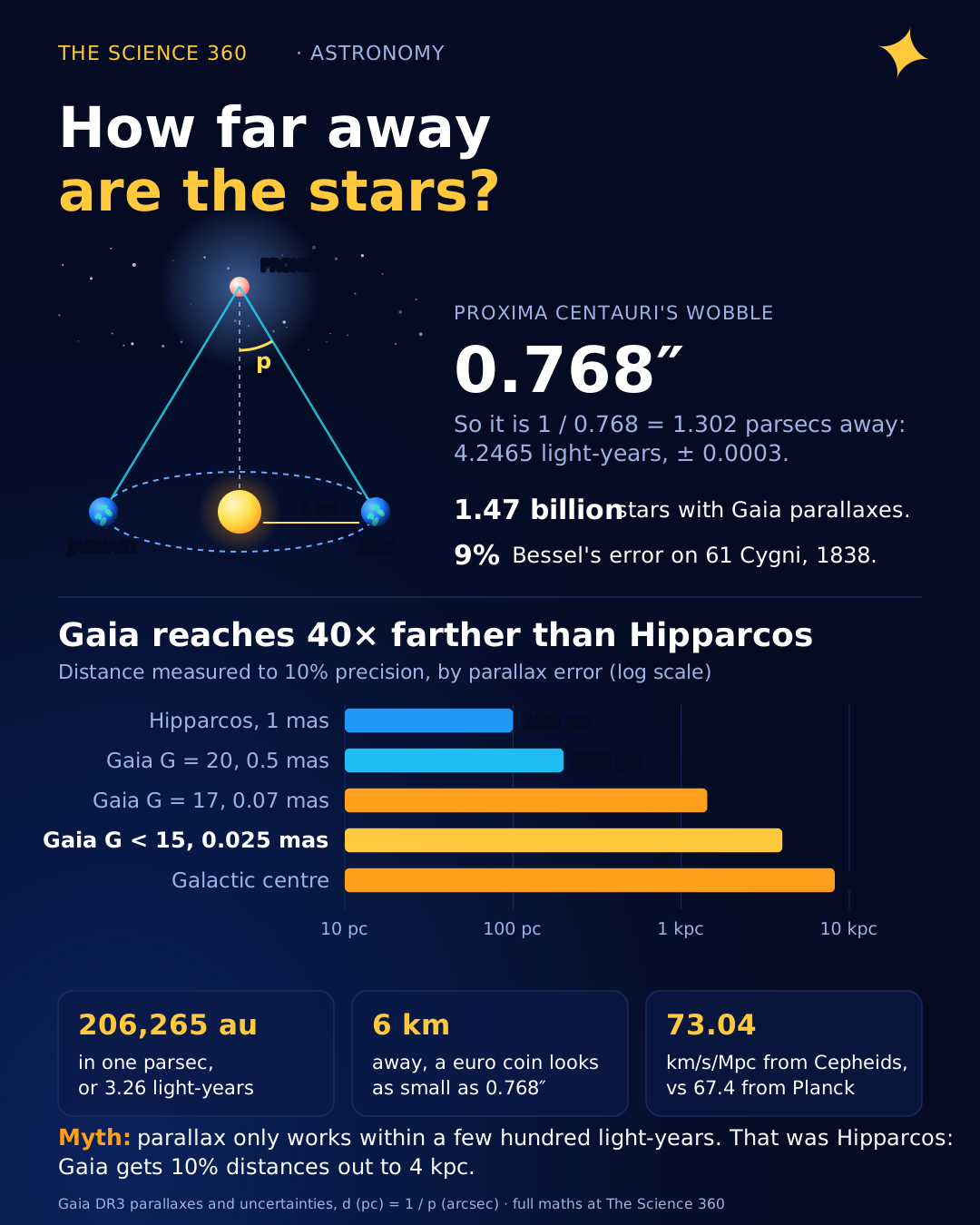
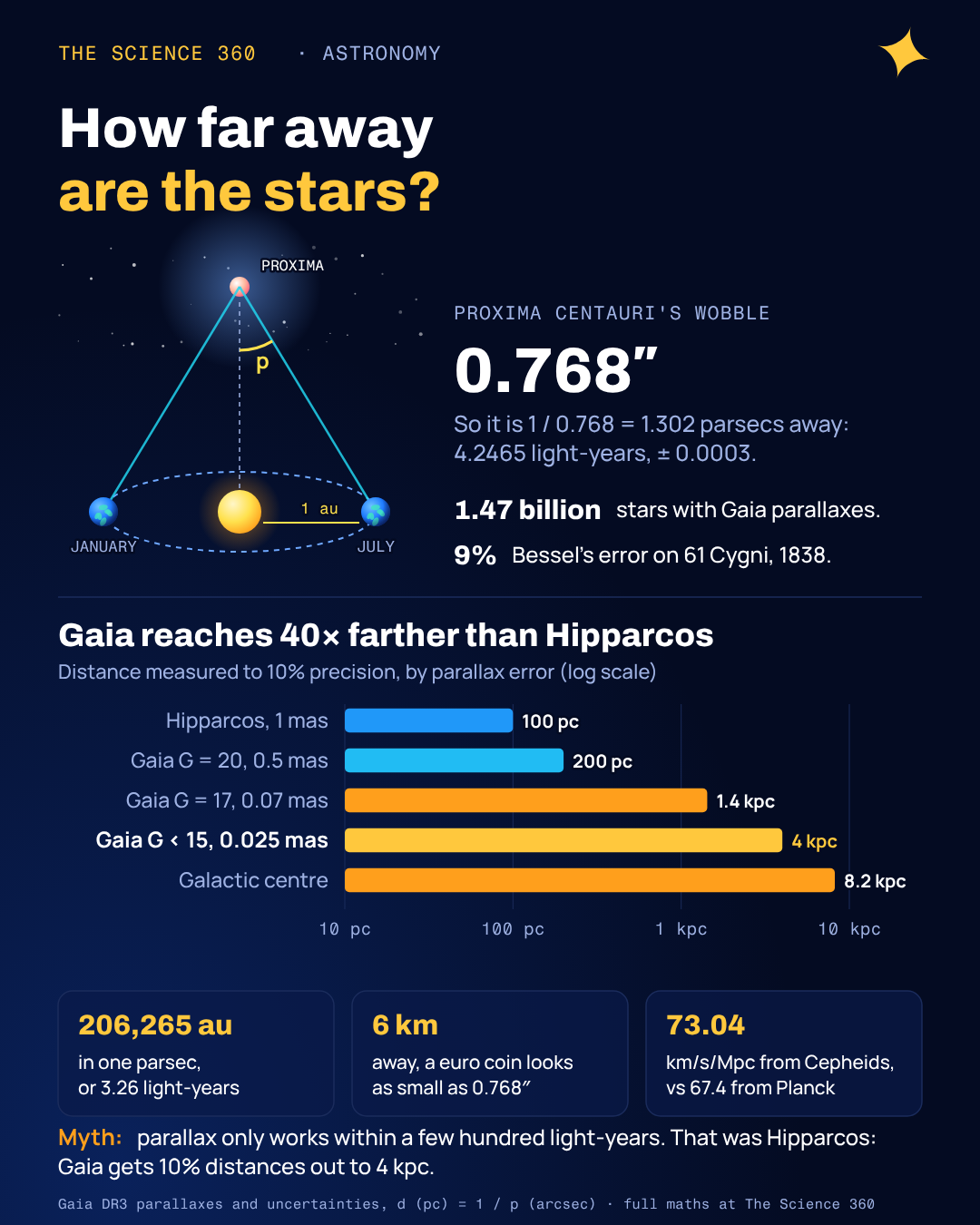
Proxima Centauri, the nearest star after the Sun, wobbles back and forth on the sky by 0.768 arcseconds every year. That is the width of a one euro coin seen from about 6 km away. From that single tiny angle, the European Space Agency's Gaia catalogue gives its distance as 4.2465 light-years, with an uncertainty of about 0.0003 light-years. That is roughly 3 billion kilometres of error on 40 trillion kilometres, or 0.007%.
No tape measure, no radar echo, no assumption about what kind of star it is. Just geometry and a very good camera. This post works through that geometry with real numbers, shows where it stops working, and explains how astronomers climb from there to galaxies billions of light-years away.
What is stellar parallax?
Hold a finger at arm's length and close each eye in turn. Your finger jumps against the far wall because your two eyes, about 6.5 cm apart, see it from different places. Stellar parallax is the same trick with a much longer baseline: Earth's orbit. In January we look at a nearby star from one side of the Sun; in July, from the other side, 300 million km away. The star appears to shift against far more distant background stars, which barely move at all.
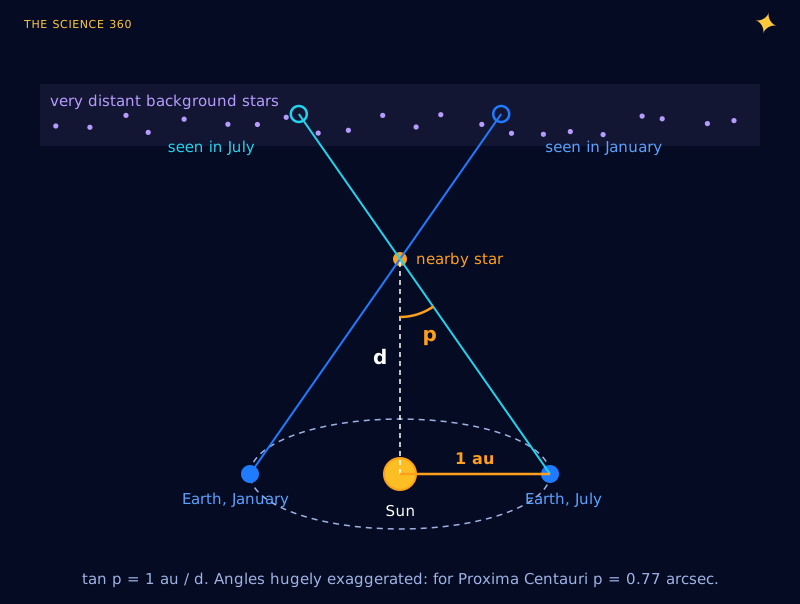
One detail trips up almost every textbook diagram reader: the parallax angle p is defined with a baseline of one astronomical unit, not the two au between January and July. The star's full shift on the sky is 2p. If you plug the full shift into the formula you get half the true distance.
The parallax formula and the parsec
From the right triangle in Figure 1, . Because is tiny, is equal to in radians to better than one part in a trillion, so . Astronomers chose a distance unit that makes this formula trivial.
Defining the parsec
1 light-year = 9.4607 × 10¹⁵ m, so 1 parsec = 3.2616 light-years. Therefore:
The name is literally "parallax of one arcsecond". No star is that close. Proxima's parallax is 0.768 arcseconds, so even the nearest star is more than one parsec away. Now the worked example with Gaia's actual number.
Worked example: Proxima Centauri (Gaia DR3)
Uncertainty
The fractional error in is the same as in for small errors:
For a sense of scale: 0.0499 mas is 2.4 × 10⁻¹⁰ radians. That is the angle a human hair (about 0.07 mm) subtends from 290 km away.
Bessel, 61 Cygni and why it took until 1838
The idea of parallax is ancient. Measuring it took until 1838 because the angles are below what the eye, and early telescopes, could resolve. The absence of any visible parallax was even used as an argument against Earth moving around the Sun: if Earth moved, the stars should shift, and nobody could see them shift. The real answer was that the stars are absurdly far away.
Friedrich Bessel picked 61 Cygni because it had a large proper motion (it drifts across the sky unusually fast), a hint that it was close. He published a parallax of 0.3136 arcseconds. Thomas Henderson (Alpha Centauri) and Friedrich Struve (Vega) published results around the same time.
How good was Bessel?
Bessel 1838:
Gaia DR3 (61 Cyg B), :
Bessel's error: 10.40 / 11.40 = 0.912, so about 9% too close. His angle was off by 28 mas.
Twenty-eight milliarcseconds with a nineteenth-century heliometer is a remarkable piece of work. Gaia's error on the same star is 0.03 mas, about a thousand times smaller.
What a star’s parallax looks like on the sky
Real stars do not just shuttle back and forth. They trace an ellipse, because we view Earth's circular orbit at an angle that depends on the star's position relative to the plane of the orbit (the ecliptic). A star at the ecliptic pole traces a circle of radius p; a star on the ecliptic traces a straight line of half-length p. At the same time the star has its own motion through the Galaxy, its proper motion, which drags the ellipse into a looping track.
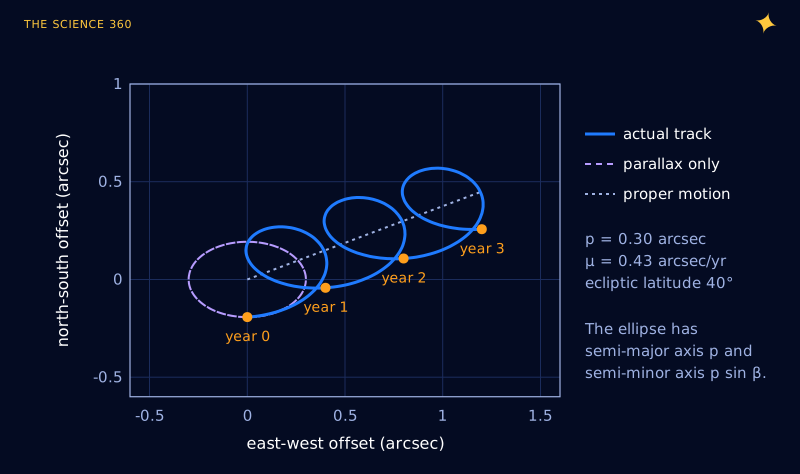
This is why a parallax needs at least a year or two of observations, ideally many more. You have to separate a periodic loop from a steady drift. Gaia fits five numbers to every star: two coordinates, two components of proper motion, and the parallax. Binary stars add a third motion, the orbital wobble, which is one reason some bright binaries have worse Gaia parallaxes than single stars of the same magnitude.
The misconception: “parallax only works for the nearest few hundred light-years”
Search results and older textbooks still say parallax only works for stars within a few hundred light-years, or "about 2,000 light-years" at most. That was true in the Hipparcos era. It is out of date by a factor of ten or more.
Ground-based telescopes, blurred by the atmosphere, managed parallaxes good to roughly 10 mas for a few thousand stars. ESA's Hipparcos satellite (1989 to 1993) measured about 118,000 stars to around 1 mas. Gaia, launched in 2013 and parked at the Sun-Earth L2 point, released its third catalogue (DR3) in June 2022: parallaxes and proper motions for about 1.47 billion sources from 34 months of data. Its median parallax uncertainty is 0.02 to 0.03 mas for stars brighter than magnitude 15, 0.07 mas at magnitude 17, and 0.5 mas at magnitude 20.
The useful rule: for a parallax error in milliarcseconds, the fractional distance error is , with in kiloparsecs.
How far does 10% precision reach?
Set , so .
Hipparcos, 1 mas: = 0.1 kpc = 100 pc (326 ly)
Gaia G = 20, 0.5 mas: 200 pc
Gaia G = 17, 0.07 mas: 1.4 kpc (4,700 ly)
Gaia G < 15, 0.025 mas: 4 kpc (13,000 ly)

There is a catch hidden in that figure. A star at 4 kpc needs to be bright (magnitude 15 or brighter) to get the 0.025 mas precision, and most stars that far away are faint dwarfs. So Gaia's reach depends on the type of star: luminous giants and hot young stars get good distances across a large part of the Galaxy, while red dwarfs get good distances only within a few hundred parsecs. Radio astronomers do even better on special targets: very long baseline interferometry tracks water and methanol masers in star-forming regions with parallax errors of order 10 microarcseconds, enough to map spiral arms on the far side of the Galactic centre.
Gaia has another quiet advantage. A ground-based telescope measures a star's shift relative to background stars, which have small parallaxes of their own, so it gets a relative parallax that needs correcting. Gaia looks in two directions at once, separated by a fixed angle of about 106.5°, and stitches the whole sky together, so it measures absolute parallaxes. Quasars, billions of light-years away with effectively zero parallax, are the check: their average Gaia DR3 parallax is about −17 μas rather than zero, which is how that zero-point offset was found.
Why you can’t just invert a noisy parallax
Here is the subtle part that most explainers skip. Distance is 1/p, and 1/p is a non-linear function. When the parallax error is small (a few percent), it barely matters. When the error is 20% or more, inverting the measured parallax gives a lopsided and biased answer, and some measured parallaxes in the Gaia catalogue are actually negative, which a naive inversion turns into a negative distance.
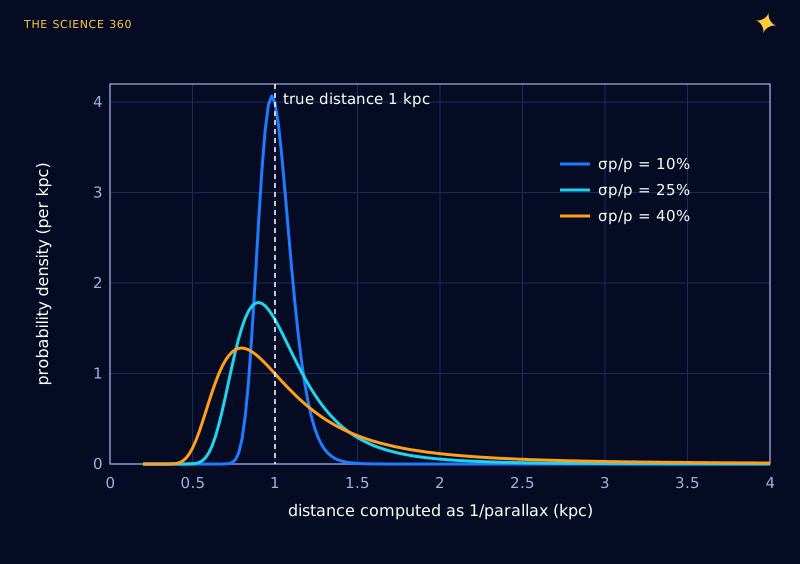
Numbers behind Figure 4 (true d = 1 kpc)
: most likely = 0.98 kpc; chance of getting is about 0.
: most likely 0.90 kpc; chance of = 9%.
: most likely 0.80 kpc; chance of = 20%; chance of a negative parallax = 0.6%.
The professional fix is to treat distance as an inference problem: combine the parallax with a prior about how stars are distributed in the Galaxy, and report a probability distribution. That is what the widely used Bailer-Jones distance catalogue does for Gaia data. If you download a Gaia parallax with a large relative error and take 1/p, you are not getting a distance so much as a guess with a tail.
Betelgeuse is a good example of a hard case. Its parallax is only a few milliarcseconds, but its visible disc is several times larger than that, and its surface is mottled with giant convection cells that shift the light centre around. Published distances have ranged from roughly 150 to 220 parsecs. A smaller parallax error bar does not help much when the "point" you are measuring is a boiling blob.
How do we measure distances beyond parallax?
Parallax is the bottom rung of what astronomers call the cosmic distance ladder. Each rung calibrates the next, so an error low down propagates all the way up.
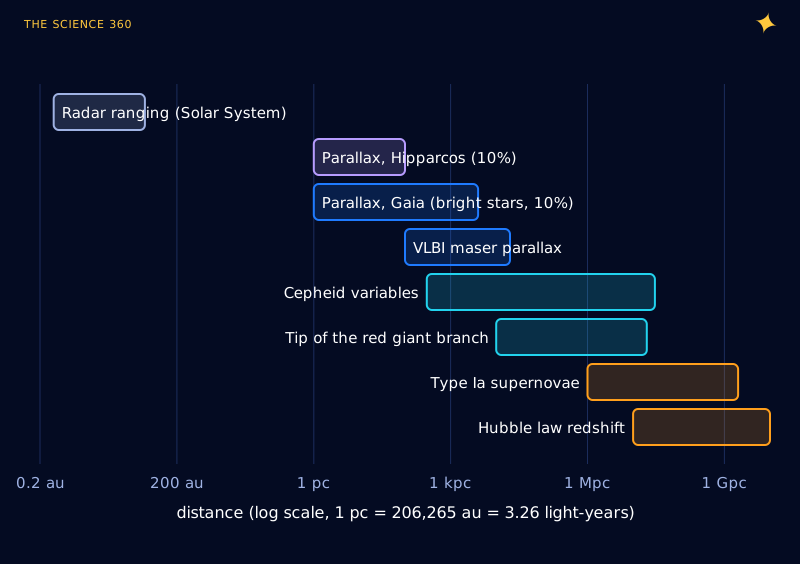
- Radar and spacecraft tracking fix the astronomical unit itself, now defined as exactly 149,597,870,700 m. Every parallax distance is in units of this baseline.
- Parallax gives direct distances to stars, including some Cepheid variables in the Milky Way.
- Cepheid variables are pulsating giant stars whose pulsation period predicts their luminosity (Henrietta Leavitt's period-luminosity law, 1912). Measure the period, read off the true brightness, compare with the apparent brightness, and the inverse-square law gives the distance. Cepheids are bright enough to see in galaxies out to a few tens of megaparsecs.
- Type Ia supernovae, calibrated in galaxies that also host Cepheids, reach peak absolute magnitudes of about −19.3 and are visible across billions of light-years.
- Redshift and the Hubble law take over at the largest scales, once the expansion rate is calibrated by the rungs below.
A standard candle in one line
Distance modulus:
A Type Ia supernova with observed at :
The stakes of the bottom rung are not academic. The SH0ES team, using Cepheids in 42 Type Ia supernova host galaxies, measured the Hubble constant as 73.04 ± 1.04 km/s/Mpc. The Planck satellite's cosmic microwave background data, interpreted with the standard cosmological model, predicts 67.4 ± 0.5. The gap is about 5 sigma, and it is known as the Hubble tension. Gaia parallaxes of Milky Way Cepheids are one of the anchors of that ladder, which is why a microarcsecond-level zero-point offset gets argued about in the literature. Either there is a subtle systematic error somewhere in the ladder, or our cosmological model is missing something.
FAQ
How far can parallax measure?
It depends on the instrument. Hipparcos, with about 1 milliarcsecond precision, reached 10 percent distances out to roughly 100 parsecs (326 light-years). Gaia DR3 reaches 10 percent at about 4,000 parsecs for bright stars and about 1,400 parsecs at magnitude 17. Radio parallaxes of masers reach across much of the Milky Way.
What is a parsec?
A parsec is the distance at which one astronomical unit subtends an angle of one arcsecond. That is 206,265 au, or 3.0857 × 10¹⁶ metres, or 3.26 light-years. Its advantage is that distance in parsecs is simply 1 divided by the parallax in arcseconds.
Who first measured the distance to a star?
Friedrich Bessel, who in 1838 published a parallax of 0.3136 arcseconds for 61 Cygni, about 10.4 light-years. The modern Gaia value is 286.0 milliarcseconds, or 11.4 light-years, so Bessel was within about 9 percent. Thomas Henderson (Alpha Centauri) and Friedrich Struve (Vega) published results around the same time.
How do astronomers measure distances to stars too far for parallax?
They use standard candles whose true brightness is known, such as Cepheid variables, whose pulsation period predicts their luminosity, and Type Ia supernovae. Comparing true and apparent brightness gives distance through the inverse-square law. Each method is calibrated on the one below it, which is why it is called the distance ladder.
Related on The Science 360
Sources
- ESA Gaia, Data Release 3 overview (1.47 billion sources with parallax, parallax uncertainties by magnitude, zero point about −17 μas, 34 months of data): cosmos.esa.int/web/gaia/dr3
- Proxima Centauri, Gaia DR3 parallax 768.0665 ± 0.0499 mas (Vallenari et al. 2023), as compiled at: en.wikipedia.org/wiki/Proxima_Centauri
- 61 Cygni, Bessel's 1838 parallax and Gaia DR3 values: en.wikipedia.org/wiki/61_Cygni
- Hipparcos mission and catalogue (about 118,000 stars, about 1 mas): en.wikipedia.org/wiki/Hipparcos
- Gaia spacecraft (launch, L2 orbit, end of observations January 2025, DR4 timing): en.wikipedia.org/wiki/Gaia_(spacecraft)
- Riess et al. 2022, "A Comprehensive Measurement of the Local Value of the Hubble Constant" (73.04 ± 1.04 km/s/Mpc, 42 SN Ia hosts, 5 sigma from Planck): arxiv.org/abs/2112.04510
- Hubble's law and Planck 2018 value (67.4 ± 0.5 km/s/Mpc): en.wikipedia.org/wiki/Hubble's_law
- Cosmic distance ladder (methods, ranges, SN Ia absolute magnitude): en.wikipedia.org/wiki/Cosmic_distance_ladder
- Britannica, "How do we know how far away the stars are?": britannica.com/story/how-do-we-know-how-far-away-the-stars-are
Method note: Figures 2 to 4 are computed from the formulas in the text. The reach of each method in Figure 5 is indicative rather than a hard limit. Figure 4 assumes Gaussian parallax errors and ignores the Galactic prior that professional catalogues apply.
Header image: ESA/Hubble & NASA (image GSFC_20171208_Archive_e000214), regraded for this article.