Which Star's Light Left the Year You Were Born?
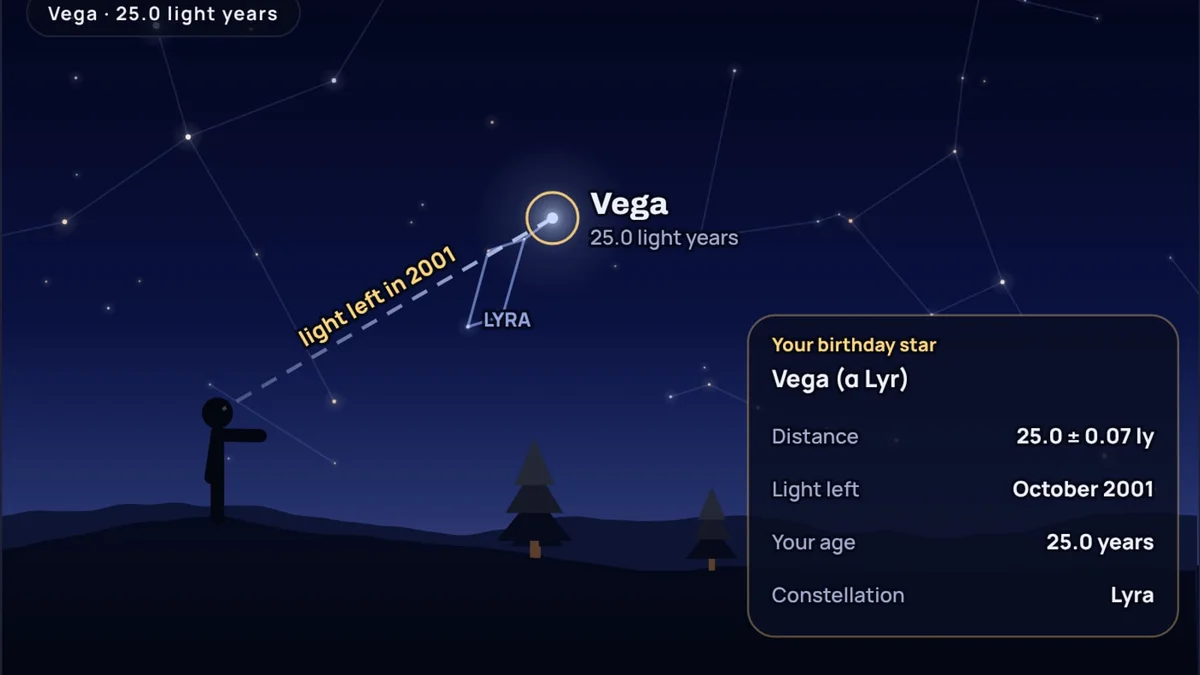
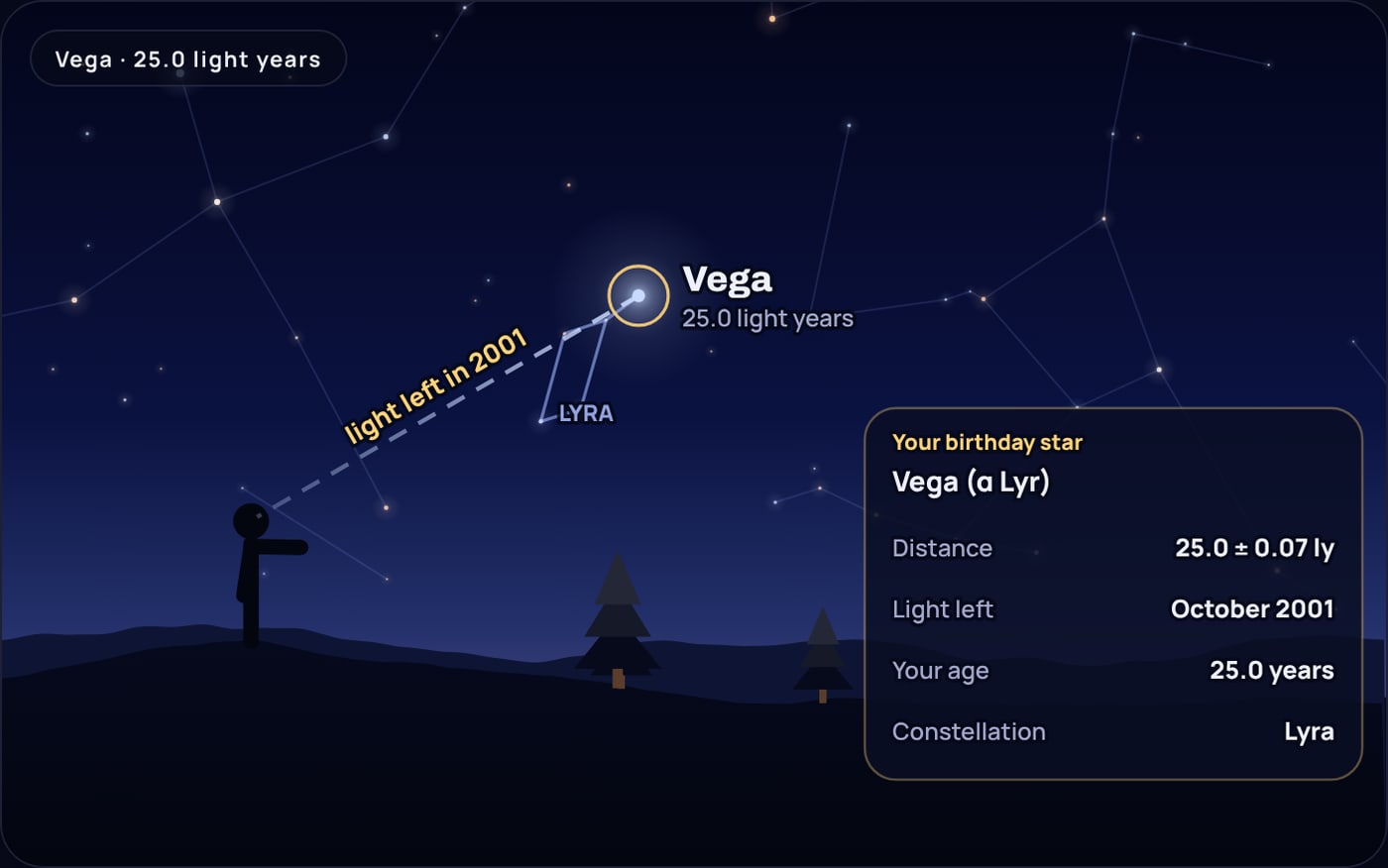
The light reaching your eye from Vega tonight left the star in late October 2001. If you were born that autumn, you and that light have been travelling for the same 25 years, it across 237 trillion km of space, you through school and whatever came after. Vega is that person's birthday star.
Everyone has one. Pick a bright star whose distance in light years equals your age and the photons arriving from it now set off around the day you were born. The birthday star finder does the matching for your birth date against 84 bright stars, shows the star in a real sky with its constellation, and prints the parallax sum that gives the distance. This post shows where those distances come from, how precise they are, and which star belongs to which age.
How does starlight tell you when it left?
Light crosses space at a fixed speed, and a light year is simply the distance it covers in one year. So a star's distance in light years is also the age of its light when it arrives. A star 25 light years away is seen as it was 25 years ago, never as it is now.
That is the whole idea. The hard part is the distance, and for stars near the Sun it comes from one measurement: parallax. As Earth goes round the Sun, a nearby star shifts back and forth against far more distant stars by a tiny angle. Half that yearly wobble is the parallax, . The parallax post walks through the geometry; the short version is that a star with a parallax of one arcsecond is one parsec away, and distance scales as one over the parallax.
Catalogues give parallax in milliarcseconds (thousandths of an arcsecond), so the working formula is:
The 3.2616 comes from the units themselves. The parsec is defined as exactly 648,000/π astronomical units (the IAU fixed this in 2015, on top of its 2012 definition of the astronomical unit). The light year is the speed of light times a Julian year of 365.25 days. Divide one by the other and a parsec is 3.2616 light years.
Worked example: why Vega is the birthday star for 25
SIMBAD, the star database run by the Strasbourg astronomical data centre, lists Vega's parallax as 130.23 ± 0.36 milliarcseconds, taken from the 2007 reduction of the Hipparcos satellite data. That is all you need.
Example 1: Vega, from parallax to the year its light left
Counting back 25.04 years (9,147 days) from 13 November 2026 lands on 27 October 2001. The uncertainty of 0.07 light years is about 25 days either way, so Vega is a fair match for anyone born between early October and late November 2001.
That precision is unusual for anything in astronomy. A 0.3% error on the distance to a star means its light's departure date is pinned to within a month. Fomalhaut, at 25.1 light years, is a near tie: its light left around 27 September 2001.
What is my birthday star by age?
Here is the best match for each age as of November 2026, from the same 84 stars the calculator uses. Most are bright enough to see from a suburb; a few, like Ran and Tau Ceti, need a dark sky.
| Age | Birthday star | Constellation | Distance (light years) |
|---|---|---|---|
| 5 | Alpha Centauri | Centaurus | 4.39 |
| 8 | Sirius | Canis Major | 8.60 |
| 10 | Ran (Epsilon Eridani) | Eridanus | 10.5 |
| 12 | Tau Ceti | Cetus | 11.9 |
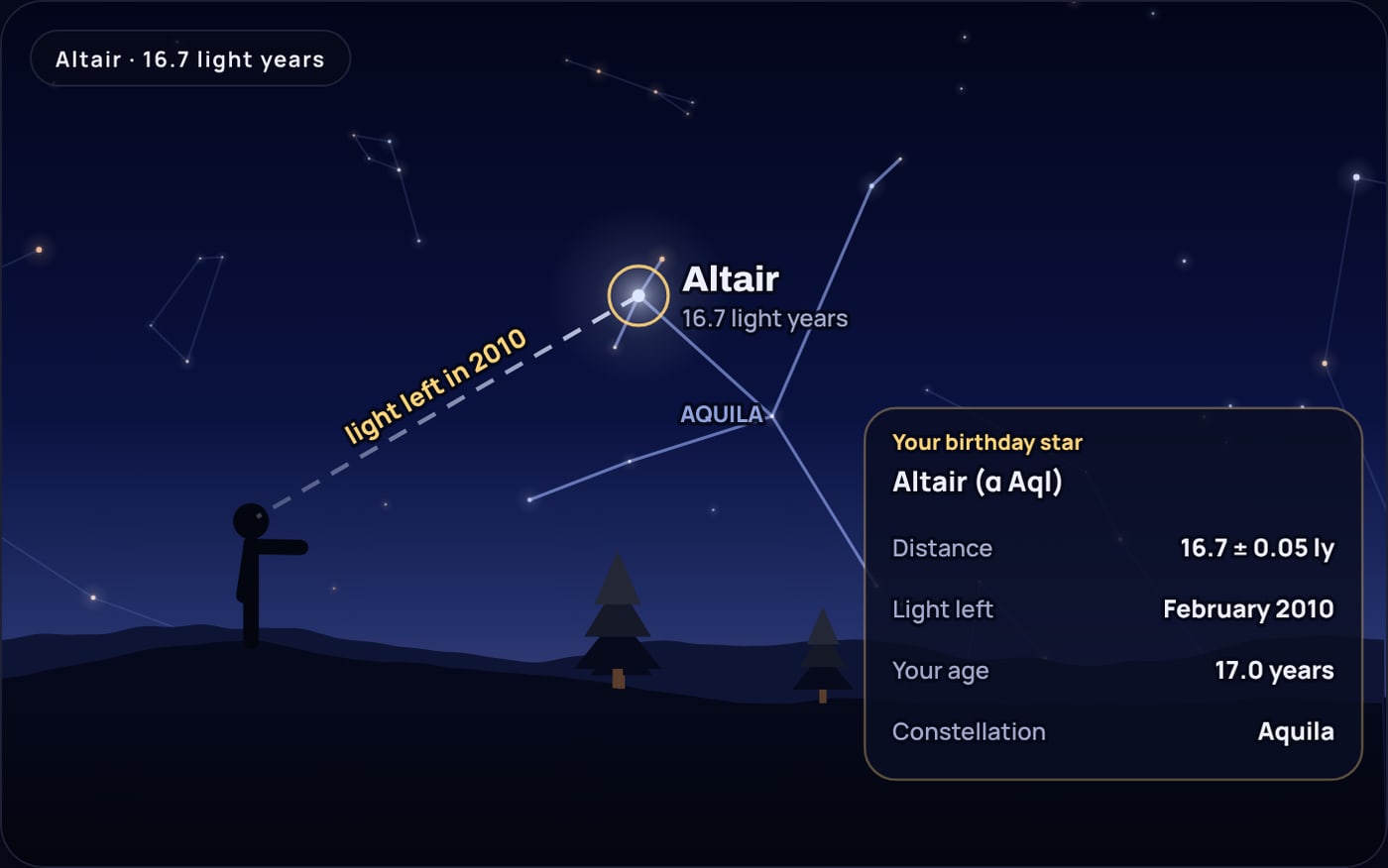
| 15 to 17 | Altair | Aquila | 16.7 |
| 20 | Delta Pavonis | Pavo | 19.9 |
| 25 | Vega | Lyra | 25.0 |
| 30 | Rana (Delta Eridani) | Eridanus | 29.6 |
| 34 | Pollux | Gemini | 33.8 |
| 37 | Muphrid | Boötes | 37.2 |
| 40 | Porrima | Virgo | 39.2 |
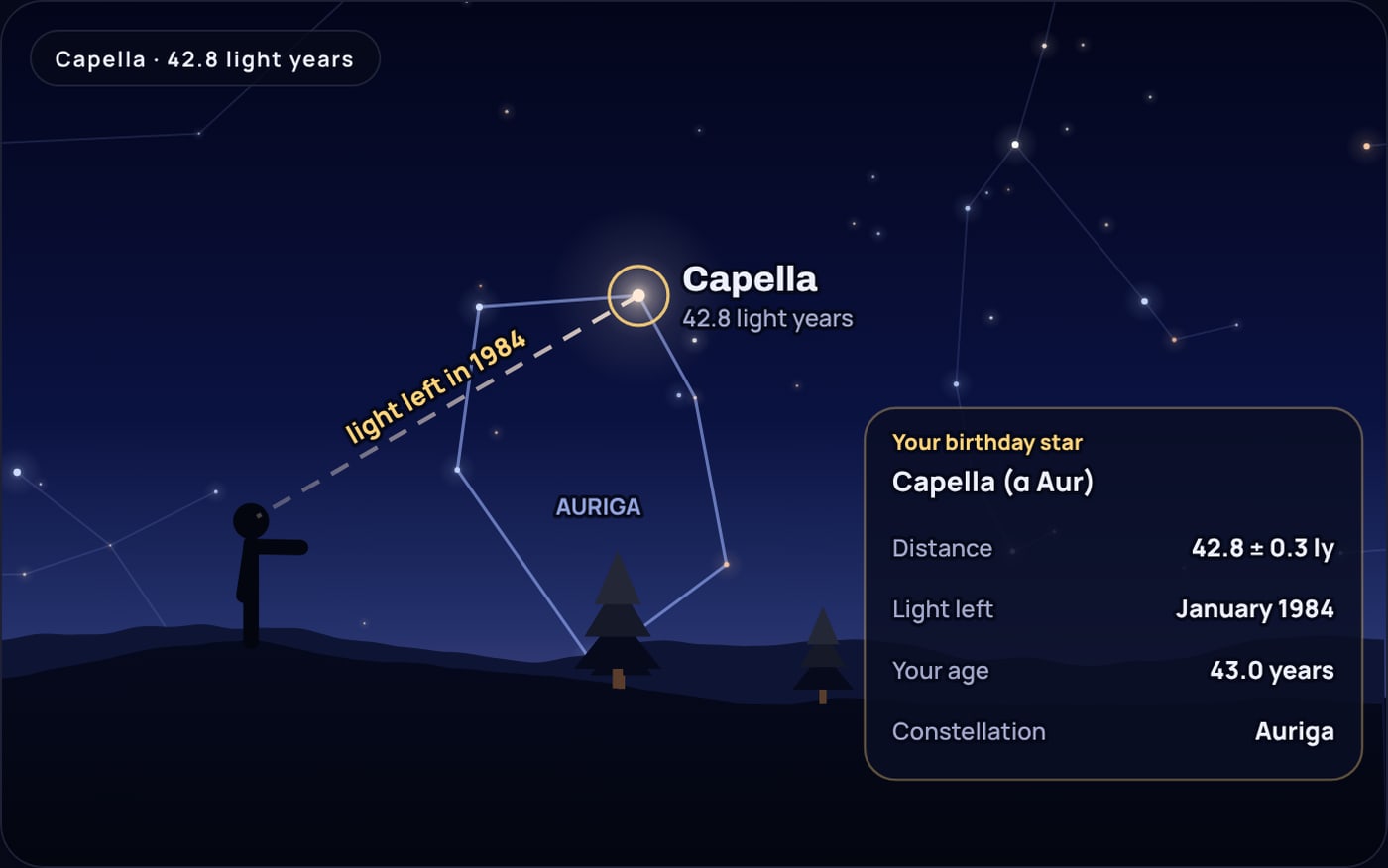
| 43 | Capella | Auriga | 42.8 |
| 45 | Alshain | Aquila | 44.4 |
| 50 | Castor | Gemini | 50.9 |
| 55 | Caph | Cassiopeia | 54.7 |
| 60 | Wasat | Gemini | 60.7 |
| 65 | Hamal | Aries | 65.8 |
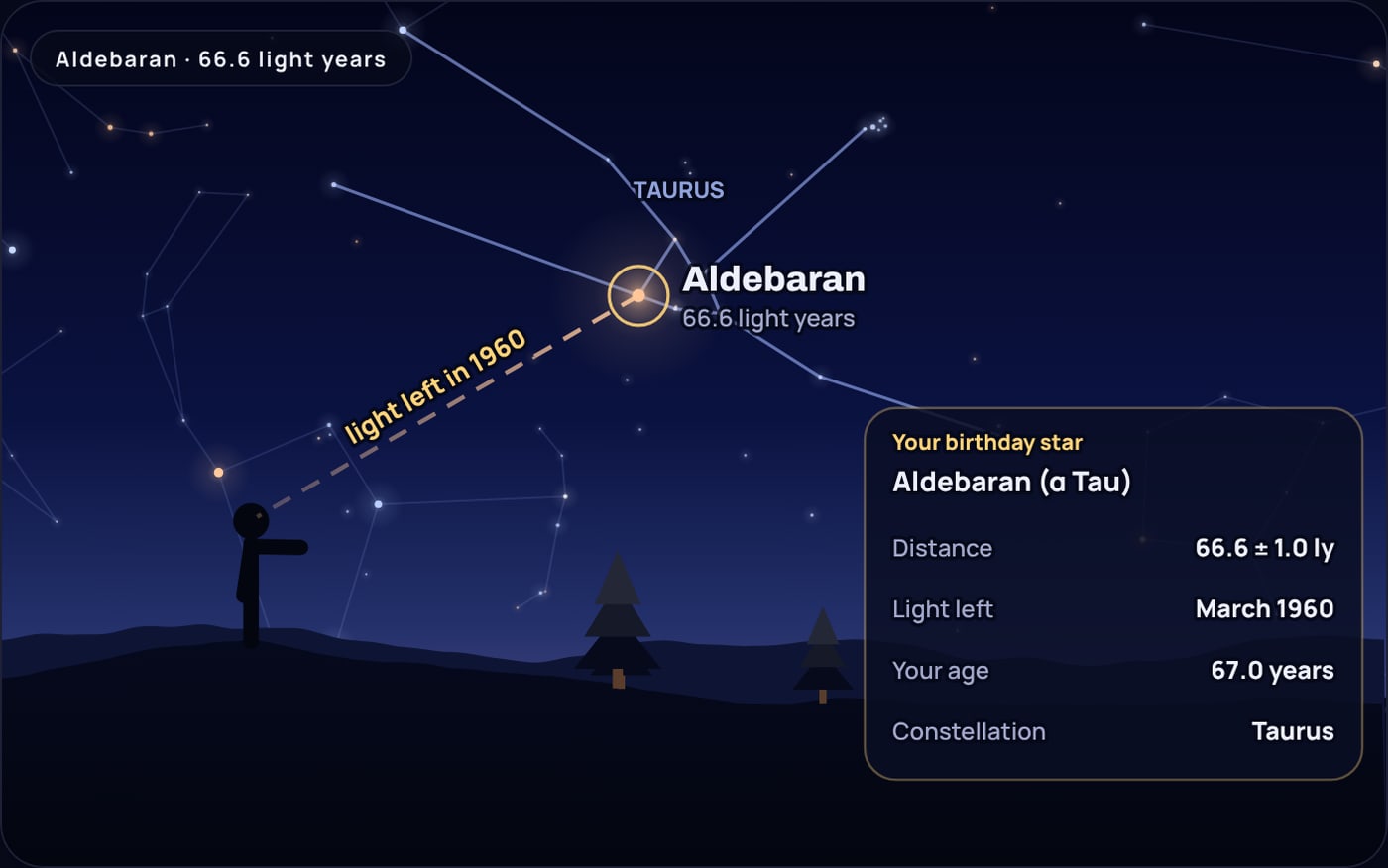
| 67 | Aldebaran | Taurus | 66.6 |
| 75 | Sarin | Hercules | 75.1 |
| 80 | Kaffaljidhma | Cetus | 79.6 |
| 85 | Ankaa | Phoenix | 84.7 |
| 90 | Cursa | Eridanus | 90.0 |
| 100 | Edasich | Draco | 100.3 |
The table is a snapshot. Your birthday star moves outward by one light year every year, so next November each row shifts by one. That is why the calculator takes a birth date rather than a fixed list.
Can you match a star to an exact birth date?
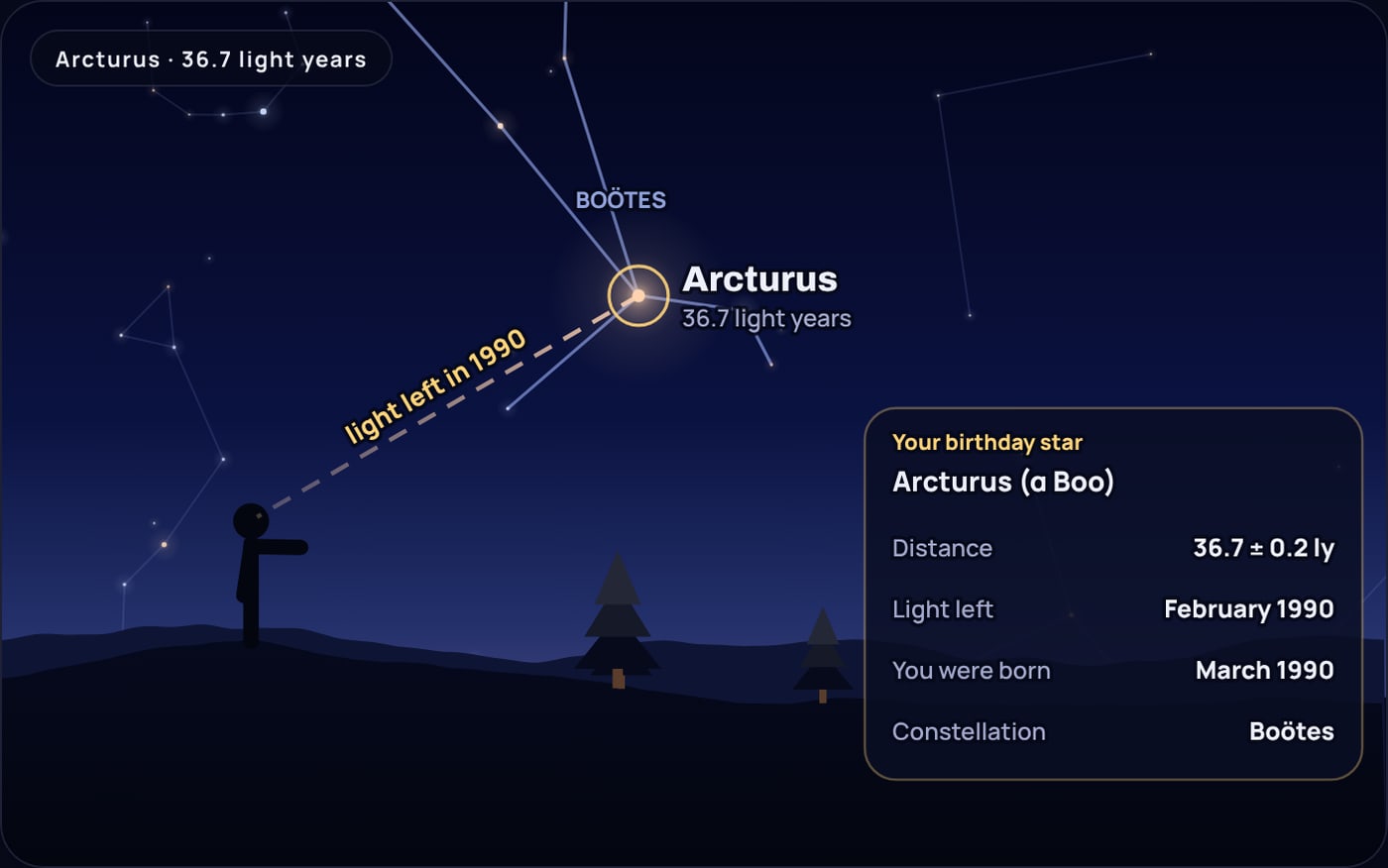
For some stars, nearly. Take someone born on 1 March 1990. On 13 November 2026 they are 36.70 years old. Arcturus, the bright orange star of Boötes, has a parallax of 88.83 ± 0.54 milliarcseconds in the Hipparcos 2007 data.
Example 2: Arcturus and a birthday on 1 March 1990
The light now arriving from Arcturus left it around 24 February 1990, five days before the birth. The uncertainty is about 80 days, so all you can honestly say is "within a season", but that is still a remarkable thing to point at.
How accurate are star distances?
It depends on the star, and the spread is large. The error on a parallax distance is, to first order, the distance times the fractional error on the parallax. Close stars have big parallaxes and small fractional errors. Far stars have small parallaxes, so the same measurement error matters more.
Castor in Gemini shows how quickly it gets loose. It is a multiple star system, which makes its position harder to fit, and SIMBAD gives 64.12 ± 3.75 milliarcseconds.
Example 3: the range of birth years Castor can claim
Here and are the near and far ends of the one-sigma range, in light years (ly). So the light reaching us from Castor in November 2026 left it somewhere between late 1972 and late 1978, with 1975 the central estimate. Anyone aged roughly 48 to 54 can call it theirs.
Compare the three stars above. Vega's distance is known to 0.3%, Arcturus to 0.6%, Castor to 6%. Of the 84 stars in the calculator, SIMBAD takes 48 of the parallaxes from the Hipparcos 2007 reduction, 35 from the European Space Agency's Gaia mission (EDR3 or DR2), and one, Alpha Centauri, from the original 1997 Hipparcos catalogue. The calculator shows the ± figure and the source catalogue for every star so you can see how firm your match is.
Is the star you see tonight already dead?
This is the misconception that tags along with every "you are looking into the past" story. It is true that you see a star as it was when the light left. It is not true that a typical bright star might have died in the meantime.
The stars in this list are between 4.4 and 140 light years away, so the light is at most a couple of human lifetimes old. Stars change on timescales of millions to billions of years; the star life cycle post shows how those lifetimes depend on mass. The chance that one of these stars changed noticeably in the last few decades is effectively zero. Vega tonight looks the way Vega looked in 2001, and the way it will look in 2051.
The second misreading is the unit. A light year is a distance, about 9.46 trillion km, not a span of time. The time link is a consequence: light that has crossed 25 light years has been travelling for 25 years.
Why do older people get dimmer birthday stars?
Because the stars thin out and get fainter with distance. Within 50 light years the list has 27 bright stars, so most ages up to 50 have a match within a few months. Past that the gaps open. Nothing bright in the list sits between Aldebaran at 66.6 and Unukalhai in Serpens at 74.2 light years, so anyone aged about 69 to 72 gets the nearest star rather than a close match, and the calculator says so. Above about 100 the brightest options are well-known stars like Dubhe in the Plough at around 123 light years, with gaps of eight to ten years between them.
There are of course thousands of fainter stars at every distance, some of them with excellent Gaia parallaxes. The calculator sticks to stars you can find without a telescope, because a birthday star you cannot see is less fun.
How do I find my birthday star in the sky?
Once you know the name, the constellation does the rest. Vega is the brightest star high overhead on northern summer evenings and sits in the small parallelogram of Lyra. Altair is the brightest star of Aquila, flanked by two fainter stars in a short line. Arcturus is found by following the curve of the Plough's handle. Capella is the bright yellow star high in northern winter skies. Aldebaran is the orange star at the tip of the V of the Hyades in Taurus.
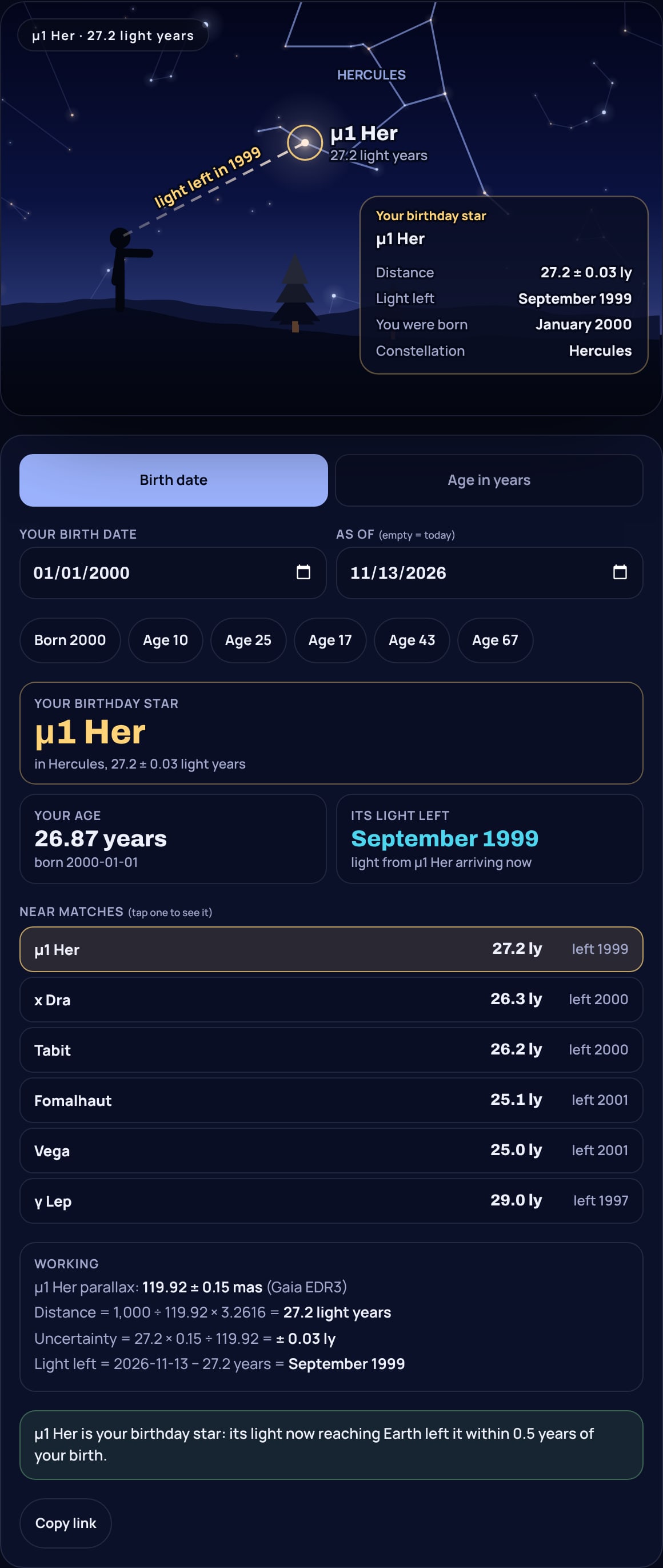
If your star has a Greek letter instead of a name, like Mu Herculis, the letter ranks it roughly by brightness within its constellation, and a free star chart app will find it. Bright stars also twinkle more near the horizon; the twinkling post explains why, and why that helps you tell a star from a planet.
Try it with your own birth date
Open the birthday star finder for someone born on 1 January 2000 and replace the date with yours. It gives your age to two decimals, the closest star, the month its light left, and five near matches you can tap to see in the sky. The working underneath shows the same parallax sum as the examples above.
Sources
- SIMBAD astronomical database, TAP service at the Harvard mirror: parallaxes with errors and their source catalogues, V magnitudes, spectral types and positions for all 84 stars, queried November 2026.
- F. van Leeuwen, Hipparcos, the New Reduction of the Raw Data (2007), VizieR catalogue I/311: parallaxes for 48 of the stars and the positions, magnitudes and colours of the background sky.
- IAU Working Group on Star Names, IAU Catalog of Star Names: proper names such as Ran, Rana and Porrima.
- Stellarium, modern sky culture: constellation line figures.
- E. Mamajek et al., IAU 2015 Resolution B2: the parsec defined as exactly 648,000/π au.
Frequently asked questions
What is a birthday star?
A star whose distance in light years matches your age, so the light reaching your eyes tonight set off from it around the time you were born. For a 25-year-old it is Vega, 25.0 light years away.
How do you find your birthday star?
Work out your age in years, then find a star whose distance in light years is the same. Star distances come from parallax: divide 1,000 by the parallax in milliarcseconds to get parsecs, then multiply by 3.2616 to get light years.
What is the birthday star for a 30, 40 or 50-year-old?
At 30 it is Rana (Delta Eridani) at 29.6 light years, at 40 Porrima (Gamma Virginis) at 39.2, and at 50 Castor in Gemini at 50.9 light years. Castor’s distance carries an uncertainty of 3 light years, so it fits anyone from about 48 to 54.
Is the star I see tonight already dead?
Not the bright ones. The stars in this list are 4 to 140 light years away, so their light is at most a lifetime or two old. Stars like these change over millions of years, so each one is still shining much as you see it.
Is a light year a unit of time?
No, it is a distance: how far light travels in one Julian year of 365.25 days, about 9.46 trillion km. The time link only appears because a star 25 light years away sends light that is 25 years old when it arrives.