How Many Miles Have You Travelled Around the Sun?
While you read this sentence, Earth carries you about 150 km round the Sun. By the end of today it will be 2.57 million km, about 1.6 million miles. By your next birthday it will be close to 584 million miles, a full lap of an orbit 93 million miles in radius. Nobody feels it, because the motion is almost perfectly steady.
This post works out the yearly and lifetime numbers in miles and kilometres, shows the two ways to get them, and explains why the even bigger galactic figures cannot simply be piled on top. The cosmic odometer runs the same sums for your birth date and ticks forward live while you watch.
How many miles does Earth travel around the Sun in a year?
There are two independent ways to get the answer, and they agree.
The first uses Earth's speed. NASA's Earth fact sheet gives the mean orbital velocity as 29.78 km/s. Multiply by the number of seconds in a year, using 365.25 days so leap years are included:
Example 1: from Earth's speed
So 939.8 million km or 584.0 million miles a year. Per day it is 2.57 million km (1.60 million miles), per hour 107,208 km (66,616 miles).
The second uses the size of the orbit. Earth's average distance from the Sun is 149.598 million km, and its orbit is so close to a circle (eccentricity 0.0167) that the circumference is within 0.01% of a circle's:
Example 2: from the size of the orbit
Dividing the circumference by the sidereal year of 365.256 days gives back the fact sheet's 29.78 km/s, which is a nice check that the two numbers belong together.
How many miles have I travelled around the Sun in my life?
Multiply your age by 584 million miles. Here are the totals for common ages, using years of 365.25 days.
| Age | Miles round the Sun | Kilometres round the Sun |
|---|---|---|
| 1 | 584.0 million | 939.8 million |
| 5 | 2.920 billion | 4.699 billion |
| 10 | 5.840 billion | 9.398 billion |
| 18 | 10.51 billion | 16.92 billion |
| 21 | 12.26 billion | 19.74 billion |
| 30 | 17.52 billion | 28.19 billion |
| 40 | 23.36 billion | 37.59 billion |
| 50 | 29.20 billion | 46.99 billion |
| 65 | 37.96 billion | 61.09 billion |
| 80 | 46.72 billion | 75.18 billion |
| 100 | 58.40 billion | 93.98 billion |
Example 3: a 30th birthday, exact to the day
From 13 November 1996 to 13 November 2026 is 10,957 days, which is 946,684,800 seconds.
That is about 73,000 trips from Earth to the Moon, or 188 times the distance from Earth to the Sun.
How fast is Earth moving around the Sun in mph?
About 66,600 mph on average. The orbit is slightly elliptical, so the speed changes through the year. NASA lists a maximum of 30.29 km/s and a minimum of 29.29 km/s:
| When | Distance from the Sun | Speed | In mph |
|---|---|---|---|
| Early January (perihelion) | 147.1 million km | 30.29 km/s | 67,760 mph |
| Average | 149.6 million km | 29.78 km/s | 66,616 mph |
| Early July (aphelion) | 152.1 million km | 29.29 km/s | 65,520 mph |
The difference is a little over 3%, and it evens out over each full year, so lifetime totals use the average. Earth moving fastest in January, during the northern winter, surprises a lot of people; distance from the Sun is not what makes the seasons. The full story of the 3% distance change is in how orbital eccentricity changes sunlight, and every other speed Earth has, with how it is measured, is in how fast is Earth moving.
Does Earth’s spin add more miles?
A little, and it depends on where you live. The equator is 40,075 km round and turns once every 23.93 hours relative to the stars, so the ground there moves at 465 m/s, about 1,040 mph. Away from the equator the circle you ride on is smaller by the cosine of your latitude.
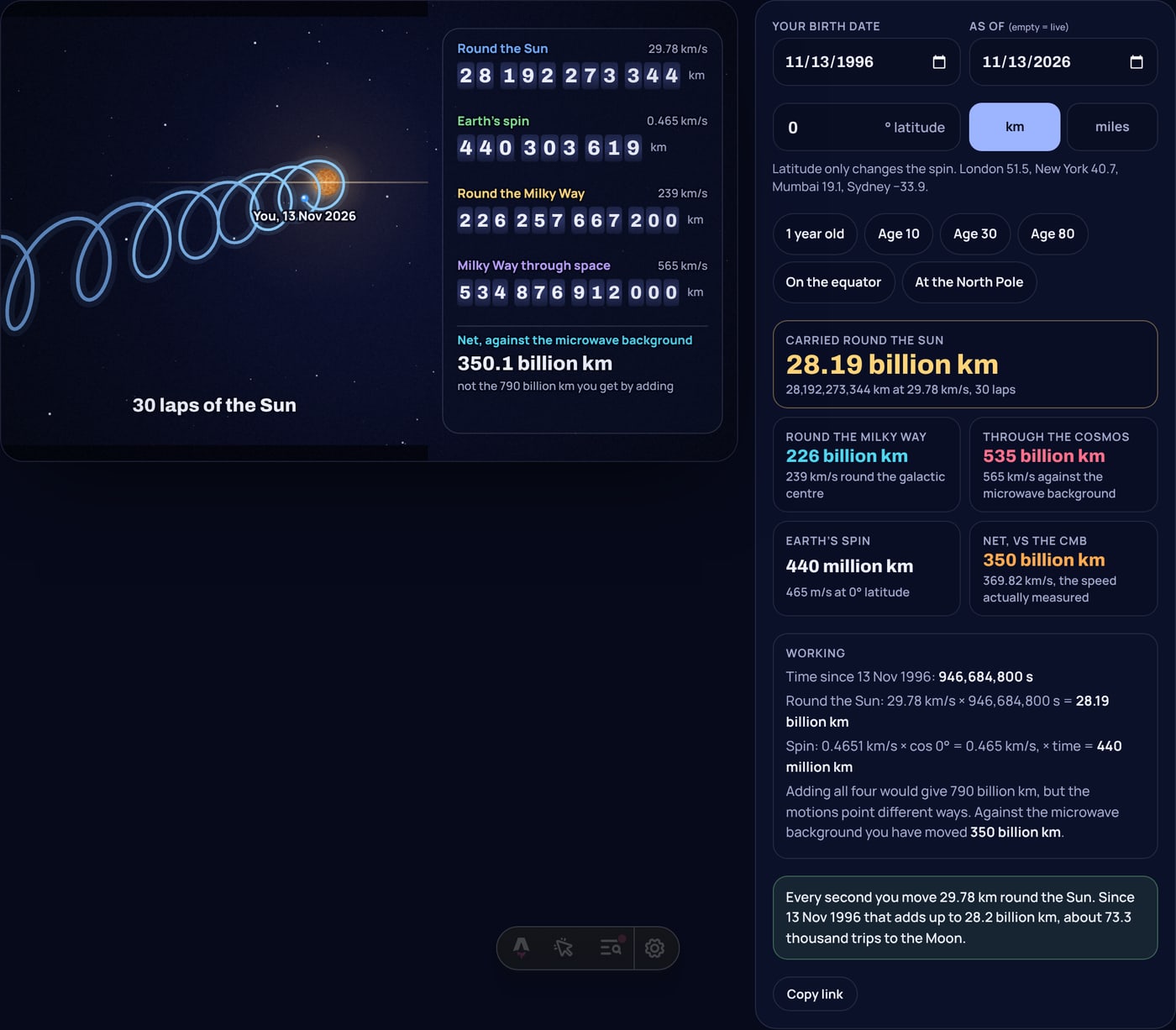
At London's 51.5 degrees that is 290 m/s, which over 30 years adds 274 million km. On the equator it would be 440 million km, and at the North Pole nothing at all. Even the equator's figure is under 2% of the distance round the Sun, and it goes round in a daily loop rather than taking you anywhere.
Are you back where you started after a year?
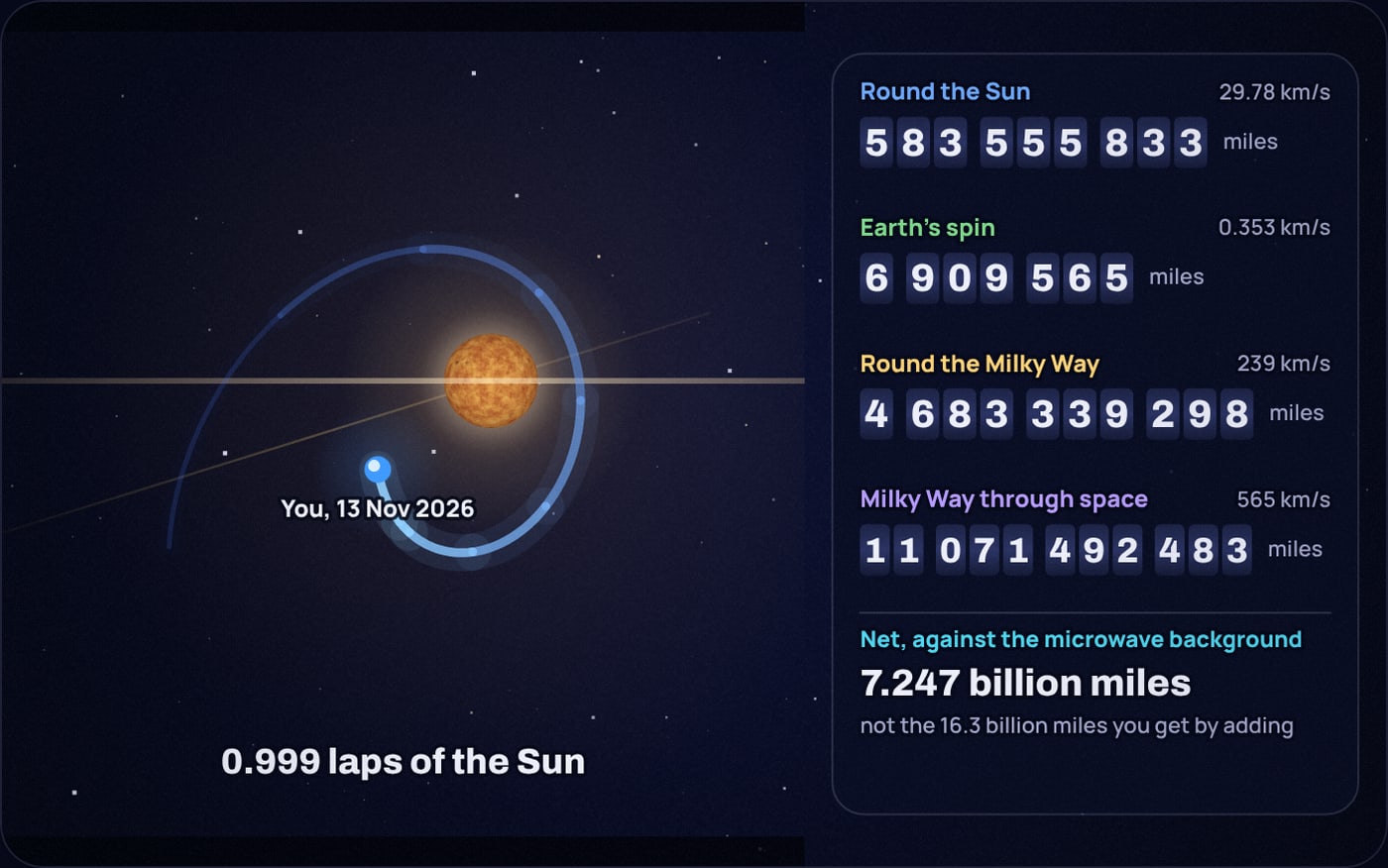
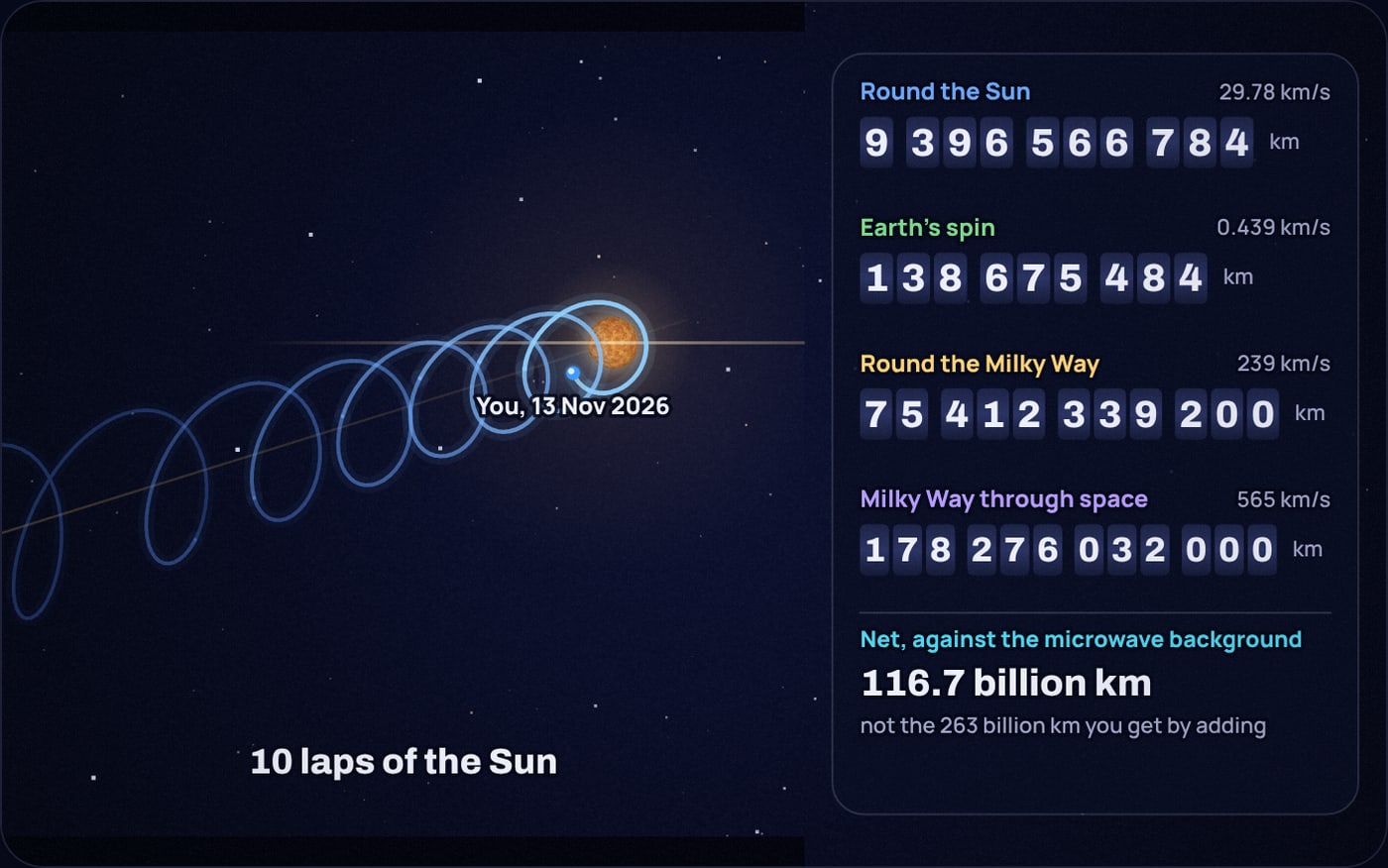
Only relative to the Sun, and that is the most common misconception about orbits. The Sun is moving too. Table 3 of the Planck 2018 overview paper, which collects the best values for these motions, gives the Sun's neighbourhood a speed of 239 ± 5 km/s round the centre of the Milky Way. In one year that is 7.54 billion km, about 50 times the Earth to Sun distance. So by your first birthday Earth has gone once round the Sun, but the Sun and Earth are 4.7 billion miles further along their path round the galaxy.
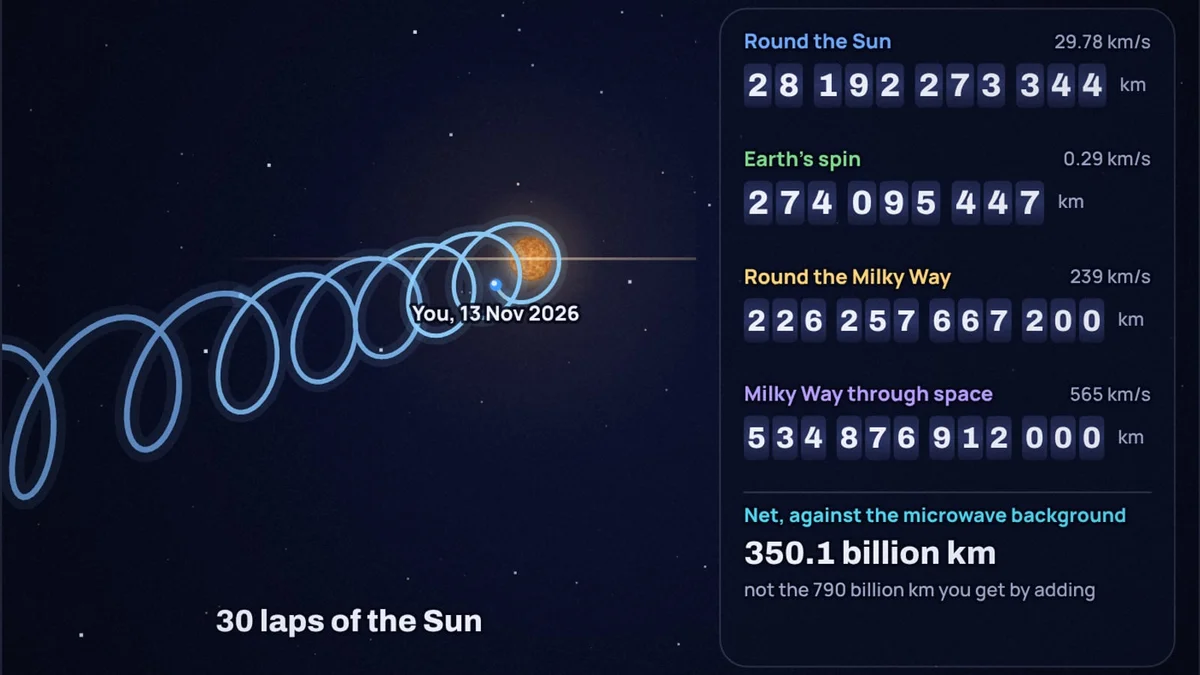
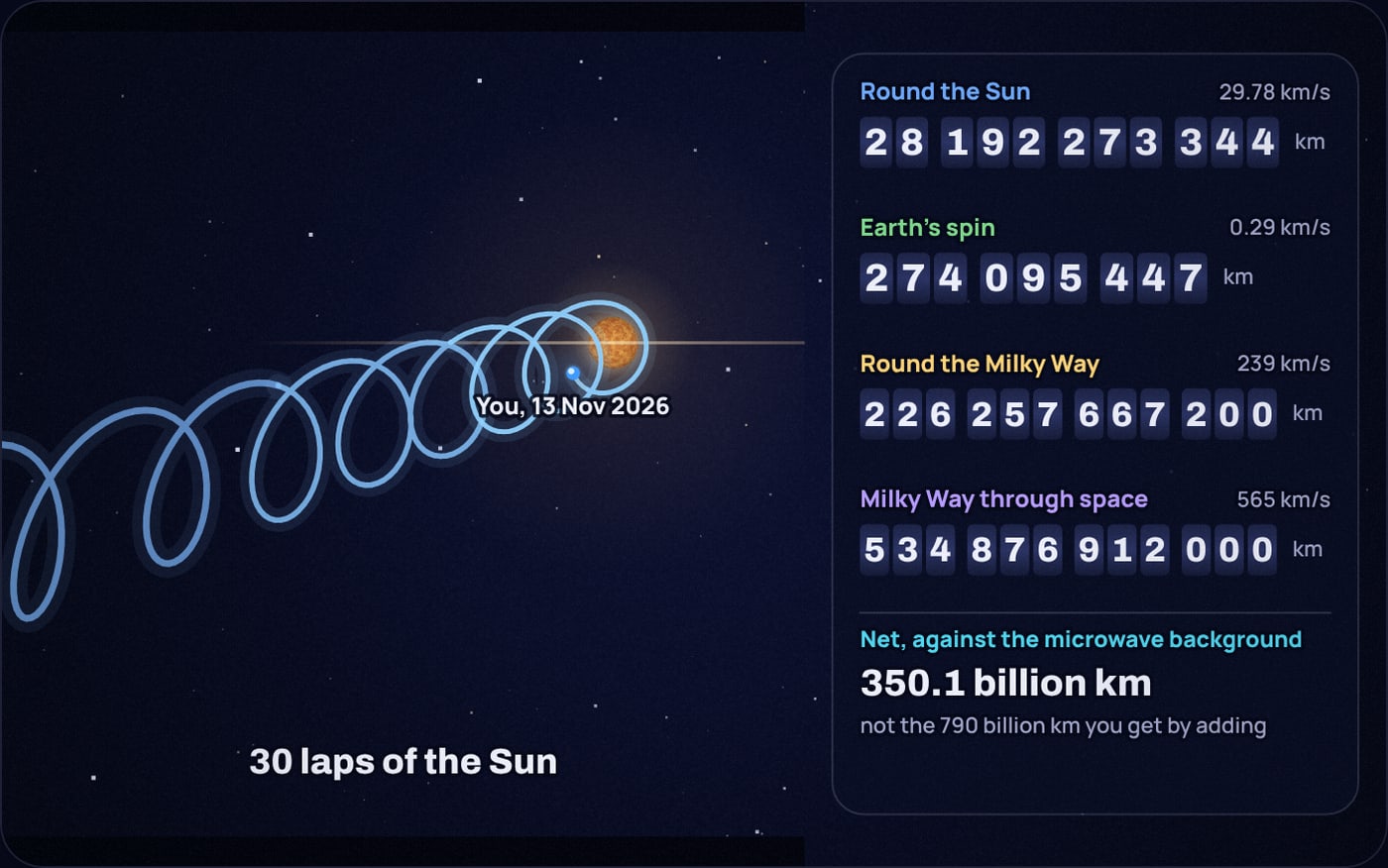
Your real path is a long, stretched spiral. The calculator draws it as a coil, one turn per year, squashed along its length so it fits on a screen. At true scale each turn would be 50 times longer than it is wide, more like a gently wavy line. NASA puts one lap of the galaxy at about 230 million years, so a whole human life covers about one part in three million of it.
Why can’t you add the galaxy and the cosmos to your total?
Because the motions point in different directions and are measured against different things. Planck's table lists the Milky Way's centre moving at 565 ± 5 km/s relative to the cosmic microwave background. Add 29.78, 0.47, 239 and 565 km/s and you get about 834 km/s, but the speed of the Sun actually measured against the microwave background, from the Doppler shift of that radiation, is 369.82 ± 0.11 km/s.
The reason is that the Sun's orbit round the galaxy points about 150 degrees away from the galaxy's own motion, so the two partly cancel. Velocities combine like arrows placed nose to tail. The redshift and blueshift post explains how a Doppler shift turns into a speed in the first place.
Over 30 years the honest net figure, your straight-line distance from where you were born measured in the frame of the microwave background, is 350.1 billion km. Adding the separate odometers would claim 790 billion km.
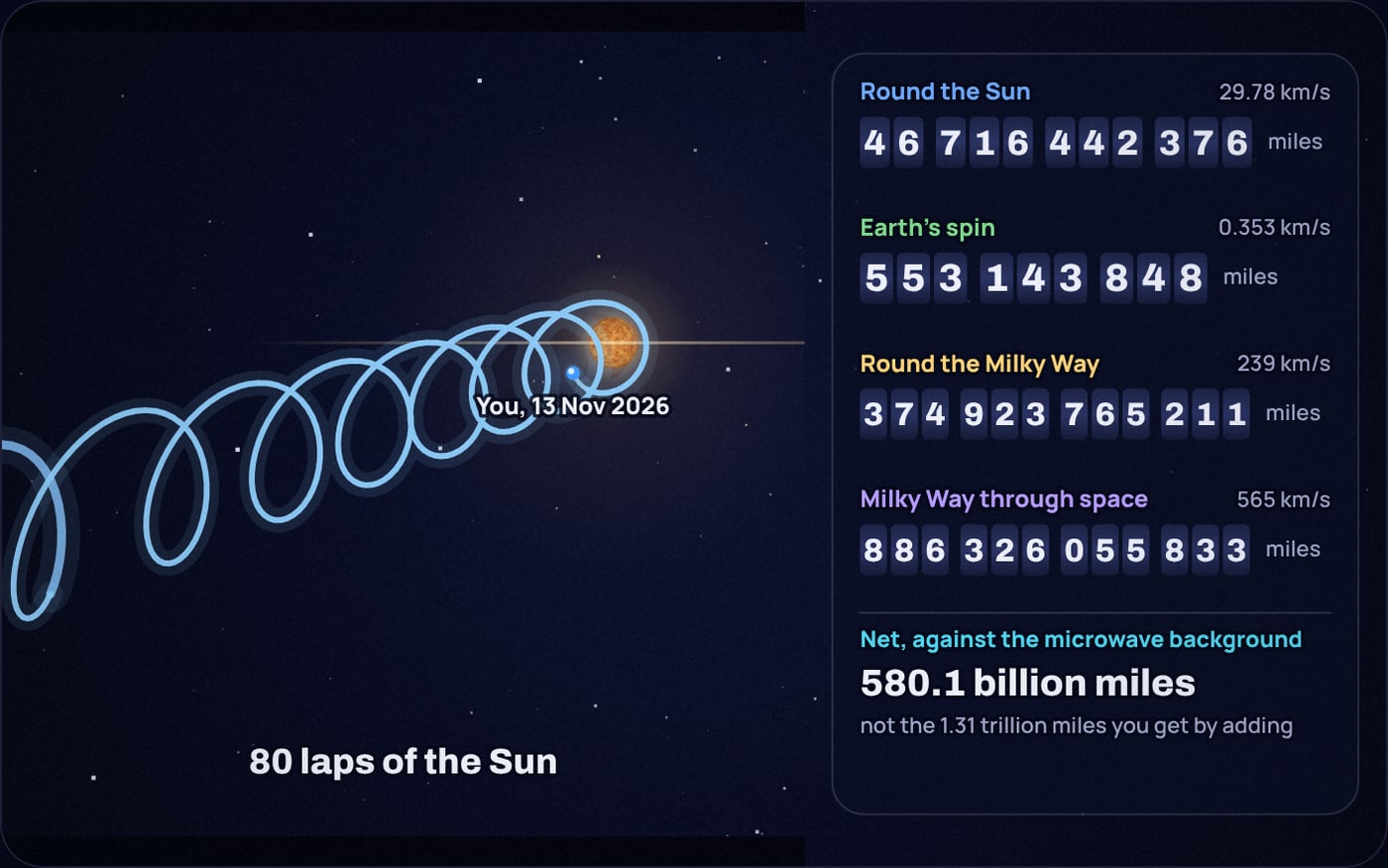
Try it with your own birth date
Open the cosmic odometer set to miles, type your birth date and latitude, and leave the "as of" box empty. The drums count up in real time, about 18.5 miles every second for the trip round the Sun, and the working below the results shows each multiplication.
Sources
- NASA NSSDCA, Earth Fact Sheet: mean orbital velocity 29.78 km/s (maximum 30.29, minimum 29.29), semimajor axis 149.598 million km, sidereal year 365.256 days, equatorial radius 6,378.137 km, sidereal rotation 23.9345 hours.
- Planck Collaboration, Planck 2018 results I, Overview, Section 3 and Table 3: Sun relative to the CMB 369.82 ± 0.11 km/s; local standard of rest round the galactic centre 239 ± 5 km/s; galactic centre relative to the CMB 565 ± 5 km/s; Local Group relative to the CMB 620 ± 15 km/s.
- NASA Science, Sun facts: about 230 million years for one trip round the Milky Way.
Frequently asked questions
How many miles do you travel around the Sun in a year?
About 584 million miles, or 940 million km. Earth’s mean orbital speed is 29.78 km/s (18.5 miles per second), and a year has about 31.56 million seconds.
How many miles have I travelled around the Sun in my lifetime?
Multiply your age in years by 584 million. A 30-year-old has gone about 17.5 billion miles, a 50-year-old about 29.2 billion and an 80-year-old about 46.7 billion miles.
How fast does Earth travel around the Sun in miles per hour?
About 66,600 mph on average. The speed varies from about 65,500 mph in early July, when Earth is farthest from the Sun, to about 67,800 mph in early January, when it is closest.
Do you end up back where you started after a year?
Only relative to the Sun. While Earth goes once round, the Sun moves about 7.5 billion km (4.7 billion miles) round the Milky Way, so your path through the galaxy is a stretched spiral that never closes.
Can I add the distance round the Sun to the distance round the galaxy?
No. The motions point in different directions and are measured against different things. The one speed measured against a single reference, the cosmic microwave background, is 369.8 km/s for the Sun, much less than the separate speeds added together.