Reading motion in starlight: redshift, blueshift and spectral fingerprints
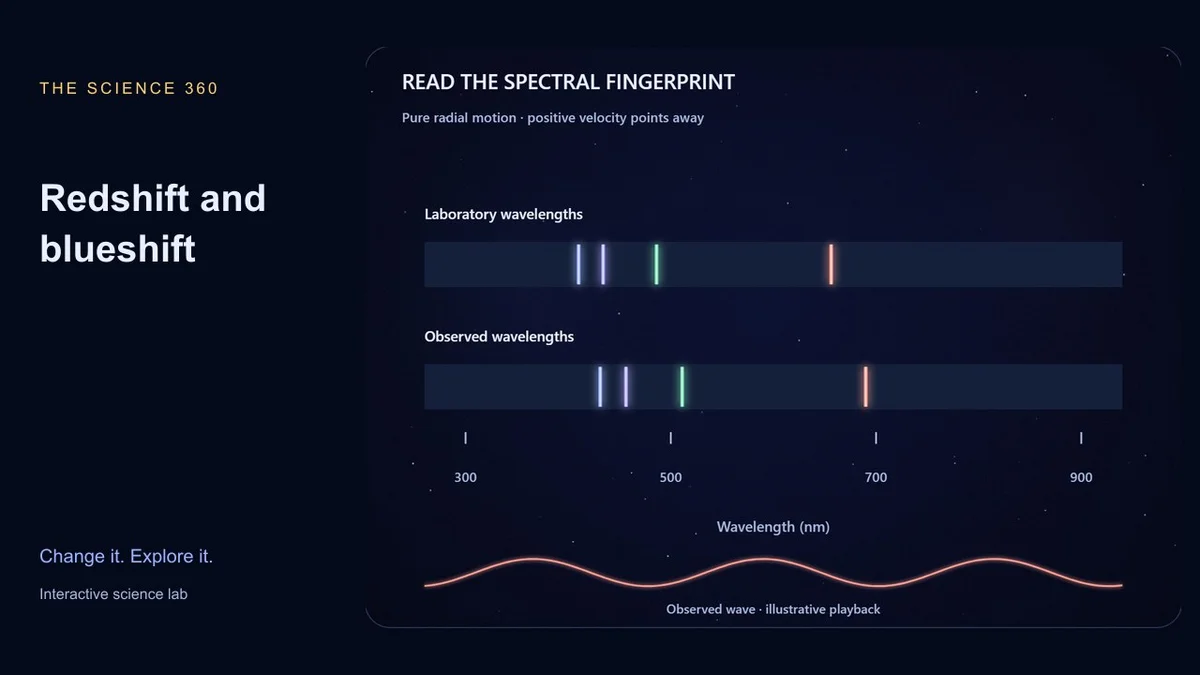
A star can be too distant for its sideways motion to be obvious, yet its light can reveal motion along our line of sight. Spectral features provide a ruler: compare their measured wavelengths with laboratory values and look for a common shift.
In the redshift and blueshift simulator, hydrogen’s Balmer lines form the fingerprint. Positive radial velocity means motion away from the observer; negative velocity means approach.
A line is a better measurement than a colour impression
The hydrogen H-alpha line has a reference wavelength near 656.28 nm. A receding source shifts it toward a longer wavelength. Other known lines shift too, allowing the whole pattern to be checked.
For purely radial relative motion, the special-relativistic factor is:
λobserved / λrest = √[(1 + β)/(1 − β)]
Here β is radial velocity divided by the speed of light. At β = 0.05, the factor is about 1.0513, moving H-alpha to about 689.96 nm. The redshift z is the factor minus one: approximately 0.0513.
The same fractional shift is not the same number of nanometres
Apply that factor to both H-alpha and the shorter 486.13 nm H-beta line. Each grows by about 5.13%, but the longer initial wavelength changes by more nanometres.
That distinction offers a useful identification test. If a proposed set of spectral features does not share a consistent wavelength ratio, the lines may be misidentified or the simple model may be incomplete. A single plausible-looking feature is weaker evidence than a matching pattern.
Reverse the velocity to −0.05c. The wavelength factor becomes the reciprocal of the receding factor. The change is therefore not exactly symmetric in nanometres around the rest wavelength.
Solve the hidden-velocity observation
Select the mystery spectrum preset. The observed line positions now stay fixed, while dashed prediction markers follow your proposed velocity. Match several lines rather than only H-alpha, then check the mismatch readout.
You can also calculate a velocity estimate. If you measure a wavelength ratio F, rearranging the equation gives:
β = (F² − 1)/(F² + 1)
Use the displayed observed H-alpha wavelength to estimate F, calculate β, and compare your result with the slider position that aligns the pattern. Copy the setup link to keep your answer.
Know which redshift is being modeled
This is a radial Doppler experiment. It does not model cosmological expansion, gravitational redshift, instrumental calibration, line broadening or noisy observations. A distant galaxy’s cosmological redshift should not automatically be interpreted as this nearby-source velocity or converted to a distance with this tool.
For another experiment with wavelength, try the refraction and prism simulation and compare a shifted spectral fingerprint with the separation of colours by a material.
Sources and further reading
 5 amazing physics experiment for your kids
 50 Hilarious Physics Jokes That Will Make You Laugh