Why does a siren change pitch as it passes you?
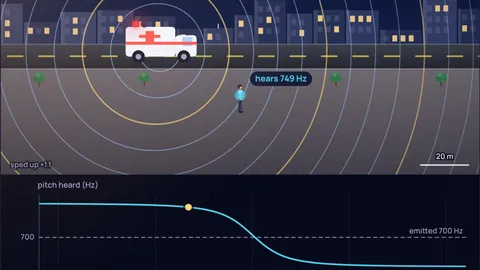
Because the ambulance moves while it sends out each sound wave. Ahead of it the crests are squeezed closer together, so they reach you more often and the pitch is higher; behind it they are stretched out and the pitch is lower. For an ambulance at 90 km/h with a 700 Hz siren, you hear about 755 Hz as it comes toward you and 652 Hz as it leaves, a drop of 2.5 semitones.
The formula is f′ = f (c + vₒ) ÷ (c − vₛ), where c is the speed of sound (343.2 m/s at 20 °C), vₛ the speed of the source toward you and vₒ your speed toward the source. The simulation draws the real wavefronts, plots the pitch the listener hears over time and, if you switch the sound on, plays it. Push the source past 343 m/s and the wavefronts can no longer get ahead: they pile up into a cone, the sonic boom. The same effect with light is how astronomers measure redshift and blueshift.
Key results from the simulation
- Ambulance at 90 km/h: a 700 Hz tone is heard at 755 Hz approaching and 652 Hz leaving, 2.5 semitones apart. The 950 Hz half of a hi-lo siren shifts by the same ratio, to 1,025 and 886 Hz.
- Wavelength ahead and behind: at 700 Hz the crests are 45 cm apart in front of the ambulance and 53 cm behind it, against 49 cm when it stands still.
- Moving listener: driving toward the ambulance at 72 km/h widens the drop to 4.5 semitones (799 Hz to 614 Hz).
- Speed of sound depends on temperature: 312.6 m/s at −30 °C, 331.3 m/s at 0 °C, 343.2 m/s at 20 °C, 351.9 m/s at 35 °C. Humidity and pressure barely matter.
- Above Mach 1: at Mach 2 the shock cone has a half-angle of 30.0 degrees, and a listener 300 m from the flight path hears the boom 0.8 s after the jet passes overhead.
Six setups worth trying
Each section gives the numbers the simulation shows and has a button that loads the setup. The sound button under the controls plays the pitch the listener hears; it is off until you press it.
An ambulance at 90 km/h
25 m/s, 700 Hz, Mach 0.073Ambulance sirens in many countries alternate between two tones near 700 and 950 Hz. At 25 m/s the source moves at only 7.3 percent of the speed of sound, so the rings in the simulation are only slightly off centre. Yet the ear notices: 755 Hz on the way in, 652 Hz on the way out, a drop of 2.5 semitones, a bit more than a whole tone.
Stand right beside the road and the drop happens almost instantly as it passes. Stand further back and it is smoother, because only the part of the ambulance's velocity that points at you counts. The pitch chart shows that S-shaped curve; the steepest point is at the moment of closest approach.
Driving toward the ambulance
Source 25 m/s, listener 20 m/sNow the listener is in a car doing 72 km/h toward the ambulance. The listener runs into the crests faster, which adds (c + vₒ) on top: 799 Hz while closing, 614 Hz after passing, a 4.5 semitone drop.
Notice that the two speeds do not play the same role. Moving the source changes the wavelength in the air; moving the listener only changes how fast you meet the crests. For sound, which travels through air, that difference is real and measurable. For light there is no air, and only the relative speed matters.
The F1 "neeeow" at 324 km/h
90 m/s, 750 Hz engine noteA Formula 1 V6 at 15,000 rpm fires 750 times a second (3 cylinders fire per revolution, 250 revolutions per second), which sets the fundamental of its scream. At 90 m/s, Mach 0.26, the trackside listener hears 1,017 Hz arriving and 594 Hz leaving, a drop of 9.3 semitones: most of an octave.
That big, fast swoop is the sound everyone imitates. It is pure Doppler: the engine does not change speed as it passes you.
At the speed of sound: the sound barrier
343 m/s at 20 °CAt Mach 1 the source keeps pace with its own wavefronts. Every crest it sends forward is still sitting at its nose when the next one leaves, so the rings touch at one point and the pressure piles up there. That wall of compressed air is what early test pilots called the sound barrier.
The textbook formula f (c ÷ (c − vₛ)) blows up here, because c − vₛ goes to zero. Nothing ahead hears anything until the source itself arrives. Behind it the wavelength is doubled: 250 Hz for a 500 Hz source.
A jet at Mach 2: the cone and the boom
686 m/s, cone half-angle 30°Faster than sound, the jet outruns every wave it makes. The rings overlap along two lines that meet at the nose, a cone in three dimensions with a half-angle μ where sin μ = 1 ÷ M. At Mach 2.0 that is 30.0 degrees. Concorde at its Mach 2.04 cruise trailed a cone of 29.4 degrees.
A listener on the ground hears nothing as the jet goes over, then the cone sweeps past and every wave arrives at once: the boom. With the jet 300 m away it comes 0.8 s after the jet is overhead. From a cruising height of 10 km it would come 25 s later, which is why you look for a supersonic jet in the wrong part of the sky.
Why "Mach 1" is not one speed
330 m/s at −30 °CThe speed of sound depends on air temperature: c = √(γRT). At 20 °C it is 343.2 m/s, at −30 °C, roughly the air at airliner height, it is 312.6 m/s. So a jet doing 330 m/s is subsonic in warm air near the ground (Mach 0.96) and supersonic in the cold (Mach 1.06).
Load this setup and slide the temperature up past about 0 °C: the cone collapses back into ordinary bunched-up rings. That is also why Mach numbers, not km/h, are what pilots watch.
Doppler shift for everyday sound sources
| Source | Speed | Emits | Heard approaching | Heard leaving | Drop |
|---|---|---|---|---|---|
| Cyclist bell | 6 m/s (22 km/h) | 2000 Hz | 2,036 Hz | 1,966 Hz | 0.6 semitones |
| Ambulance siren (low tone) | 25 m/s (90 km/h) | 700 Hz | 755 Hz | 652 Hz | 2.5 semitones |
| Ambulance siren (high tone) | 25 m/s (90 km/h) | 950 Hz | 1,025 Hz | 886 Hz | 2.5 semitones |
| Train horn | 30 m/s (108 km/h) | 300 Hz | 329 Hz | 276 Hz | 3.0 semitones |
| Motorway car horn | 33 m/s (119 km/h) | 420 Hz | 465 Hz | 383 Hz | 3.3 semitones |
| F1 car engine | 90 m/s (324 km/h) | 750 Hz | 1,017 Hz | 594 Hz | 9.3 semitones |
| Propeller plane | 120 m/s (432 km/h) | 100 Hz | 154 Hz | 74 Hz | 12.6 semitones |
Air at 20 °C (c = 343.2 m/s), listener standing still on the line of travel. Source frequencies are typical values chosen for illustration; the ambulance tones are the 700 and 950 Hz pair used in a University of Leicester analysis. The drop in semitones depends only on the speed, not on the pitch.
How the simulation works
The source moves along a straight road at speed vₛ and passes a listener who stands (or drives toward it at vₒ) a short distance to the side. Every few milliseconds of simulated time the source emits a ring that grows at the speed of sound from the point where the source was at that moment. The rings shown are a sample of the crests (one ring stands for many), but the spacing ratio ahead and behind is exact: (c − vₛ) ÷ (c + vₛ).
For the pitch chart the simulation solves, for each moment, which crest is reaching the listener and when it was emitted (the retarded time). The heard frequency is f′ = f (c − vₒ·û) ÷ (c − vₛ·û), where û is the direction from the source at emission to the listener at reception. On the line of travel this reduces to the textbook (c + vₒ) ÷ (c − vₛ).
Above Mach 1 the equation for the emission time has no solution until the shock cone arrives and two solutions after it. The chart shows silence, a boom marker, then the branch heard in normal order. The cone half-angle is μ = arcsin(1 ÷ M).
The speed of sound is c = √(γRT) with γ = 1.4 and R = 287.05 J/(kg·K), the formula NASA Glenn gives: 343.2 m/s at 20 °C. The optional sound uses the Web Audio API: an oscillator that follows the heard frequency, alternating 700 and 950 Hz style tones for the ambulance, and a filtered noise burst for the boom. It starts only when you press the sound button, and the picture is slowed or sped up to keep the waves visible, as the label on the stage says.
What the model leaves out
- Loudness and echoes: the sound gets quieter with distance in the audio, but there are no reflections from buildings, which in a real street smear the pitch drop.
- Wind: a steady wind adds to the speed of sound in one direction and subtracts in the other. The model has still air.
- Real siren sounds: a siren is a rich tone with harmonics and a sweep; the audio plays a simple tone. Every harmonic shifts by the same ratio, so the musical interval is right.
- Shock strength: the model shows where the boom is, not how loud. Real booms depend on the aircraft size, altitude and the air in between.
- Relativity: for sound the speeds involved are tiny compared with light, so the classical formula is exact enough. For light the formula changes, see the redshift simulator.
Common misconceptions
“The siren itself changes pitch.” The ambulance emits the same tones all the time; the driver hears no shift at all. The change is in how often the crests reach you.
“The pitch rises as it gets closer.” It is high and nearly constant while the ambulance approaches, then drops as it passes. What rises as it gets closer is the loudness, and the brain tends to mix the two.
“A sonic boom happens once, when the jet breaks the sound barrier.” The cone trails the aircraft for as long as it flies supersonic, so everyone under its path hears a boom when the cone sweeps over them.
Frequently asked questions
What is the Doppler effect in simple words?
When a sound source moves toward you, its waves arrive squeezed together and you hear a higher pitch; when it moves away, they arrive stretched and you hear a lower pitch. An ambulance at 90 km/h with a 700 Hz siren sounds like 755 Hz coming and 652 Hz going.
What is the Doppler effect formula?
f′ = f (c + vₒ) ÷ (c − vₛ) when source and listener approach each other, and f′ = f (c − vₒ) ÷ (c + vₛ) when they move apart. Here f is the emitted frequency, c the speed of sound (343.2 m/s at 20 °C), vₛ the source speed and vₒ the listener speed.
Why does an ambulance siren sound different when it passes?
Because of the Doppler effect: the ambulance moves while emitting, so the crests ahead of it are closer together (higher pitch) and those behind are further apart (lower pitch). At 90 km/h the drop is about 2.5 semitones.
What causes a sonic boom?
When an aircraft flies faster than sound, it outruns the pressure waves it makes. They overlap along a cone that trails the aircraft, with half-angle arcsin(1 ÷ Mach). When that cone sweeps over you, all the pressure arrives at once and you hear a boom.
Does temperature change the speed of sound?
Yes. The speed of sound in air is √(γRT), so it rises with absolute temperature: about 313 m/s at −30 °C, 331 m/s at 0 °C and 343 m/s at 20 °C. It rises by about 0.6 m/s per degree near room temperature.
Is redshift the same as the Doppler effect?
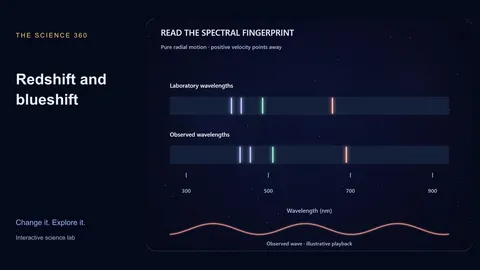
For a galaxy moving away it is the light version of the same idea: the waves are stretched, so the light looks redder. The formula is different because light needs no air and moves at the same speed for everyone. See the redshift and blueshift simulator.
Keep learning
Why Does an Ambulance Siren Change Pitch as It Passes?
At 90 km/h a 700 Hz siren is heard at 755 Hz coming and 652 Hz going, 2.5 semitones apart. Here is the Doppler math, and how to read speed from the pitch.
Reading motion in starlight: redshift, blueshift and spectral fingerprints
Measure a hydrogen line’s Doppler shift, distinguish fractional and absolute wavelength changes, and solve a synthetic mystery spectrum.

How Do Noise Cancelling Headphones Work? The Timing Math
Noise cancelling headphones play inverted sound, but a 20° phase error leaves a third of the noise. Why ANC kills engine drone and not voices, with plots.

Quarter Wave Antenna Length: 234/f, 246/f and Why
A quarter wave is 246/f feet (74.95/f m), but a resonant whip is 2 to 7% shorter, depending on wire thickness. Worked 433 MHz and 2.4 GHz lengths.