How Do Noise Cancelling Headphones Work? The Timing Math
Put on a pair of noise cancelling headphones on a plane and press the button. The engine drone drops away as if someone closed a door. The baby three rows back, the clink of the drinks trolley and the cabin announcements come through almost unchanged. That split is not a matter of software polish. It is set by one number: how many millionths of a second late the anti-noise arrives at your eardrum.
Nearly every explanation that ranks for this question stops at "the headphones make an opposite wave, and the two cancel." True, but it hides all of the physics. An opposite wave that is a little bit late, or a little bit too loud, cancels far less than you would guess. Work through the arithmetic once and both the drone and the baby make sense.
What does “cancelling” a sound wave actually mean?
Sound in your ear canal is a small pressure fluctuation on top of atmospheric pressure. Pressures add. If the noise at your eardrum is p(t) and the headphone driver adds exactly −p(t), the total is zero, and you hear nothing. Physicists call this destructive interference. The energy is not "destroyed": the driver simply stops the air at your eardrum from moving, and the sound field around your head is rearranged, not erased.
The idea is old. Paul Lueg was granted US patent 2,043,416 in 1936 for cancelling tones in a duct and sounds near a loudspeaker by inverting their polarity. Willard Meeker built an active earmuff in 1957 that attenuated roughly 50 to 500 Hz by up to about 20 dB, and commercial headsets arrived in the late 1980s. What took decades was not the idea but the electronics fast enough to make it work over more than a narrow band.
How much does a small error ruin the cancellation?
Suppose the anti-noise has the right shape but is off by a factor a in amplitude and by an angle φ in phase. Writing both waves as phasors, the fraction of noise left over is the length of the difference between two arrows:
Residual noise after cancellation
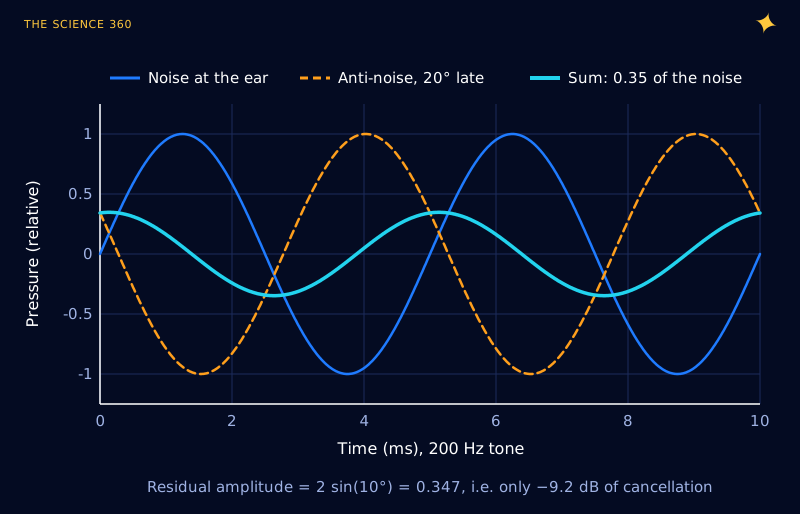
Perfect amplitude (a = 1), phase off by 20°
So a wave that is "nearly opposite", only 20° off out of 360°, removes just two thirds of the pressure. Figure 1 shows what that looks like.
Turn the formula around and ask what precision each level of cancellation demands. Setting a = 1 gives , where R is the residual you are willing to accept.
Phase tolerance for a target cancellation (amplitude perfect)
The three targets correspond to R = 0.316, 0.100 and 0.032.
Amplitude tolerance (phase perfect)
−20 dB needs the anti-noise level within about +0.8 dB / −0.9 dB of the noise.
Each extra 10 dB of cancellation needs the phase about three times tighter. Thirty decibels, which would make a jet engine sound like a quiet office, needs the anti-noise right to within two degrees of phase and about a quarter of a decibel in level, at your eardrum, in a seal that changes every time you chew.
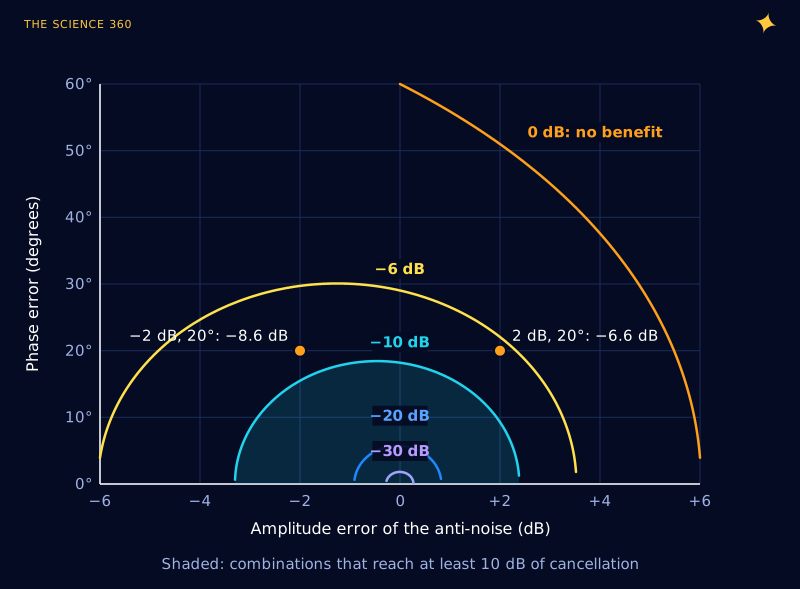
A detail that design guides sometimes blur: a Knowles applications engineer writing in audioXpress picks −10 dB as a clearly audible target and says it is reached "with a magnitude mismatch of up to 2dB and phase deviation from the ideal of 180° up to 20°." Each tolerance on its own is roughly right (20° alone gives −9.2 dB, 2 dB alone gives −11.7 to −13.7 dB). Both at once, as the two orange dots in Figure 2 show, give only −6.6 to −8.6 dB. Errors stack, and they stack badly. Notice also that the contours lean left: anti-noise that is slightly too quiet is more forgiving than anti-noise that is slightly too loud.
Why does noise cancelling work on low frequencies but not high?
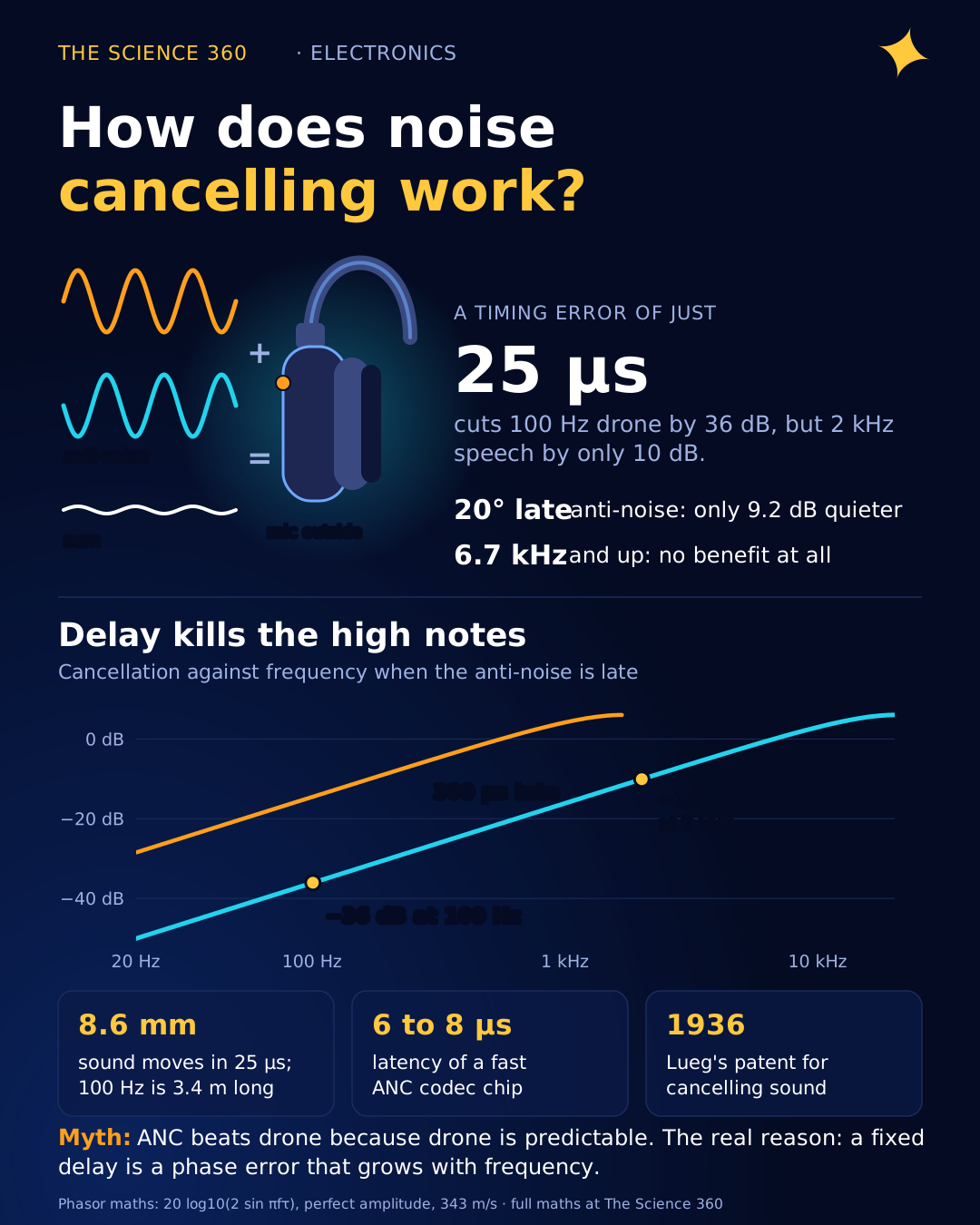
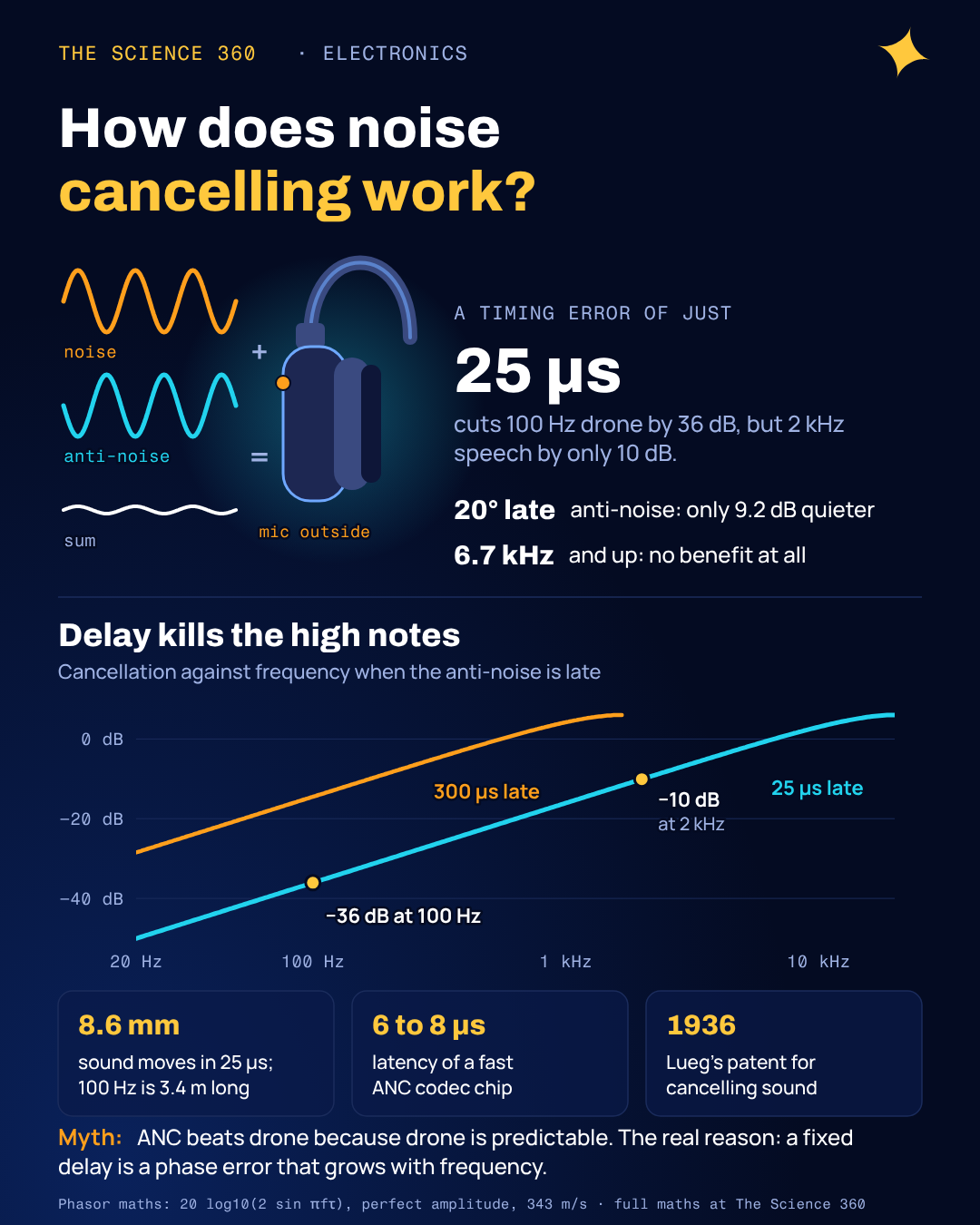
Here is the misconception worth correcting. Many explanations say ANC handles engine drone because it is steady and "predictable", and struggles with voices because they are sudden. Predictability helps a bit with adaptive filters, but it is not the main reason. The main reason is that any timing error becomes a phase error that grows in proportion to frequency.
Every stage between the microphone and the driver costs time: the microphone's own converter, the digital filter, the output converter, the driver and the air between the driver and your eardrum. Call the uncorrected timing error τ. A delay τ is a phase error of , so with perfect amplitude the cancellation becomes .
A 25 µs timing error at three frequencies
100 Hz is an aircraft drone, 2,000 Hz the consonants in speech, and at 6,700 Hz there is no benefit at all. The frequency where cancellation falls to −10 dB:
τ = 25 µs gives 2.0 kHz, τ = 100 µs gives 506 Hz and τ = 300 µs gives 169 Hz.
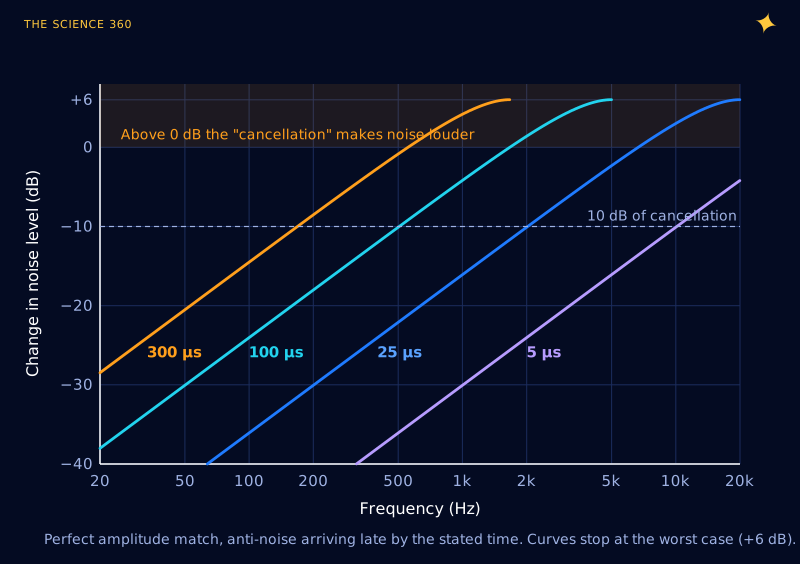
The same story in wavelengths: sound travels at about 343 m/s at 20 °C, so a 100 Hz wave is 3.4 m long and a 5 kHz wave is 6.9 cm long. In 25 µs sound moves 8.6 mm. That is a rounding error against 3.4 m and a big fraction of 6.9 cm. Being a centimetre off in position or a few tens of microseconds off in time is the same mistake.
How fast do the electronics have to be?
In a feedforward design (more on that below), a microphone on the outside of the ear cup hears the noise before it leaks to your eardrum. The electronics have exactly the acoustic travel time from that microphone to the eardrum to produce their answer. Anything later is an error, and the filter cannot fix it for random noise, because it would have to know the future.
Rough latency budget for an earbud (my estimate of the geometry)
Acoustic path, outside mic to eardrum: about 1.5 cm (an assumption, not a published spec).
The second line is one sample at the 48 kHz rate used for music. Knowles' baseline digital MEMS microphone has 24 µs of converter latency alone.
Two ordinary audio samples and a standard microphone's converter already overrun the budget. That is why ANC chips do not run their cancellation path at music sample rates. Dolphin Design describes an ANC codec with converters running at 192 kHz and an input-to-output latency of 6 to 8 µs, and Knowles describes a microphone variant with 3 µs latency instead of 24 µs. Research systems have gone further: a fully digital feedback controller presented at an Institute of Acoustics conference reported 2.03 µs from analog in to analog out. The engineering effort in modern ANC is mostly a fight over these microseconds.
Periodic sounds are the exception, and this is where the "predictable" idea has some truth. A pure tone repeats, so a filter can effectively use the previous cycle to cancel the next one, and delay matters much less. Propeller and engine tones are close to periodic. Speech and clatter are not.
Feedforward vs feedback ANC: what is the difference?
Feedforward uses the outside microphone. Its filter tries to model the exact path the noise takes through the cup and into your ear, then plays the inverse. It has no stability problems, because the anti-noise never goes back into its own microphone. Its weakness is that the model has to be right: if the earbud is pushed in differently or the seal leaks, the real path changes and Figure 2 tells you what happens to the cancellation. Dolphin quotes feedforward as effective from about 80 Hz to 2 kHz.
Feedback puts the microphone inside, next to the driver, and simply tries to drive whatever it hears to zero. It does not care how the noise got in, so it is tolerant of fit. Its weakness is the loop: the signal goes from driver to microphone to filter and back to the driver, and any delay around that loop limits how much gain you can use before it oscillates. Dolphin quotes feedback as effective from about 50 Hz to 800 Hz. The control theory is the same as the phase margin of an op amp feedback loop.
Feedback has a second, stranger cost. A theorem by Hendrik Bode says that for a stable loop of this kind, the dB of noise reduction summed over frequency must be paid back somewhere as amplification. Engineers call it the waterbed effect: push the noise down in one band and it bulges up in another.
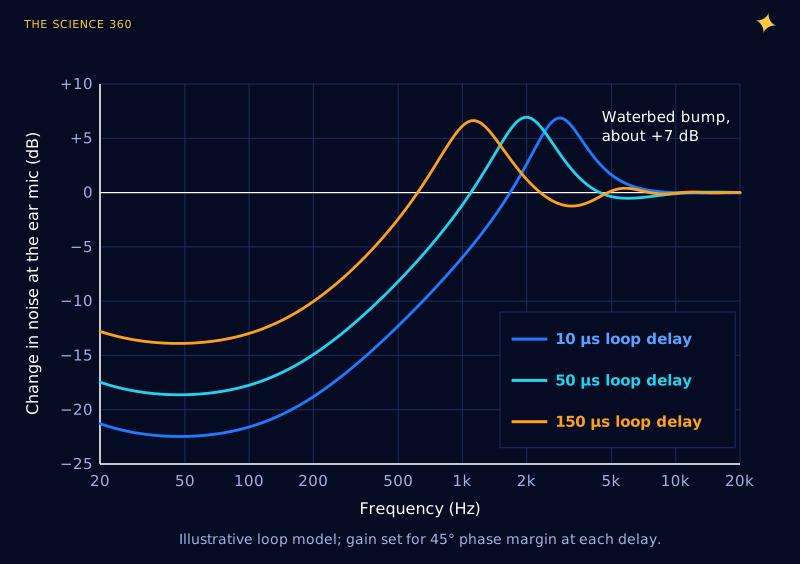
The model is deliberately simple, but its shape matches what Knowles reports for a real feedback design: more than 15 dB of cancellation around 200 Hz and amplification between 1 and 3 kHz. Most premium headphones use hybrid ANC, both microphones at once, so each can cover the other's weak region.
What blocks the high frequencies, then?
The ear cushion or the silicone tip. Passive isolation is the opposite of active cancellation: it is easy at high frequency and hard at low. A wall of mass m per unit area is pushed back and forth by the sound pressure. For a given pressure its acceleration is fixed, so its velocity, which is what re-radiates sound on the inside, falls as 1/(2πf m). The textbook "mass law" consequence is that transmission loss rises by about 6 dB for every doubling of frequency. To block 100 Hz as well as a thin cup blocks 3.2 kHz you would need a cup 32 times heavier.
Real noise cancelling headphones are therefore two filters glued together. The passive seal does most of the work above about 1 kHz, the electronics do most of the work below a few hundred hertz, and the hand-over region in between is where you hear the leftovers. A bad seal ruins both halves: low-frequency noise leaks around the gap and the feedforward model no longer matches reality. If your ANC suddenly seems weak, check the fit before blaming the firmware.
Why can’t ANC cancel the whole room?
Cancellation is a point property. At 1 kHz the wavelength is 34 cm, and Wikipedia's ANC article points out that an 800 Hz tone has a wavelength about twice the distance between your ears, so a sound arriving from one side can be cancelled at one ear and reinforced at the other. Inside a sealed ear cup, a few centimetres from the eardrum, the zone is small enough to control. In open space, high frequencies reflect and arrive from every direction, and no single speaker can match all of them at once. That is why active noise control in cars, ducts and aircraft cabins mostly targets low, tonal hum, like the 100 or 120 Hz hum of a transformer.
FAQ
How do noise cancelling headphones work?
A microphone measures the noise, electronics invert it, and the headphone driver plays the inverted copy so the two pressure waves add to nearly zero at your eardrum. The ear cushions block high frequencies passively. The electronic part only works where the anti-noise can be matched to within a few degrees of phase, which in practice means low frequencies.
Why don’t noise cancelling headphones block voices?
Much of what makes speech intelligible, the consonants, sits above 1 kHz, where a timing error of 25 microseconds is already a phase error of 9 degrees or more. Cancellation collapses quickly with phase error, so active cancellation fades out in the low kilohertz. Above that only the passive seal of the ear cups or tips is working, which is why voices and clatter get through.
What is the difference between feedforward and feedback ANC?
Feedforward ANC uses a microphone on the outside of the ear cup and predicts the noise that will leak inside. Feedback ANC uses a microphone inside, next to the driver, and corrects whatever it hears in a closed loop. Hybrid ANC uses both. Feedforward reaches higher frequencies, feedback copes with fit and leaks, and feedback always amplifies some band above its working range.
Is noise cancelling bad for your ears?
No. The anti-noise is a sound of similar level to the noise it replaces, so the total sound reaching your eardrum goes down, not up. The pressure-like feeling some people report is not a measured pressure change. Lower background noise also lets you listen at a lower volume, which helps protect hearing.
Why do noise cancelling headphones sometimes hiss?
The microphones and amplifiers have their own electronic noise, and the ANC filters play it into your ear along with the anti-noise. In a quiet room there is nothing for that small hiss to hide behind. Transparency modes are worse because they deliberately amplify the outside microphone signal.
Related on The Science 360
Sources
- N. Skovorodnikov (Knowles), "The Impact of Microphone Specifications on Active Noise Cancellation Performance", audioXpress, November 2023 (−10 dB target with 2 dB and 20° tolerances, 24 µs and 3 µs microphone latency, feedback above 15 dB near 200 Hz, amplification at 1 to 3 kHz): audioxpress.com
- H. Yu and C. Moulin (Dolphin Design), "Audio codec for TWS, part 3: optimizing latency key factor", Design & Reuse, 2021 (192 kHz converters, 6 to 8 µs I/O latency, feedforward 80 Hz to 2 kHz, feedback 50 Hz to 800 Hz): design-reuse.com
- Wikipedia, "Active noise control" (Lueg patent 1936, Meeker 1957 earmuff, late-1980s headsets, 800 Hz wavelength versus head size): en.wikipedia.org/wiki/Active_noise_control
- Wikipedia, "Speed of sound" (343 m/s in dry air at 20 °C): en.wikipedia.org/wiki/Speed_of_sound
- P. Benois, P. Nowak and U. Zölzer, "Fully digital implementation of a hybrid feedback structure for broadband active noise control in headphones", Institute of Acoustics proceedings (2.03 µs analog-to-analog latency, as quoted in the IOA search listing; the PDF link was offline when checked): ioa.org.uk
Method note: Figures 1 to 3 are exact phasor arithmetic. Figure 4 is an illustrative linear loop model I built to show the trade between delay, gain and the waterbed bump; it is not a model of any specific product. The 1.5 cm acoustic path in the latency budget is my own estimate.
Header image: NASA/Norah Moran (image jsc2021e022488), regraded for this article.