What is the escape velocity of each planet?
Escape velocity is 11.2 km/s from Earth's surface, 2.38 km/s from the Moon, 5.03 km/s from Mars and 59.5 km/s from Jupiter. From the Sun's surface it is 618 km/s, and from a neutron star about 57% of the speed of light. It depends only on the mass and the distance from the centre: v = √(2GM/r).
It is the speed a coasting object needs, not what a rocket must reach at lift-off. Why rockets do not need escape velocity explains that difference; the companion post compares every world, and the space travel time calculator shows how long the trips take.
Key results from the calculator
- Earth: 11.2 km/s to escape and 7.91 km/s to orbit at the surface; 10.9 km/s and 7.67 km/s at the space station's 400 km.
- Orbital speed is always escape speed ÷ √2, about 71% of it, at any height around any body.
- Small worlds are easy to leave: 2.38 km/s from the Moon and only 239 m/s from Saturn's moon Enceladus.
- Dead stars are extreme: 6,584 km/s from the white dwarf Sirius B and about 171,335 km/s from a neutron star.
Seven launches
Each example loads the body, the starting height and a sideways launch speed.
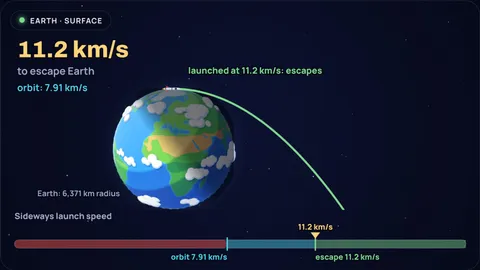
Leaving Earth from the surface
The textbook numberWith Earth's mean radius of 6,371 km and NASA's GM, escape velocity is 11.2 km/s, matching NASA's 11.186. Air resistance is ignored; at that speed in the lower atmosphere it would be enormous.
400 km up at 60% of escape speed
Falls backAt the height of the space station, 6.51 km/s sideways is below the 7.67 km/s needed for orbit. The path curves down and meets the surface.
400 km up at 71% of escape speed
Circular orbitJust above √½ of escape speed the rocket circles the Earth every 92 min, like the space station.
Leaving the Moon
Small worldThe Moon has 1.2% of Earth's mass, so escape needs only 2.38 km/s.
Leaving Jupiter
Largest planetFrom Jupiter's 1 bar cloud level, escape takes 59.5 km/s, 5.3 times Earth's.
Leaving the Sun
A starFrom the Sun's visible surface, 618 km/s. From Earth's distance it falls to about 42 km/s, which is why spacecraft leaving the solar system use planetary flybys.
Leaving a neutron star
Extreme gravityNICER measured PSR J0030+0451 at 1.44 solar masses in a 13 km radius. Escape takes about 171,335 km/s, 57.2% of light speed.
Escape and orbital speed at the surface
| Body | Escape | Orbit | Surface gravity | vs Earth |
|---|---|---|---|---|
| Mercury | 4.25 km/s | 3.01 km/s | 3.70 m/s² | 0.38 × |
| Venus | 10.4 km/s | 7.33 km/s | 8.87 m/s² | 0.93 × |
| Earth | 11.2 km/s | 7.91 km/s | 9.82 m/s² | 1.00 × |
| The Moon | 2.38 km/s | 1.68 km/s | 1.62 m/s² | 0.21 × |
| Mars | 5.03 km/s | 3.55 km/s | 3.73 m/s² | 0.45 × |
| Jupiter | 59.5 km/s | 42.1 km/s | 24.79 m/s² | 5.32 × |
| Saturn | 35.5 km/s | 25.1 km/s | 10.44 m/s² | 3.17 × |
| Uranus | 21.3 km/s | 15.1 km/s | 8.87 m/s² | 1.90 × |
| Neptune | 23.5 km/s | 16.6 km/s | 11.15 m/s² | 2.10 × |
| Pluto | 1.21 km/s | 856 m/s | 0.62 m/s² | 0.11 × |
| Io | 2.56 km/s | 1.81 km/s | 1.80 m/s² | 0.23 × |
| Europa | 2.03 km/s | 1.43 km/s | 1.32 m/s² | 0.18 × |
| Ganymede | 2.74 km/s | 1.94 km/s | 1.43 m/s² | 0.25 × |
| Titan | 2.64 km/s | 1.87 km/s | 1.35 m/s² | 0.24 × |
| Enceladus | 239 m/s | 169 m/s | 0.11 m/s² | 0.02 × |
| The Sun | 618 km/s | 437 km/s | 274.20 m/s² | 55.22 × |
Radius: volumetric mean for solid bodies and the Sun, 1 bar equatorial for the giant planets, as NASA uses for its escape velocities. Gravity ignores rotation. Speeds ignore air and the body's spin, which helps a launch toward the east.
How the calculator works
Escape velocity: a coasting object escapes when its kinetic energy ½mv² equals the energy needed to climb from distance r to infinity, GMm/r. Solving gives v = √(2GM/r). The mass m cancels, so it is the same for a pebble and a spaceship.
Orbital speed: a circular orbit needs gravity to supply exactly the centripetal force, GM/r² = v²/r, so v = √(GM/r), escape speed divided by √2.
Altitude: both use r, the distance from the centre: the radius plus the starting height.
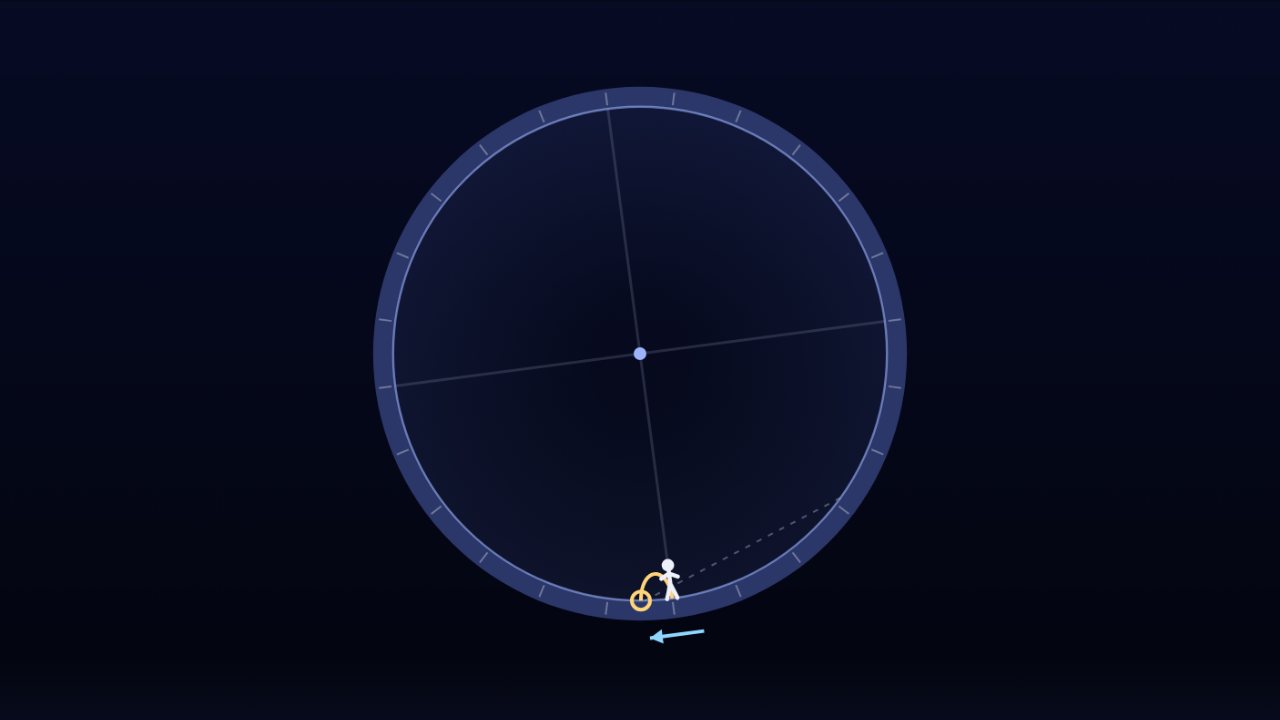
The launch drawing: the rocket fires sideways. Its path is a conic section: an ellipse that hits the surface, an ellipse that clears it, a parabola at exactly escape speed or a hyperbola above it.
What the model leaves out
- Air: drag would slow anything launched at these speeds in an atmosphere.
- Rotation: Earth's spin gives an eastward launch about 0.46 km/s at the equator.
- Other bodies: leaving Earth is not the same as leaving the Sun's pull; escaping the solar system from Earth's orbit needs about 42 km/s relative to the Sun.
- Relativity: for the neutron star the simple formula still gives the speed a local observer would measure, but distances and times are no longer Newtonian.
Common misconceptions
"Rockets must reach 11.2 km/s to leave Earth." A rocket that keeps burning can leave at any speed. Escape velocity is for something that has stopped pushing.
"Escape velocity means escaping gravity." Gravity never switches off; an escaping object slows forever but never quite stops or turns back.
"Heavier objects need more speed." The object's own mass cancels out. Only the body's mass and your distance from its centre matter.
Frequently asked questions
What is the escape velocity of Earth?
11.2 km/s from the surface, ignoring air, using NASA's GM and Earth's mean radius. From the space station's height it is 10.9 km/s.
Which planet has the highest escape velocity?
Jupiter, at 59.5 km/s from its cloud tops, then Saturn at 35.5 km/s. Mercury has the lowest of the planets, 4.25 km/s.
What is the escape velocity of the Moon?
2.38 km/s, about a fifth of Earth's.
How is orbital speed related to escape velocity?
At the same distance from the centre, circular orbital speed is escape velocity divided by √2, about 71% of it.
Does escape velocity depend on the mass of the rocket?
No. The rocket's mass appears on both sides of the energy balance and cancels. It depends only on the body's mass and the distance from its centre.
Keep learning
Escape Velocity of Every Planet Compared, Plus the Moon, Sun and a Neutron Star
Escape velocity is 11.2 km/s on Earth, 2.38 on the Moon, 5.03 on Mars and 59.5 on Jupiter. Every planet and the big moons compared, why size and density decide it, and what happens on dead stars.
Do Rockets Need to Reach Escape Velocity? No. Here's Why
Escape velocity is 11.2 km/s, but no rocket needs it to leave Earth. It is a coasting speed, not a launch requirement. The real cost is energy and delta-v.