What If Earth Became a Black Hole? (It Would Fit in Your Hand)
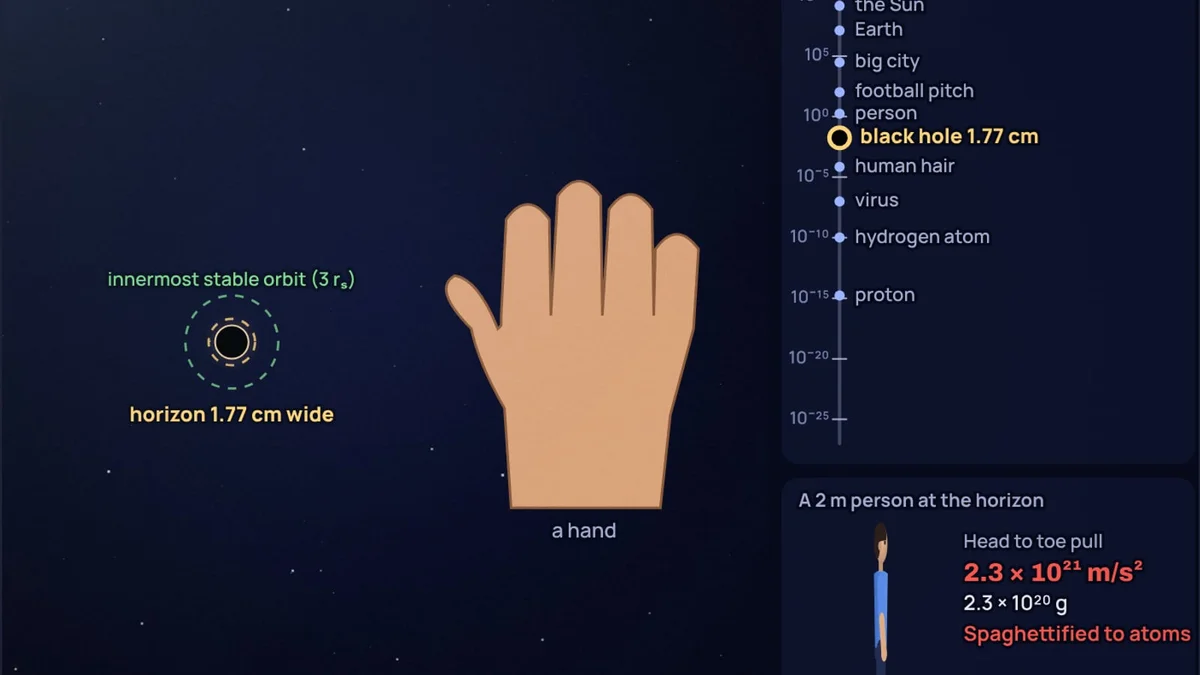
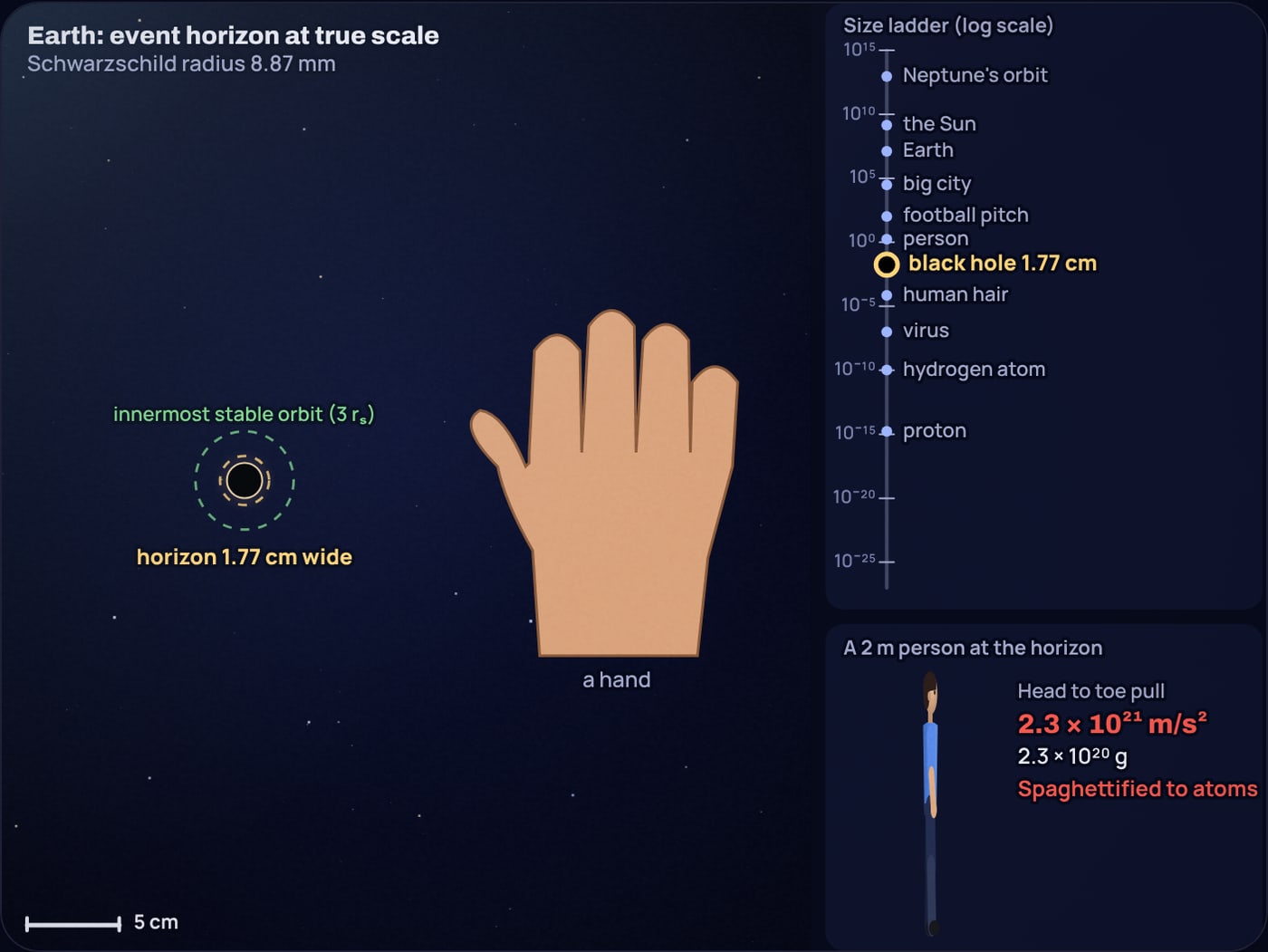
Take the whole Earth, all six thousand billion billion tonnes of rock, iron and ocean, and press it into a ball 1.77 cm across. That ball would be a black hole. You could hold it in the middle of your palm, at least on paper, and it would still pull the Moon round its orbit once every 27.3 days as if nothing had happened.
The number comes from one short formula, and you can try it for any mass in the Schwarzschild radius calculator. It draws the event horizon at true scale next to a hand, a marble, a city or a planetary orbit, and works out the density, the tidal stretch and how long the black hole would last.
How small would Earth be as a black hole?
A black hole is any mass packed inside its own Schwarzschild radius. Karl Schwarzschild found the solution to Einstein's equations for a single, non spinning mass in 1916, while serving on the Russian front, and the radius that falls out of it is
where is the gravitational constant, the mass and the speed of light. At that radius the escape speed reaches the speed of light, and inside it every path, even for light, leads further in. The sphere at is the event horizon.
Worked example: the Schwarzschild radius of Earth.
Twice that is a horizon 1.77 cm across. The factor is metres per kilogram, which is why ordinary masses make absurdly small black holes.
The radius is directly proportional to the mass. Double the mass and you double the radius. That one fact explains almost everything else on this page, including why huge black holes are gentle and tiny ones are violent.
How dense would an Earth black hole be?
Earth today has an average density of about 5,510 kg per cubic metre, five and a half times water. Squeeze the same mass into a sphere of radius 8.87 mm and the volume shrinks by a factor of , which is about .
Worked example: the average density inside the horizon.
That is about times the density of an atomic nucleus. A sugar cube of it would weigh kg, a third of the mass of Earth.
Put into the density formula and you get . The density falls as the square of the mass. That is the strangest result in this whole topic: the heavier the black hole, the less dense it is on average, and the biggest ones are thinner than air. More on that below.
Would the Moon fall in?
No, and this is the misconception worth clearing up first. A black hole does not suck. Outside a spherical mass, gravity depends only on how much mass there is and how far away you are. Newton proved this for ordinary spheres, and general relativity keeps it for a black hole once you are well outside the horizon.
The Moon is 384,400 km away. It would feel the same pull from a 1.77 cm black hole as it does from a 12,742 km planet, and it would carry on round its orbit every 27.3 days. Satellites would carry on too. A spacecraft at the distance where Earth’s surface used to be, 6,371 km from the centre, would feel the same 9.8 m/s² that you feel standing on the ground today; there would just be no ground.
What changes is how close you can get. Today you cannot get closer to Earth’s centre than its surface, because rock is in the way. Around the black hole you can keep going. At 1 metre from the centre the pull would be about 4 × 10¹⁴ m/s², forty trillion times normal gravity.
What would happen if you got close?
You would be stretched apart long before you reached the horizon. What tears things apart near a black hole is the difference in pull between one end of you and the other, the tidal acceleration. For a body of length pointing at a mass from distance , the difference is .
Worked example: the stretch on a 2 m person at Earth's horizon.
No material survives that. Atoms would be pulled apart, and the result would be a thin stream of particles spiralling in.
Physicists call this spaghettification. At the horizon itself the formula simplifies to , which again falls as the square of the mass. Small black holes are the dangerous ones. For a full account of the trip, including what your clock and an outside observer see, read what happens if you fall into a black hole.
How big are other black holes?
The same formula works for any mass. Here is what the calculator gives for the presets, from your own body up to the largest black hole ever imaged.
| Object | Mass | Horizon diameter | Average density | Stretch across 2 m |
|---|---|---|---|---|
| You | 70 kg | 2.1 × 10⁻²⁵ m | 1.5 × 10⁷⁶ kg/m³ | 1.7 × 10⁶⁶ g |
| The Moon | 7.3 × 10²² kg | 218 µm | 1.4 × 10³⁴ kg/m³ | 1.5 × 10²⁴ g |
| Earth | 6.0 × 10²⁴ kg | 1.77 cm | 2.0 × 10³⁰ kg/m³ | 2.3 × 10²⁰ g |
| Jupiter | 1.9 × 10²⁷ kg | 5.64 m | 2.0 × 10²⁵ kg/m³ | 2.3 × 10¹⁵ g |
| The Sun | 2.0 × 10³⁰ kg | 5.91 km | 1.8 × 10¹⁹ kg/m³ | 2.1 × 10⁹ g |
| Sagittarius A* | 4.3 million Suns | 0.17 AU | 998,000 kg/m³ | 1.1 × 10⁻⁴ g |
| M87* | 6.5 billion Suns | 257 AU | 0.44 kg/m³ | 5.0 × 10⁻¹¹ g |
The Moon would make a black hole the size of a grain of fine sand. Jupiter would make one about the height of a two storey house. The Sun would make one 5.91 km across, small enough to sit inside the centre of a city.
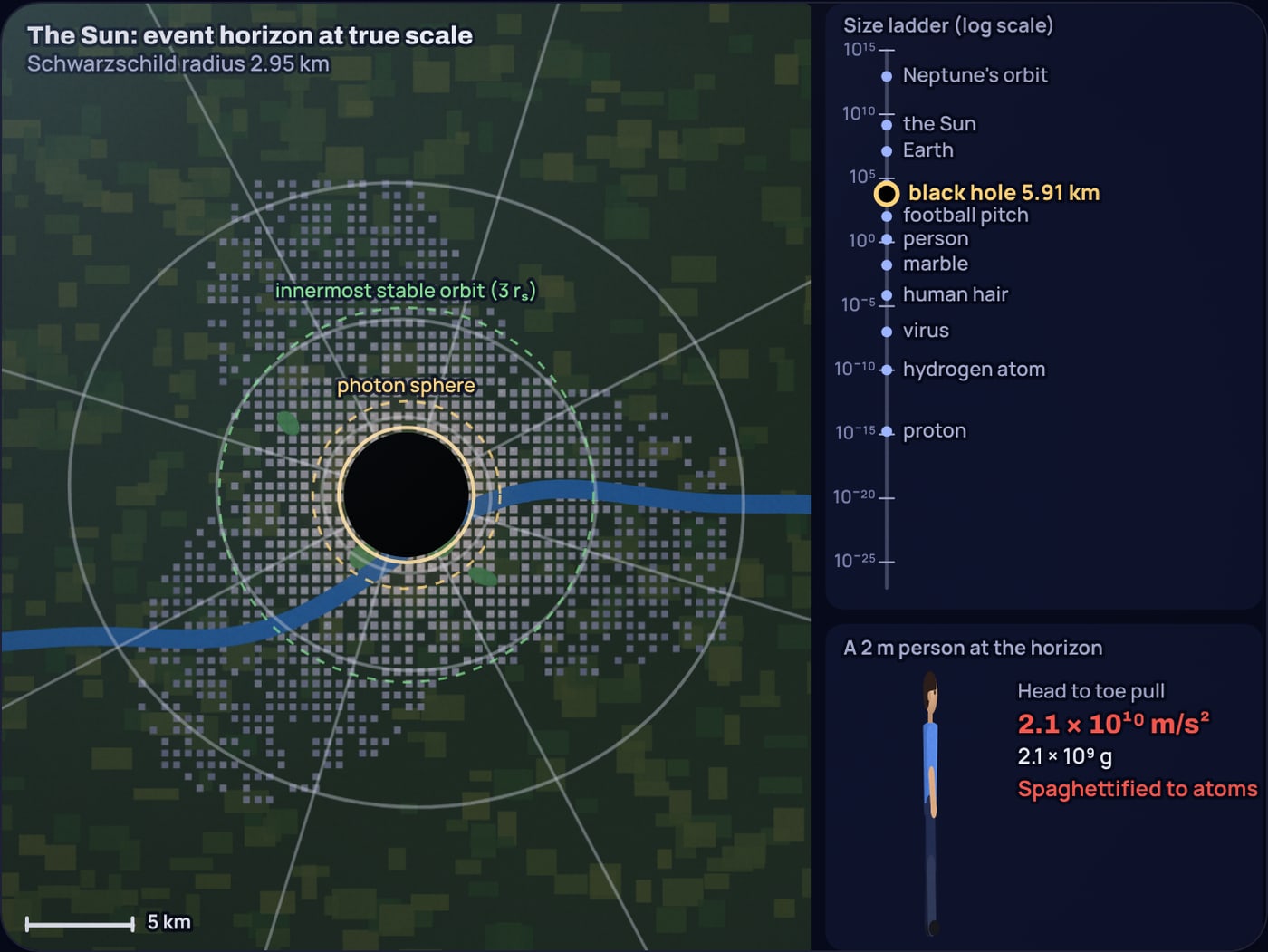
The Sun will never actually do this. A star needs roughly 20 or more times the Sun’s mass to leave a black hole when it dies; the Sun will end as a white dwarf about the size of Earth. To watch a star shrink step by step towards its horizon, try Squeeze a star, which follows the collapse through the white dwarf and neutron star stages.
The real giants: Sagittarius A* and M87*
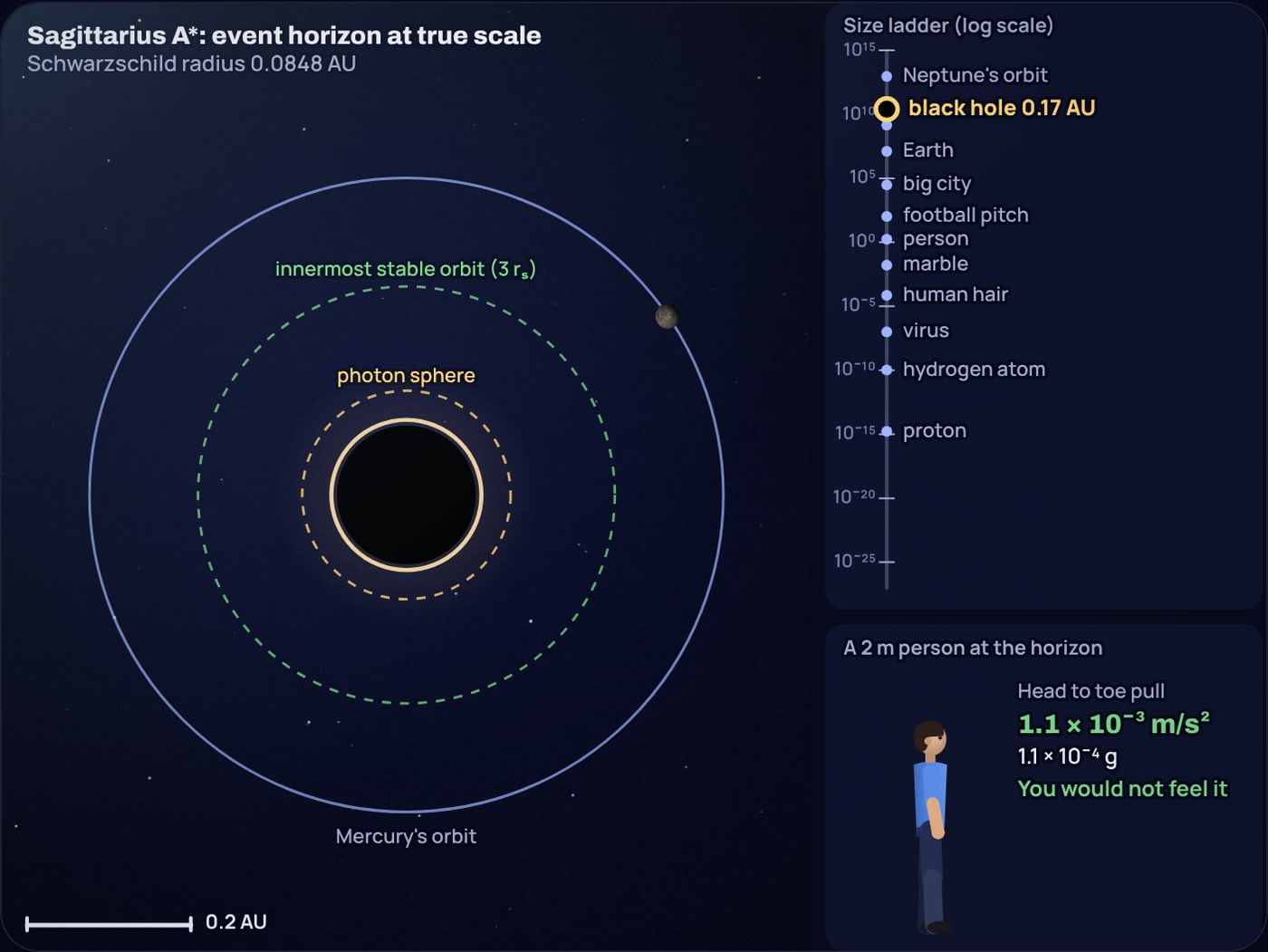
The black hole at the centre of our galaxy, Sagittarius A*, was weighed by watching stars orbit it for three decades. The GRAVITY collaboration’s 2023 analysis gives 4.297 million solar masses. Its Schwarzschild radius is 0.0848 AU, about 12.7 million km, around 18 times the radius of the Sun. Drawn to scale, the whole horizon sits well inside the orbit of Mercury.
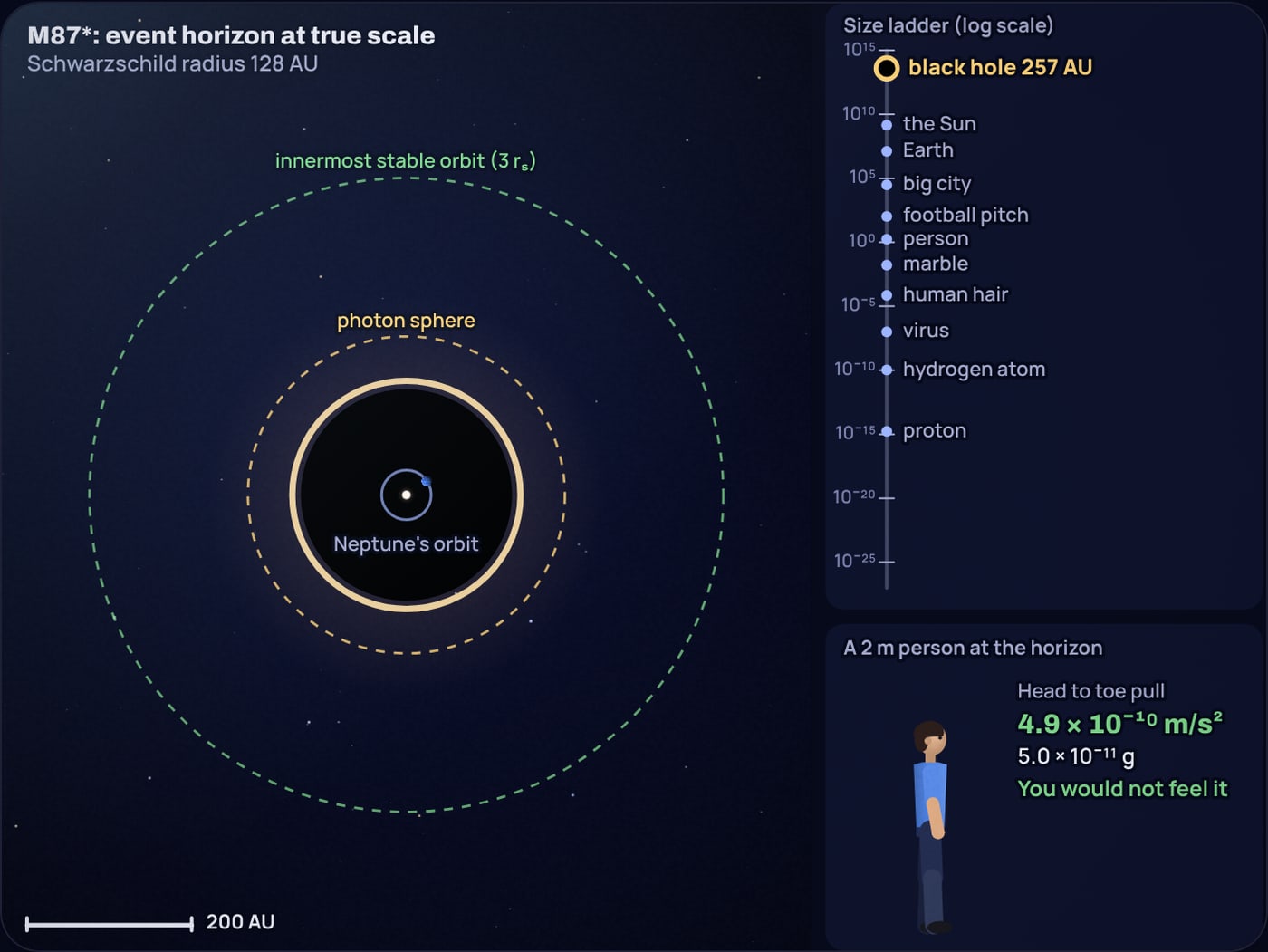
M87*, in a galaxy 55 million light years away, was the first black hole ever imaged. The Event Horizon Telescope team estimated 6.5 billion solar masses from the size of its shadow. That gives a horizon 257 AU across. The orbit of Neptune, 60 AU across, fits inside it with room to spare.
Why are big black holes gentle?
Because both the average density and the tidal stretch at the horizon fall as . M87* is about times heavier than Earth, so its horizon stretch is about times weaker. A person could cross the horizon of M87* without feeling anything at all. Its average density, 0.44 kg per cubic metre, is about a third of the density of the air at sea level.
That does not mean a black hole is a thin gas. “Average density” here is the mass divided by the volume of a sphere as wide as the horizon, a bookkeeping number from outside. Inside the horizon space and time are so curved that a ruler would not measure that volume. What makes something a black hole is not how dense it is but whether its mass sits inside its own Schwarzschild radius.
Would an Earth black hole evaporate?
Stephen Hawking showed in 1974 that quantum effects make a black hole glow faintly, with a temperature . For an Earth mass that is 0.0205 K. The universe is filled with the cosmic microwave background at 2.7 K, warmer than the black hole, so today an Earth black hole would absorb more than it gives off and grow very slowly. The break even mass is about kg, a little under the mass of the Moon.
On its own, with nothing to eat, an Earth mass black hole would take about 5.7 × 10⁵⁰ years to evaporate. The lifetime grows as the mass cubed, so a black hole made from you would be the opposite case: 2.1 × 10⁻²⁵ m across, about ten billion times smaller than a proton, with a temperature of 1.8 × 10²¹ K. It would be gone in 2.9 × 10⁻¹¹ seconds, releasing your whole mass as energy, 6.3 × 10¹⁸ J, about 1.5 gigatons of TNT.

Photon sphere, innermost orbit and what the picture leaves out
Two more rings appear in the simulator. At 1.5 times the Schwarzschild radius light can circle the black hole; this is the photon sphere, 13.3 mm from the centre for Earth. Inside 3 times the Schwarzschild radius no circular orbit is stable, so matter spirals in; this innermost stable circular orbit is 2.66 cm from the centre for Earth. Gas discs around real black holes end there.
Real black holes spin, and spin shrinks the horizon, down to half the Schwarzschild radius for the fastest possible spin, and pulls the innermost orbit closer. Sagittarius A* and M87* probably spin, so the numbers here are the standard non spinning values, good to a factor of two. The dark shadow in the Event Horizon Telescope images is also larger than the horizon, about 2.6 times its diameter, because light bends around the photon sphere on its way to us.
Could Earth ever become a black hole?
No. Nothing in nature can squeeze a planet that hard. Ordinary matter resists compression, and even the pressure from a dying star’s own weight only wins above a few solar masses. Below that, matter settles as a white dwarf or a neutron star. Earth will end, billions of years from now, as a cold rock or as part of the Sun’s red giant envelope, not as a marble sized black hole.
The thought experiment is still the best way to see what a black hole is: not a cosmic vacuum cleaner, but ordinary gravity from an ordinary mass, packed so tight that the escape speed at its surface reaches the speed of light. To try your own masses, open the Schwarzschild radius calculator and drag the slider from 70 kg to 6.5 billion Suns.
Sources
- GRAVITY Collaboration (2023), the mass of Sgr A* from stellar orbits and flares, 4.297 million solar masses, arXiv:2311.09484
- Event Horizon Telescope Collaboration (2019), First M87 Event Horizon Telescope Results. VI. The Shadow and Mass of the Central Black Hole, arXiv:1906.11243
- NIST CODATA value of the Newtonian constant of gravitation
- IAU 2015 Resolution B3 on nominal solar and planetary conversion constants
- Hawking (1974), Black hole explosions?, Nature 248, 30
Frequently asked questions
How big would Earth be as a black hole?
Earth’s Schwarzschild radius is 8.87 mm, so its event horizon would be 1.77 cm across, about the size of a marble. All 5.97 times 10 to the 24 kg of the planet would be inside it.
Would the Moon fall into an Earth black hole?
No. From outside, gravity depends only on the mass and the distance. The Moon would feel exactly the same pull at 384,000 km and would keep the same 27.3 day orbit around a 1.77 cm black hole.
How dense would Earth be as a black hole?
The average density inside the horizon would be about 2.0 times 10 to the 30 kg per cubic metre, roughly 3.7 times 10 to the 26 times denser than Earth is today.
Would an Earth mass black hole evaporate?
Not today. Its Hawking temperature is 0.02 K, colder than the 2.7 K cosmic background, so it absorbs more radiation than it emits and slowly grows. On its own it would last about 5.7 times 10 to the 50 years.
How do you calculate the Schwarzschild radius?
Use r = 2GM/c squared. With G = 6.674 times 10 to the minus 11 and c = 299,792,458 m/s, that is 1.485 times 10 to the minus 27 metres per kilogram, or about 2.95 km per solar mass.
 Why the 2027 Solar Eclipse Lasts 6 Minutes 23 Seconds
 How We Know 3I/ATLAS Is Interstellar: Orbit Math