How big is a black hole of a given mass?
The event horizon of a non-spinning black hole has radius r = 2GM/c², which works out to about 3 km for every solar mass, or about 8.87 mm for the mass of Earth. Squeeze Earth that small and it becomes a black hole 1.77 cm across: it would sit inside your closed fist. The radius grows in direct proportion to the mass, so ten times the mass gives ten times the size.
That radius is called the Schwarzschild radius, after Karl Schwarzschild, who found the solution in 1916. The calculator works it out for any mass and draws the horizon at true scale next to the nearest everyday object, from a proton to the orbit of Neptune. It also gives the average density inside the horizon, how hard the horizon would stretch a 2 metre person, and how long the black hole would take to evaporate. If you want to watch a real star shrink towards its horizon, try Squeeze a star; for what the trip in would feel like, read what happens if you fall into a black hole.
Key results from the simulation
- Size grows with mass. You (70 kg): 2.1 × 10⁻²⁵ m across. The Moon: 218 µm, a grain of sand. Earth: 1.77 cm, a marble. Jupiter: 5.64 m. The Sun: 5.91 km, smaller than a city.
- The real giants. Sagittarius A*, at the centre of our galaxy (4.3 million Suns), has a horizon 0.17 AU across, well inside the orbit of Mercury. M87* (6.5 billion Suns) is 257 AU across, 4.3 times the radius of Neptune's orbit.
- Density falls as the mass grows. The average density inside the horizon goes as 1/M². An Earth mass black hole averages 2.0 × 10³⁰ kg/m³; M87* averages only 0.436 kg/m³, thinner than the air you breathe.
- Small black holes shred you; big ones do not. At the horizon of a Sun mass black hole the head to toe pull on a 2 m body is 2.1 × 10⁹ g. At Sagittarius A* it is 1.1 × 10⁻⁴ g, too small to notice.
Six black holes worth making
Each button sets the mass and picks a comparison object of similar size. All black holes here are Schwarzschild black holes: no spin and no charge. Change the "Compare with" menu to set any object beside any mass.
What if Earth became a black hole?
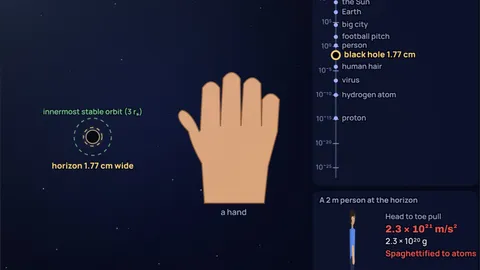
Mass 5.97 × 10²⁴ kg · horizon 1.77 cmAll six thousand billion billion tonnes of Earth would fit inside a sphere 1.77 cm across, about the size of a marble or a large grape. Hold out your hand and the horizon would sit in the middle of your palm, though you would not want it there.
The Moon would carry on orbiting exactly as before, because from outside the gravity of a mass depends only on the mass and the distance. What changes is how close you can get. At the horizon the tidal stretch across a 2 m body is 2.3 × 10²⁰ g, enough to pull atoms apart long before you reached it.
The Sun as a black hole: a horizon smaller than a city
Mass 1.99 × 10³⁰ kg · horizon 5.91 kmThe Sun's Schwarzschild radius is 2.95 km. The simulation lays the horizon over a 30 km map of a made-up city: the whole Sun would fit inside the downtown, with the photon sphere at 4.43 km and the innermost stable orbit at 8.86 km.
The Sun will never actually do this. Stars need roughly 20 or more solar masses to leave a black hole when they die; the Sun will end as a white dwarf about the size of Earth.
You as a black hole
Mass 70 kg · horizon 2.1 × 10⁻²⁵ mA 70 kg person would need to be squeezed to 2.1 × 10⁻²⁵ m across, about ten billion times smaller than a proton. Nothing in nature can do that, and the result would not last: a black hole this small is fiercely hot (1.8 × 10²¹ K) and would evaporate by Hawking radiation in 2.9 × 10⁻¹¹ s, releasing the energy of your whole mass, about 6.3 × 10¹⁸ J, in a flash.
Sagittarius A*: the black hole at the centre of the Milky Way
4.3 million Suns · horizon 0.17 AUThe mass comes from watching stars orbit it for decades: the GRAVITY team measured 4.297 million solar masses. The Schwarzschild radius is 0.0848 AU, about 12.7 million km, so the horizon would fit well inside the orbit of Mercury.
Average density inside the horizon is 998,000 kg/m³, about 90 times the density of lead, and the tidal pull across your body at the horizon is 1.1 × 10⁻³ m/s². You could cross it without feeling a thing, which is why big black holes are the gentle ones.
M87*: a horizon bigger than the solar system
6.5 billion Suns · horizon 257 AUM87* was the first black hole ever imaged, by the Event Horizon Telescope in 2019, which measured 6.5 billion solar masses. Its horizon is 257 AU across. Drawn to scale, the orbit of Neptune sits inside the black disc with room to spare.
The average density inside the horizon is only 0.436 kg/m³, less than a third of the density of air at sea level. A black hole is not "dense stuff"; it is a region where the mass is far too close to its own centre for light to get out.
Jupiter as a black hole: about the height of three people
318 Earths · horizon 5.64 mJupiter is 318 times the mass of Earth, so its horizon is 318 times bigger: 5.64 m, about the height of a two storey house. The simulation stands a person beside it for scale.
Even this one would tear you apart before you reached it: the pull across your body at the horizon is 2.3 × 10¹⁵ g.
Schwarzschild radius, density, tidal pull and lifetime by mass
| Object | Mass (kg) | Radius | Density (kg/m³) | Pull (g) | Lifetime (yr) |
|---|---|---|---|---|---|
| You | 70 | 1.0 × 10⁻²⁵ m | 1.5 × 10⁷⁶ | 1.7 × 10⁶⁶ | 9.1 × 10⁻¹⁹ |
| The Moon | 7.3 × 10²² | 109 µm | 1.4 × 10³⁴ | 1.5 × 10²⁴ | 1.1 × 10⁴⁵ |
| Earth | 6.0 × 10²⁴ | 8.87 mm | 2.0 × 10³⁰ | 2.3 × 10²⁰ | 5.7 × 10⁵⁰ |
| Jupiter | 1.9 × 10²⁷ | 2.82 m | 2.0 × 10²⁵ | 2.3 × 10¹⁵ | 1.8 × 10⁵⁸ |
| The Sun | 2.0 × 10³⁰ | 2.95 km | 1.8 × 10¹⁹ | 2.1 × 10⁹ | 2.1 × 10⁶⁷ |
| Sagittarius A* | 8.5 × 10³⁶ | 0.0848 AU | 998,000 | 1.1 × 10⁻⁴ | 1.7 × 10⁸⁷ |
| M87* | 1.3 × 10⁴⁰ | 128 AU | 0.436 | 5.0 × 10⁻¹¹ | 5.8 × 10⁹⁶ |
Radius r = 2GM/c² with G = 6.6743 × 10⁻¹¹ m³ kg⁻¹ s⁻² and c = 299,792,458 m/s. Density is the mass divided by the volume of a sphere of that radius. The pull is the difference in gravity between head and feet, 2GML/r³ with L = 2 m, in units of g = 9.81 m/s². Lifetime is the Hawking evaporation time 5120πG²M³/(ħc⁴), ignoring anything the black hole swallows. The age of the universe is about 1.4 × 10¹⁰ years.
How the simulation works
Radius. For a black hole with no spin and no charge, the event horizon is a sphere of radius r = 2GM/c². Nothing, not even light, can climb back out from inside it. The radius is directly proportional to the mass.
True scale picture. The left panel draws the horizon and the chosen object with the same metres per pixel, with a scale bar. For orbits, cities and planets the object is drawn behind or around the black hole; for small things it sits beside it. When the horizon is too small to draw, the panel says how many times smaller it is.
Photon sphere and innermost stable orbit. At 1.5 times the horizon radius light can orbit the black hole (the photon sphere). Inside 3 times the horizon radius no stable circular orbit exists for matter, so a disc of gas ends there. These dashed rings are drawn when they fit.
Size ladder. A logarithmic ladder from 10⁻²⁷ m to 10¹⁵ m places the horizon among protons, atoms, people, cities and orbits.
Tidal stretch. The difference in pull between your head and your feet, 2GML/r³, evaluated at the horizon. At the horizon this equals c⁶L/(4G²M²), so it falls as 1/M²: small black holes stretch hardest.
Density and lifetime. Average density is M divided by (4/3)πr³, which goes as 1/M². Hawking temperature is ħc³/(8πGMk) and the evaporation time 5120πG²M³/(ħc⁴), which goes as M³.
What the model leaves out
- Spin. Real black holes spin. A fast spinning one has a smaller horizon (down to half the Schwarzschild radius) and a closer innermost orbit. Both Sagittarius A* and M87* probably spin, but the radius here is the standard non-spinning value.
- The shadow. The dark patch the Event Horizon Telescope imaged is bigger than the horizon: about 2.6 times its diameter, because light bends around the photon sphere.
- How to make one. Nothing can squeeze Earth or you to these sizes. Black holes form when massive stars collapse or when gas piles up in galaxy centres.
- Space inside. Inside the horizon space and time are strongly curved, so "radius" and "density" are bookkeeping numbers from the outside, not a ruler measurement.
- Feeding. Real black holes swallow gas and the cosmic background radiation, so any black hole heavier than about the Moon is currently growing, not evaporating.
Common misconceptions
"A black hole sucks everything in." From far away a black hole pulls exactly like any other object of the same mass. If the Sun became a black hole, Earth would keep the same orbit, in the dark.
"Black holes are infinitely dense." The average density inside the horizon falls as 1/M², and for the biggest black holes it is less than that of air.
"You would be spaghettified at any black hole." Only small ones. At the horizon of Sagittarius A* the stretch across your body is about a ten thousandth of g.
Frequently asked questions
How do you calculate the Schwarzschild radius?
Multiply the mass by 2G/c², which is 1.485 × 10⁻²⁷ metres per kilogram. For the Sun (1.989 × 10³⁰ kg) that gives 2.95 km; for Earth (5.972 × 10²⁴ kg) it gives 8.87 mm.
How small would Earth be as a black hole?
Earth would have a Schwarzschild radius of 8.87 mm, so its horizon would be 1.77 cm across, about the size of a marble. It would keep the same mass and the Moon would keep orbiting it.
How big is the Sun as a black hole?
The Sun's Schwarzschild radius is 2.95 km, so the horizon would be 5.91 km across, small enough to fit inside a city.
How big is Sagittarius A*?
With 4.297 million solar masses, its Schwarzschild radius is about 12.7 million km (0.0848 AU), well inside the orbit of Mercury.
Would you be spaghettified at the event horizon?
It depends on the mass. At a Sun mass black hole the stretch across your body would be 2.1 × 10⁹ g at the horizon. At Sagittarius A* it is 1.1 × 10⁻⁴ g, so you would cross without noticing.
How long does a black hole last?
By Hawking radiation the lifetime grows as the mass cubed. A Sun mass black hole would last about 2.1 × 10⁶⁷ years. A 70 kg black hole would be gone in 2.9 × 10⁻¹¹ s.
Keep learning
What If Earth Became a Black Hole? (It Would Fit in Your Hand)
Squeeze Earth into a black hole and its event horizon is 1.77 cm across, the size of a marble. The Schwarzschild radius maths, density, tides and the Moon.
What Happens If You Fall Into a Black Hole? The Real Numbers
At a stellar black hole's horizon the stretch is 21 million g. At Sgr A* it is 0.0001 g. Tidal math, your clock and what outsiders see, worked out.
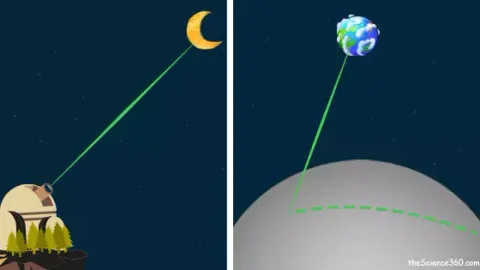
Why Was the Name Black Hole Given?
Ever wondered why the term "black hole" was chosen to describe these fascinating cosmic phenomena? This article delves...
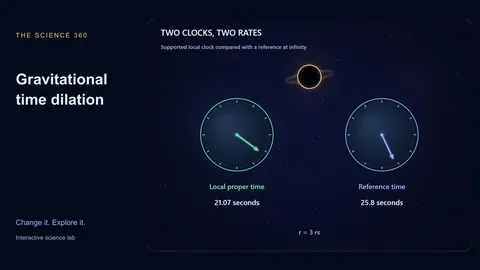
Black hole time dilation: compare two clocks without the movie shortcuts
Work through supported-clock time dilation outside a nonrotating black hole, and distinguish clock rates from orbits and delayed light signals.
How Much Does a Teaspoon of Neutron Star Weigh?
A 5 mL teaspoon of average neutron star weighs about 1.9 billion tonnes, not the 10 million often quoted. The density math, and what it would do on Earth.