Black hole time dilation: compare two clocks without the movie shortcuts
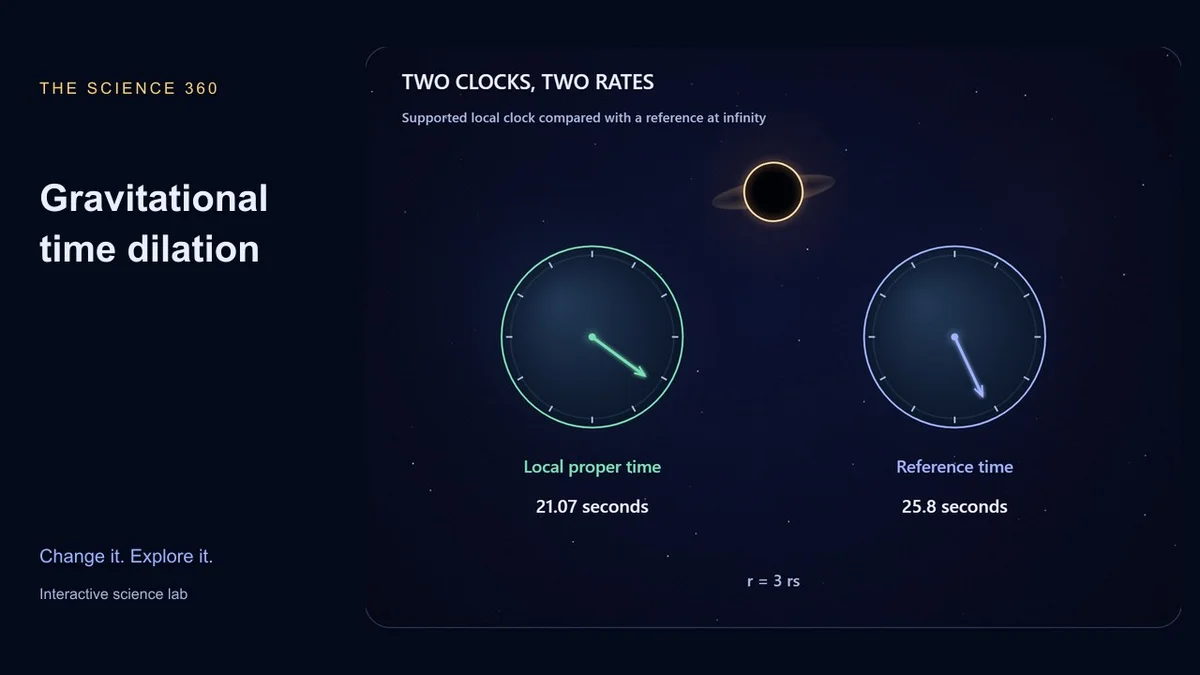
Two clocks can accumulate different amounts of time because they occupy different gravitational environments. Near a nonrotating black hole, a clock held at a fixed radius ticks more slowly than an ideal reference clock infinitely far away.
The gravitational time dilation simulator isolates that comparison. “Held at a fixed radius” matters: the local clock is supported, not orbiting or freely falling.
Start with a radius measured in horizons
The Schwarzschild radius is rs = 2GM/c². For ten solar masses it is about 29.53 km. It scales directly with mass, so a hundred-solar-mass black hole has ten times that horizon radius.
Outside the horizon, the supported-clock ratio is:
local proper time / reference time = √(1 − rs/r)
Select r = 3rs. The ratio becomes √(2/3), or about 0.8165. During 60 reference seconds, the local clock accumulates about 48.99 seconds. Conversely, one local hour corresponds to about 1.225 hours on the distant reference clock. Those are two ways of describing the same ratio.
What happens closer in?
Load the 1.01rs preset. The ratio is about 0.0995, so one local hour corresponds to about 10.05 reference hours. The formula approaches zero as the supported clock approaches the horizon, but an observer cannot hover exactly on the horizon. The acceleration needed to remain static grows without bound in that limit.
The local observer still experiences an ordinary second per second on their own clock. Time dilation is a statement about comparisons between clocks, not an experience of watching one’s own thoughts slow down.
Separate mass from the dimensionless ratio
At r = 3rs, change the black hole mass. The physical radius changes, but rs/r remains one third, so the clock ratio stays the same. This is a useful check on what the equation actually depends on.
It does not imply every environmental hazard is unchanged. Tidal gradients and the acceleration required for support involve additional dimensional quantities. This lab reports a clock-rate comparison rather than a survivable travel plan.
A clock comparison is not a telescope image
Light takes time to travel, and signals climbing out are gravitationally redshifted. A distant telescope’s view also depends on how signals propagate and how the source moves. The animated clocks do not ray-trace those signals; they show accumulated local proper time and the reference coordinate time.
Likewise, a rapidly spinning black hole and an orbiting planet require different equations. The Interstellar scenario is not recreated by placing this static clock very close to a Schwarzschild horizon.
Pause at a chosen playback position and calculate the local elapsed time yourself. Then compare with the twin paradox simulation, where the source of the clock difference is a different journey through spacetime.
Sources and further reading
 5 amazing physics experiment for your kids
 50 Hilarious Physics Jokes That Will Make You Laugh