How slowly does a supported clock tick near a black hole?
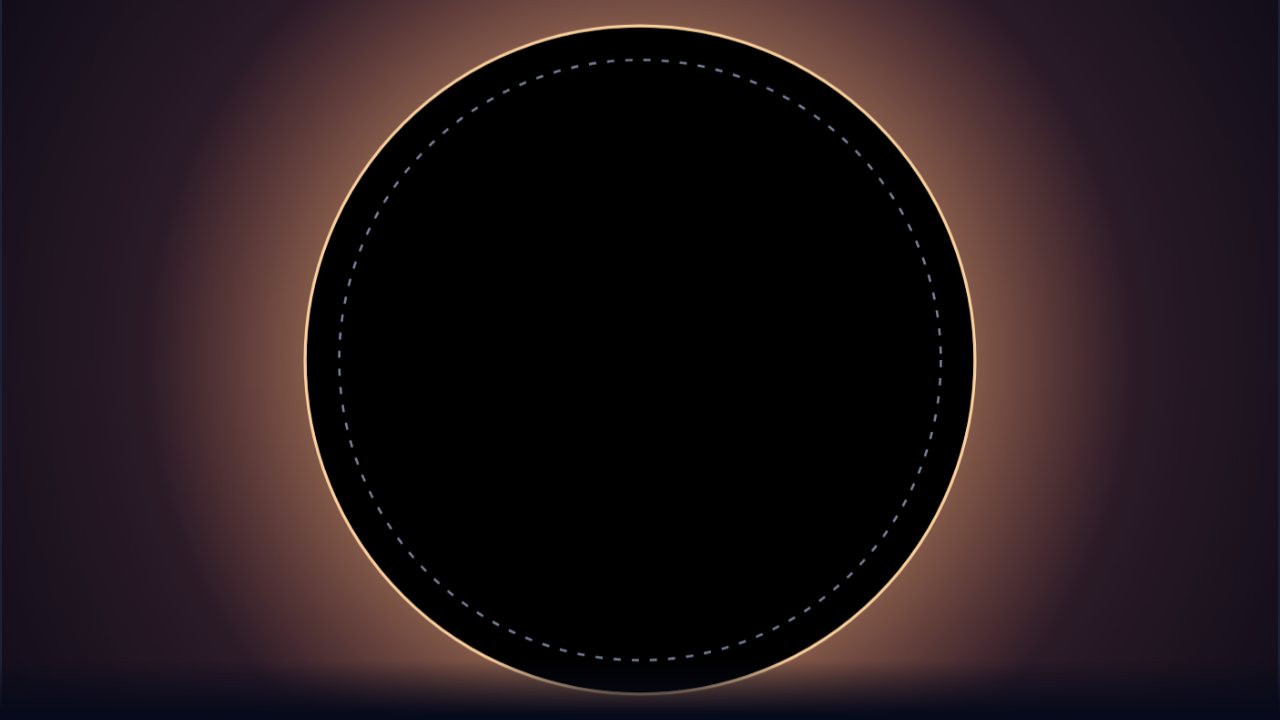
A supported clock outside a spherical, nonrotating black hole ticks more slowly than an ideal clock at infinity. Its rate is √(1 − rs/r), where rs is the Schwarzschild radius.
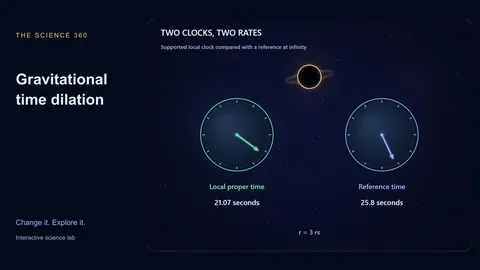
The two animated clocks compare accumulated proper time locally with Schwarzschild coordinate time at infinity. They do not show the visual delay of light signals sent to a telescope. Playback time is accelerated for illustration.
Read the companion article for a worked investigation, or continue with twin paradox.
What to look for
- At r = 3rs the supported clock runs at about 0.8165 of the reference rate.
- At r = 1.01rs one local hour corresponds to about 10.05 reference hours.
- Holding r/rs fixed holds the time ratio fixed, even when the mass changes.
Experiments to try
Load a complete preset, predict what will change, then adjust one control and compare the live measurements.
Three horizon radii
Guided experimentA supported clock at three Schwarzschild radii ticks at √(2/3), about 81.65% of the distant reference rate. If one hour passes locally, about 1.225 hours pass at infinity.
Near the horizon
Guided experimentAt 1.01 Schwarzschild radii the supported-clock factor is about 10.05. Hovering this close would require enormous acceleration. This is a mathematical clock comparison, not a viable orbit or travel recommendation.
Larger black hole
Guided experimentAt the same radius expressed in Schwarzschild units, changing mass changes the physical distance but leaves the clock ratio unchanged. The model helps separate dimensional size from the dimensionless strength of this comparison.
Compare the cases
| Supported clock radius | Local rate | Distant hours per local hour |
|---|---|---|
| 20 rs | 0.9747 | 1.0260 |
| 3 rs | 0.8165 | 1.2247 |
| 1.01 rs | 0.0995 | 10.0499 |
Rounded values and classifications refer to the model and assumptions on this page.
How the model works
The selected mass sets the physical horizon radius. The slider then sets r/rs, always strictly greater than one, so the supported-clock expression remains real and finite.
The same ratio gives a photon’s gravitational redshift from the local supported emitter to infinity: z = 1/rate − 1. Orbital motion would introduce additional time dilation and is not included.
What the model leaves out
- Supported, static clocks only; no orbiting or freely falling observer.
- No black-hole spin, frame dragging, accretion disk or light-propagation delay.
- The Interstellar seven-years-per-hour scenario is not reproduced by this Schwarzschild model.
Common misconceptions
The local observer does not feel their own seconds slowing down. Each clock measures ordinary proper time locally; the difference appears when comparing clocks at different gravitational potentials.
Frequently asked questions
Can this model Miller’s planet in Interstellar?
No. That scenario involves a rapidly spinning Kerr black hole and orbital motion. This simulation uses supported clocks outside a nonrotating black hole.
Can the clock sit on the horizon?
No static supported observer exists at the horizon. The slider stops outside it, and the required support acceleration grows without bound toward it.
Keep learning
Black hole time dilation: compare two clocks without the movie shortcuts
Work through supported-clock time dilation outside a nonrotating black hole, and distinguish clock rates from orbits and delayed light signals.