What is the twin paradox, and why is the traveller younger?
In the twin paradox, one twin makes a round trip to a distant star at a large fraction of the speed of light and comes back younger than the twin who stayed home. It is not a contradiction, because the twins are not in the same situation: the traveller has to turn round, so they change inertial frames, and the home twin never does. The traveller's path through spacetime is the shorter one, and a clock records the length of its own path. The calculator above works out both ages for any speed from 0.5c up and for five destinations, from Alpha Centauri to the Andromeda galaxy.
For example, a round trip to Alpha Centauri (4.37 ly away) at 0.900c takes the home twin 9.71 yr, while the traveller's clock shows only 4.23 yr, because γ = 2.29. For the physics behind it read the physics of time dilation; for a real-world test of the same effect see our muon paradox simulation.
Key results from the calculator
- The formula: the home twin ages T = 2d ÷ v. The traveller ages T ÷ γ, where γ = 1 ÷ √(1 − v²/c²). At 0.900c, γ = 2.29.
- Speed is what matters: to Alpha Centauri and back, 0.5c leaves a gap of only 2.34 yr, while 0.99c leaves the traveller's clock at 1.25 yr against 8.83 yr at home.
- Distance multiplies it: the same γ over a longer trip gives a larger gap. At 0.9999c a trip to Vega (25 ly) takes 50.0 yr at home and 0.71 yr for the traveller.
- The turnaround is the key: in the outbound frame the home clock runs slow, and so it does in the inbound frame. The missing time appears when the traveller changes frame, a jump of 2βd (7.87 yr for the first example).
Six trips, one formula
Each section gives the numbers the calculator shows for that trip and has a button that loads the speed and the destination into the simulation above. The slider uses log₁₀ of γ so each extra "nine" in the speed gets a comparable stretch of track.
Alpha Centauri at half the speed of light
Time dilation is real but modestAlpha Centauri is 4.37 ly away, so at 0.5c the round trip takes the home twin about 17.5 yr. With γ = 1.15 the traveller's clock shows 15.1 yr, so they come back 2.34 yr younger.
That is a small but unmistakable difference. Half the speed of light is fantastically beyond any spacecraft today (the fastest probes manage about 0.06% of c), but it already sits in the regime where the formula bites.
Alpha Centauri at 0.9c, and the paradox resolved
Why the symmetric argument failsAt 0.9c, γ = 2.29: the home twin waits 9.71 yr and the traveller's clock shows 4.23 yr. The "paradox" says: from the traveller's view, the home twin is the one moving, so their clock should run slow, not the traveller's. The catch is that the traveller does not stay in one frame. Switch the simulation to "The turnaround" to see why.
Before the turnaround, the outbound traveller judges that home has aged 0.92 yr. After the turn, the inbound frame has a different idea of which events at home are "simultaneous" with the turnaround. Between the two, the traveller's "now" at home jumps by 2βd = 7.87 yr. Add up 0.92 yr + 7.87 yr + 0.92 yr and you get the home twin's 9.71 yr, in agreement with everyone. A good companion read is the arrow of time paradox.
Sirius at 0.99c
More than a decade lostSirius is 8.6 ly away. At 0.990c, γ = 7.09, so the home twin waits 17.4 yr and the traveller's clock shows 2.45 yr. The traveller comes back 14.9 yr younger.
In the traveller's own frame the 8.6 ly to Sirius is contracted to 1.21 ly, which is why the trip is so short for them. Sirius is also the brightest star in our night sky, so this is a trip with a good view. For the other things people say can beat light, read the top things that can travel faster than light.
Tau Ceti at 0.999c
A decade for the traveller, two for homeTau Ceti is 11.9 ly away. At 0.999c, γ = 22.4: the home twin waits 23.8 yr while the traveller's clock shows 1.07 yr. The one-way trip is only 0.53 ly long in the traveller's frame.
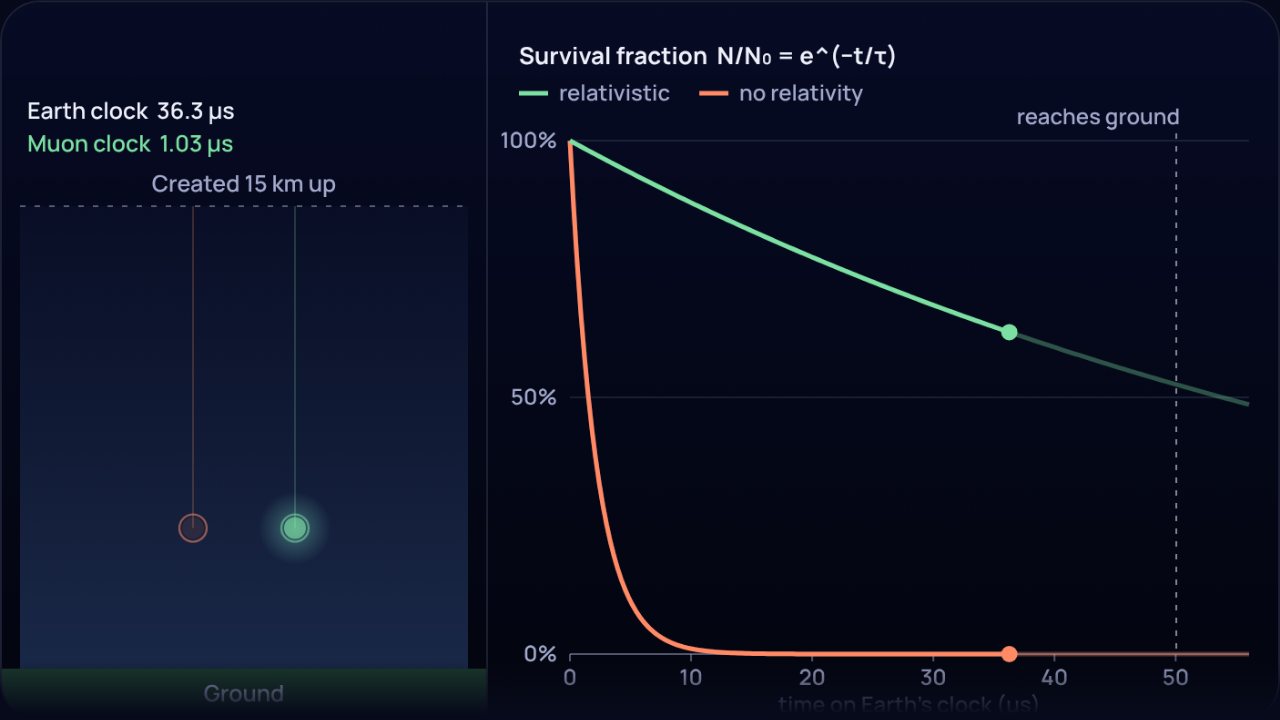
The cost is energy. A 1,000 kg ship at this γ needs a kinetic energy of (γ − 1)mc², about 1.9 × 10²¹ joules, roughly 3 times humanity's annual energy use (about 6 × 10²⁰ joules), even before you try to stop and turn round. Particles do reach these values of γ: the muons in the muon paradox have γ in the same range.
Vega at 0.9999c
Months for the travellerVega is 25 ly away. At 0.9999c, γ = 70.7: the home twin waits 50.0 yr and the traveller's clock shows 0.71 yr, about 8 months. The gap is 49.3 yr.
The speed is only a hair below that of light, yet the traveller feels nothing odd on board: their clocks, heartbeat and meals all run normally in their own frame. The effect is only visible when you compare clocks at the end. Because the speed cannot reach c, the traveller's time never reaches zero, however large γ gets.
Andromeda at γ = 1,000
An extreme caseThe Andromeda galaxy is about 2.5 million ly away. At γ = 1,000 (0.999999c) the home twin's wait is 5.00 million yr, while the traveller's clock shows 5,000 yr for the round trip. The trip is still far longer than a human life.
To make the round trip fit into a human lifetime, of say 80 years, γ would have to be about 62,500. For comparison, the protons in the Large Hadron Collider have γ of about 7,000. That is the territory of cosmic-ray particles, not of anything that could carry people.
All six trips side by side
| Trip | Speed | γ | Home twin | Traveller | Younger by |
|---|---|---|---|---|---|
| Alpha Centauri (4.37 ly) | 0.500c | 1.15 | 17.5 yr | 15.1 yr | 2.34 yr |
| Alpha Centauri (4.37 ly) | 0.900c | 2.29 | 9.71 yr | 4.23 yr | 5.48 yr |
| Sirius (8.6 ly) | 0.990c | 7.09 | 17.4 yr | 2.45 yr | 14.9 yr |
| Tau Ceti (11.9 ly) | 0.999c | 22.4 | 23.8 yr | 1.07 yr | 22.8 yr |
| Vega (25 ly) | 0.9999c | 70.7 | 50.0 yr | 0.71 yr | 49.3 yr |
| Andromeda (2.5 million ly) | 0.999999c | 1,000 | 5.00 million yr | 5,000 yr | 5.00 million yr |
Values come from the formulas the simulation uses, with instant turnarounds and a constant speed. A real ship would need to accelerate and brake, which adds time. See time dilation in more detail.
How the calculator works
In the home frame the traveller moves at speed v = βc to a star at distance d and straight back, so the round trip takes T = 2d ÷ v on the home twin's clock. The Lorentz factor is γ = 1 ÷ √(1 − β²). A moving clock ticks slow by that factor, so the traveller's own clock shows τ = T ÷ γ = 2d ÷ (vγ). With d in light-years and times in years, c = 1 and v = β.
The spacetime diagram plots distance across and the home twin's time upward, with equal scales so that light rays are at 45 degrees. The home twin's world line is vertical. The traveller's is a V on its side, always steeper than a light ray. The small ticks along each line are equal steps of that twin's own time: the traveller's line has fewer ticks because its length measured in proper time is shorter, by the factor γ.
In "The turnaround" view, two orange lines are the traveller's lines of simultaneity just before and just after the turn. Outbound, events with the same traveller-time satisfy t − βx = constant; inbound, t + βx = constant. They meet the home world line at T/2 − βd and T/2 + βd, so the stretch between them, 2βd, is home time the traveller's reckoning skips over. The animation is a time-lapse: the whole trip plays in 9 seconds whatever its real length.
What the model leaves out
- Instant turnaround: a real ship needs to accelerate, brake, turn and accelerate again. Taking them into account changes the totals. If a ship accelerates at 1 g to the midpoint and then brakes at 1 g all the way to Alpha Centauri (one way), the ship's clock shows about 3.6 years and Earth's about 6.0 years.
- Gravity and rotation: the model has no gravity. Real clocks on satellites and aircraft are also affected by gravity (general relativity), which is why GPS needs both corrections.
- Constant speed only: the simulation uses one cruising speed, with no acceleration phases and no fuel.
- A single star at rest: the destination does not move relative to home. Real stars have their own motion, which would change the numbers a little.
- No signals: the model does not show what each twin would see through a telescope. Light-travel delays make that picture different from the clock readings shown here.
Common misconceptions
“From the traveller's view, home is moving, so home should be younger.” That is true for the outbound leg and the inbound leg separately. The twins can only compare clocks when they reunite, and that requires the traveller to turn round. The turnaround is the asymmetry.
“The traveller must feel the slowing of time.” No. Both twins feel their own time pass normally. Aboard the ship, a year is a year; the difference only shows up when you compare the clocks.
“Acceleration causes the age difference.” Not directly. The age difference comes from the different path lengths in spacetime, and it can be worked out with no acceleration at all, using three clocks. Acceleration is only what lets the paths join up again.
Frequently asked questions
What is the twin paradox?
A thought experiment in special relativity. One twin travels at a speed close to that of light to a star and back, and ends up younger than the twin who stayed on Earth. It is called a paradox because it seems each twin could say the other is moving, but it is resolved by the fact that only the traveller turns round. Read more in the physics of time dilation.
How do you calculate time dilation for the twin paradox?
Work out γ = 1 ÷ √(1 − v²/c²). The home twin's trip time is T = 2d ÷ v, and the traveller's is T ÷ γ. For d = 4.37 light-years and v = 0.9c, T = 9.71 years, γ = 2.29, and the traveller's clock shows 4.23 years.
Why is it not symmetric?
The home twin stays in one inertial frame the whole time. The traveller uses two (outbound and inbound) and has to accelerate at the turnaround. A spacetime diagram makes it obvious: the two world lines have different lengths, and the straight one is the longest in time.
Has the twin paradox been tested?
Yes, with clocks rather than twins. In 1971, Hafele and Keating flew atomic clocks around the world on airliners and found differences from clocks on the ground of tens to hundreds of nanoseconds, in line with relativity. Muons in storage rings, whose lifetimes are stretched by their speed, are a more extreme test: see the muon paradox and our muon simulation.
Could anyone really travel like this?
Not with current technology. At 0.9c a ship needs a kinetic energy of (γ − 1)mc², more than the rest energy of the ship itself, and has to carry the fuel to stop again. Nothing with mass can reach c, so the effect gets stronger without limit but never reaches zero time. See things that can travel faster than light for what does not count.
Does the traveller see the home twin age faster or slower?
Through a telescope, the home twin appears to age slowly on the way out (the signals take longer and longer to arrive and the Doppler shift stretches them) and then very fast on the way back. The calculator's clock readings are what each twin would find after correcting for these light-travel delays.
Keep learning

The Physics of Time Dilation: A Closer Look
Header 1: The Physics of Time Dilation: A Closer Look Introduction (Approximately 100 words): Time dilation, a concept in physics, challenges our unde

The Muon Paradox: Cosmic Rays and Relativity
The muon paradox—a captivating phenomenon where cosmic ray-generated muons defy expected decay rates, showcasing relativity in action.

Top 6 things that can travel faster than light
The speed of light is the ultimate sped barrier of the Universe or is it? Here are 6 ways that you can break the speed of light and can FTL

What are the 3 things faster than light?
What are the 3 things faster than light? Is there anything that can go faster than light? well, we will dive into that in this blogpost

The Arrow of Time Paradox
The Arrow of Time Paradox: Exploring the Mysteries of Time's One-Way Flow. Learn about this fascinating topic and its implications for the universe.