How Much Does a Teaspoon of Neutron Star Weigh?
Search for this and you will see 10 million tonnes, 100 million tonnes, a billion tonnes, 4 billion tonnes and "as much as a mountain", sometimes two different answers in the same article. One popular magazine quotes 10 million tonnes for a teaspoon and 100 million tonnes for a single cubic centimetre, which cannot both be true, since a teaspoon is five cubic centimetres.
The honest answer for a typical neutron star, averaged over the whole thing, is about 1.9 billion tonnes. But the spread in published figures is more than sloppiness. Neutron stars have layers, and the density changes by a factor of a billion between the surface and the centre. So the real question is where you dip the spoon. Below we work out every version, then deal with the part the "fun fact" pages wave away: what happens if you actually bring the spoon home.
How dense is a neutron star?
A neutron star is the collapsed core of a massive star that went supernova. It packs more than the Sun's mass into a ball about the size of a city. Ten years ago the radius was uncertain by several kilometres. Now NASA's NICER X-ray telescope on the ISS has measured it for two pulsars by timing hot spots as they rotate and tracking how much the star's gravity bends their light.
Average density of a typical neutron star
With :
One teaspoon (5 mL = 5 × 10⁻⁶ m3)
For context, nuclear saturation density, the density of matter inside a heavy atomic nucleus, corresponds to 0.16 nucleons per cubic femtometre, or about 2.7 × 10¹⁷ kg/m3. So the average neutron star is about 1.4 times denser than an atomic nucleus. It really is one enormous nucleus, held together by gravity instead of the strong force.
Why do the teaspoon numbers vary so much?
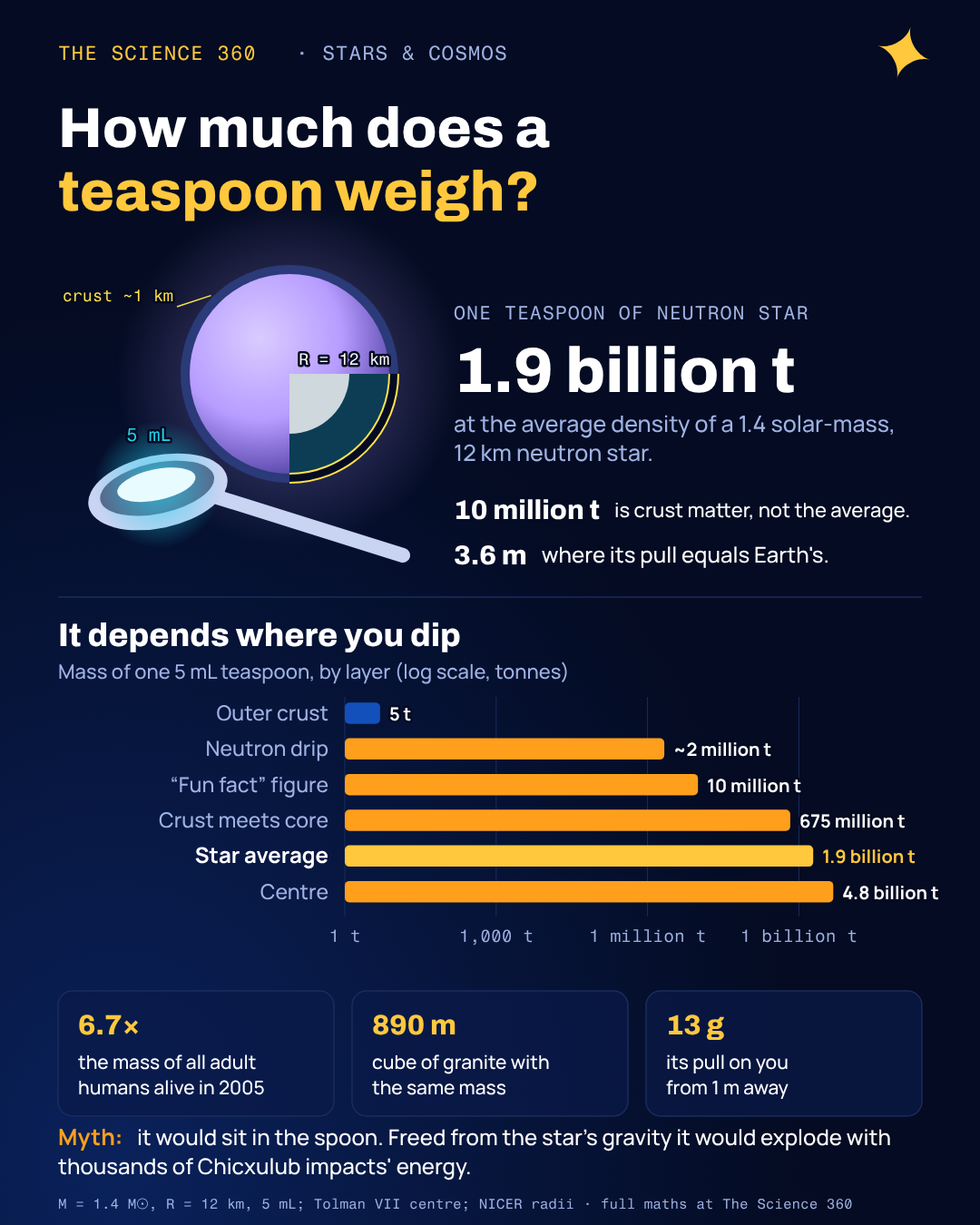
The phrase "a teaspoon of neutron star" quietly assumes the star has one density. It does not. Figure 1 shows what a teaspoon weighs at each level, from the outer layers down to the centre.
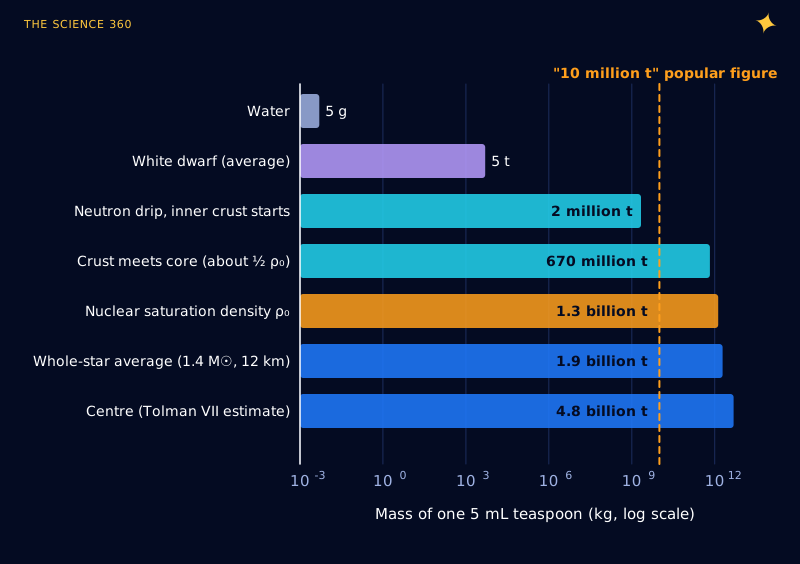
There are three separate sources of disagreement, and each one is a factor of a few or more:
Which layer. The outer crust is a lattice of nuclei swimming in electrons, a few hundred metres thick. Its density rises from around 109 kg/m3 (about the same as a white dwarf, 5 tonnes per teaspoon) to 4.3 × 10¹⁴ kg/m3 at neutron drip. The popular 10 million tonnes corresponds to a density of 2 × 10¹⁵ kg/m3, which is inner crust material just below that point. It is a real density in the star, just not a representative one.
Which star. Neutron stars range from about 1.2 to just over 2 solar masses, and their radii are thought to lie between about 11 and 14 km. Density goes as , so a small change in radius matters a lot.
Which teaspoon. A US teaspoon is 4.93 mL, a metric one is 5 mL, and a Science in School article on this exact question points out that estimates for the volume of an actual teaspoon range from 1.5 to 5 mL. That alone is a factor of three.
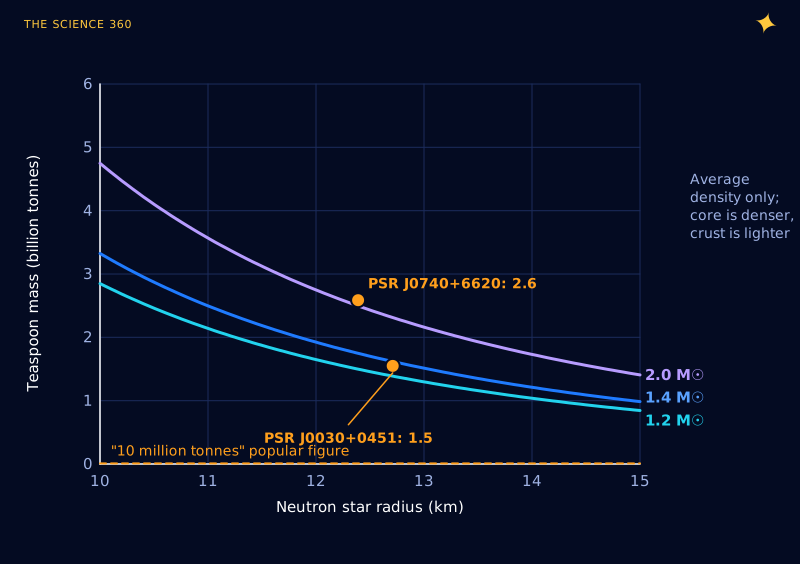
Using real measured stars instead of a textbook one:
PSR J0030+0451 (NICER: 1.34 solar masses, 12.71 km)
That is 1.5 billion tonnes per teaspoon.
PSR J0740+6620 (NICER: 2.07 solar masses, 12.39 km)
That is 2.6 billion tonnes per teaspoon.
The radii carry real error bars. Riley and colleagues give J0740+6620 as 12.39 km with a range of +1.30 and −0.98 km, and a separate team analysing the same data (Miller and colleagues) got about 13.7 km. Since density goes as , that spread alone changes the teaspoon mass by a factor of about 1.35.
What is the density at the centre of a neutron star?
Nobody knows precisely. It depends on the equation of state of matter at several times nuclear density, which is one of the biggest open problems in nuclear physics. But we can get a decent estimate from a simple analytic model that matches realistic calculations surprisingly well, the Tolman VII profile, where density falls off as the square of the radius:
Integrating gives , so = 2.5 × average density:
That is 3.6 times nuclear density. A teaspoon from the centre:
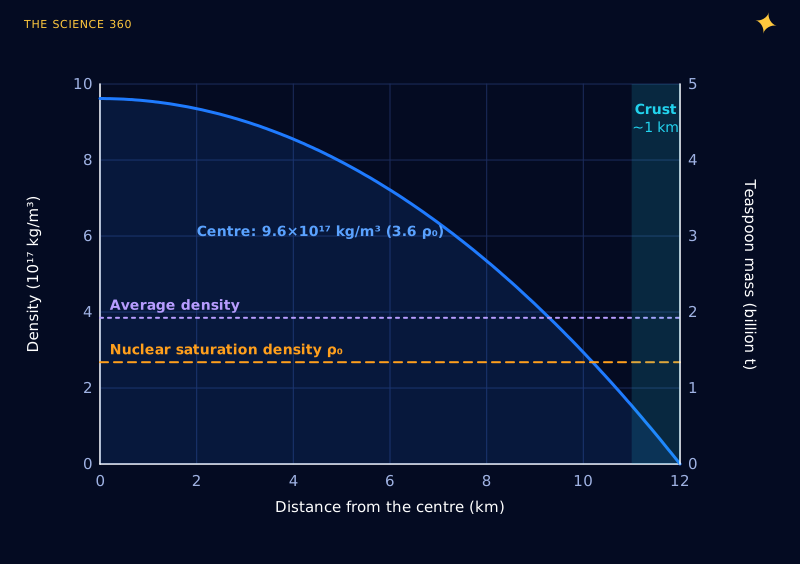
Notice that most of the star by volume is denser than an atomic nucleus. The crust, where all the gentler numbers come from, is a thin skin about a kilometre thick. If you could push a spoon in at a random point, the odds are good that you would come back with more than a billion tonnes.
How heavy is 1.9 billion tonnes, really?
Weight on Earth:
Same mass of granite (2,700 kg/m3): , a cube 890 m on a side.
All adult humans in 2005 (Walpole et al.): about 287 million tonnes, so one teaspoon is about 6.7 times all of adult humanity.
"As heavy as a mountain" is fair, then, for a small mountain. The comparison is weaker than it sounds because estimates of a mountain's mass depend heavily on where you decide its base is; published figures for Everest differ widely. A cube of rock almost a kilometre wide is a cleaner picture.
The teaspoon would also have gravity you could feel. Two billion tonnes concentrated in a centimetre-sized blob pulls hard at close range:
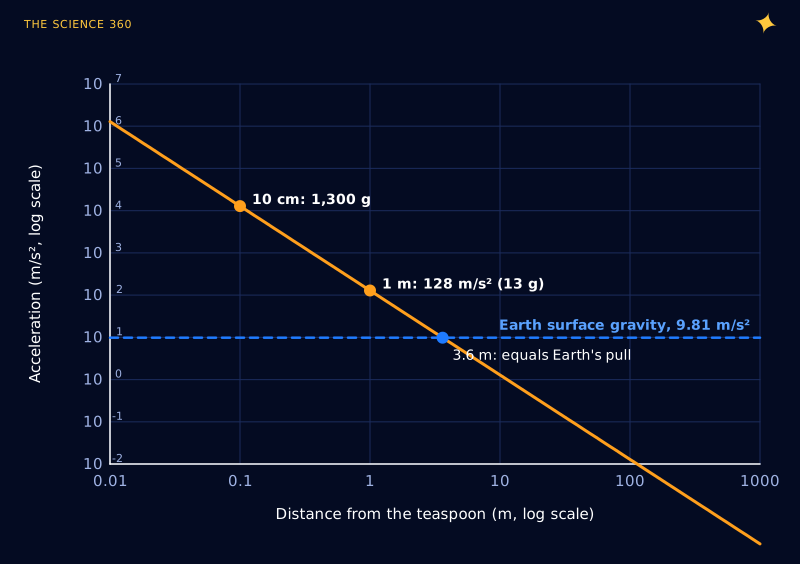
Gravity at 1 m from the teaspoon:
Distance where it matches Earth's gravity:
Stand next to it and you would fall onto it sideways. It would also sink straight through the floor, the foundations and the crust, since no material can support 1.9 × 10¹³ N on a contact patch the size of a coin. But all of that assumes the teaspoon stays a teaspoon, and it would not.
What would happen if you brought neutron star matter to Earth?
This is the misconception hiding in the whole question. Neutron star matter is not a strange solid that happens to be heavy. It is held at nuclear density by the weight of a whole star pressing on it. Neutron stars have surface gravity of roughly 1012 m/s2, about a hundred billion times Earth's. Take that away and nothing holds the neutrons together.
Pure neutron matter is not bound. Nuclear physicists can calculate its energy at nuclear density with chiral effective field theory: Tews, Krüger, Hebeler and Schwenk give 14.1 to 21.0 MeV per neutron at saturation density. All of that comes out when the matter expands.
Decompression energy of one teaspoon (author's estimate)
Number of neutrons:
Energy per neutron at saturation density: 14.1 to 21.0 MeV, or 2.26 to 3.36 × 10⁻¹² J.
In megatons (4.184 × 10¹⁵ J each): about 600 to 900 billion Mt. In Chicxulub impacts (about 4.2 × 10²³ J): about 6,000 to 9,000.
That is a lower bound in one sense, because the average teaspoon is denser than saturation density and the energy per neutron rises with density. It would come out fast: the matter expands at a sizeable fraction of light speed, so a centimetre-scale blob would explode in well under a nanosecond. The result is a fireball carrying thousands of times the energy of the asteroid that ended the dinosaurs. Our Death Star calculation puts Earth's binding energy at 2.5 × 1032 J, so the planet would survive as a planet, but very little on its surface would.
Then comes the second act. A free neutron is unstable, decaying into a proton, an electron and an antineutrino with a mean lifetime of about 878 seconds, just under 15 minutes. (Experiments that count surviving neutrons in a bottle and those that count decay protons from a beam disagree by about 9 seconds, an unsolved puzzle in its own right.) That beta decay releases another 0.78 MeV per neutron, about 1.4 × 1026 J for the teaspoon, much of it carried off by antineutrinos. The expanding cloud would be intensely radioactive for its first hour.
Something like this does happen in nature. When two neutron stars merge, a few percent of a solar mass of neutron-rich matter is flung out and decompresses. The neutrons are captured onto nuclei faster than they can decay, forging gold, platinum and uranium. The kilonova seen after the gravitational-wave event GW170817 in 2017 was the glow of exactly that decompressing matter. Scale it down to a teaspoon and you have the result of bringing the sample home.
FAQ
How much does a teaspoon of neutron star weigh?
At a typical neutron star's average density of about 3.8 × 10¹⁷ kg per cubic metre, a 5 mL teaspoon holds about 1.9 × 10¹² kg, or 1.9 billion tonnes. Depending on the star's mass and radius and on which layer you scoop from, the answer ranges from a few million tonnes in the crust to about 5 billion tonnes near the centre.
Why do sources give different weights for a teaspoon of neutron star?
Three reasons: teaspoon volumes differ (from about 1.5 to 5 mL in some estimates), neutron stars differ in mass and radius, and density inside one star climbs from about 109 kg per cubic metre near the surface to around 1018 at the centre. The often-repeated 10 million tonnes corresponds to inner crust material, not the star's average.
What would happen if you brought neutron star material to Earth?
It would not stay a teaspoon. Only the star's gravity holds neutrons at nuclear density. Released, a teaspoon of pure neutron matter would expand explosively, releasing roughly 3 × 1027 J by the author's estimate, thousands of times the energy of the dinosaur-killing impact, and the free neutrons would then decay with a lifetime of about 15 minutes.
How dense is a neutron star compared with an atomic nucleus?
About the same, and somewhat more on average. Nuclear saturation density, the density inside a heavy nucleus, is about 2.7 × 10¹⁷ kg per cubic metre. A typical neutron star averages roughly 1.4 times that, and its centre may reach three to eight times nuclear density depending on the unknown equation of state.
Related on The Science 360
Sources
- Riley, T. E. et al. (2021), "A NICER View of the Massive Pulsar PSR J0740+6620" (2.072 M☉, 12.39 +1.30/−0.98 km): arxiv.org/abs/2105.06980
- Riley, T. E. et al. (2019), "A NICER View of PSR J0030+0451" (1.34 M☉, 12.71 km): arxiv.org/abs/1912.05702
- Miller, M. C. et al. (2021), "The Radius of PSR J0740+6620 from NICER and XMM-Newton Data" (about 13.7 km): arxiv.org/abs/2105.06979
- Chamel, N. and Haensel, P. (2008), "Physics of Neutron Star Crusts", Living Reviews in Relativity (layer structure, nuclear density): arxiv.org/abs/0812.3955
- Chamel, N. et al. (2015), "Neutron drip transition in accreting and nonaccreting neutron star crusts" (drip at about 4.3 × 10¹¹ g/cm3): arxiv.org/abs/1504.04537
- Tews, I., Krüger, T., Hebeler, K. and Schwenk, A. (2013), "Neutron matter at next-to-next-to-next-to-leading order in chiral effective field theory" (14.1 to 21.0 MeV per particle at n0): arxiv.org/abs/1206.0025
- Lattimer, J. M. and Prakash, M. (2001), "Neutron Star Structure and the Equation of State" (Tolman VII as an approximation to realistic profiles): arxiv.org/abs/astro-ph/0002232
- Science in School, "The neutron teaspoon" (teaspoon volume estimates from 1.5 to 5 mL): scienceinschool.org/article/2006/teaspoon
- BBC Sky at Night Magazine, "A teaspoon of neutron star weighs 10 million tonnes" (the popular figure): skyatnightmagazine.com
- Walpole, S. C. et al. (2012), "The weight of nations", BMC Public Health 12, 439 (adult human biomass 287 million tonnes): doi.org/10.1186/1471-2458-12-439
- Particle Data Group, neutron mean lifetime (about 878 s): pdg.lbl.gov
Method note: average and central densities, the gravity curve and the decompression energy are my own calculations from the cited inputs. The decompression estimate uses the pure neutron matter energy at saturation density and ignores the crust's protons; treat it as an order-of-magnitude figure.
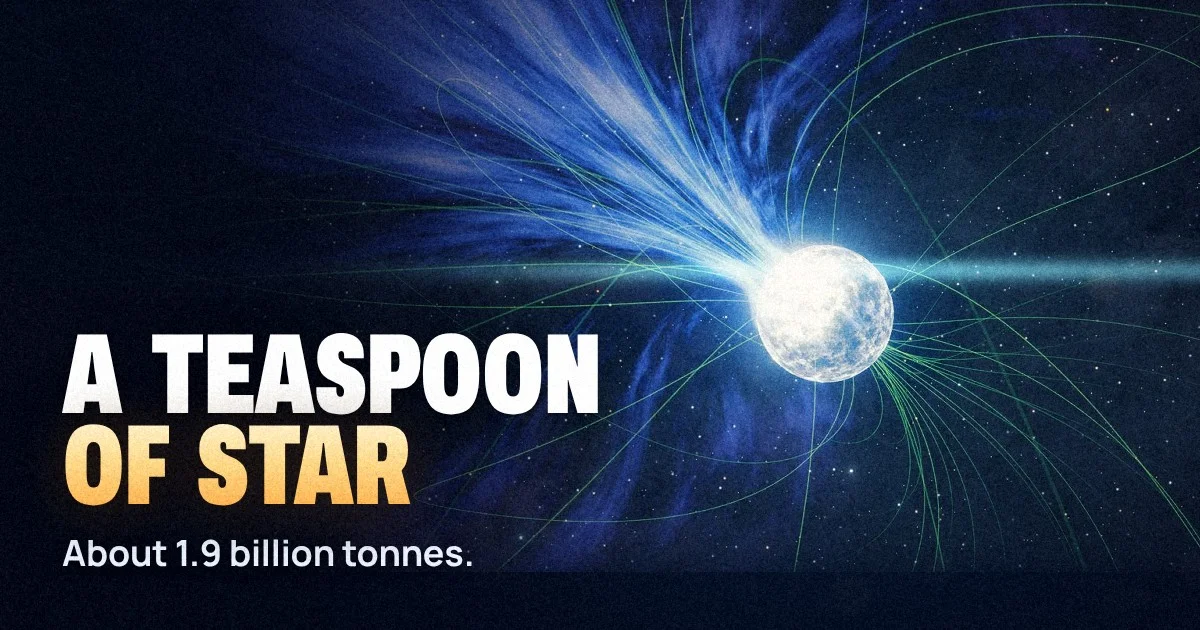
Header image: NASA/JPL-Caltech (image PIA26274), regraded for this article.