What Happens If You Fall Into a Black Hole? The Real Numbers
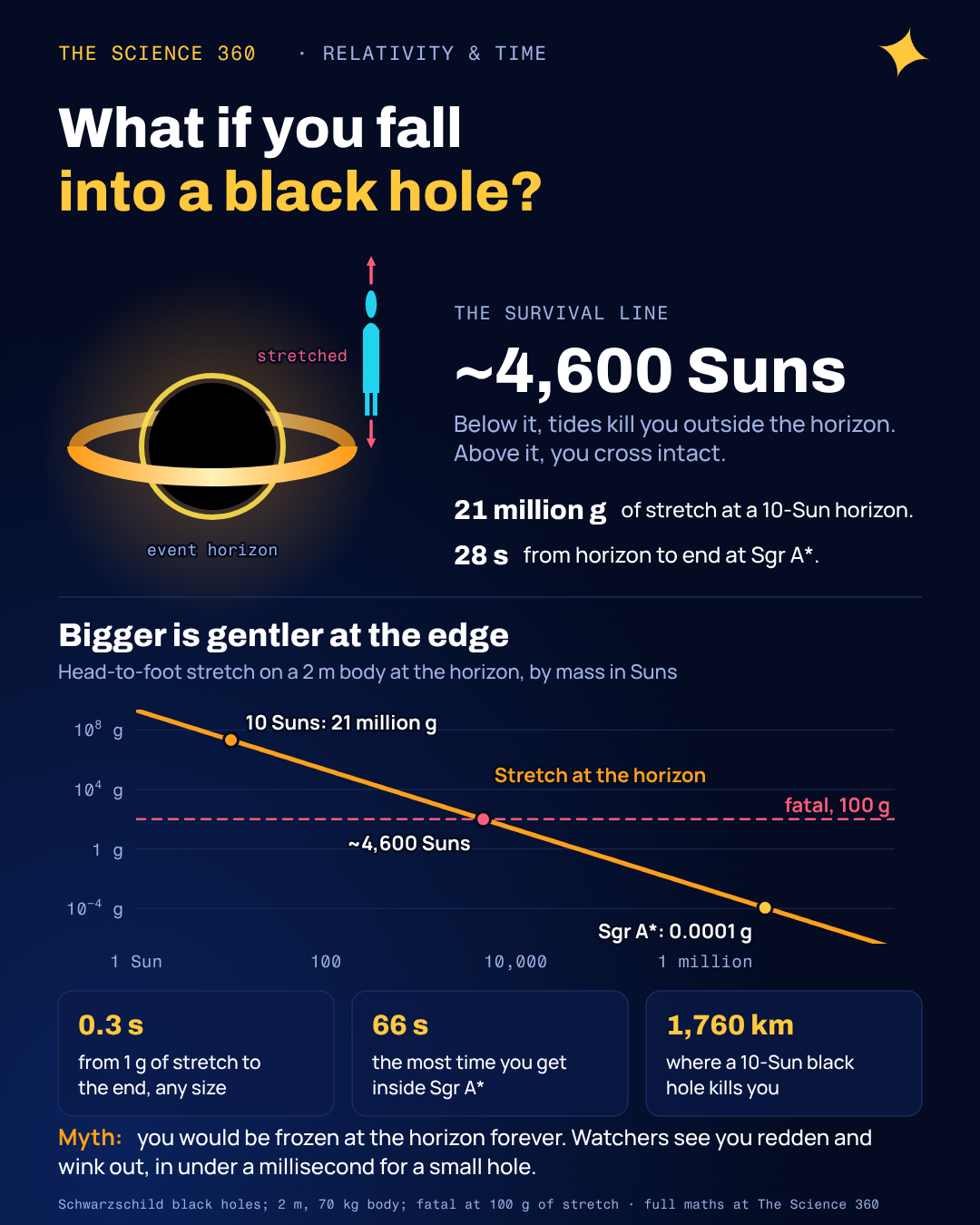
Fall feet first toward a 10 solar mass black hole and, at the moment your feet reach its event horizon, gravity pulls on them about 21 million g harder than it pulls on your head. Do the same at Sagittarius A*, the black hole at the centre of our galaxy, and the difference is 0.0001 g. That is a ten-thousandth of your weight, less than the tug of a coat on a hanger. Same physics, same horizon, eleven orders of magnitude apart.
Most answers to this question tell a nice story about spaghetti and frozen clocks. Fewer of them give you the numbers, and the numbers change the story. Size decides whether you die outside or inside. Your own clock decides how long you have once you are in. And the famous "frozen at the horizon forever" picture is only half right, even from the outside.
What is spaghettification, and how strong are the tides?
Gravity weakens with distance, so any extended object in a gravitational field is pulled harder at its near end than at its far end. That difference is the tidal acceleration. For a body of length L pointing straight at a mass M, at distance r from its centre, it is:
The in the denominator is the whole drama. Halve your distance and the stretch grows eightfold. The same expression also holds, exactly, for the radial stretching felt by someone falling into a non-rotating (Schwarzschild) black hole, even inside the horizon, when is the Schwarzschild radial coordinate. Sideways, you get squeezed by half as much in each direction. Stretched lengthways and compressed sideways: that is the spaghetti.
How much stretch kills you? Nobody has measured it, so we need a defensible marker. For a uniform body the tension at its middle is about one quarter of its mass times the head-to-foot difference. Here is what that means for a 70 kg, 2 m person:
Tension across your waist
At :
like a 17 kg weight hanging from your ankles. At :
about 1.75 tonnes-force.
One g of stretch is unpleasant but survivable. A hundred g is almost two tonnes trying to pull you in half, which no joint or spine survives. I use 100 g as the "fatal" marker below, and 1 g as "you notice". Change those thresholds tenfold and the distances shift by only a factor of 2.15, because distance goes as the cube root.
Worked example: where a 10 solar mass black hole kills you
Event horizon:
Fatal radius, at over :
Stretch at the horizon itself:
So for a stellar black hole you die sixty horizon radii out, far outside the point of no return. You never experience the horizon at all. What crosses it is a stream of atoms.
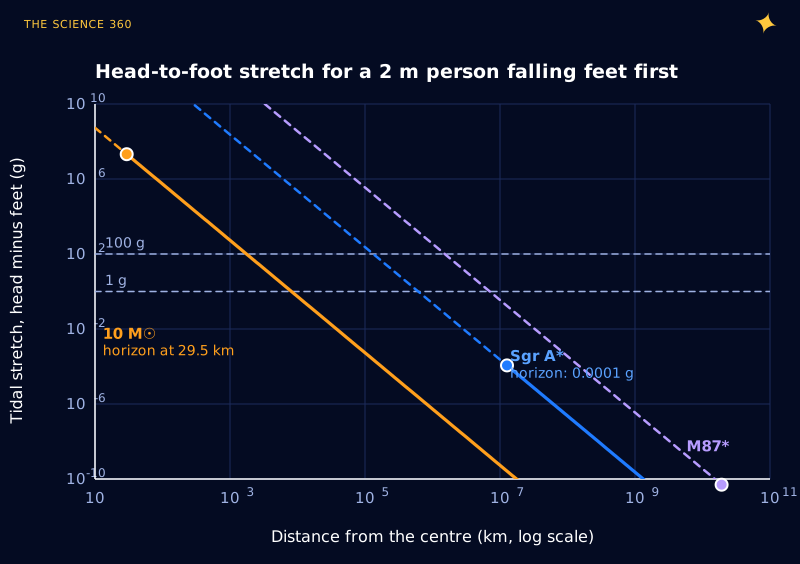
Why are big black holes gentler at the horizon?
This is the counterintuitive part, and it falls straight out of two scalings. The horizon radius grows in proportion to mass: , about 2.95 km per solar mass. The fatal radius grows only as the cube root of mass. Put the horizon radius into the tidal formula and the mass mostly cancels:
Horizon tides fall as . Double the mass, and the stretch at the horizon drops fourfold. Set that equal to 100 g and solve for the mass where the two radii coincide:
At the 1 threshold the same formula gives about 46,000 solar masses.
Every black hole lighter than roughly 4,600 Suns kills a person outside its horizon. Every one heavier lets you cross intact. That covers all known stellar black holes on the lethal side and every supermassive black hole on the gentle side. Intermediate-mass black holes, the rare and still debated class between about a hundred and a hundred thousand solar masses, straddle the line.
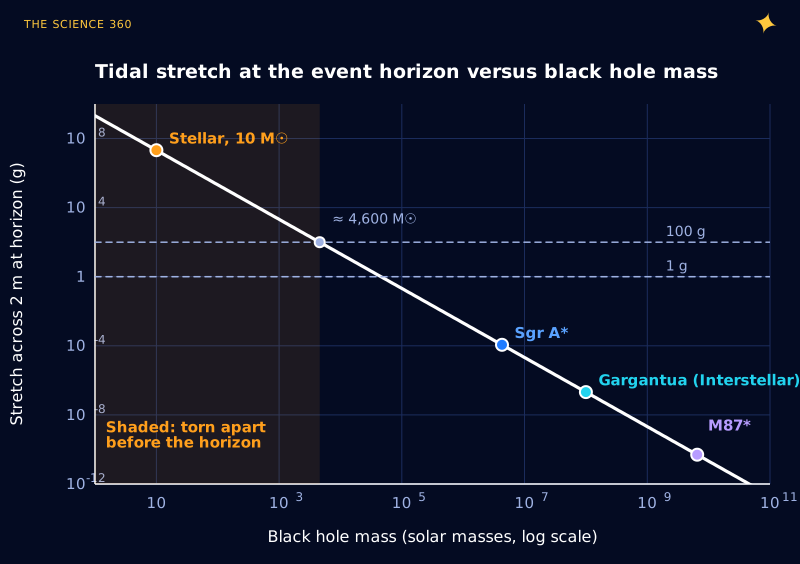
Stars obey the same rule with bigger numbers. A Sun-like star is torn apart outside the horizon only if the black hole is lighter than about 100 million solar masses. That is why astronomers see tidal disruption flares from galaxies with modest central black holes and not from the very largest ones.
How long do you have once you cross the event horizon?
Inside the horizon of a Schwarzschild black hole, the radial direction behaves like time. Moving toward smaller r is no more optional than moving toward next Tuesday. The singularity is not a place in front of you that you could steer around; it is a moment in your future. What you can calculate is how much of your own time remains, called proper time.
Two cases bracket it. If you fall from rest a long way off (physicists call this the "raindrop" trajectory), your proper time from the horizon to is . The absolute maximum, achieved by arriving at the horizon with just enough outward thrust to hang there momentarily and then switching off, is .
Sagittarius A*,
Raindrop:
Maximum:
Horizon radius:
That is 12.7 million km (0.085 AU).
The scale factor is 15.5 microseconds per solar mass for the maximum. Figure 3 runs it across the range of known black holes.
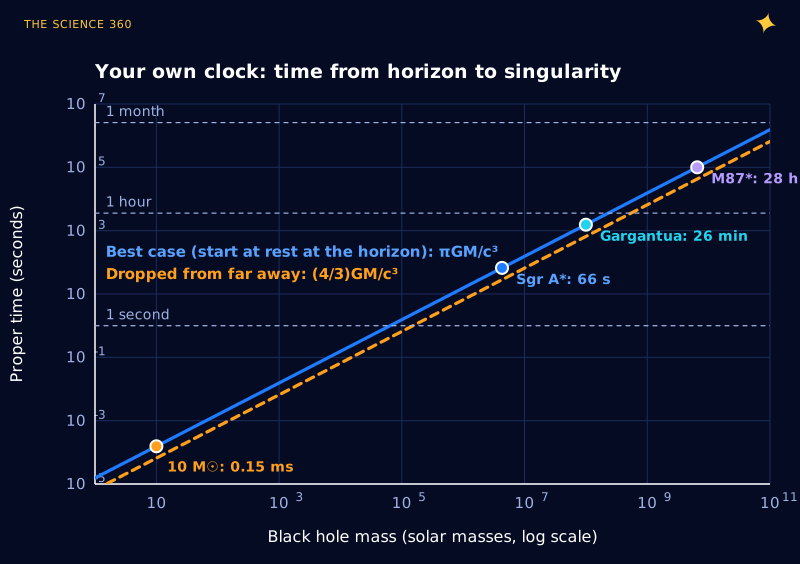
A popular line says that inside a supermassive black hole "you would last a few hours". That is only true for the biggest ones, around a billion solar masses and up. For the black hole in our own galaxy, it is about half a minute if you jump straight in, and a little over a minute at best.
Can rockets buy you more? Geraint Lewis and Juliana Kwan worked this out in 2007. If you are falling freely, a well-judged burn can stretch your remaining time toward the limit, but never past it, and burning too hard in any direction shortens it. The intuition is the same as the "twin paradox": in relativity the unaccelerated path between two events is the one with the most elapsed time, and here every path ends on the singularity.
The last 0.3 seconds are the same in every black hole
Here is a result I have not seen on any of the popular pages, and it is easy to check. For the raindrop fall, your speed relative to a local observer at radius is , and your proper time remaining until works out to
Now substitute the radius at which the tidal stretch reaches a given value, . The mass cancels completely:
From 1 of stretch to the end:
From 100 of stretch to the end:
So whether you fall into a 10 solar mass black hole or M87*, the interval from "this is uncomfortable" to the end is about a third of a second, and the fatal phase is the final 30 milliseconds. What mass changes is where that happens. For the stellar black hole it is 8,000 km to 1,800 km outside the horizon. For Sgr A* it is about 600,000 km to 130,000 km from the centre, around 1% of the horizon radius, about 28 seconds after you crossed.
What would someone watching from outside see?
This is where the "frozen forever" story comes from. In the Schwarzschild coordinates that suit a distant observer, the time coordinate t runs to infinity as an infalling object approaches the horizon. Figure 4 shows both clocks for the same fall.
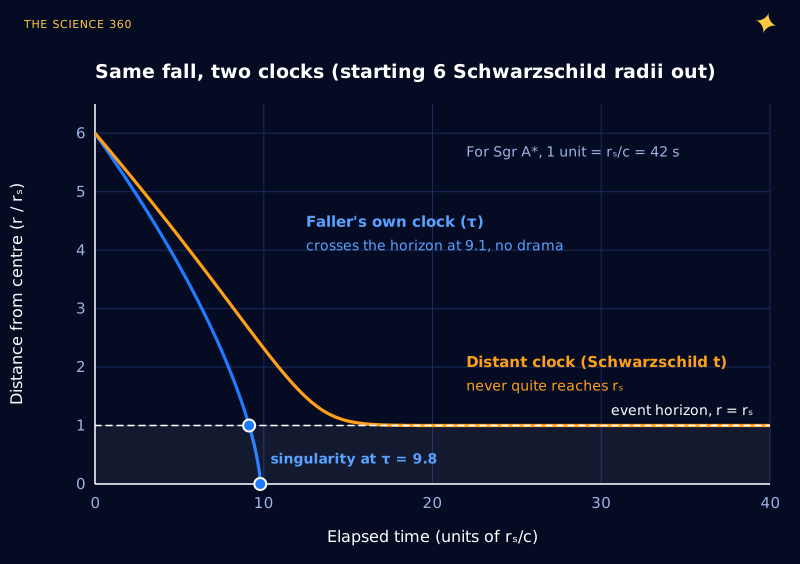
Coordinate time is not what anyone sees, though. What reaches a distant telescope is light, and each photon climbing out from near the horizon arrives later and with a longer wavelength than the one before. Close to the horizon the redshift grows exponentially, with an e-folding time of :
10 solar masses:
Sgr A*:
M87*: about 36 hours
Every e-fold the light gets e times redder and the arriving photon rate drops, so after a few dozen e-folds the falling object simply is not there in any detector. John Baez's Physics FAQ puts it neatly: an object dropped into a few-solar-mass black hole winks out in a fraction of a millisecond, and the last photon you could ever catch arrives about 0.01 s later. "Frozen forever" is a statement about a coordinate, not about what you would see.
Do you see the whole future of the universe as you fall in?
No, not for a realistic non-rotating black hole. This one is common in documentaries. Light from the outside universe does keep falling in behind you, but you reach the singularity in finite proper time, and light from the far future never catches up. Looking back, you see the sky blueshifted and squeezed into a shrinking patch, plus some distortion from light that has looped around the hole. You do not see stars burn out.
The infinite-blueshift picture belongs to idealized rotating or charged black holes, which have an inner horizon. Light piling up there would be infinitely blueshifted for an observer crossing it. Most relativists think that pile-up destabilizes the inner horizon in real black holes, so the "watch the end of time" scene is more a warning sign about an idealized solution than a travel brochure.
Could Cooper survive falling into Gargantua?
Kip Thorne, who advised on Interstellar, set Gargantua's mass at about 100 million solar masses. He needed it at least that heavy so that Miller's planet, orbiting close in, would not be torn apart by tides. Plug that mass into the horizon formula and the stretch on a 2 m astronaut is about 2 × 10⁻⁷ g. Cooper's body would not notice the horizon.
The non-rotating numbers then give about 11 minutes (raindrop) to 26 minutes (maximum) before the tidal end. Thorne's Gargantua spins at nearly the maximum rate, and spinning black holes have a different interior with that inner horizon, so what happens to Cooper afterwards is honestly beyond known physics. The tesseract is fiction. The painless horizon crossing is not.
What else could kill you on the way in?
Tides are the textbook answer, but they are not the only hazard.
- The accretion flow. Black holes that are actively feeding are surrounded by gas at millions of degrees, emitting X-rays. Sgr A* happens to be very quiet, so it is the friendliest candidate. A bright quasar would cook you long before tides mattered.
- Falling gas and blueshifted light. Anything falling alongside you is moving at nearly the speed of light relative to distant matter, and light from behind you is blueshifted. In a real, messy environment this could add up to a lethal dose of radiation, though for a clean, quiet hole it stays modest.
- A firewall, if they exist. In 2012 Almheiri, Marolf, Polchinski and Sully argued that quantum consistency might require a wall of high-energy quanta at the horizon of old black holes. It is unresolved and many physicists doubt it, but it is the one serious proposal under which crossing even a supermassive horizon would be instantly fatal.
Hawking radiation is not a danger: for any astrophysical black hole it is colder than the cosmic microwave background and immeasurably faint.
Is a black hole a cosmic vacuum cleaner?
No. Far from the hole its gravity is identical to that of any other object with the same mass. If the Sun were replaced by a one solar mass black hole, the Earth would keep its orbit exactly, it would just get cold and dark. The strange physics only starts within a few Schwarzschild radii, and for a solar mass black hole the horizon is just under 3 km in radius. You have to aim very carefully to fall in.
FAQ
Would you die instantly if you fell into a black hole?
Not necessarily at the horizon. Near a stellar-mass black hole tides tear you apart more than a thousand kilometres before you reach the horizon. At a supermassive black hole like Sagittarius A* you cross the horizon feeling almost nothing and are only stretched apart much deeper inside, about 28 seconds later on your own clock if you were dropped from far away.
How long does it take to reach the singularity of a black hole?
On your own clock, at most after crossing the horizon, about 15.5 microseconds per solar mass. That is 0.15 milliseconds for a 10 solar mass black hole, 66 seconds for Sagittarius A* and about 28 hours for M87*. Falling in from far away gives about 58% less than that maximum.
Does time stop at the event horizon?
No. Your own clock ticks normally and you cross the horizon in a finite time. What diverges is the Schwarzschild time coordinate used by distant observers. A distant observer sees you slow down and redden, but you fade from view within a few multiples of , about 85 seconds per e-fold for Sagittarius A*, rather than hanging there visibly forever.
Would you see the whole future of the universe as you fell in?
Not for an ordinary non-rotating black hole. Light from the far future of the outside universe never catches up with you before you reach the singularity, so you see only a modestly blueshifted and distorted view of the sky. The infinite-blueshift picture applies only to idealized rotating or charged black holes near their inner horizon.
What is spaghettification?
It is stretching by tidal forces: gravity pulls harder on the part of you closer to the black hole than on the part farther away, while squeezing you sideways. The head-to-foot difference is about , so it grows very fast as distance shrinks and becomes fatal at about 1,800 km from a 10 solar mass black hole.
Related on The Science 360
Sources
- J. Baez et al., Physics FAQ, "What happens to you if you fall into a black hole?" (finite proper time, fading with a time scale of about 0.2 ms for 8 solar masses, no view of the far future for Schwarzschild holes): math.ucr.edu/home/baez/physics/Relativity/BlackHoles/fall_in.html
- Max Planck Institute for Extraterrestrial Physics, "The massive black hole" (GRAVITY results for Sgr A* mass and distance): mpe.mpg.de/6588951/The-black-hole
- Event Horizon Telescope Collaboration, "First Sagittarius A* EHT Results VI: Testing the Black Hole Metric" (uses GRAVITY mass 4.297 × 10⁶ solar masses): arxiv.org/abs/2311.09484
- Event Horizon Telescope Collaboration (2019), "First M87 Event Horizon Telescope Results I" (M87* mass 6.5 × 10⁹ solar masses): arxiv.org/abs/1906.11238
- K. Thorne, The Science of Interstellar, excerpt on Gargantua's mass (at least 100 million solar masses): space.com/28077-science-of-interstellar-book-excerpt.html
- G. F. Lewis and J. Kwan (2007), "No Way Back: Maximizing survival time below the Schwarzschild event horizon", PASA 24, 46: arxiv.org/abs/0705.1029
- Tidal disruption event, threshold of about 108 solar masses for a Sun-like star: en.wikipedia.org/wiki/Tidal_disruption_event
- A. Almheiri, D. Marolf, J. Polchinski, J. Sully (2012), "Black Holes: Complementarity or Firewalls?": arxiv.org/abs/1207.3123
- Royal Museums Greenwich, "What happens if you fall into a black hole?" (typical popular treatment): rmg.co.uk/stories/space-astronomy/what-happens-if-you-fall-black-hole
Method note: all figures use the non-rotating (Schwarzschild) solution with . The 1 g and 100 g thresholds are judgment calls, not measured injury limits; because distances scale as the cube root of the threshold, changing them tenfold moves the danger radius by a factor of about 2.
Header image: NASA Goddard Space Flight Center (image GSFC_20171208_Archive_e000386), regraded for this article.