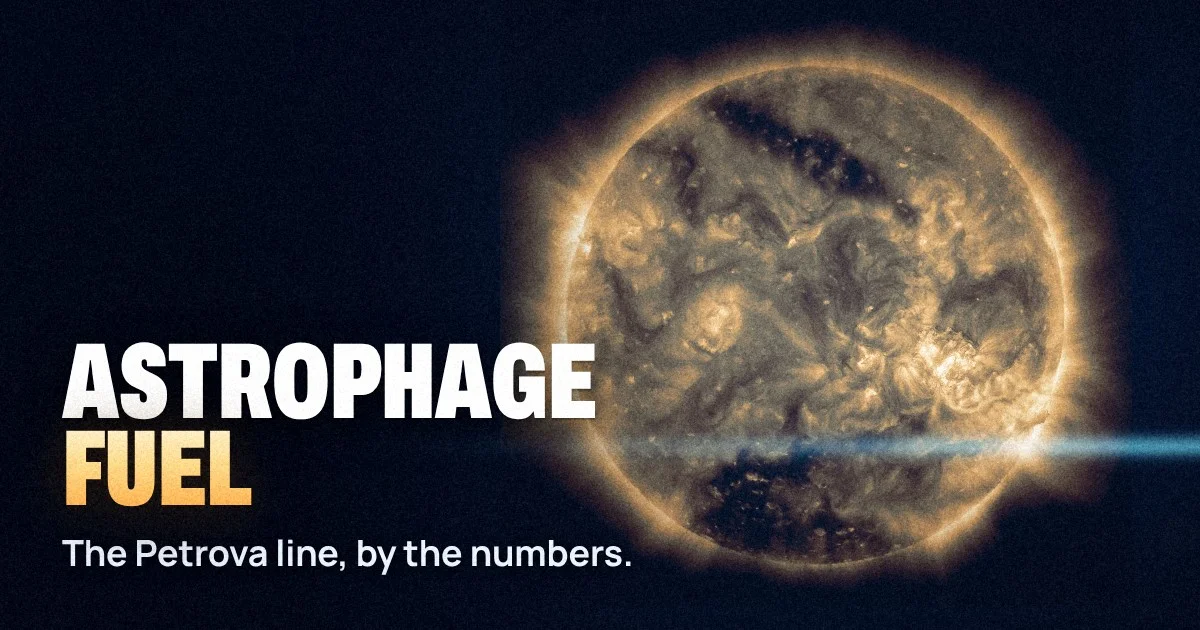
Project Hail Mary Astrophage Science: The Real Math
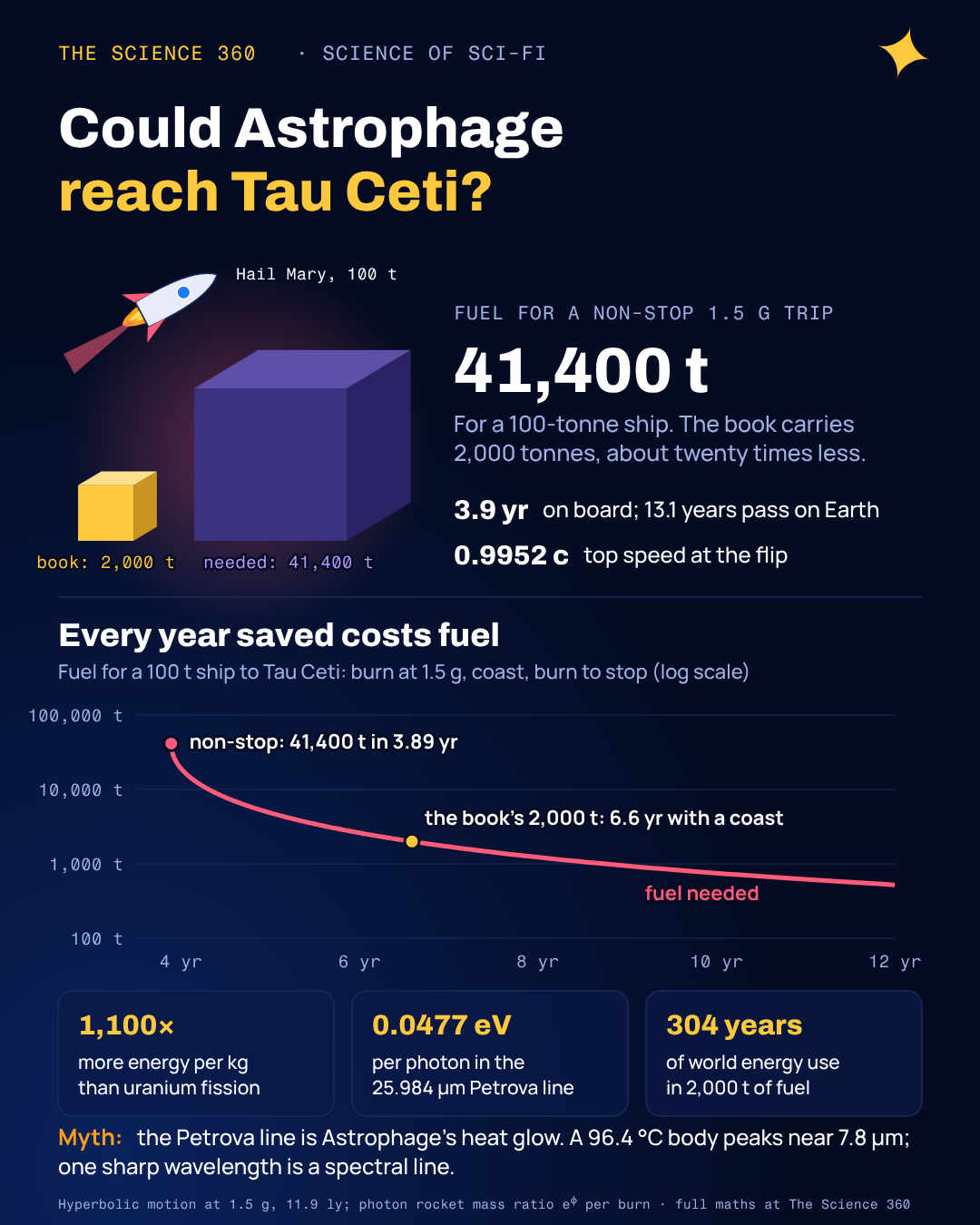
Two thousand tonnes of Astrophage holds 1.8 × 10²³ joules. That is roughly 300 years of everything humanity burns, generates and consumes, at 2024 rates, packed into the fuel tanks of one small ship. And by my arithmetic it still isn't enough to get the Hail Mary to Tau Ceti the way Andy Weir describes.
That is not a complaint. Project Hail Mary is the rare story, book and now 2026 film, where the physics is good enough that you can actually check it, and checking it is a good way to learn how relativistic rockets work. So let's take Astrophage seriously, as an engineer would: what is its energy density, how long does the trip take, how much fuel does it really need, and what is that 25.984 micrometre "Petrova line" telling us? I'll flag where Weir is sharp and where he bends the rules.
A note on sources: book details (fuel mass, ship mass, the Petrova wavelength, Astrophage's 96.415 °C operating temperature) are checked against several fan references and reviews rather than quoted from the text, and I say where they disagree.
What is Astrophage, physically?
In the novel, Astrophage is a single-celled organism about 10 micrometres across that lives on the surface of the Sun, soaks up sunlight, and stores the energy as mass, in the form of neutrinos held inside the cell. It migrates to Venus to breed (it needs carbon dioxide), and it moves by emitting infrared light at one precise wavelength, 25.984 µm. It keeps itself at 96.415 °C, and it is so good at capturing energy that its spread across the Sun's surface is making the Sun dim: a 1% drop in solar output within nine years, 5% within twenty, enough to trigger an ice age on Earth.
For a physicist, the key line is "stores energy as mass." That means Astrophage is the perfect battery. Einstein's sets the exchange rate between mass and energy, and nothing can beat it.
How much energy is in a kilogram of Astrophage?
For comparison (computed from the reaction energies):
U-235 fission, 200 MeV per 235 u: (0.09% of )
D-T fusion, 17.6 MeV per 5.03 u: (0.38% of )
The Hail Mary's fuel load:
World primary energy use in 2024: 592 EJ =
Astrophage beats nuclear fission by a factor of about 1,100 and the best fusion fuel by about 270. That is not a quirk of the fiction: total mass conversion is simply the ceiling, and fission and fusion only ever release a fraction of a percent of the mass involved.
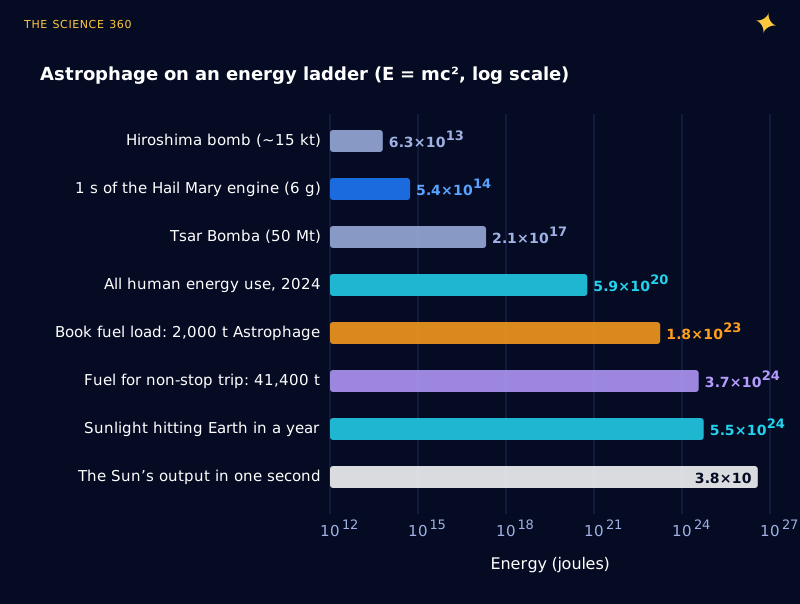
Here is a number that puts the Petrova problem in perspective. If Astrophage is stealing 1% of the Sun's output, it is capturing 3.83 × 1024 watts. Divide by c² and that is 42,600 tonnes of new Astrophage mass-energy every second. The entire Hail Mary fuel load is what the Sun's infestation gathers in about 0.05 seconds. No wonder the plan in the book is to collect and breed Astrophage rather than make the energy any other way.
What is the Petrova line, and why 25.984 µm?
The Petrova line is how humanity first notices Astrophage: a faint infrared arc from the Sun toward Venus at exactly 25.984 micrometres. Run the photon energy:
Frequency:
Photons per kilogram of Astrophage:
A common reading is that the Petrova line is just Astrophage's heat. It can't be. Something at 96.415 °C (369.6 K) glows across a broad band of infrared with a peak near 7.8 µm, as Wien's law tells you. A body whose thermal glow peaked at 25.984 µm would have to be at 111.5 K, about −162 °C. And thermal glow is never a single wavelength anyway. A razor-sharp emission at one wavelength is a spectral line: every photon has the same energy because every photon comes from the same process.
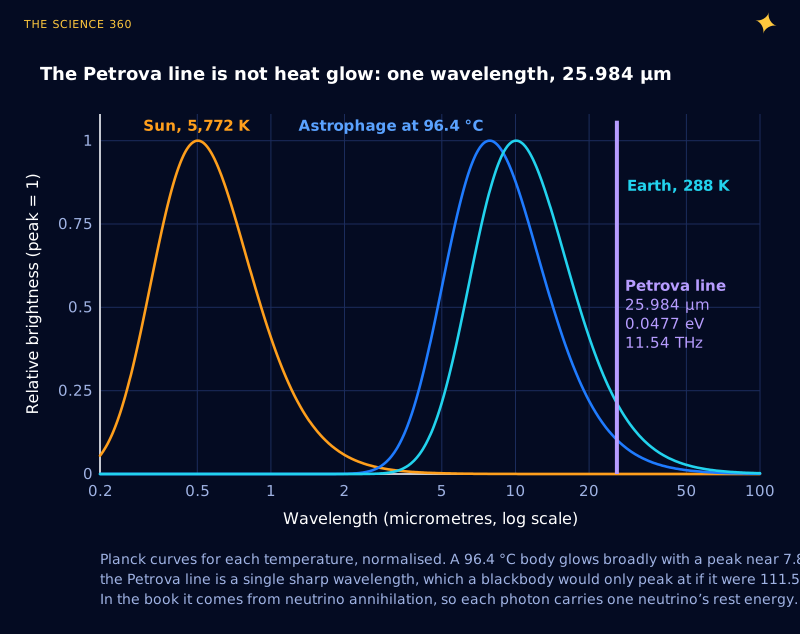
In the book, that process is neutrino annihilation: stored neutrinos meet antineutrinos and turn into photons. If a pair annihilates at rest into two photons, each photon carries exactly one neutrino's rest energy. So Weir's universe has a neutrino mass of 0.0477 eV/c². Here is where he looks either very well read or very lucky. Real neutrino oscillation experiments measure a mass-squared splitting of about 2.5 × 10⁻³ eV², which means at least one real neutrino must weigh at least √(2.5 × 10⁻³) ≈ 0.050 eV. Direct measurements by KATRIN cap the mass at below 0.45 eV. A 0.048 eV neutrino lands right in the plausible window.
The bend is everything else about it. Real neutrinos barely interact with anything; a neutrino and antineutrino colliding to make light is a process so suppressed it has never been observed. Holding trillions of trillions of them inside a cell is pure fiction, which the book covers with Astrophage's "super cross-sectionality," its ability to stop particles and long-wavelength light that should sail through it. Weir is upfront that this part breaks known physics.
How long does the trip to Tau Ceti take at 1.5 g?
The Hail Mary accelerates at 1.5 g, flips at the halfway point, and decelerates at 1.5 g the rest of the way. Tau Ceti is 11.9 light years away. Constant proper acceleration gives what relativists call hyperbolic motion, and the numbers fall out of three formulas.
Step 1. Scales
Step 2. Speed at the flip (halfway, 5.95 ly)
Step 3. Crew time (proper time), both halves
Step 4. Earth time
That matches the book's framing well: Grace's body ages about four years, while roughly 12 to 14 years pass on Earth. Astrophysicist Becky Smethurst, asked about this by Inverse, said the book's timeline checks out, and the numbers above agree.
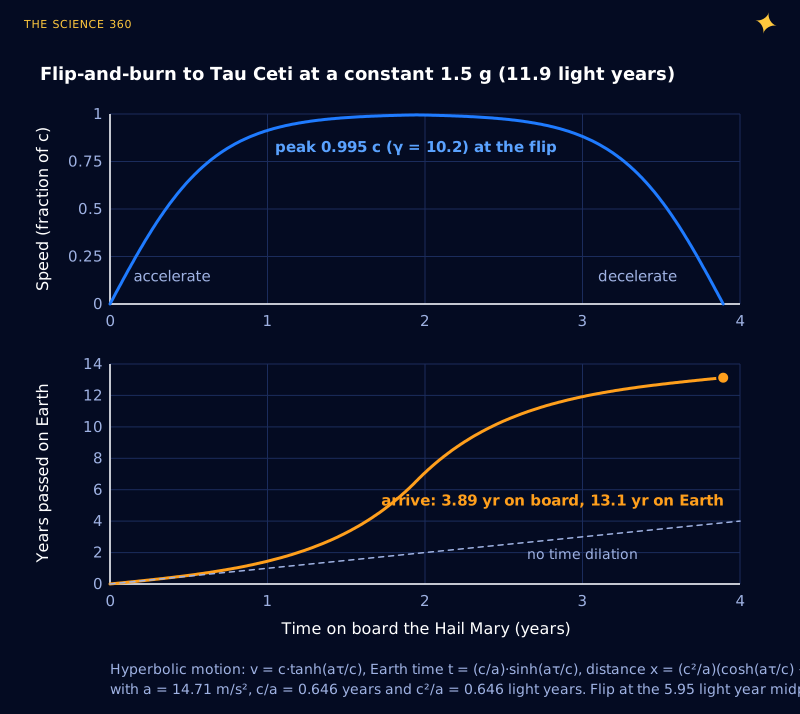
One misconception worth clearing up: covering 11.9 light years in 3.9 years does not mean the ship went faster than light. From Earth's point of view the trip takes 13.1 years at under c. From the crew's point of view the distance to Tau Ceti shrinks by length contraction while they are moving fast. Both descriptions agree on what the crew's clocks read on arrival. The same two ingredients, speed and gravity, are behind the tiny clock corrections in your phone's navigation; our post on GPS relativity and its 38 microseconds a day works through the everyday version.
Does 2,000 tonnes of Astrophage get you there? The fuel budget
This is where the story and the arithmetic part ways. The Hail Mary is a photon rocket: it throws light out the back. For any rocket, the relativistic version of the rocket equation says the mass ratio (full mass over empty mass) depends on the change in rapidity, not speed. For a photon rocket, whose exhaust moves at c, it is beautifully simple:
Mass ratio for one burn:
Speeding up to : . Slowing back down: another factor of 20.4.
With a 100-tonne dry ship (as fan references give it):
Book's load: 2,000 t of fuel + 100 t ship gives a mass ratio of 21, which is : almost exactly one burn to .
The book's mass ratio of 21 is a near-perfect match for accelerating to the flip speed. It looks as if the budget covered the acceleration and forgot that slowing down costs the same rapidity all over again, which squares the mass ratio rather than doubling it. One reader who did this calculation reports that Weir agreed with him when contacted and suggested a coast phase would fix it. I couldn't find that in a primary source, so treat it as unconfirmed, but the arithmetic stands on its own.
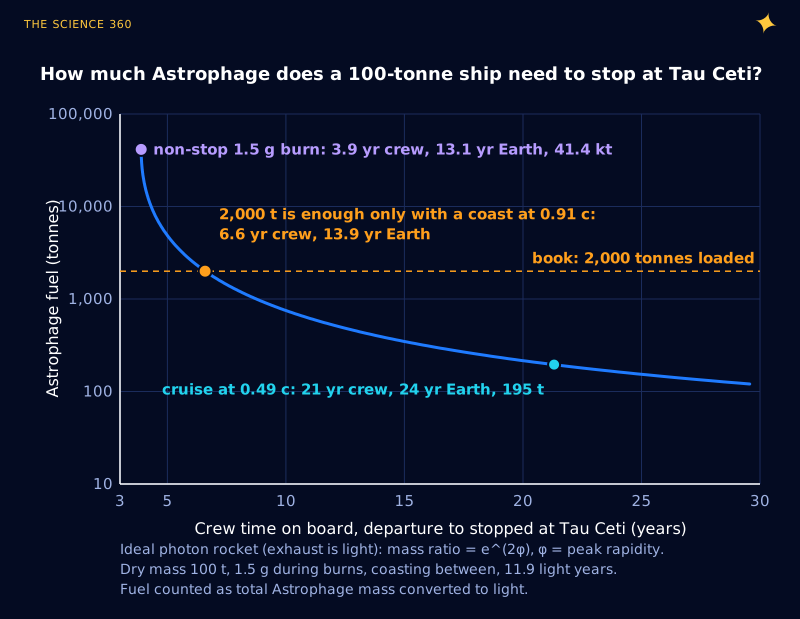
The fix is easy and costs the plot little. Burn at 1.5 g for about a year until the ship reaches 0.91 c, coast, then burn for another year to stop. That uses exactly the book's 2,000 tonnes, takes 6.6 years of crew time, and 13.9 years on Earth. Grace spends the trip in a coma anyway.
There is a nice consistency check hiding in the book, too. Fan references quote Grace working out that the engines burn about 6 grams of Astrophage per second, releasing about 540 trillion joules each second. For a photon rocket, thrust is power divided by c:
Mass that thrust pushes at 1.5 :
That is what you would expect of a 100-tonne ship near the end of its trip with a little fuel left, which fits a nearly empty ship, as it would be after arriving. At departure, fully fuelled at 2,100 tonnes, the same 1.5 g would need 103 grams per second and a beam power of 9.3 × 10¹⁵ W, about 5% of all the sunlight that hits Earth, pointed in one direction. Any photon rocket's exhaust is a weapon.
Where does Andy Weir bend physics?
Taking the story on its own terms, the relativity, the trip times, the photon-rocket thrust and the idea of storing energy as mass are all handled correctly. The bends are concentrated in Astrophage itself.
The biggest is the neutrino storage. Converting stored energy back to light with 100% efficiency, on demand, in a living cell, through a process real neutrinos essentially never undergo, is magic with good manners. Weir builds the rules carefully and keeps to them, which is why the rest holds up. Super cross-sectionality, Astrophage stopping neutrinos and long-wavelength light that should pass through something 10 µm wide, is admitted in the book as new physics.
The second is the fuel budget, which by the calculation above is short by a factor of about 20 for a non-stop trip. It is easy to repair with a coast phase, and it does not change the shape of the story.
The third is subtler and mostly forgivable: a perfect photon rocket needs the light collimated into a perfect beam. Any spread costs thrust, which falls with the cosine of the beam angle, and any heat the engine absorbs has to be radiated away. At petawatt power levels, even a 0.01% loss is nearly a terawatt of waste heat. The book's spin drives sidestep this by having Astrophage itself emit in one direction, which is consistent with its other superpowers.
If you enjoy this kind of check, the same exercise on a black hole planet is even stranger: see our breakdown of Miller's planet time dilation in Interstellar, where the time dilation factor is 61,362 rather than 10.
FAQ
Is Astrophage real?
No. The physics it relies on, storing energy as mass and turning it back into light with , is real, but no known organism or material can do it, and its ability to absorb neutrinos and long-wavelength light breaks known physics, as the book itself admits.
How fast does the Hail Mary go?
Accelerating at 1.5 g to the halfway point and then decelerating, it peaks at about 99.5% of the speed of light, with a time dilation factor of about 10.2.
How long did the trip to Tau Ceti take in Project Hail Mary?
About 4 years for the crew and roughly 13 on Earth. A non-stop 1.5 g flip-and-burn gives 3.89 years on board and 13.1 years on Earth. With only the book's 2,000 tonnes of fuel the ship must coast, and the crew time becomes about 6.6 years.
What is the Petrova line?
In the novel it is a faint infrared arc at exactly 25.984 µm between the Sun and Venus, emitted by migrating Astrophage. Each photon carries 0.0477 eV. Because it is one sharp wavelength, it is a spectral line, not heat glow.
How much energy does Astrophage store?
Since it stores energy as mass, 1 kg holds 8.99 × 10¹⁶ J. The Hail Mary's 2,000 tonnes would hold 1.8 × 10²³ J, about 300 years of human energy use at 2024 levels.
Sources
- Wikipedia, "Project Hail Mary" (novel overview, Tau Ceti destination): en.wikipedia.org/wiki/Project_Hail_Mary
- M. Brady, "A Field Guide to Astrophage" (cell size about 10 µm, 96.415 °C, 25.984 µm, super cross-sectionality): thescienceof.org
- ProjectHailMary.net, "The Astrophages: the science of chapter 3" (Petrova wavelength): projecthailmary.net/en/the-astrophages
- Inverse, "Reel Science: Project Hail Mary time dilation" (about 4 years on board, 12 to 14 on Earth; Becky Smethurst comments): inverse.com
- A. (Systems of Ashish), "I Contacted the Author of Project Hail Mary About Wrong Fuel Calculations" (100 t ship, 2,000 t fuel, reported author reply; not independently verified): systemsofashish.com
- KATRIN Collaboration, "Direct neutrino-mass measurement based on 259 days of KATRIN data," Science 388, 180 (2025), mν < 0.45 eV: pubmed.ncbi.nlm.nih.gov/40208982
- Esteban et al., NuFIT global fit of three-neutrino oscillations (2024), atmospheric mass splitting about 2.5 × 10⁻³ eV²: arxiv.org/abs/2410.05380
- Energy Institute, Statistical Review of World Energy 2025 (global primary energy 592 EJ in 2024): energyinst.org/statistical-review
- Wikipedia, "Solar luminosity" (IAU nominal 3.828 × 1026 W): en.wikipedia.org/wiki/Solar_luminosity
- Wikipedia, "Tau Ceti" (11.9 light years): en.wikipedia.org/wiki/Tau_Ceti
- Wikipedia, "Little Boy" (about 15 kt) and "Tsar Bomba" (50 Mt): Little Boy, Tsar Bomba
Header image: NASA Goddard Space Flight Center (image GSFC_20171208_Archive_e000759), regraded for this article.