Why Are Days Longer in Summer? Daylight Hours Explained
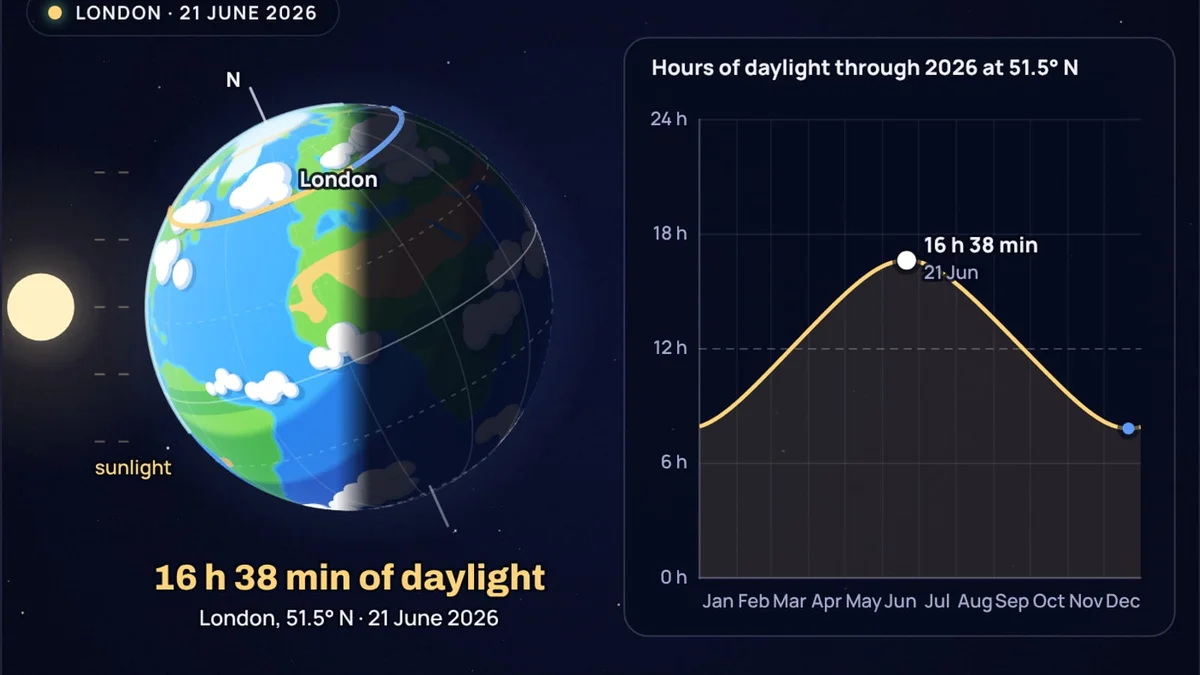
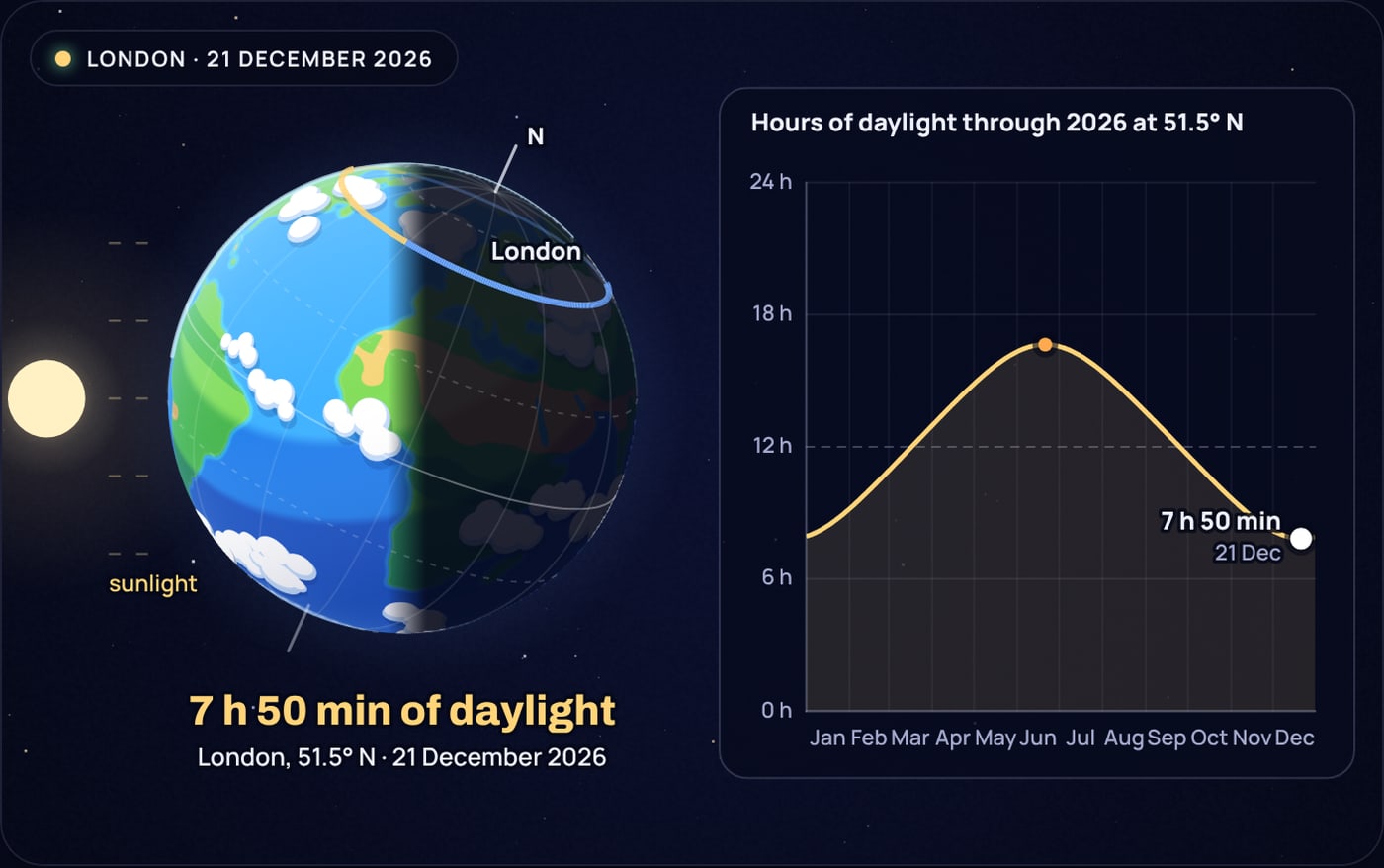
On 21 June London gets 16 hours 38 minutes of daylight. Six months later, on 21 December, it gets 7 hours 50 minutes. Same city, same Sun, same Earth spinning once a day, and yet almost nine hours of light go missing between summer and winter. The cause is one number, 23.44°, the tilt of Earth's axis, and you can work out the rest with a calculator and two lines of trigonometry.
This post explains why summer days are long, how many hours of daylight you get on the shortest and longest days around the world, and why even the equinox is not quite 12 hours. You can check every number in the day length calculator, which draws the globe for any date and plots the whole year's daylight for your latitude.
Why does the tilt make summer days longer?
Picture Earth from the side, with the Sun far off to the left. Sunlight lights exactly half the globe, and the boundary between day and night, the terminator, is a circle at right angles to the sunlight. Earth spins about its axis, carrying you round your circle of latitude once a day. The fraction of that circle on the lit side is the fraction of the day that is daytime.
If the axis were upright, the terminator would cut every latitude circle exactly in half, and everywhere would get 12 hours of day all year. But the axis is tilted 23.44° and keeps pointing the same way in space as Earth goes round the Sun. In June the north end leans towards the Sun. Now the terminator cuts the northern circles off centre: most of each circle is on the sunny side. In December the north end leans away and the same circles are mostly in darkness.
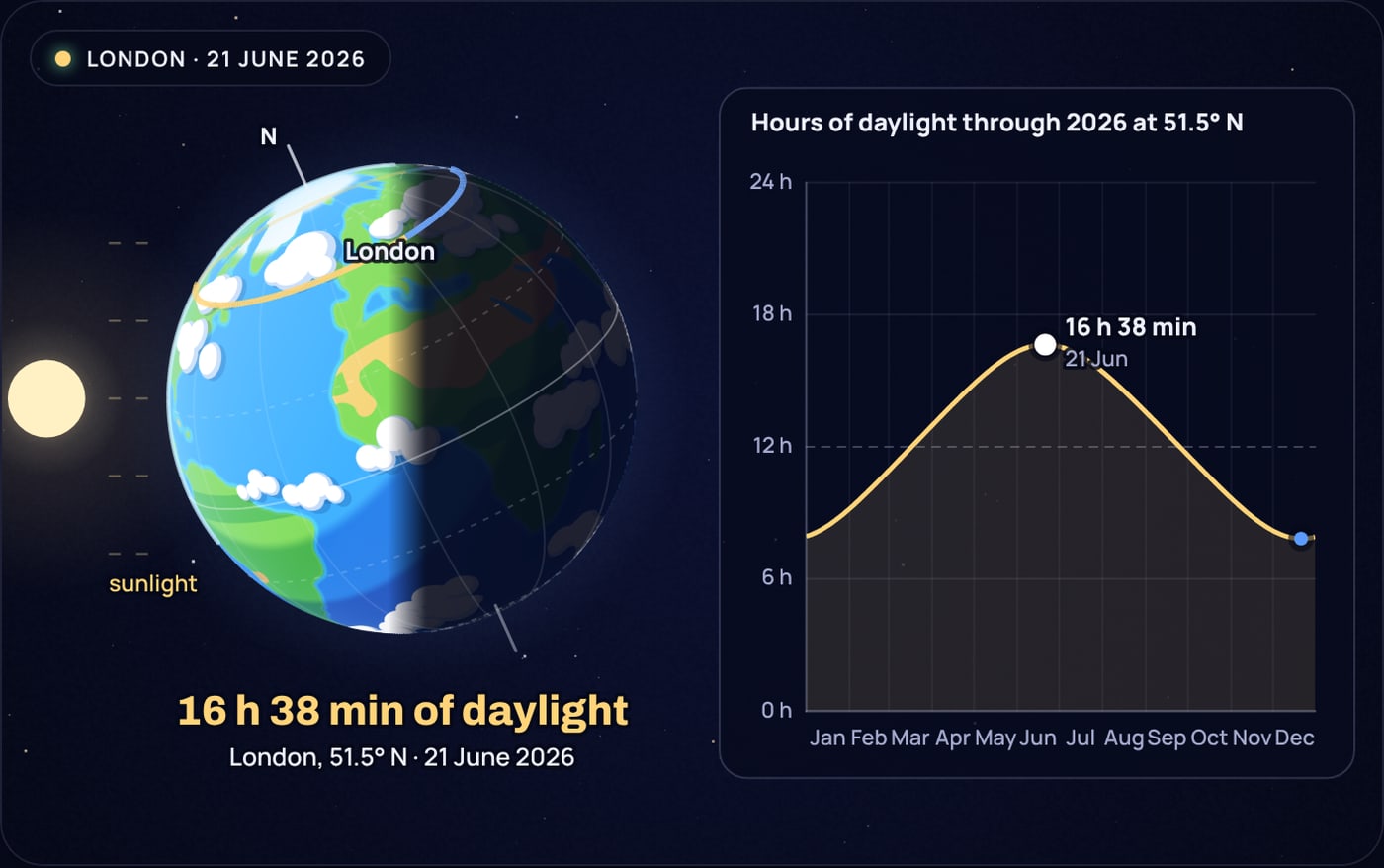
The higher your latitude, the smaller your circle and the more the tilt matters. At the equator the terminator always cuts the circle in half, whatever the season. At the Arctic Circle, 66.56° N, the June circle lies entirely in sunlight: the Sun does not set. The seasons simulation shows the same geometry from above as Earth orbits.
Distance from the Sun has nothing to do with it. Earth is closest to the Sun in early January, in the middle of the northern winter. The few percent difference in sunlight that causes is covered in how orbital eccentricity changes sunlight; it is small next to the effect of the tilt.
How do you calculate the hours of daylight?
Two angles do the work. Your latitude , and the Sun's declination , the latitude where the Sun is overhead at noon. The declination swings from +23.44° at the June solstice to −23.44° at the December solstice. Sunrise and sunset happen at an hour angle either side of noon, given by:
Here is the altitude of the Sun's centre at sunrise and sunset, the value used by NOAA and the US Naval Observatory. Earth turns 15° an hour, so the day length in hours is:
Example 1: London on the June solstice
Latitude 51.51° N, declination +23.44°.
Put in −23.44° for December and the middle term changes sign: cos H = +0.5198, H = 58.68°, and the day is 7.82 hours, or 7 h 50 min. The US Naval Observatory gives London's sunrise and sunset on 20 June 2024 as 03:43 and 20:21 UT, also 16 h 38 min.
The calculator does one more step. The declination drifts slightly between sunrise and sunset, by up to 0.4° a day around the equinoxes, so it recomputes the Sun's position at each event and solves again. That brings it to within a minute of the Naval Observatory's tables.
How many hours of daylight on the shortest day?
It depends almost entirely on latitude. Here are the longest and shortest days for 2026 from the calculator:
| Place | Latitude | Longest day | Shortest day |
|---|---|---|---|
| Singapore | 1.4° N | 12 h 12 min | 12 h 3 min |
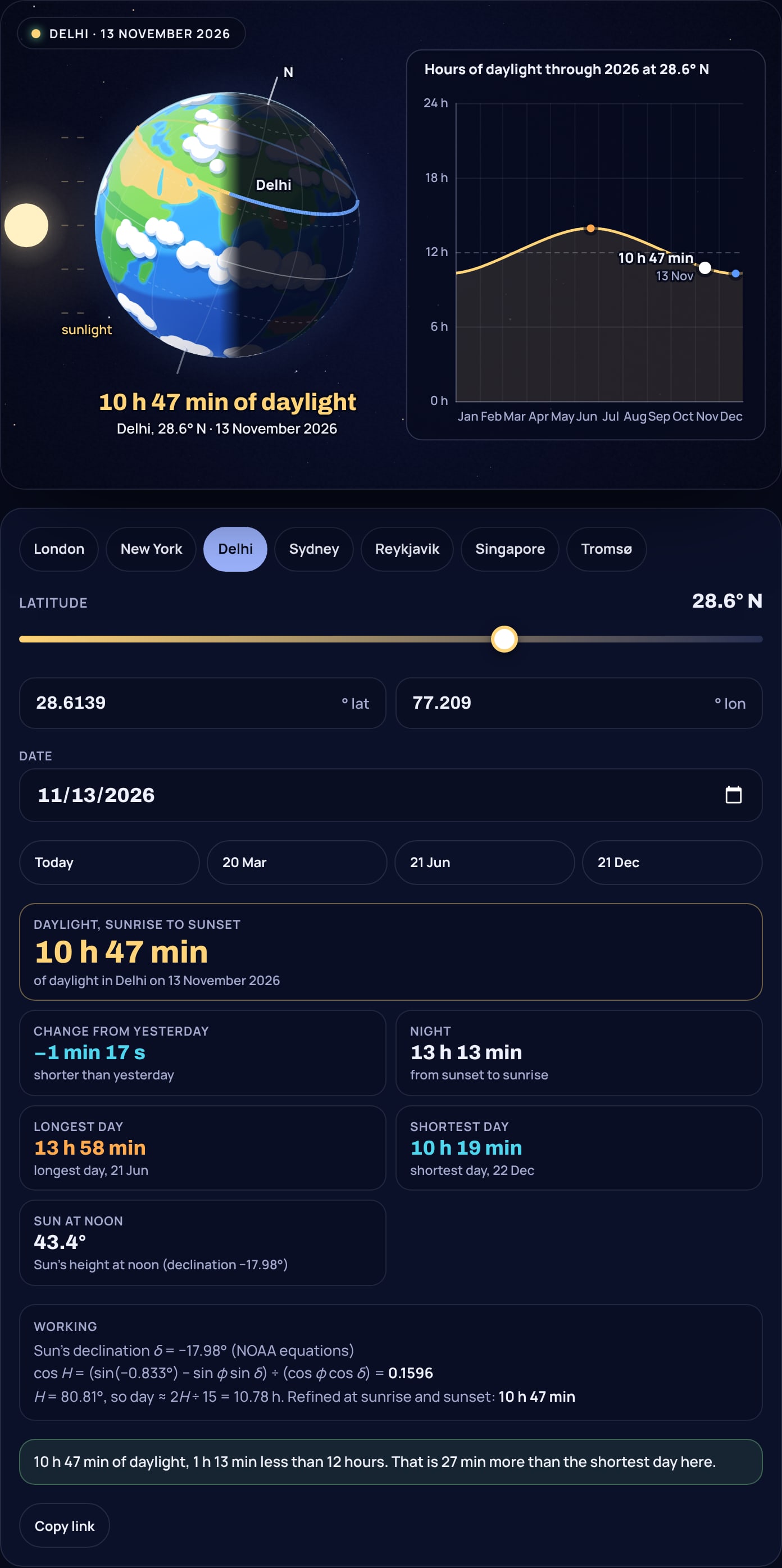
| Delhi | 28.6° N | 13 h 58 min | 10 h 19 min |
| Sydney | 33.9° S | 14 h 25 min (December) | 9 h 54 min (June) |
| New York | 40.7° N | 15 h 6 min | 9 h 15 min |
| London | 51.5° N | 16 h 38 min | 7 h 50 min |
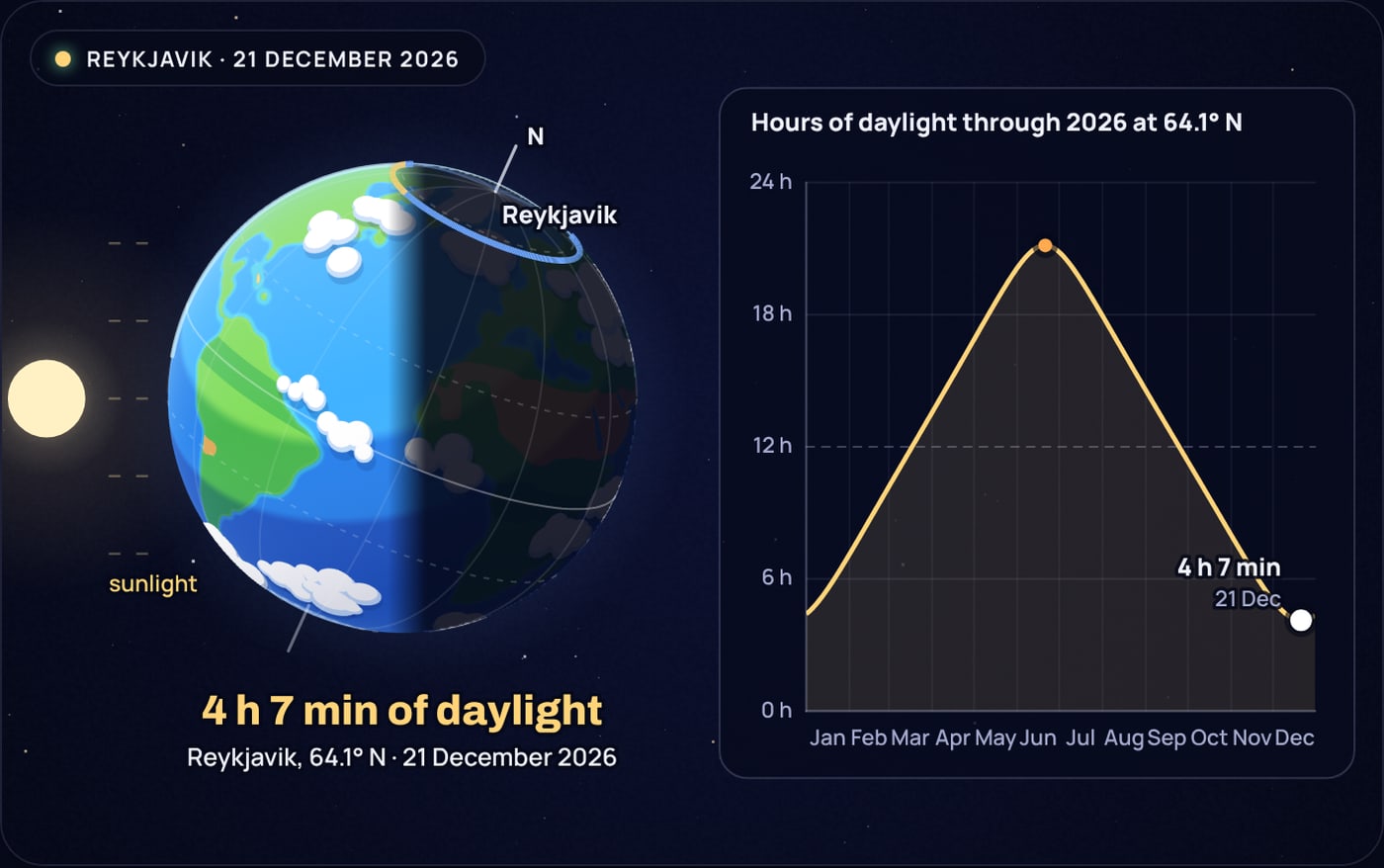
| Reykjavik | 64.1° N | 21 h 9 min | 4 h 7 min |
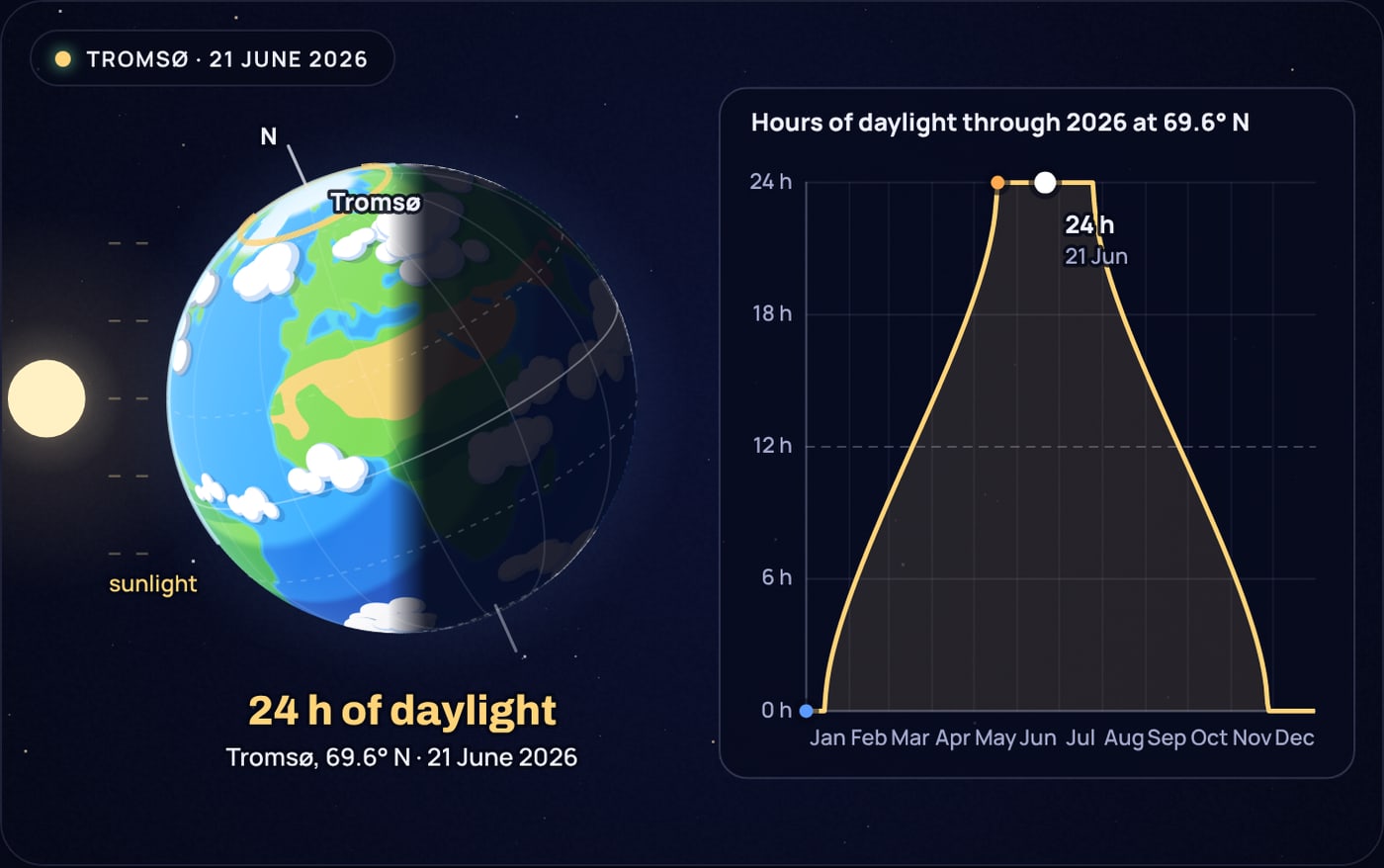
| Tromsø | 69.6° N | 24 h for 69 days | 0 h for 48 days |
Two things stand out. The range grows quickly with latitude: about 9 minutes in Singapore, 3 h 39 min in Delhi, almost 9 hours in London and 17 hours in Reykjavik. And the southern hemisphere runs the other way, so Sydney's longest day is in December.
What happens above the Arctic Circle?
Look at the formula again. If the right-hand side is less than −1, there is no angle whose cosine it equals: the Sun never gets down to −0.833°, so it never sets. If it is more than +1, the Sun never rises. That happens when your latitude plus the Sun's declination puts the whole latitude circle on one side of the terminator.
Tromsø in northern Norway, at 69.6° N, has 69 days of midnight sun in 2026 and 48 days on which the Sun does not rise. In between, the day length swings fast: on 13 November there are only 4 h 29 min of daylight left, and it is losing more than ten minutes a day. NOAA notes its equations get less accurate beyond about 72° latitude, because the Sun crosses the horizon at a shallow angle and small changes in refraction shift sunrise by many minutes.
Why is the equinox day longer than 12 hours?
At the equinox the Sun is over the equator, the declination is zero, and you might expect exactly 12 hours everywhere. The calculator gives a little more, and so does every sunrise table.
Example 2: the equator at the equinox
The extra 7 minutes come from the 0.833°: the Sun's centre has to be 0.833° below the horizon at sunrise and sunset, which the Earth takes about 3.3 minutes to turn through at each end.
That 0.833° has two parts. About 0.567° is refraction: air bends sunlight downward over the horizon, so you see the Sun while it is geometrically still below it. The rest, about 0.267°, is the Sun's radius, because sunrise counts from the first glint of the upper edge, not the centre. The same bending of light is behind the green flash at sunset. At higher latitudes the Sun rises at a slant, so the bonus grows: London's equinox day is 12 h 10 min and Tromsø's is 12 h 18 min.
When do the days get longer fastest?
The daylight curve is close to a sine wave, so it is flattest at the top and bottom and steepest in the middle. Around the solstices the day length barely changes for a week. Around the equinoxes London gains or loses about 4 minutes every day, roughly 28 minutes a week, which is why March evenings seem to stretch so quickly. Delhi changes by at most about 1 min 45 s a day; Reykjavik by more than 6 minutes.
One more surprise: the shortest day is not the day of the latest sunrise. In London the earliest sunset comes around 12 December and the latest sunrise around 30 December, because the Sun's noon drifts later by the clock through late December, an effect of Earth's elliptical orbit and its tilt called the equation of time. Day length still bottoms out on the solstice.
Try your own city: open the day length calculator, type your latitude, and press 21 Dec, then 21 Jun, to see your own longest and shortest days. For a sense of how fast you are actually moving round that latitude circle, see how fast is Earth moving.
Sources
- NOAA Global Monitoring Laboratory: Solar Calculation Details (equations after Meeus, 0.833° refraction allowance, accuracy within about a minute between ±72° latitude)
- US Naval Observatory: Sun and Moon data for one day (sunrise and sunset used to check London, New York, Delhi, Sydney, Reykjavik, Singapore and Tromsø)
- Jean Meeus, Astronomical Algorithms, 2nd edition (Willmann-Bell, 1998)
Frequently asked questions
Why are days longer in summer?
Because Earth’s axis is tilted 23.44 degrees. In summer your hemisphere leans towards the Sun, so the Sun sits north of the equator (for northern summer) and your latitude circle spends more than half of each rotation on the sunlit side of Earth.
How many hours of daylight are there on the shortest day?
About 7 h 50 min in London, 9 h 15 min in New York, 10 h 19 min in Delhi and 4 h 7 min in Reykjavik. Near the equator it is still about 12 hours, and north of the Arctic Circle the Sun does not rise at all.
Is the longest day always 21 June?
The June solstice falls on 20, 21 or 22 June depending on the year and your time zone. The day length changes by only seconds for several days either side, so the longest day is effectively a week long.
Why is the day longer than 12 hours at the equinox?
Sunrise is counted when the top edge of the Sun appears, and the atmosphere bends sunlight so the Sun is visible while it is still below the horizon. Together these add about 7 minutes at the equator and more at higher latitudes.
Do days get longer at the same rate all year?
No. The change is fastest around the equinoxes, when London gains or loses about 4 minutes a day, and almost zero around the solstices.