How Far Can You See From a Mountain or Tall Building?
Ride the lift to the Level 148 deck of the Burj Khalifa, 555 m above the ground, and look out over the Gulf. The line where sea meets sky is about 90 km away, and it took 555 m of height to push it there. Climb to the summit of Everest, 16 times higher, and the horizon only moves out to about 360 km, four times as far. Height buys distance, but at a square root rate.
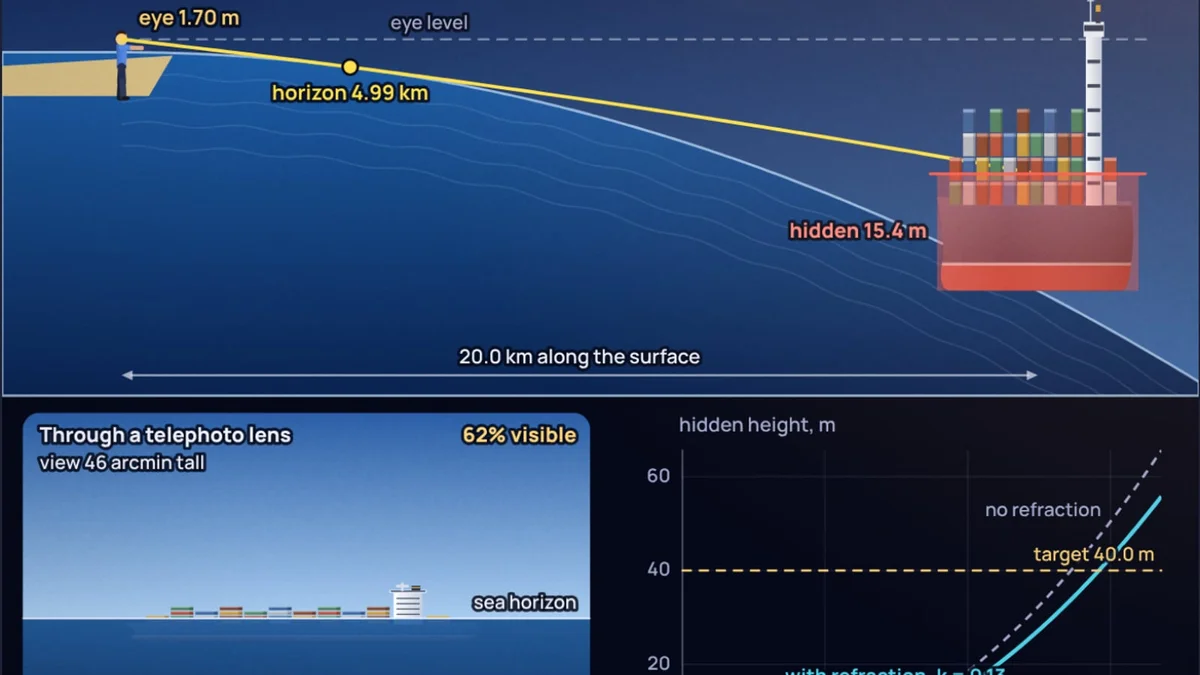
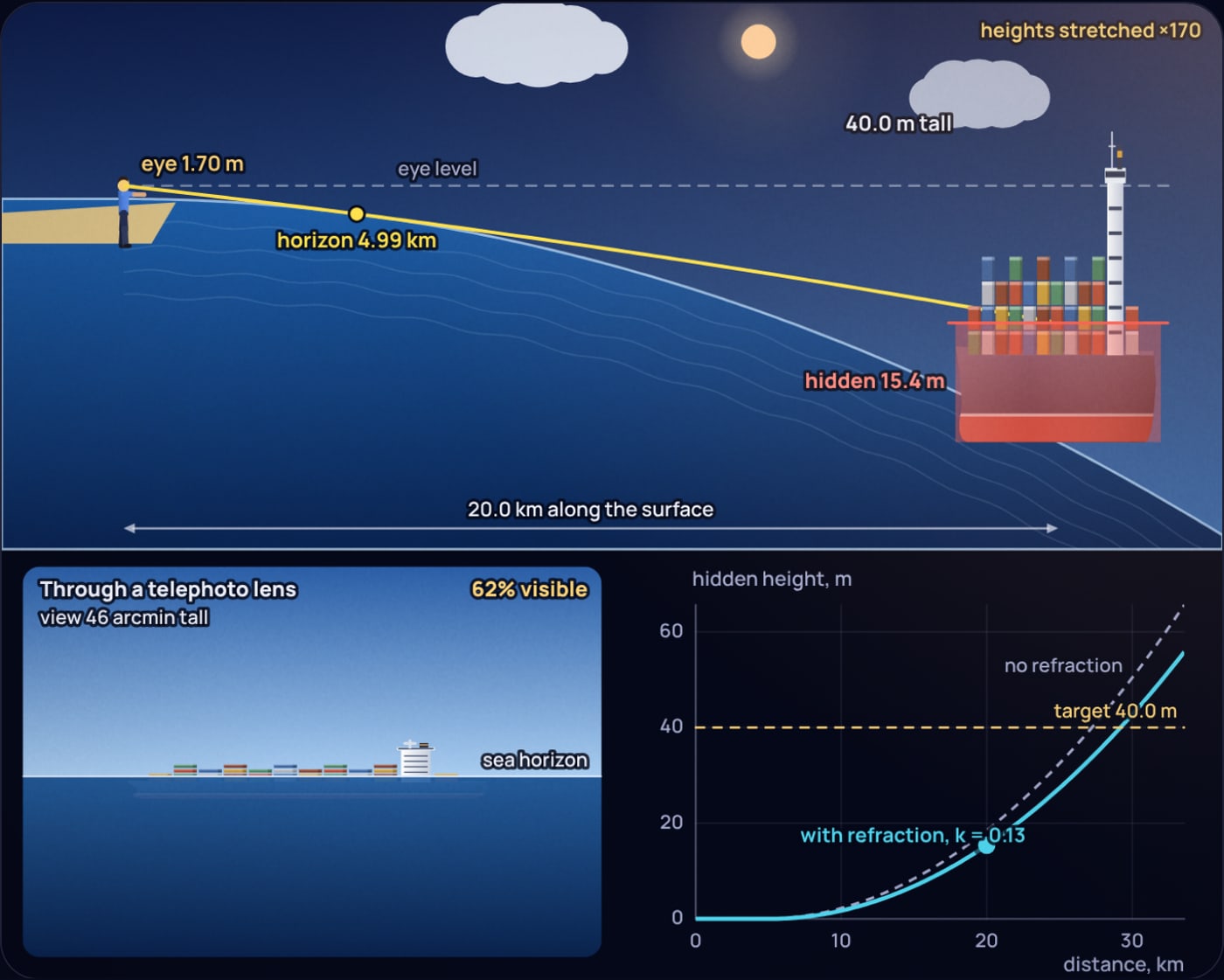
The Earth curvature calculator lets you set your eye height and a distant ship, tower or mountain, then shows the sight line grazing the curved sea and how much of the target it hides. This post answers the question people actually type into search: how far can you see from a mountain or a tall building, and how far away can a mountain or tower itself be seen?
How far is the horizon from a given height?
Your sight line to the horizon just touches the sea, so it meets Earth's radius at a right angle. Pythagoras on that triangle gives the distance, which our horizon distance guide derives step by step:
Air bends light slightly downward, because it is denser near the ground. Surveyors handle this with a refraction coefficient , a value Gauss measured in the 1820s, and it works out the same as using an Earth about 15% bigger, . The horizon then moves out by a factor , which turns 3.57 into 3.86.
,
With refraction:
Here is the same sum for a range of viewpoints. The dip is how far below eye level you look to see the horizon, a useful number because it explains why the horizon looks flat and level from almost anywhere you can stand.
| Viewpoint | Height | Horizon, geometry | Horizon, k = 0.13 | Dip below level |
|---|---|---|---|---|
| Standing on a beach | 1.7 m | 4.7 km | 5.0 km | 0.04° |
| Third floor balcony | 10 m | 11.3 km | 12.1 km | 0.09° |
| 30 floor tower in Mumbai | 100 m | 35.7 km | 38.3 km | 0.30° |
| Burj Khalifa, Level 148 | 555 m | 84.1 km | 90.2 km | 0.71° |
| A 2,000 m hill station ridge | 2,000 m | 159.6 km | 171.1 km | 1.34° |
| Pic de Finestrelles, Pyrenees | 2,826 m | 189.7 km | 203.4 km | 1.59° |
| Summit of Everest | 8,849 m | 335.6 km | 359.8 km | 2.82° |
| Airliner at 35,000 ft | 10,668 m | 368.4 km | 395.0 km | 3.09° |
One caution for the mountain rows: the horizon here is the sea-level horizon. From a peak in the Himalaya or the Western Ghats, the ground around you is not at sea level and other ridges usually block the view long before the curve does. The numbers are the ceiling, not the typical view.
How far away can you see a mountain or a tall building?
This is the question the horizon formula alone does not answer. A tall object has its own horizon. Its summit can see the sea out to a distance , and you can see its summit as long as the two horizons meet or overlap. So the greatest distance is simply the sum:
From a beach, a 100 m tower drops fully out of sight at 43 km with normal refraction. The Burj Khalifa's tip, at 828 m, goes at 115 km. Everest's summit could in principle be seen from about 365 km, if there were a sea at its foot and perfectly clean air.
Before it disappears, a distant object goes in stages: first the base, then more and more of it, from the bottom up. The part hidden at distance is roughly , where is your own horizon distance.
Eye height 1.7 m, so with refraction your horizon is and
So 616 m of the 828 m tower is hidden and the top 212 m shows. Without refraction, 714 m is hidden.
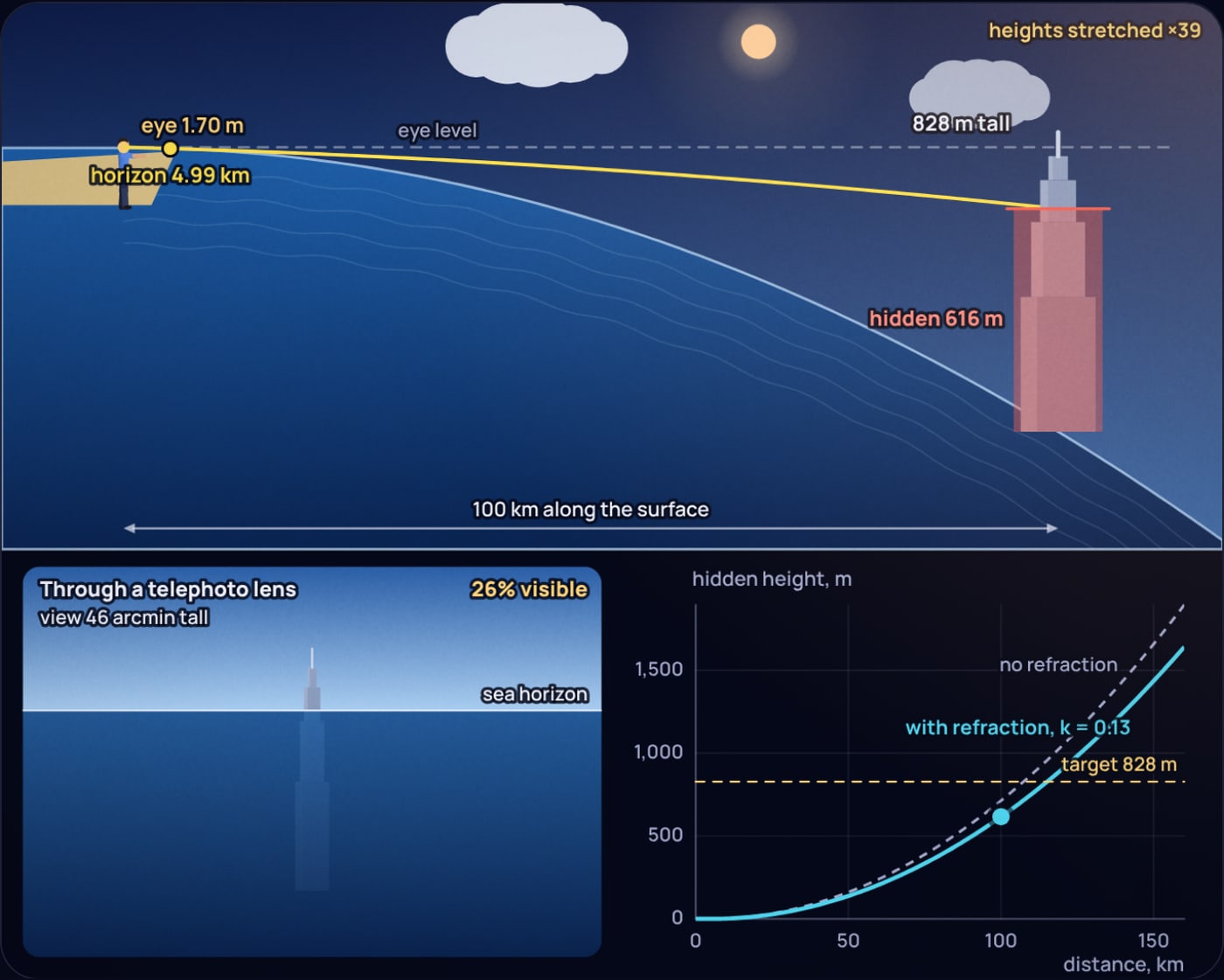
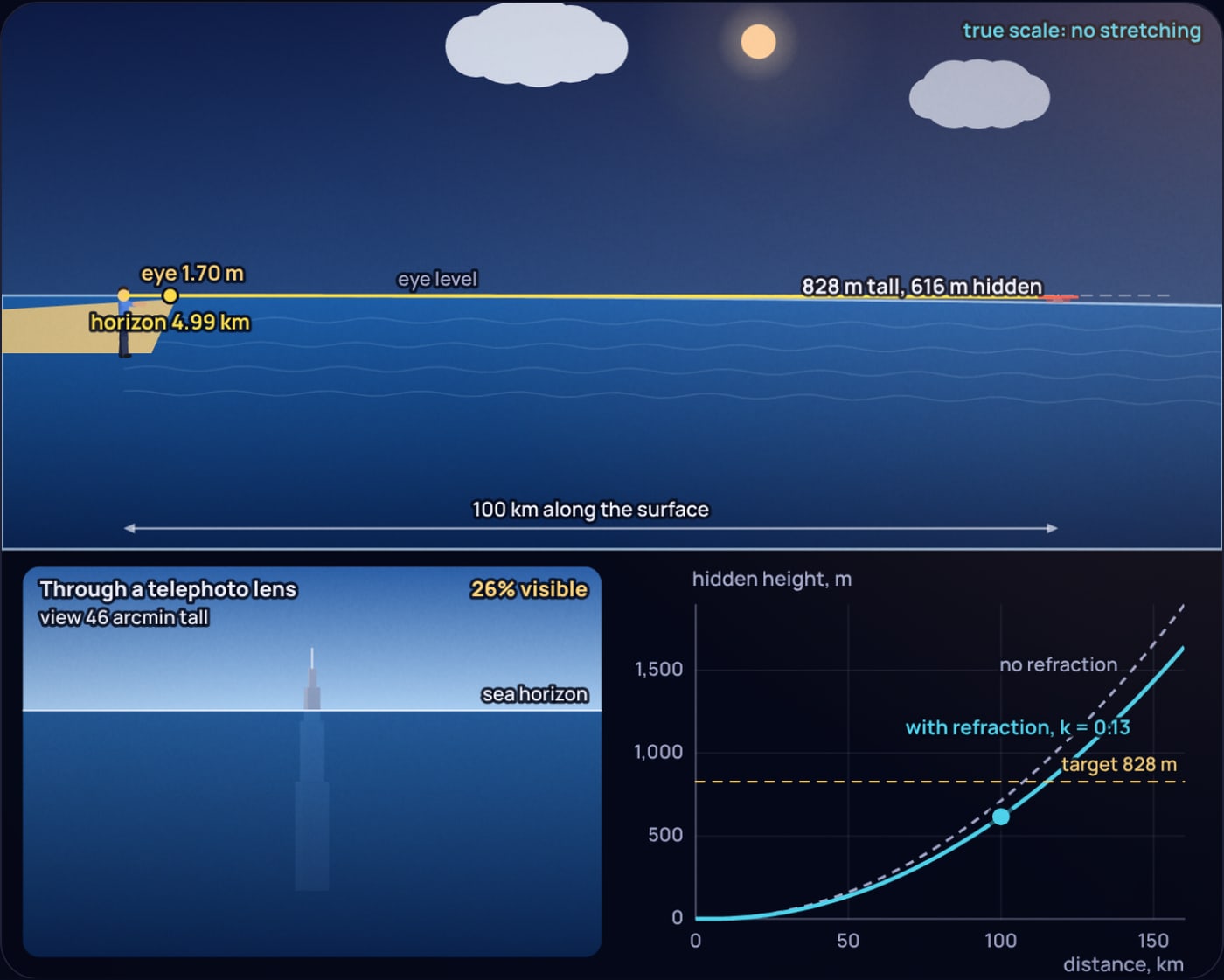
The side view in Figure 2 stretches heights 39 times. Switch the simulator to True scale and the same scene is a nearly straight line: across 100 km the sea bulges only about 200 m above the chord between the two ends, a fifth of a percent of the distance. That is why a curve that hides a 600 m chunk of skyscraper is invisible to the eye.
What is the longest line of sight ever photographed?
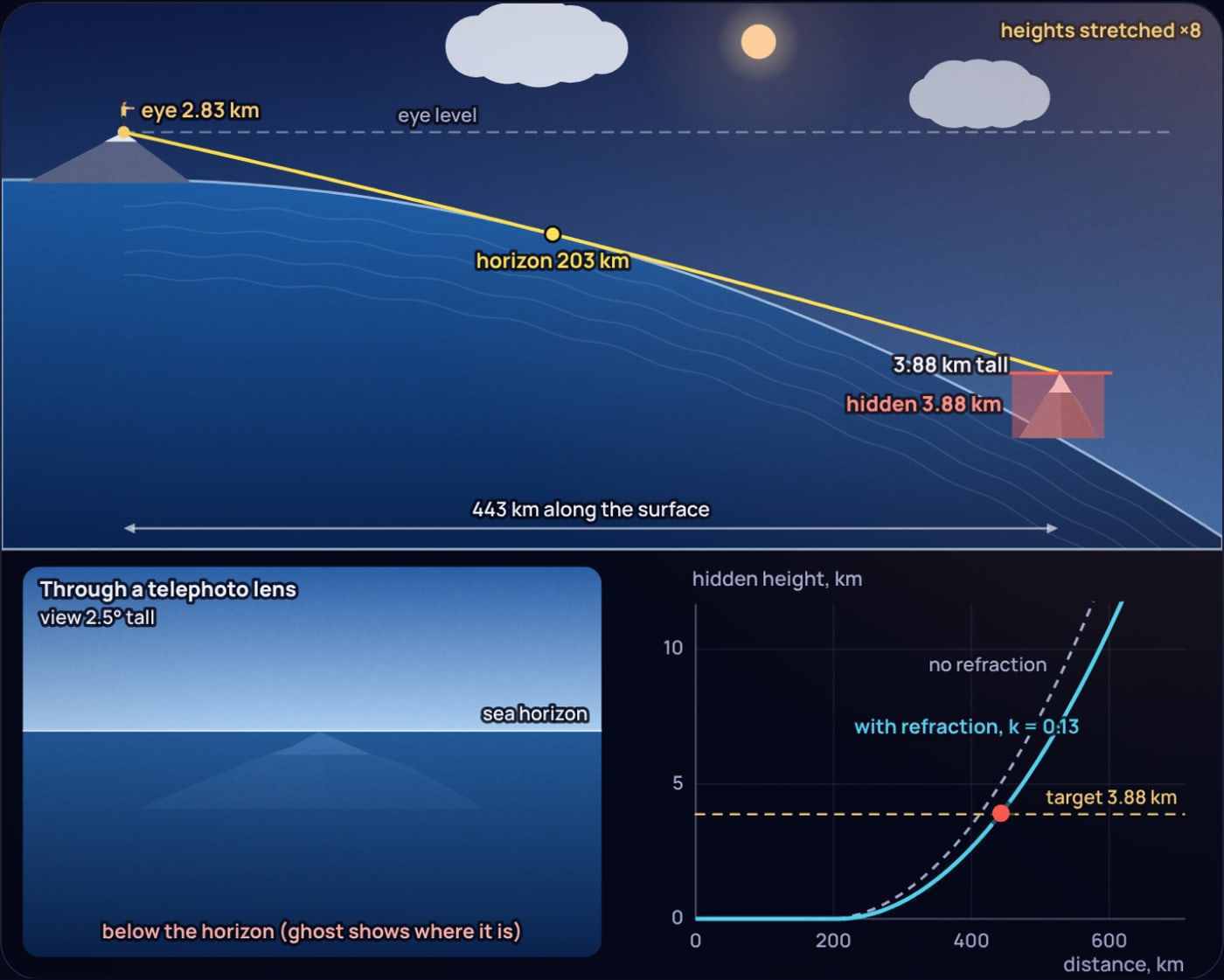
For years the record people quoted was Marc Bret's photograph of 16 July 2016: Pic Gaspard (3,883 m) in the French Alps, seen at dawn from Pic de Finestrelles (2,826 m) in the Pyrenees, 443 km away. Guinness World Records now lists 493.07 km, photographed by Richard Jezik near Giresun, Turkey, on 15 December 2024.
The 443 km photo makes a good test of the formula. Pure geometry gives horizons of 189.7 km and 222.4 km, which add to only 412 km, so by geometry alone the summit would be 31 km beyond the limit. With the standard the horizons stretch to 203.4 km and 238.4 km, a total of 441.8 km. That is still about 1 km short, which in hidden height means the summit sits about 38 m below the sight line.
Solving for the refraction needed gives , a hair above standard. Cold dawn air over the Gulf of Lion, which the line crosses, does that easily. So the photograph does not break the geometry; it sits right at its edge, on a morning with slightly stronger bending than average.
Can refraction let you see things that should be hidden?
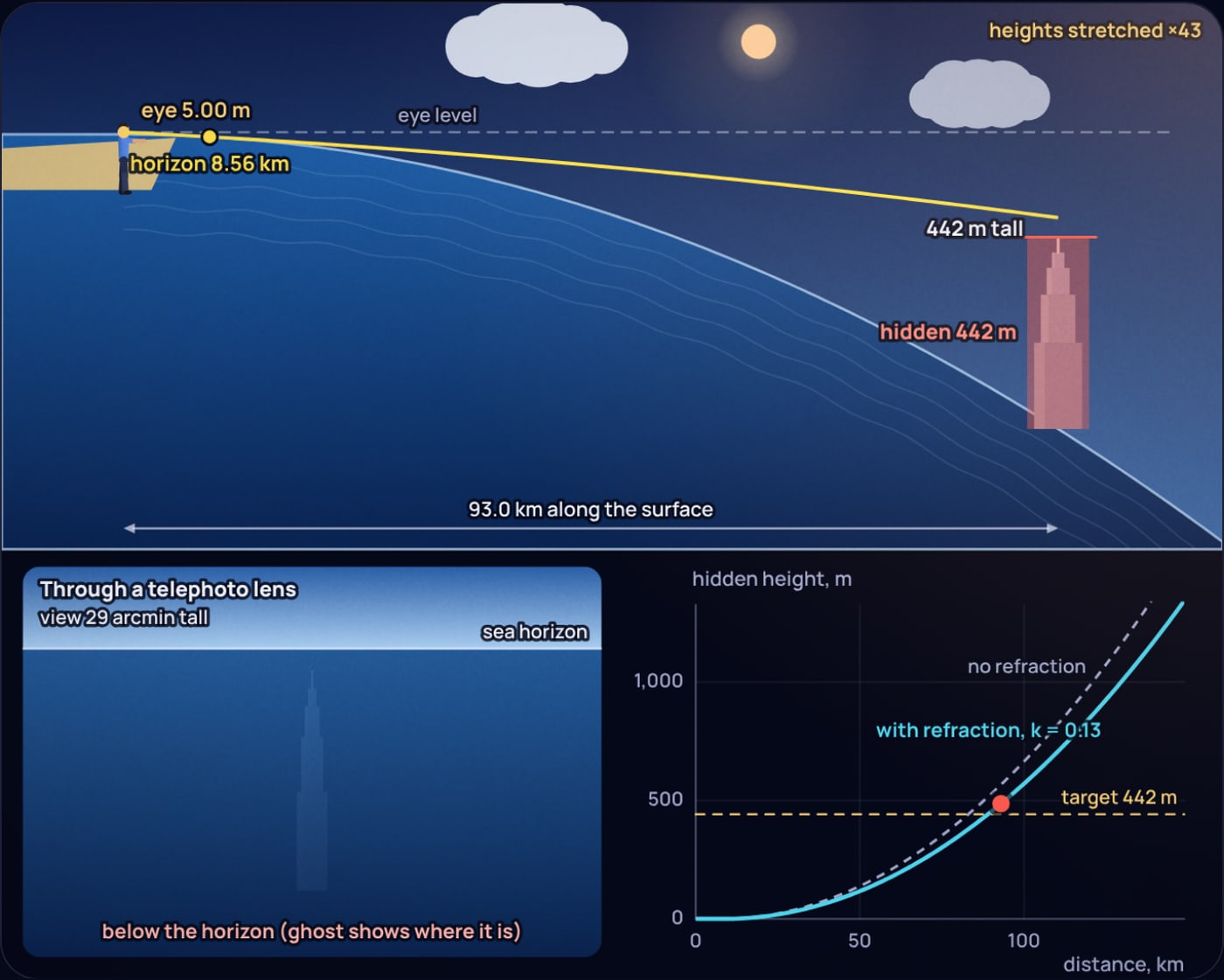
Yes, and sometimes dramatically. On spring days warm air flows over cold water, the temperature rises with height instead of falling, and light bends down strongly enough to follow the curve for a while. That is a superior mirage, and it is behind the photos of the Chicago skyline taken from the Michigan shore of Lake Michigan, roughly 93 km (58 miles) away measured on a map; local news put it at almost 60 miles.
Run the numbers for a normal day. From 5 m above the lake the curve hides 487 m at 93 km with standard refraction, more than the 442 m roof of the Willis Tower. The tip of the tower needs of about 0.20 to peek over. With , a plausible inversion value, the hidden part drops to 262 m and the top 180 m of the tower appears. Local news stations covered the photos as mirages for exactly this reason: on most days, from that beach, Chicago is invisible.
The opposite happens over hot ground. Air near a sun-baked road or desert is hotter and thinner than the air above, light bends upward, goes negative and distant objects sink further than geometry says. Anyone who has watched a highway shimmer in Rajasthan in May has seen the effect.
The misconception: “8 inches per mile squared” is not what is hidden
Flat Earth arguments often lean on this rule. It says the surface drops 8 inches times the distance in miles squared below a level line, so at 20 miles it drops 3,200 inches, 267 ft. Then a building or ship 20 miles away that shows more than its top 267 ft is claimed as proof of a flat Earth.
The rule is a fine approximation of the drop below a level line that starts at the ground under your feet. But your eyes are not on the ground. Your sight line starts above the water, grazes the sea at your horizon, and only starts to lose ground after that. For a 6 ft observer and a target 20 miles away the real hidden height is 193 ft by geometry and about 163 ft with standard refraction, not 267 ft. Use the right formula and the "impossible" photos are ordinary.
Why does the horizon look flat from a mountain or a plane?
Because the dip is tiny. From the top of Everest the horizon is only 2.82 degrees below eye level, and from an airliner 3.09 degrees. Across a view 60 degrees wide, the horizon bows by a fraction of a degree. Your eyes, and most camera lenses, cannot separate that from a straight line, and wide-angle lens distortion is often bigger than the real curve. Curvature becomes obvious only from far higher, where a wide view takes in thousands of kilometres.
What actually limits how far you can see?
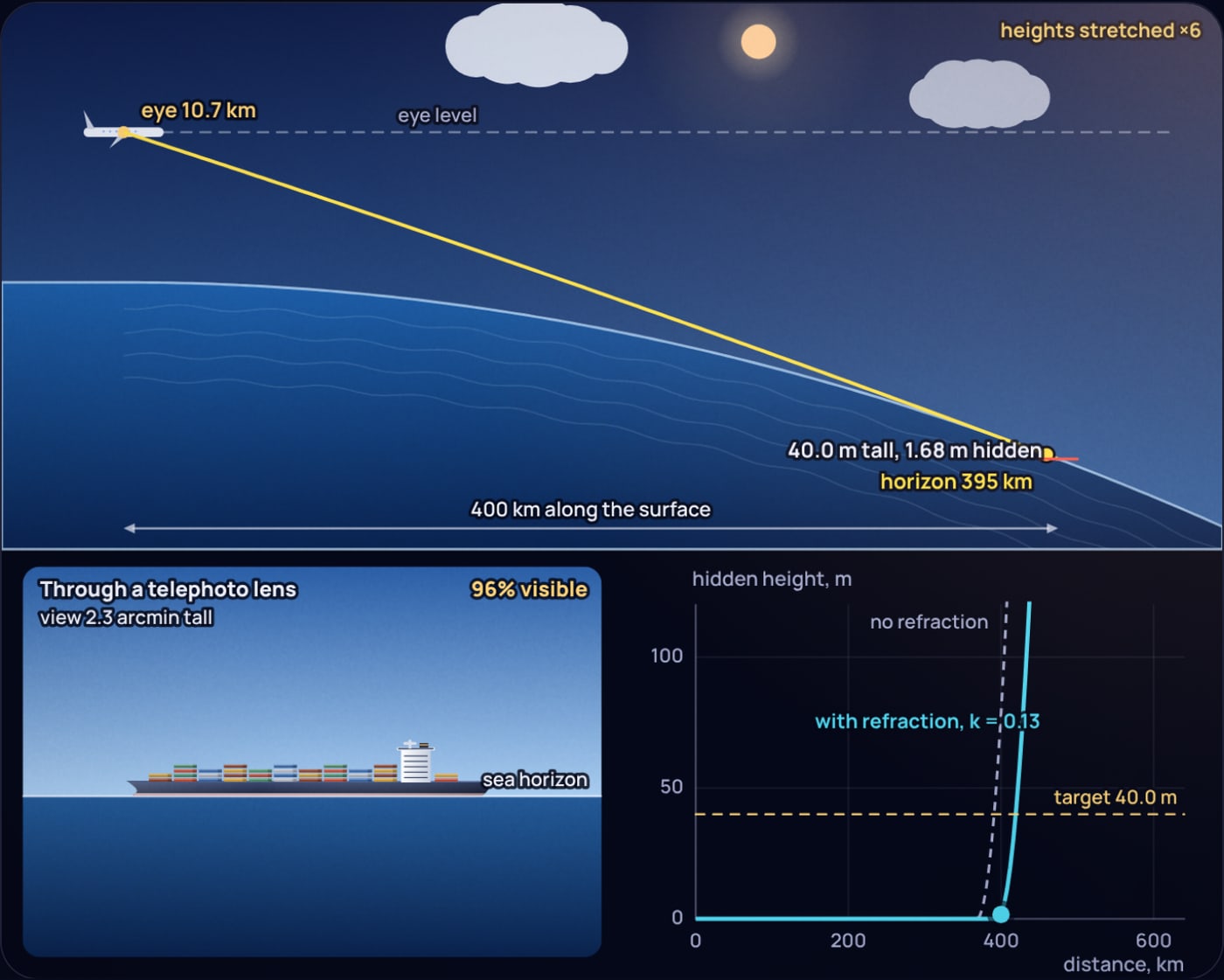
Almost always the air, not the curve. Molecules and particles scatter light, so distant objects fade towards the sky colour. In very clean mountain air the theoretical limit is a few hundred kilometres. Over the Indo-Gangetic plain in winter, visibility can fall below a kilometre in smog and fog. The Himalaya is visible from parts of Punjab and Bihar only on the clearest days, often after rain has washed the dust out, which is why such sightings make the news.
The size of the object matters too. Your eye resolves about one arcminute. A 40 m ship 100 km away is about 1.4 arcminutes tall, barely a dot. A big mountain stays visible to the limit set by haze and curvature because it is so large.
Try it yourself
Open the 443 km Pyrenees to Alps preset, then lower the refraction to None and watch the summit sink about 1.2 km below the sight line. Or load the Mumbai from Elephanta preset, where at 10 km the curve hides only the bottom 1.4 m of the city. For more on why the low Moon looks bigger near that same horizon, read why the Moon looks huge near the horizon, and for how fast the ground under you is really moving, see how fast is Earth moving.
Sources
- Pic Gaspard, Wikipedia (Marc Bret photograph, 16 July 2016, 443 km)
- Pic de Finestrelles, Wikipedia (summit 2,826 m)
- Beyond Horizons: Finestrelles to Pic Gaspard, 443 km
- Guinness World Records: Longest line of sight on Earth photographed (493.07 km, 2024)
- Guinness World Records: Burj Khalifa At the Top SKY, level 148, 555 m
- ABC57: Mirage of Chicago skyline seen from Michigan shoreline
- Elephanta Island, Wikipedia (about 10 km from the Mumbai shore)
Frequently asked questions
How far can you see from the top of a mountain?
To the sea-level horizon, about 3.57 times the square root of your height in metres, in kilometres, or about 3.86 times with normal refraction. From 2,000 m that is 160 km by geometry and 171 km with refraction. From the summit of Everest it is 336 km and 360 km.
How far can you see from the Burj Khalifa?
From the Level 148 observation deck at 555 m the sea horizon is 84 km away by pure geometry and about 90 km with normal refraction. Another tall object can be seen from farther, because its own horizon adds on: the tip of a 40 m ship would just show at about 114 km. Dubai haze usually limits the real view to much less.
How far away can a mountain be seen?
Add the mountain’s horizon distance to yours. The summit of Everest, 8,849 m, has a horizon 360 km away with standard refraction, so from a beach it could in principle be seen from about 365 km. The longest photographed line of sight is 493 km (Guinness, 2024), and the famous 443 km Pyrenees to Alps photo needed slightly stronger than normal refraction.
Does the horizon distance double if you double your height?
No. Horizon distance grows with the square root of height, so doubling your height multiplies the distance by about 1.41. To double the distance you need four times the height: 4.7 km at 1.7 m becomes 9.3 km at 6.8 m.
Why can I not see as far as the formula says?
The formula is geometry. The real limit is usually the air: haze, humidity and dust scatter light so that distant objects fade into the sky. On a typical hazy day in the plains of India, visibility of 5 to 20 km is common, far short of what the curve allows.
 50 Hilarious Physics Jokes That Will Make You Laugh
 Could Ant-Man Really Shrink? The Physics Says No