How much does the curve of the Earth hide?
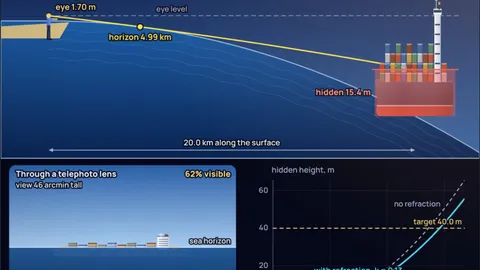
From a beach, with your eyes 1.70 m above the water, the sea horizon is 4.65 km away by pure geometry and about 4.99 km with normal atmospheric refraction. Anything farther away loses its bottom part behind the bulge of the water: a ship 20.0 km out has its lowest 15.4 m hidden (18.5 m with no refraction). The amount hidden depends on two horizons, yours and the target's, which is why height matters so much.
The calculator uses Earth's mean radius of 6,371 km and the standard surveyor's refraction coefficient k = 0.13, which treats the ray as straight over an Earth about 15% larger. Switch refraction off to see the bare geometry, or to "Mirage" (k = 0.5) for the cold-water inversions that make distant skylines loom. Our horizon distance guide derives the basic formula; this page is about what the curve hides and the record sight lines.
Key results from the simulation
- Horizon distance grows as the square root of height: 4.99 km from 1.7 m, 12.1 km from 10 m, 38.3 km from 100 m, 110 km from the top of the Burj Khalifa and 395 km from an airliner at 35,000 ft (standard refraction).
- Hidden height is not "8 inches per mile squared": for a 6 ft observer and a target 20 miles away that rule gives 267 ft, but the true hidden height is 193 ft without refraction and 163 ft with it, because your eyes are above the water.
- Two horizons add up: a target's top just disappears at your horizon plus its own. A 40 m ship seen from a beach vanishes completely at 29.2 km; the Burj Khalifa at 115 km.
- Refraction matters at long range: at 100 km it changes the hidden part of the Burj Khalifa from 714 m to 616 m. The famous 443 km Pyrenees to Alps photo only works with k above about 0.135.
Six real sight lines
Each case loads a preset in the simulator. Heights are above sea (or lake) level, distances are along the surface, and the hidden heights use standard refraction (k = 0.13) unless stated.
A ship sinking hull first from a beach
Eye 1.7 m, ship 40 m tall, 20.0 km awayStand at the waterline and watch a container ship with its bridge 40.0 m above the water head out to sea. Your horizon is 4.99 km away. Once the ship passes it, the hull starts to disappear from the bottom up. At 20.0 km the lowest 15.4 m is behind the curve and 62% of the ship still shows. The top of the bridge drops out of sight at 29.2 km.
Hull-first disappearance is one of the oldest arguments for a round Earth, already used by Greek and Roman writers. A zoom lens does not bring the hull back, because the water itself is in the way. That is what the telephoto panel in the simulation shows.
Mumbai high-rises from Elephanta Island
Eye 2 m, 200 m towers, 10.0 km awayElephanta Island sits about 10.0 km across the harbour from the Gateway of India. From the jetty, eyes about 2.00 m up, the horizon is 5.41 km away, so the far shore is already beyond it. The curve hides only the bottom 1.44 m of the city, about the height of a doorway. A 200 m tower is 99% visible.
This is the useful lesson of short sight lines: across a harbour or a lake the curve is real but small, and haze, waves and the shoreline itself usually hide more than geometry does. The hidden height grows with the square of the distance past your horizon, so doubling the distance does far more than double it.
The Burj Khalifa from a boat 100 km out
Eye 1.7 m, 828 m tower, 100 km awayAt 828 m the Burj Khalifa has its own horizon 110 km away. From a small boat 100 km off the coast, the bottom 616 m of the tower is behind the sea and the top 212 m pokes up, roughly the spire and the upper setbacks. Without refraction the hidden part would be 714 m.
The tip finally sinks at 115 km. In practice Gulf haze usually hides it long before that: a visibility of 100 km needs unusually clean air, which is the real limit on most long views.
The Chicago skyline from Michigan
Eye 5 m, 442 m tower, 93.0 km across the lakePhotographs of the Chicago skyline taken from the Michigan shore of Lake Michigan, roughly 93.0 km (about 58 miles) away, are a favourite of flat Earth videos. Run the numbers: from 5.00 m above the lake, the curve hides 487 m at that distance with standard refraction, more than the 442 m roof of the Willis Tower. On a normal day the whole skyline should be below the horizon, and it is.
The photos are taken on the rare days with a strong temperature inversion over cold lake water, when light bends enough to follow the curve. Local news covered them as a superior mirage. Even the tip of the tower needs k above about 0.20; at k = 0.5 the hidden part shrinks to 262 m. Switch the refraction setting to see the skyline rise.
Pic Gaspard from the Pyrenees: the 443 km photograph
Eye 2.83 km, summit 3.88 km, 443 km awayOn 16 July 2016 Marc Bret photographed Pic Gaspard (3.88 km) in the French Alps from the summit of Pic de Finestrelles (2.83 km) in the Pyrenees, 443 km away, at dawn. It held the record for the longest photographed line of sight until a 2024 photo from Turkey (Guinness lists 493 km). The two horizons add to 442 km with standard refraction and only 412 km without, so geometry alone would put the summit well below the line.
With k = 0.13 the summit is just 38.1 m short. It needs k of about 0.135 or more, a little above standard, which is ordinary for cold dawn air over the Gulf of Lion. Both summits are also above most of the haze. The simulation shows the sea-level version of the line; the real one crosses the Mediterranean, so that is close to the truth.
From an airliner window at 35,000 ft
Eye 10.7 km, ship 400 km awayAt a cruising height of 10.7 km (35,000 ft) the horizon is 395 km away and sits 3.09 degrees below eye level. A ship 400 km out has only 1.68 m hidden. That sounds like a view across a whole country, and geometrically it is.
What you actually see is set by haze and contrast: a ship 400 km away would be a fraction of a pixel to your eye. The horizon also looks flat from an airliner because a 3.09 degree dip and the gentle curve across a narrow window are hard to perceive. Curvature becomes obvious only from much higher, where a wide-angle view takes in thousands of kilometres.
Horizon distance and what hides beyond it
| Eye height | Horizon, no refraction | Horizon, k = 0.13 | Dip below level | Hidden at 20 km | Hidden at 50 km |
|---|---|---|---|---|---|
| 1.70 m | 4.65 km | 4.99 km | 0.04° | 15.4 m | 138 m |
| 10.0 m | 11.3 km | 12.1 km | 0.09° | 4.26 m | 98.1 m |
| 30.0 m | 19.6 km | 21.0 km | 0.16° | 0 m | 57.6 m |
| 100 m | 35.7 km | 38.3 km | 0.30° | 0 m | 9.39 m |
| 500 m | 79.8 km | 85.6 km | 0.67° | 0 m | 0 m |
| 2.00 km | 160 km | 171 km | 1.34° | 0 m | 0 m |
| 10,668 m (35,000 ft) | 368 km | 395 km | 3.09° | 0 m | 0 m |
Mean Earth radius 6,371 km, distances along the surface, hidden heights with k = 0.13. Real refraction varies with the weather, see the limits below.
How the calculator works
Horizon. An eye h above a sphere of radius R sees the surface touch its sight line at a distance d = R·arccos(R ÷ (R + h)) along the ground, which is very close to √(2Rh). With R = 6,371 km that is about 3.57√h km for h in metres.
Hidden height. Past the horizon the grazing ray rises away from the surface. At a distance D the ray is R ÷ cos((D − d) ÷ R) − R above the surface, roughly (D − d)² ÷ 2R. Anything under that height at the target is hidden, so a target taller than it shows its top. The greatest distance at which the top can be seen is your horizon plus the target's own horizon.
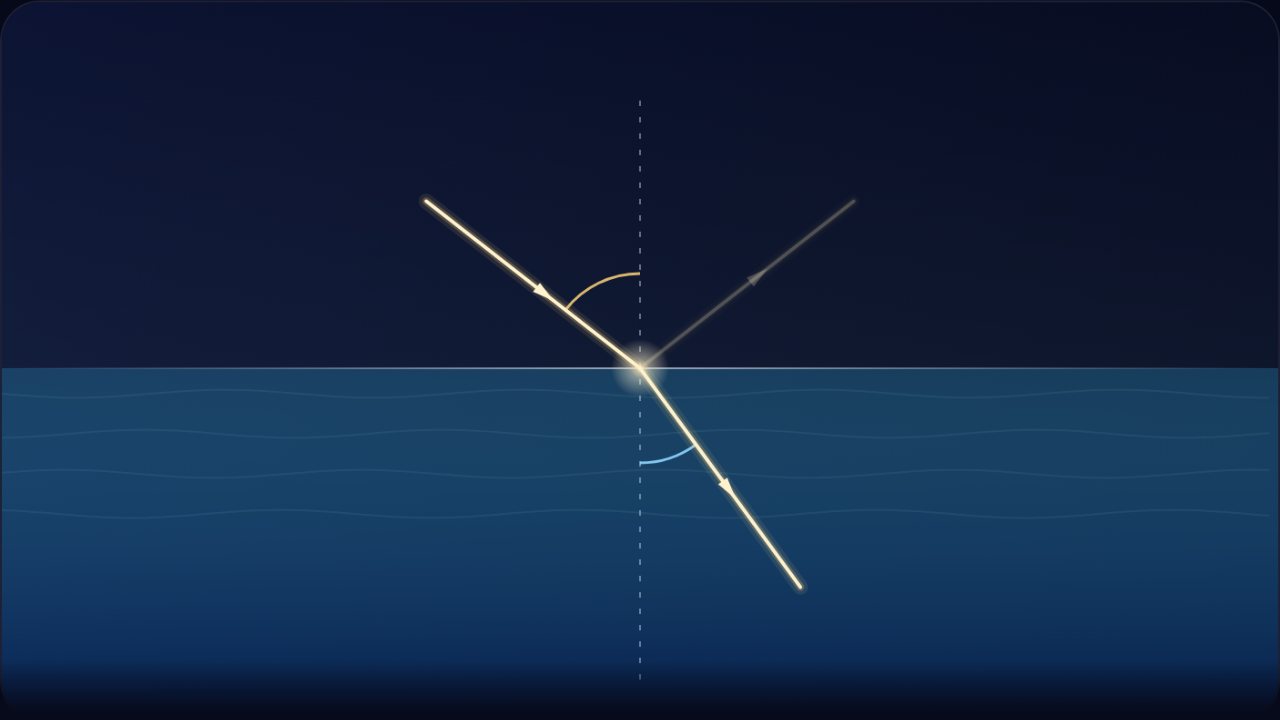
Refraction. Air density falls with height, so light bends slightly downward. Surveyors describe it with a coefficient k, the ratio of the ray's curvature to the Earth's. Gauss measured k = 0.13 in his Hannover survey in 1826, and it is still the standard value; many manuals use 0.14 (one seventh). Bending the ray with curvature k ÷ R is mathematically the same as a straight ray over an Earth of radius R ÷ (1 − k), and the calculator uses that effective radius. The side view draws the true Earth and bends the ray, so the hidden height you read off the picture is right.
The pictures. The side view stretches heights by the factor shown in its corner, because at true scale even a 443 km sight line bulges by only a few kilometres in the middle; the True scale button proves it. The telephoto panel uses exact angles: the elevation of the horizon, the target base and the target top as seen from the eye, zoomed until the target fills the frame, with the sea drawn over the hidden part.
What the model leaves out
- Weather-dependent refraction: k is about 0.13 on an average day but can fall below zero over hot ground (things sink, an inferior mirage) or rise above 1 over cold water (a superior mirage, where the horizon itself lifts). The Mirage button shows k = 0.5 as an example, not a forecast.
- Terrain between you and the target: the model assumes open water or flat land at sea level all the way. A hill, island or the target's own foreground ridge can hide more.
- Haze and contrast: the calculator says what is geometrically above the horizon. Whether you can make it out depends on visibility, light and your optics, and usually ends far sooner.
- Waves and tides: a sea with 1 m waves raises the effective horizon a little, and tide changes your eye height above the water.
- Earth's shape: Earth is slightly flattened and the radius of curvature changes with latitude and direction by up to about 1 percent. The calculator uses the mean radius.
Common misconceptions
"Curvature drop is 8 inches per mile squared, so the hidden height is that." The rule gives how far the surface falls below a level line drawn from a point on the ground. It ignores your eye height. For a 6 ft observer and a target 20 miles away the rule says 267 ft, but only 193 ft is hidden, or 163 ft with normal refraction.
"If I can see a distant skyline, the Earth must be flat." A visible skyline at long range usually means strong refraction. The Chicago from Michigan photos are taken on inversion days; on a normal day the 442 m Willis Tower is fully hidden at 93.0 km, and that is what people see most days.
"A good zoom lens brings back what is over the horizon." Zoom magnifies what reaches the lens. The lower part of a distant ship is blocked by water, so no lens can see it.
Frequently asked questions
How much of an object is hidden by the curvature of the Earth?
Work out your horizon distance d ≈ 3.57√h km (h in metres), subtract it from the distance to the object, and the hidden height is about (D − d)² ÷ 2R. For eyes 1.7 m up and a target 20 km away that is 18.5 m, or 15.4 m with normal refraction.
How far away can you see a tall building or mountain?
Add your horizon distance to the object's own. From a beach, a 100 m tower disappears completely at 43.3 km and an 828 m tower at 115 km, with standard refraction. Haze usually limits the view before geometry does.
What is the longest line of sight ever photographed?
Guinness World Records lists 493.07 km, photographed by Richard Jezik from Giresun, Turkey, on 15 December 2024. The earlier famous record was Marc Bret's 2016 photo of Pic Gaspard in the Alps from Pic de Finestrelles in the Pyrenees, 443 km away.
Why can I sometimes see a city that should be hidden by the curve?
Warm air over cold water bends light downward much more than usual, a superior mirage. In the calculator, raising k from 0.13 to 0.5 cuts the hidden part of the Chicago skyline seen from Michigan from 487 m to 262 m.
What refraction coefficient should I use?
For average daytime conditions use k = 0.13 (Gauss) or 0.14 (one seventh), which is the same as computing with an Earth radius about 15 to 16 percent larger. Over water at dawn it is often higher, and over sun-heated ground it can be lower or even negative.
Keep learning
How Far Can You See From a Mountain or Tall Building?
From the Burj Khalifa deck the sea horizon is 90 km away; from Everest, 360 km. How far you can see, and why distant peaks need two horizons added.
How Far Is the Horizon? Formula, Refraction, Examples
At 1.7 m eye height the sea horizon is 4.7 km away, about 5 km with refraction. The formula, how far you can see tall objects, and the 8 inches per mile error.

Why does the Moon look huge near the horizon? Try this camera test
The Moon illusion feels convincing. A controlled photo comparison separates perception from orbital size changes, colour, and atmospheric distortion.

How Fast Is Earth Moving Through Space? Every Frame
Earth spins at up to 465 m/s, orbits at 29.8 km/s and moves at 370 km/s relative to the CMB. How each speed is measured, and why they don't add.