How Much Magnification Do You Need to See Saturn's Rings?
Saturn's rings span about 45 arcseconds from tip to tip at their largest. The full Moon is about 1,900 arcseconds. So even at its closest, Saturn with its rings is roughly 40 times narrower than the Moon, far too small for the naked eye to see as anything but a point. A telescope has to make it look at least a third of a degree wide before the rings show, and that sets the number you need.
This post works through how much magnification shows the rings, what more power buys you, and where it stops helping. Every figure comes from the telescope magnification calculator, which draws Saturn, Jupiter, the Moon or the Orion Nebula at their true size in the eyepiece for any telescope you enter.
How big do Saturn’s rings look?
Start with the real sizes. NASA's Saturn fact sheet gives the planet's apparent diameter as 14.5 to 19.9 arcseconds, depending on how far away it is. Its equatorial radius is 60,268 km, and the ring fact sheet puts the outer edge of the bright A ring at 136,780 km from the centre. The rings are therefore 136,780 ÷ 60,268 = 2.27 times as wide as the globe, about 45 arcseconds at most.
Magnification multiplies that angle. A telescope at 25× makes the rings look 25 × 45″ = 1,130″, about 0.31°, roughly 60% of the width of the full Moon seen with the naked eye. That is the smallest image in which the eye can just tell the shape is not round. Alan MacRobert of Sky & Telescope, quoted by EarthSky, puts it simply: the rings should be visible in even the smallest telescope at 25×, and a good 3 inch telescope at 50× can show them as a separate structure, detached on all sides from the ball of the planet. Celestron's observing guide gives the same floor: an aperture of at least 50 mm and 25×.
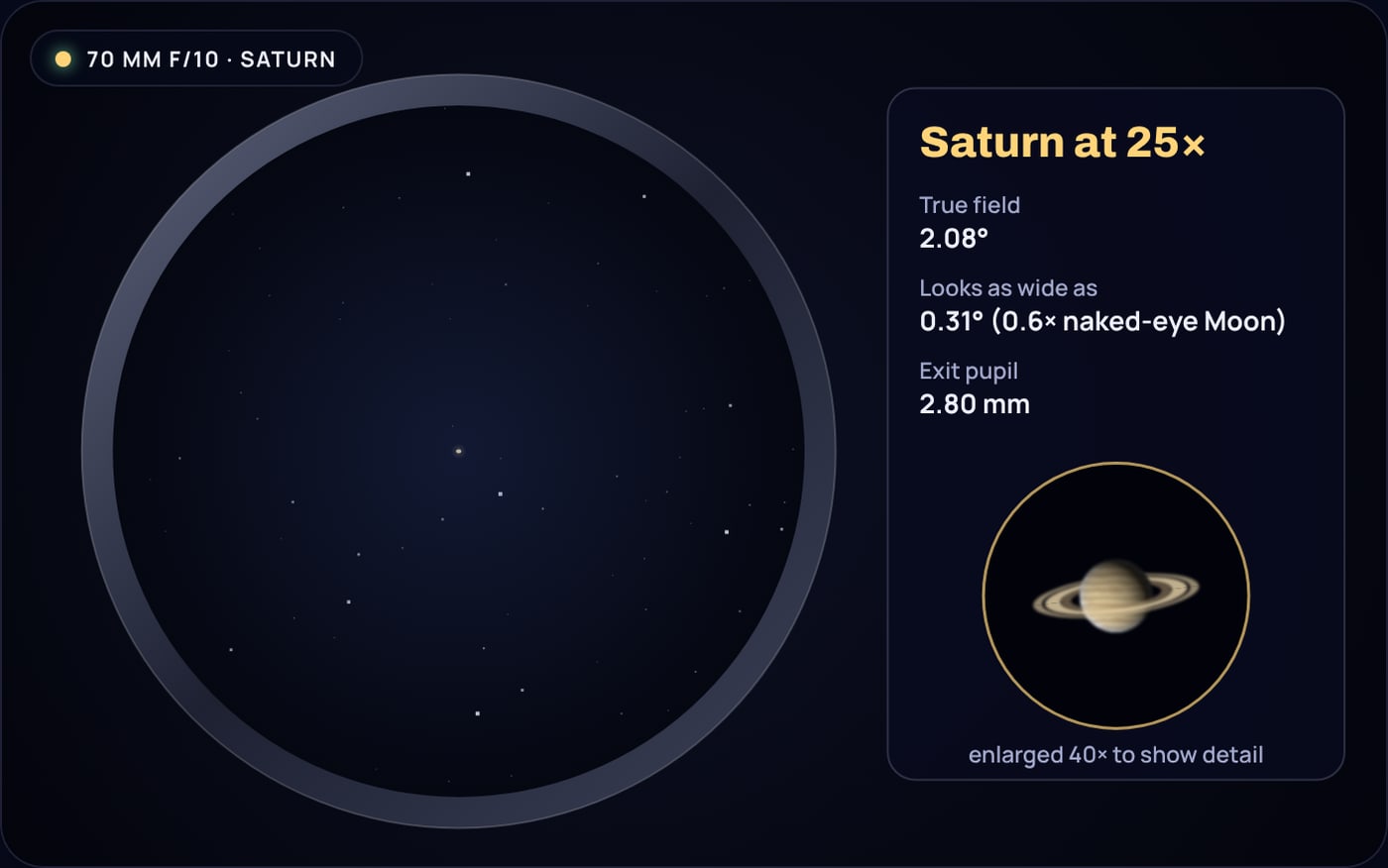
Figure 1 is the honest version of that view. The circle is a 52° eyepiece field, and Saturn sits in the middle at its true size for 25×. It is small. Most people expect the rings to fill the eyepiece, and the first sight of a tiny, perfect Saturn is a surprise for that reason. The inset shows what is there to be seen if your eye could take it in.
How do you work out your telescope’s magnification?
Magnification is the telescope's focal length divided by the eyepiece's focal length. Tele Vue's formula page gives it in exactly that form:
Both lengths are in millimetres and are usually printed on the tube and on the eyepiece. A Barlow lens multiplies the telescope's focal length, so a 2× Barlow doubles the magnification of every eyepiece.
Example 1: a 70 mm f/10 refractor
The telescope has a 700 mm focal length. Which eyepiece gives the 25× needed to see the rings, and what does the supplied 10 mm eyepiece give?
Any eyepiece of 28 mm or shorter shows the rings. With the 10 mm eyepiece they look 0.88° wide, about 1.7 times the naked-eye Moon, which is a comfortable first view.
Here are the four common beginner telescopes with the two eyepieces they usually come with:
| Telescope | Focal length | 25 mm eyepiece | 10 mm eyepiece | Highest useful |
|---|---|---|---|---|
| 70 mm refractor | 700 mm | 28× | 70× | 140× |
| 114 mm reflector | 900 mm | 36× | 90× | 228× |
| 127 mm Maksutov | 1500 mm | 60× | 150× | 254× |
| 8 inch (203 mm) Dobsonian | 1200 mm | 48× | 120× | 406× |
Every one of them shows the rings with the longer eyepiece already. The real question is how much power you can usefully add.
What does more magnification add?
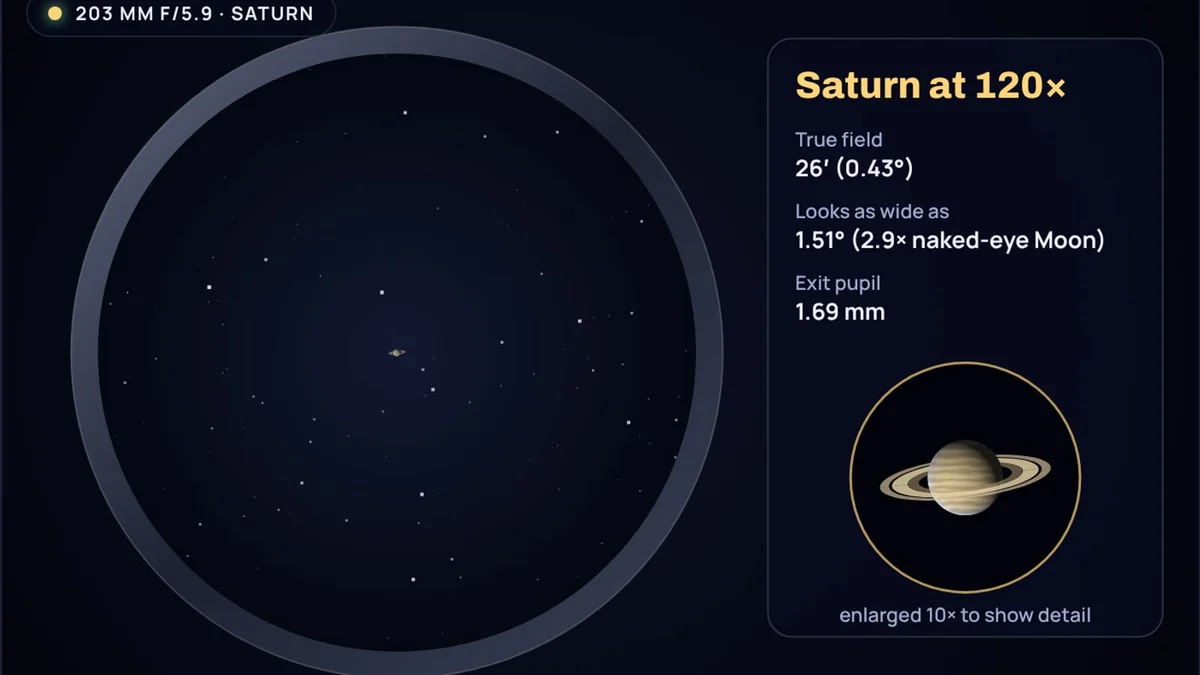
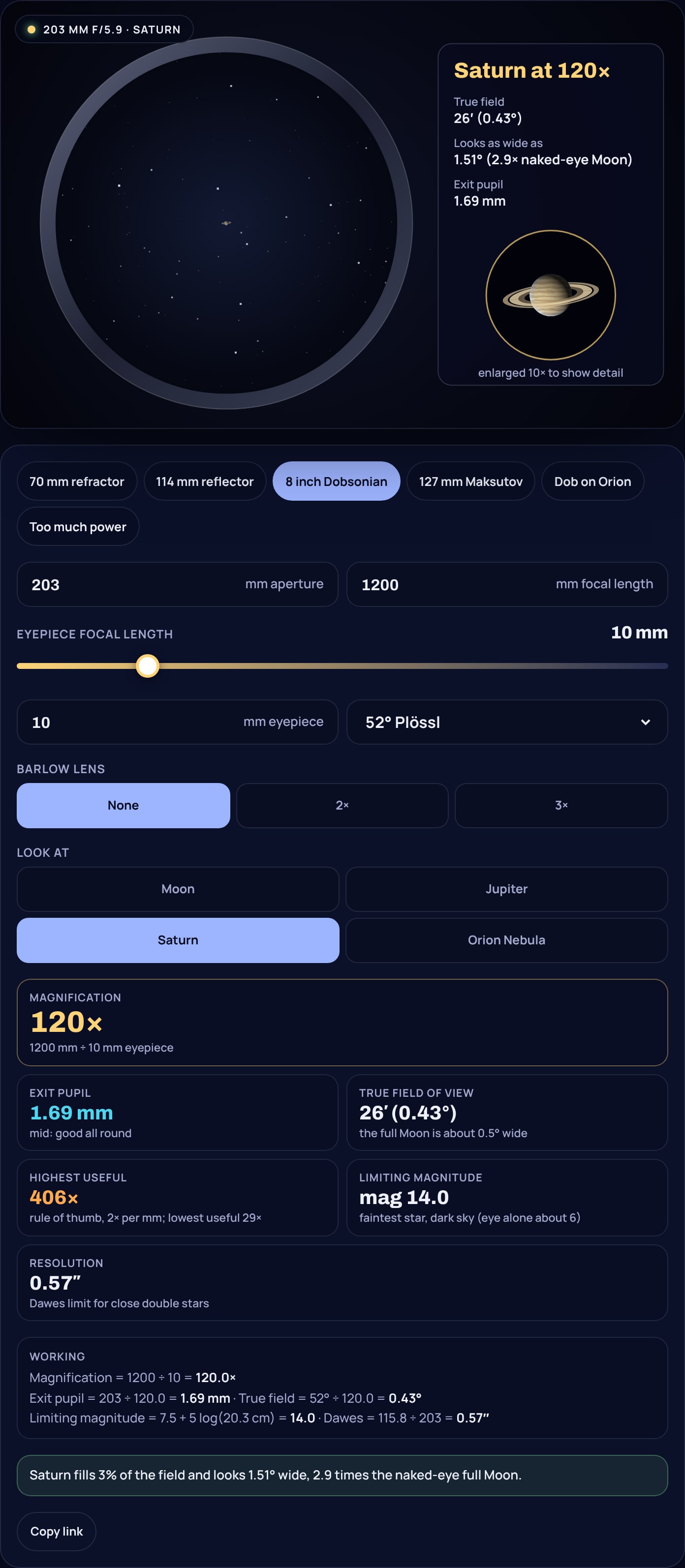
Doubling the magnification doubles the size of the image, so the gap between ring and globe gets easier to see, and the shadow of the globe on the rings and the darker equatorial belts begin to show. Figure 2 is the 8 inch Dobsonian at 120×. Saturn now looks about 1.5° wide, nearly three times the naked-eye Moon, but it still fills only a small part of a 26 arcminute field.
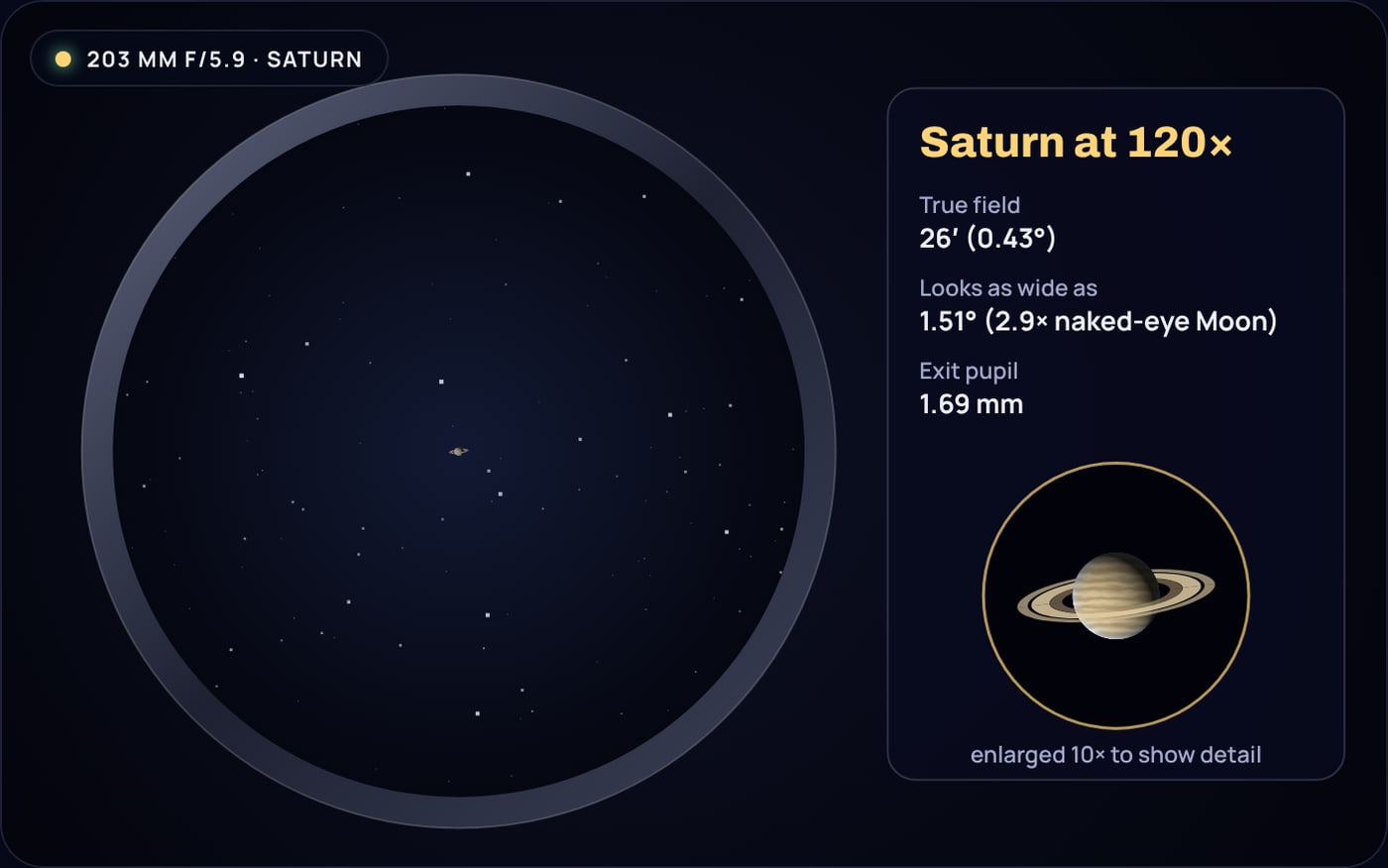
The field size matters because the sky moves. The true field is the eyepiece's apparent field divided by the magnification, about 52° ÷ 120 = 0.43° here. Stars drift across the sky by 15 arcseconds every second near the celestial equator, so without a motor Saturn crosses that field in under two minutes and you nudge the telescope to follow it. Higher power means more frequent nudging.
What limits the useful magnification?
Two things: the aperture and the air.
Light spreading through a circular opening forms a small blurred disc, so a telescope cannot separate details closer than a limit set by its diameter. The usual figure for close double stars is the Dawes limit, which the Ryukyu Astronomy Club's formula collection gives as 115.8 ÷ D arcseconds, with D in millimetres. Magnification makes that blur bigger along with everything else. Past a certain point you see the blur, not new detail.
The rule of thumb for that point is 2× per millimetre of aperture, or 50× per inch. Tele Vue's page is frank about it: above 50× per inch you are only magnifying the blur, and in practice the turbulence in our atmosphere usually holds larger telescopes to 20× to 30× per inch. So a 70 mm telescope tops out around 140×, and an 8 inch telescope that could in theory take 400× will often give its best view of Saturn at 150× to 250×.
Example 2: can an 8 inch telescope show the Cassini division?
The Cassini division is the dark gap between the bright B ring, whose outer edge is 117,507 km from Saturn's centre, and the A ring, which starts at 122,340 km (NASA ring fact sheet). At its largest, Saturn's 120,536 km wide globe looks 19.9″ wide.
The gap is wider than the 8 inch telescope's limit and narrower than the 70 mm telescope's. A dark line can still be glimpsed below the Dawes limit, which is why 75 mm telescopes sometimes show it, but the bigger aperture makes it far easier. This is an estimate: the gap varies along its length and the planet is not always at its closest.
That is why the useful answer to "how much magnification" depends on aperture. Magnification makes things bigger; aperture decides how much detail there is to make bigger.
What happens if you use too much magnification?
Cheap telescopes are often sold on enormous magnification figures, reached with the shortest eyepiece in the box and a 3× Barlow. Figure 3 is a 70 mm, 700 mm refractor with a 4 mm eyepiece and a 3× Barlow: 700 × 3 ÷ 4 = 525×.
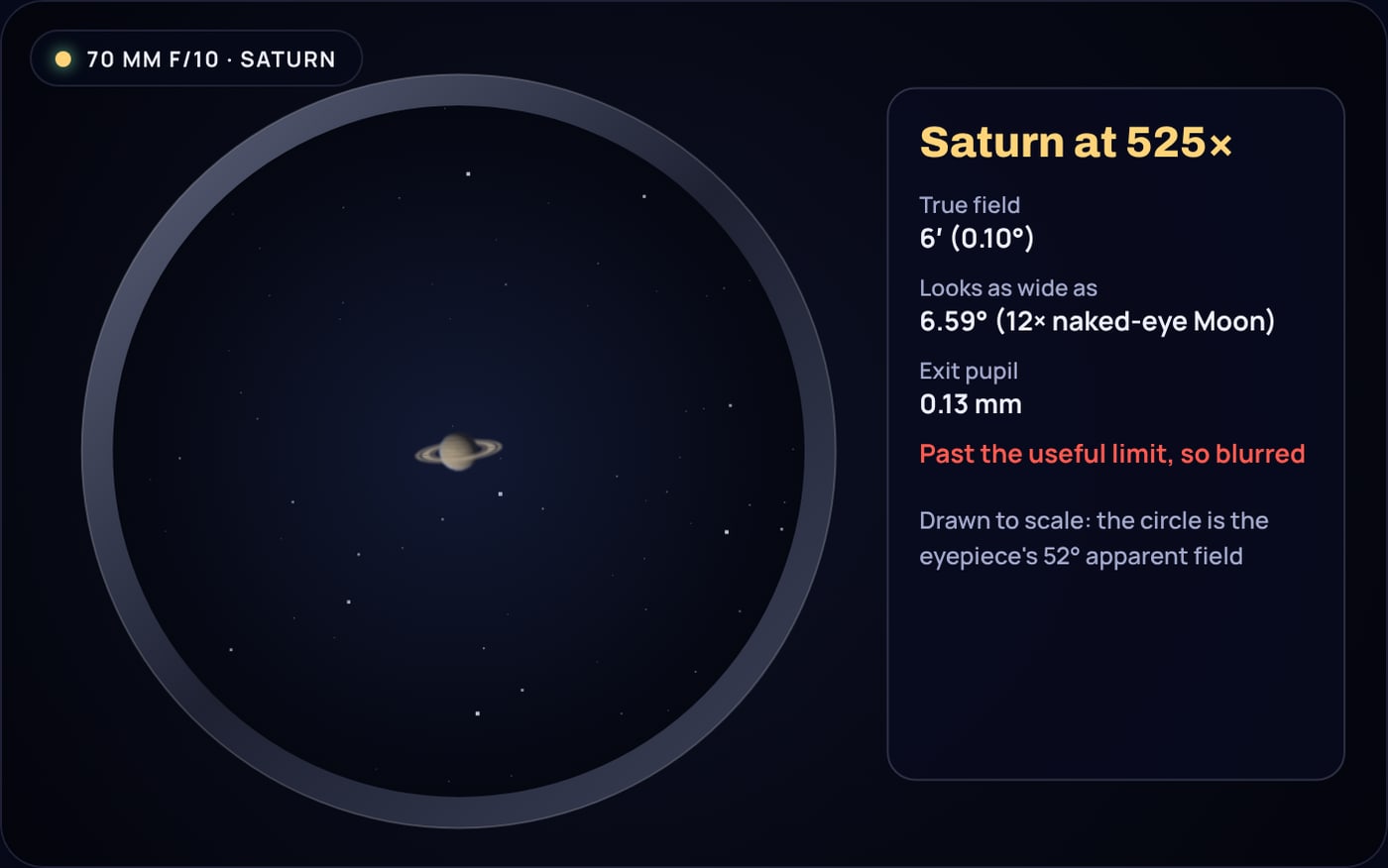
Three things go wrong at once. The 1.65″ blur of a 70 mm aperture is now 525 times larger, so it smears the rings. The exit pupil, the width of the beam that leaves the eyepiece, is 70 ÷ 525 = 0.13 mm, so the image is very dim and every floater in your eye shows. And the field is 52° ÷ 525 = 0.1°, so Saturn drifts out of view in about 25 seconds. The same telescope at 70× to 100× shows more.
Is it only about magnification?
No. Three other things change what you see.
The tilt of the rings. Saturn's rings are very thin, and their angle to us changes over Saturn's 29 year orbit. EarthSky notes they were edge-on in March 2025 and are tilted only about 7.5° around the October 2026 opposition, so this season they look like a narrow ellipse cutting across the globe rather than the wide open rings of 2017. They will open to their full 27° by 2032. A narrow ring is harder to see clear of the globe, so this year a little more magnification helps.
The steadiness of the air. On most nights the image shimmers. Watch for a while at a moderate power and moments of sharp detail come and go. Raising the power on a turbulent night only enlarges the shimmer.
Saturn's distance. At its farthest Saturn is 14.5″ across instead of 19.9″, so it looks about a quarter smaller at the same magnification. Around opposition, when Saturn is opposite the Sun and up all night, is the best time.
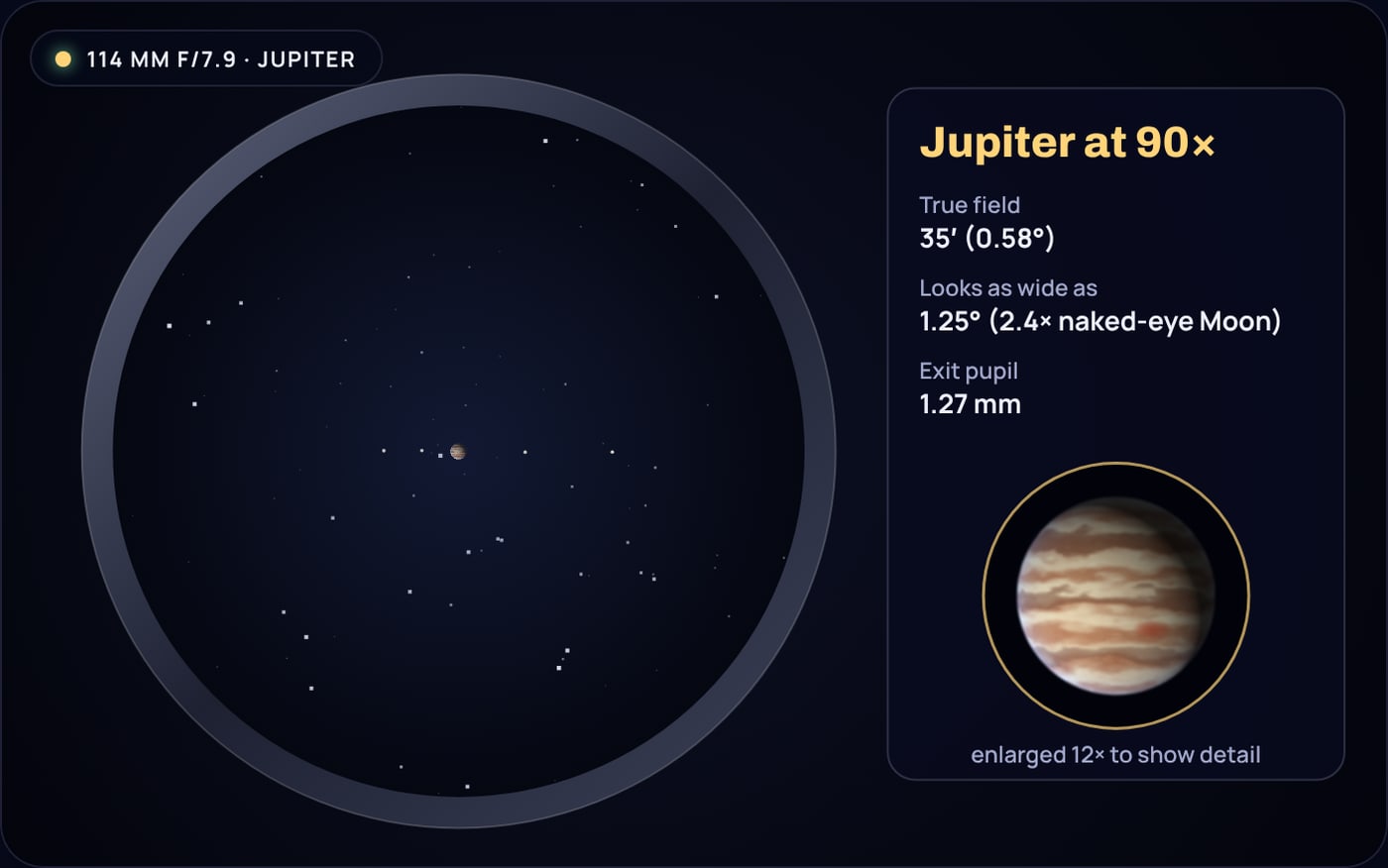
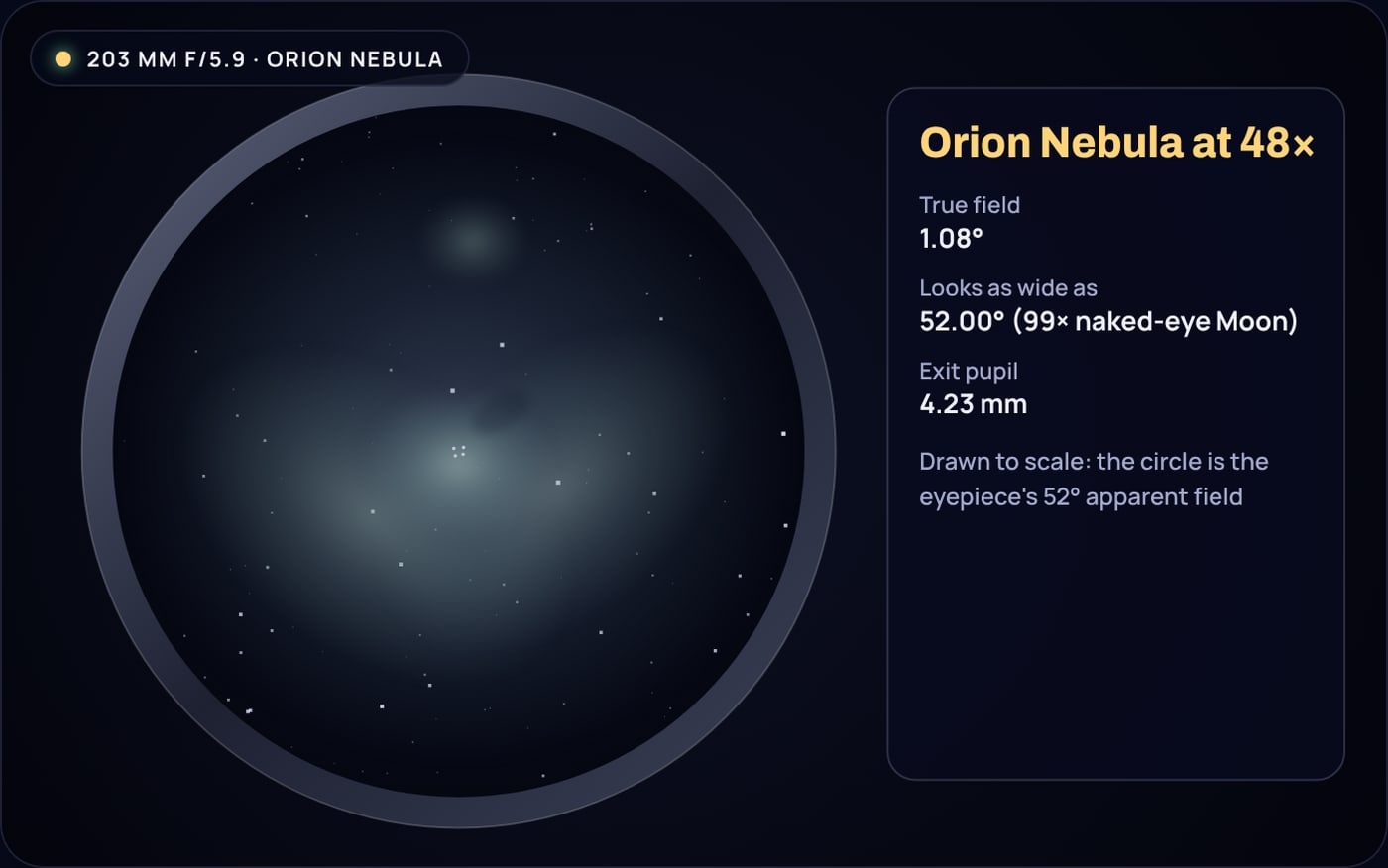
The same arithmetic works for other targets. Jupiter is 50.1″ across at most, so 90× in a 114 mm reflector makes it about 1.25° wide with the cloud belts showing (Figure 4). Faint, large objects want the opposite: the Orion Nebula is about 65 by 60 arcminutes, and a 25 mm eyepiece at 48× in an 8 inch telescope just fits it into a 1.08° field with a bright 4.2 mm exit pupil (Figure 5).
What should you use on Saturn?
Find Saturn with your longest eyepiece, centre it, then step up. A sensible plan for each telescope:
- 70 mm refractor: 28× to find it and see the shape, 70× to 100× for the best view, no more than about 140×.
- 114 mm reflector: 90× to 150×.
- 127 mm Maksutov: 60× already shows the rings detached; 150× on a steady night.
- 8 inch Dobsonian: 120× to 200× on most nights, more only when the air is very steady.
The calculator panel in Figure 6 shows all the numbers for the 8 inch telescope at once, with the working: magnification, exit pupil, true field, the 2× per mm ceiling, the faintest star and the Dawes limit.
To check your own telescope, open the telescope magnification calculator, type its aperture and focal length, and slide the eyepiece until Saturn looks right. If you are still choosing a telescope, our look at whether to buy a Celestron telescope in India covers what each type is good for.
Sources
- Tele Vue Optics: Telescope Formulas (magnification, exit pupil, and the 50× per inch and 20× to 30× per inch limits)
- Ryukyu Astronomy Club: Telescope Formulae (Dawes limit 115.8 ÷ D, limiting magnitude, true field approximation)
- NASA Saturn Fact Sheet (apparent diameter 14.5″ to 19.9″, equatorial radius 60,268 km)
- NASA Saturnian Rings Fact Sheet (B ring outer edge 117,507 km, A ring 122,340 to 136,780 km)
- NASA Jupiter Fact Sheet and NASA Moon Fact Sheet (apparent diameters)
- EarthSky: Viewing Saturn's rings, tips for beginners (Alan MacRobert on 25× and 50×; ring tilt in 2025 and 2026)
- Celestron: The Ultimate Guide to Observing Saturn (at least 50 mm and 25×)
- Naked Eye Planets: Saturn through a telescope (Cassini division in 75 mm telescopes in good seeing)
Frequently asked questions
What is the minimum magnification to see Saturn’s rings?
About 25×. At that power Saturn looks like a tiny point that is clearly not round. About 50× in a 3 inch (75 mm) telescope shows the rings standing clear of the globe.
Can I see Saturn’s rings with binoculars?
Not as rings. Typical binoculars magnify 7× to 15×, which makes the 45 arcsecond ring system look only 5 to 11 arcminutes wide, below the 25× that observing guides give as the minimum. Saturn shows as a bright point.
How do I work out my telescope’s magnification?
Divide the telescope’s focal length by the eyepiece’s focal length, both in millimetres. A 1200 mm telescope with a 10 mm eyepiece gives 120×. A 2× Barlow lens doubles it.
What is the best magnification for Saturn?
Roughly 100× to 150× on most nights, as long as it stays below about 2× per millimetre of aperture. Above that the image only gets bigger and dimmer, and turbulence in the air often sets a lower limit.
What magnification shows the Cassini division?
The division is under 1 arcsecond wide, so it needs about 100× or more, a steady night and the rings well tilted towards us. A 75 mm telescope can show it in good conditions; a larger aperture makes it much easier.