How much magnification does my telescope give?
Divide the telescope's focal length by the eyepiece's focal length. A 1200 mm Dobsonian with a 10 mm eyepiece gives 120×; swap to a 25 mm eyepiece and it drops to 48×. The same telescope has a practical ceiling of about 406× (2× per millimetre of aperture, a rule of thumb), and the calculator also gives the exit pupil, the patch of sky you see, the faintest star and the finest detail.
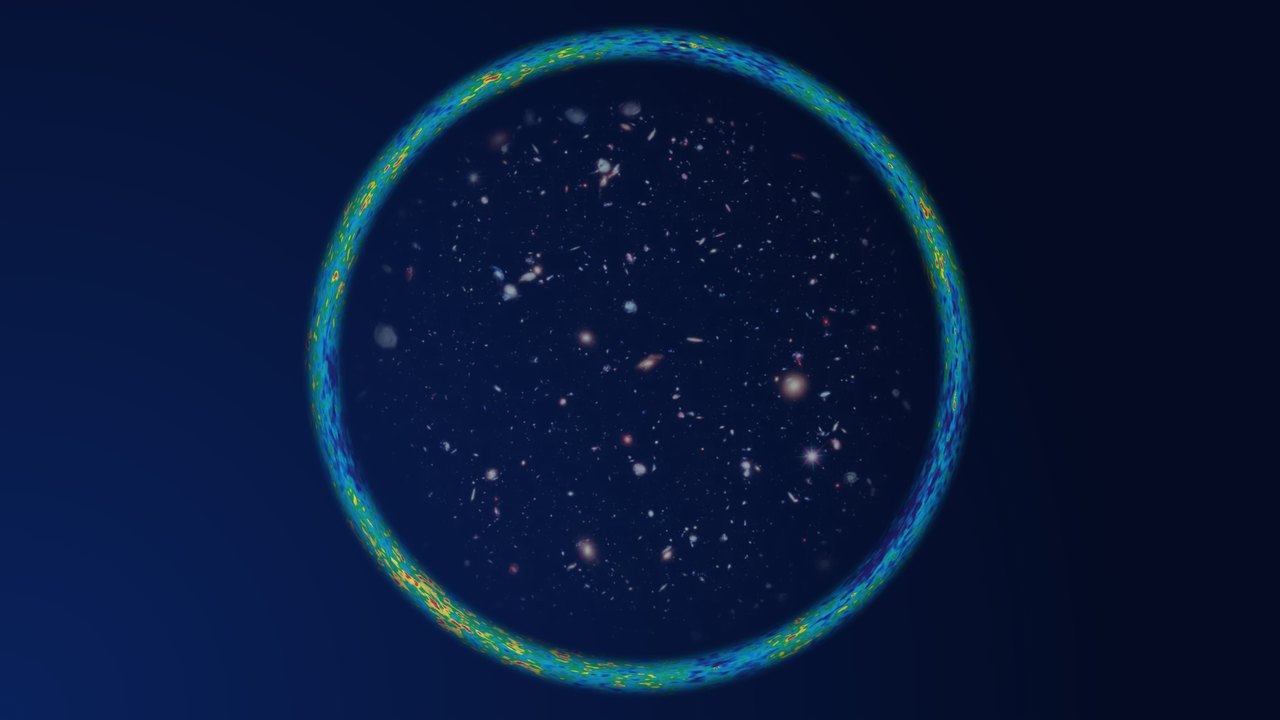
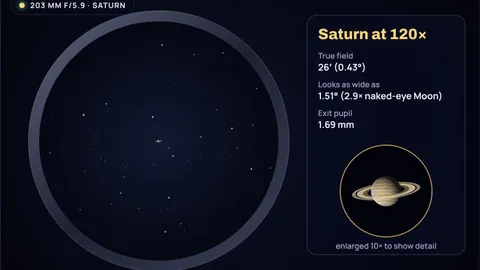
The circle on the left is drawn to scale: its edge is the eyepiece's apparent field, and the target sits inside it at its real angular size times the magnification. That is why Saturn looks so small even at 120×. The companion post works through what it takes to see the rings, and our guide to buying a Celestron in India covers choosing a first telescope.
Key results from the calculator
- Saturn's rings first show at about 25×, and stand clear of the globe at about 50×. At 25× the rings look 0.31° wide, about 60% of the full Moon seen with the naked eye.
- An 8 inch (203 mm) Dobsonian with a 10 mm eyepiece: 120×, exit pupil 1.69 mm, true field 26′, faintest star about magnitude 14.0, Dawes limit 0.57″.
- The highest useful magnification is about 2× per mm: 406× for 203 mm, 140× for a 70 mm refractor. Above that the image grows but no new detail appears.
- A 70 mm refractor with a 4 mm eyepiece and 3× Barlow gives 525×, more than three times its useful limit, with a 0.13 mm exit pupil. That is how cheap telescopes reach the big numbers printed on their boxes.
Six telescopes and what they show
Each setup loads the telescope, eyepiece and target. All use a 52° apparent field eyepiece (a standard Plössl).
70 mm refractor on the Moon
First telescopeA 70 mm f/10 refractor with its 25 mm eyepiece gives 28× and a 1.86° field. The whole Moon fits with room to spare, filling about 28% of the field width, and craters along the terminator show clearly.
Its limits are a Dawes resolution of 1.65″, stars down to about magnitude 11.7, and a useful ceiling of about 140×.
114 mm reflector on Jupiter
Small reflectorA 114 mm f/7.9 reflector with a 10 mm eyepiece gives 90×. Jupiter at its largest, 50.1″ across, looks 1.25° wide, a little more than twice the naked-eye Moon, with the two dark equatorial belts visible.
The four Galilean moons are points of light strung out on either side. Even Callisto, up to 26 Jupiter radii out (about 11′), stays inside the 35′ field at this power.
8 inch Dobsonian on Saturn
Popular all-rounderAn 8 inch (203 mm) f/5.9 Dobsonian with a 10 mm eyepiece gives 120×. Saturn with its rings spans 45″ at most, so it looks 1.51° wide: about three naked-eye Moons, and plenty to see the gap between the rings and the globe and, on a steady night with the rings well open, the Cassini division.
The same telescope reaches about magnitude 14.0 under a dark sky, about 1,600 times fainter than the naked-eye limit of magnitude 6.
127 mm Maksutov on Saturn
Long focal lengthA 127 mm Maksutov has a long 1500 mm focal length, so even its supplied 25 mm eyepiece gives 60×, enough to show Saturn's rings standing clear of the globe.
The cost is field: only 52′, so the Moon (about 32′) fits with a little room and the largest star clusters do not. A 10 mm eyepiece gives 150×, close to its 254× ceiling.
8 inch Dobsonian on the Orion Nebula
Deep sky, low powerFor faint, extended objects use low power. The 25 mm eyepiece gives 48× and a 4.2 mm exit pupil, so the nebula looks bright, and the 1.08° field just holds the 65 by 60 arcminute glow.
At the centre the four Trapezium stars sit inside the brightest part. To the eye the nebula is grey-green, not the red of long-exposure photographs.
525× from a 70 mm telescope
What not to doPut a 4 mm eyepiece and a 3× Barlow in a 70 mm, 700 mm refractor and the arithmetic gives 525×. The telescope can only resolve 1.65″, so the extra magnification spreads the same blur over a bigger, dimmer disc.
The exit pupil is 0.13 mm, far under 0.5 mm, where the view turns dim and fuzzy, and the field is so small (6′) that Saturn drifts across it in about 25 seconds without a motor drive.
Limits set by aperture
| Aperture | Highest useful | Lowest useful | Faintest star | Dawes limit |
|---|---|---|---|---|
| 50 mm | 100× | 7× | mag 11.0 | 2.32″ |
| 70 mm | 140× | 10× | mag 11.7 | 1.65″ |
| 90 mm | 180× | 13× | mag 12.3 | 1.29″ |
| 114 mm | 228× | 16× | mag 12.8 | 1.02″ |
| 127 mm | 254× | 18× | mag 13.0 | 0.91″ |
| 150 mm | 300× | 21× | mag 13.4 | 0.77″ |
| 203 mm (8″) | 406× | 29× | mag 14.0 | 0.57″ |
| 254 mm (10″) | 508× | 36× | mag 14.5 | 0.46″ |
| 305 mm (12″) | 610× | 44× | mag 14.9 | 0.38″ |
Highest useful is the 2× per mm rule of thumb; Tele Vue notes large telescopes are usually held to 20× to 30× per inch by the air. Lowest useful gives a 7 mm exit pupil, the widest a young dark-adapted eye opens. Faintest star is for a dark sky and an experienced observer.
How the calculator works
Magnification is the telescope's focal length divided by the eyepiece's, as Tele Vue's formula page gives it. A Barlow lens multiplies the telescope's focal length, so a 2× Barlow doubles every eyepiece's magnification.
Exit pupil is the aperture divided by the magnification: the width of the beam of light leaving the eyepiece. If it is wider than your eye's pupil (about 7 mm in the dark, less with age), some light misses your eye.
True field is the eyepiece's apparent field divided by the magnification. This is an approximation; the exact value comes from the eyepiece's field stop, but it is usually within a few per cent.
Faintest star and Dawes limit use the formulas collected by the Ryukyu Astronomy Club: limiting magnitude 7.5 + 5 log₁₀(D in cm), and resolution 115.8 ÷ D arcseconds with D in mm. The view is blurred to that limit and dimmed when the exit pupil is small.
The view draws the target at its true angular size: Saturn 19.9″ with rings 2.27 times wider, Jupiter 50.1″ (both at their largest, from the NASA fact sheets), the Moon 1,896″ and the Orion Nebula 65′ by 60′.
What the model leaves out
- Seeing: turbulence in the air usually limits detail to 1″ or 2″, whatever the telescope. Good nights are rare; bad ones cap even a big telescope at 150× or so.
- Central obstruction and optical quality: reflectors and Maksutovs have a secondary mirror that lowers contrast slightly. The Dawes limit assumes good optics.
- The planets' distance: Saturn and Jupiter are drawn at their largest. Away from opposition Jupiter can shrink to about 30″ and Saturn to about 15″.
- Light pollution: the limiting magnitude assumes a dark sky. From a city subtract two magnitudes or more.
Common misconceptions
"More magnification is better." A telescope's detail is set by its aperture. Past about 2× per mm the image only gets bigger and dimmer.
"The box says 675×, so it can show that." The figure is just the arithmetic with the shortest eyepiece and a Barlow. A 70 mm telescope tops out near 140×.
"Planets will look like the photos." Even at 200× Saturn looks about as wide as five full Moons, with far less detail than an image stacked from thousands of frames.
Frequently asked questions
How do I calculate the magnification of a telescope?
Divide the telescope's focal length by the eyepiece's focal length, both in millimetres. A 1200 mm telescope with a 10 mm eyepiece gives 120×. A 2× Barlow doubles it.
What is the highest useful magnification?
A common rule of thumb is 2× per millimetre of aperture (50× per inch): about 140× for a 70 mm telescope and 406× for an 8 inch. In practice the steadiness of the air often sets a lower limit.
What magnification do I need to see Saturn's rings?
About 25× shows that Saturn is not round, and about 50× in a 3 inch (75 mm) telescope shows the rings detached from the globe. 100× to 150× gives a clear view; the Cassini division, under 1″ wide, needs steady air and the rings well tilted towards us.
What is the exit pupil?
The width of the light beam leaving the eyepiece: aperture divided by magnification. Around 0.5 to 1 mm suits planets, 2 to 4 mm general viewing, and up to 7 mm faint nebulae.
How do I work out a telescope's field of view?
Divide the eyepiece's apparent field (printed on it or in its specifications, often 50° to 52°) by the magnification. A 52° eyepiece at 48× shows about 1.08°, twice the width of the full Moon.
Keep learning
How Much Magnification Do You Need to See Saturn's Rings?
The magnification that shows Saturn's rings, why 25× is the floor and 50× to 150× the sweet spot, how to work out your own telescope's power, and why 500× does not help.

Celestron Telescope: Should You Buy one in India?
Should You Buy a Celestron Telescope in India? You might be searching if Celestron Brand is good for telescope or not. Come on and see what..