How Old Would I Be on Mars? Mars Years Explained
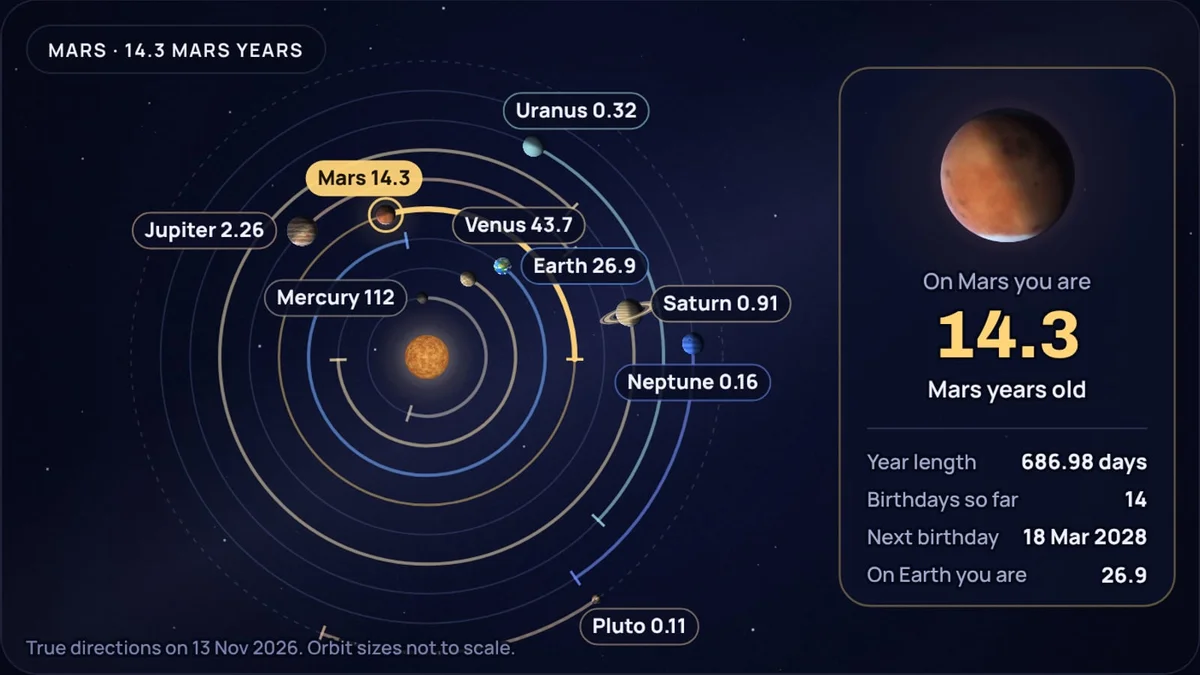
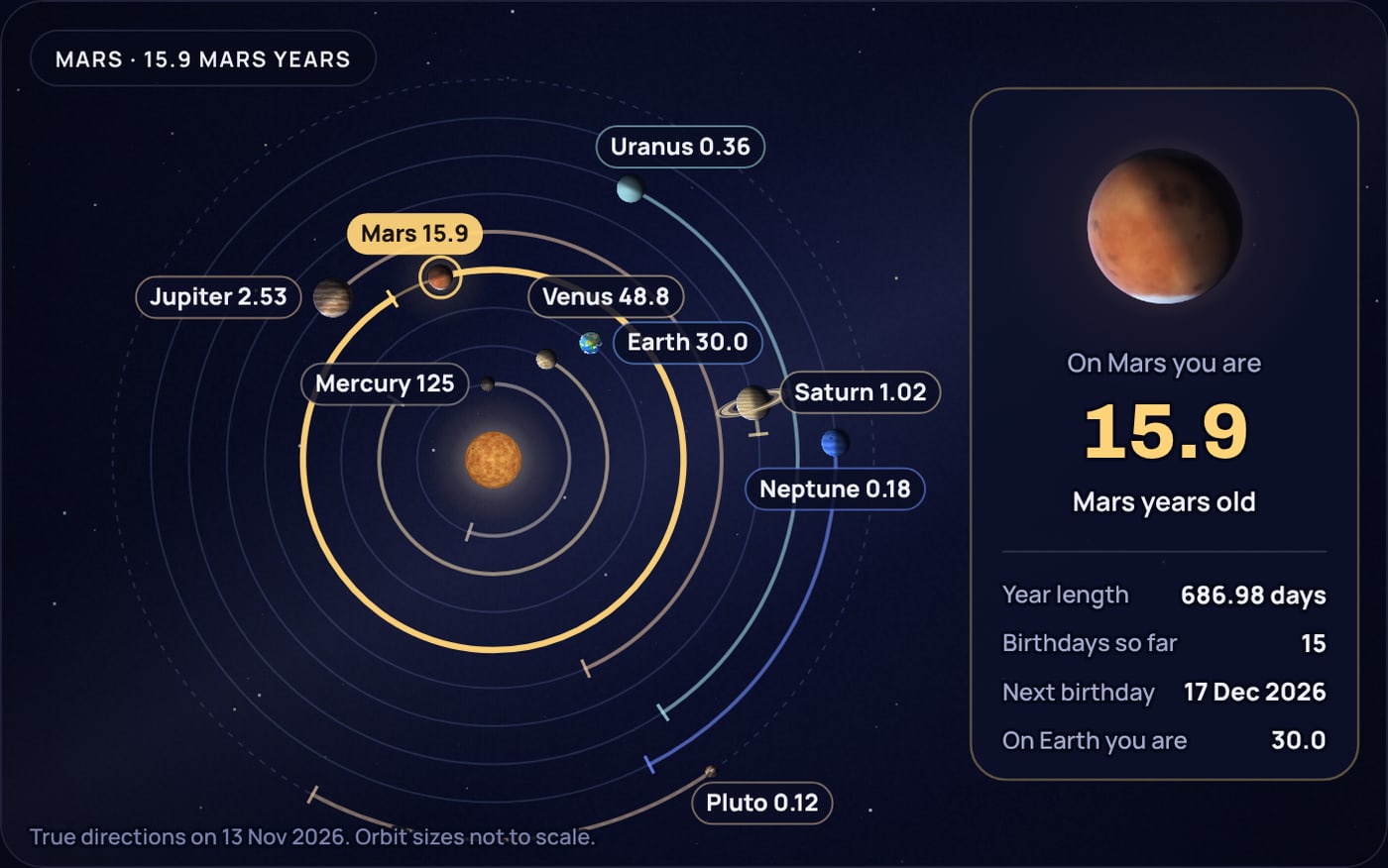
Someone who turned 30 today has been alive for 10,957 days. Mars needs 686.98 of those days to go once round the Sun, so on Mars that person has had 15 birthdays and is 15.95 years old, closing in on 16. The 16th Mars birthday falls on 17 December 2026, just 34 days after their 30th on Earth. The age on other planets calculator does this for any birth date and shows where every planet sits on its orbit today.
This post shows the arithmetic behind it, gives a shortcut you can do in your head, works out when your next Mars birthday lands, and clears up two things people often get wrong: whether you would actually age more slowly, and how many Mars days are in a Mars year.
How long is a year on Mars?
A year is one lap of the Sun. NASA's Mars fact sheet gives the sidereal orbit period, the time to go once round relative to the distant stars, as 686.980 Earth days. That is 1.881 Earth years. Mars takes longer than Earth for two reasons: its orbit is bigger, with an average distance from the Sun of 227.96 million km against Earth's 149.60 million km, and it moves more slowly along it, at 24.08 km/s on average against Earth's 29.78 km/s.
Those two facts are tied together by Kepler's third law. For anything orbiting the Sun, the square of the period in years equals the cube of the average distance in astronomical units. You can check the Mars year with nothing more than its distance:
Example 1: the Mars year from Kepler's third law
The tiny gap to NASA's 686.98 days comes from rounding the distance to three decimals. Run the same sum for Jupiter at 5.204 AU and you get 11.87 years, which is why a Jupiter age is always about a twelfth of your Earth age.
NASA also lists a tropical orbit period for Mars of 686.972 days, measured from one spring equinox to the next. The difference from the sidereal year is about 12 minutes, which makes no difference to anybody's birthday.
How do you work out your age on Mars?
Count the days you have lived and divide by 686.98. Counting days rather than dividing years handles leap years automatically and lets you turn the answer back into a calendar date.
Example 2: born on 1 January 2000, as of 13 November 2026
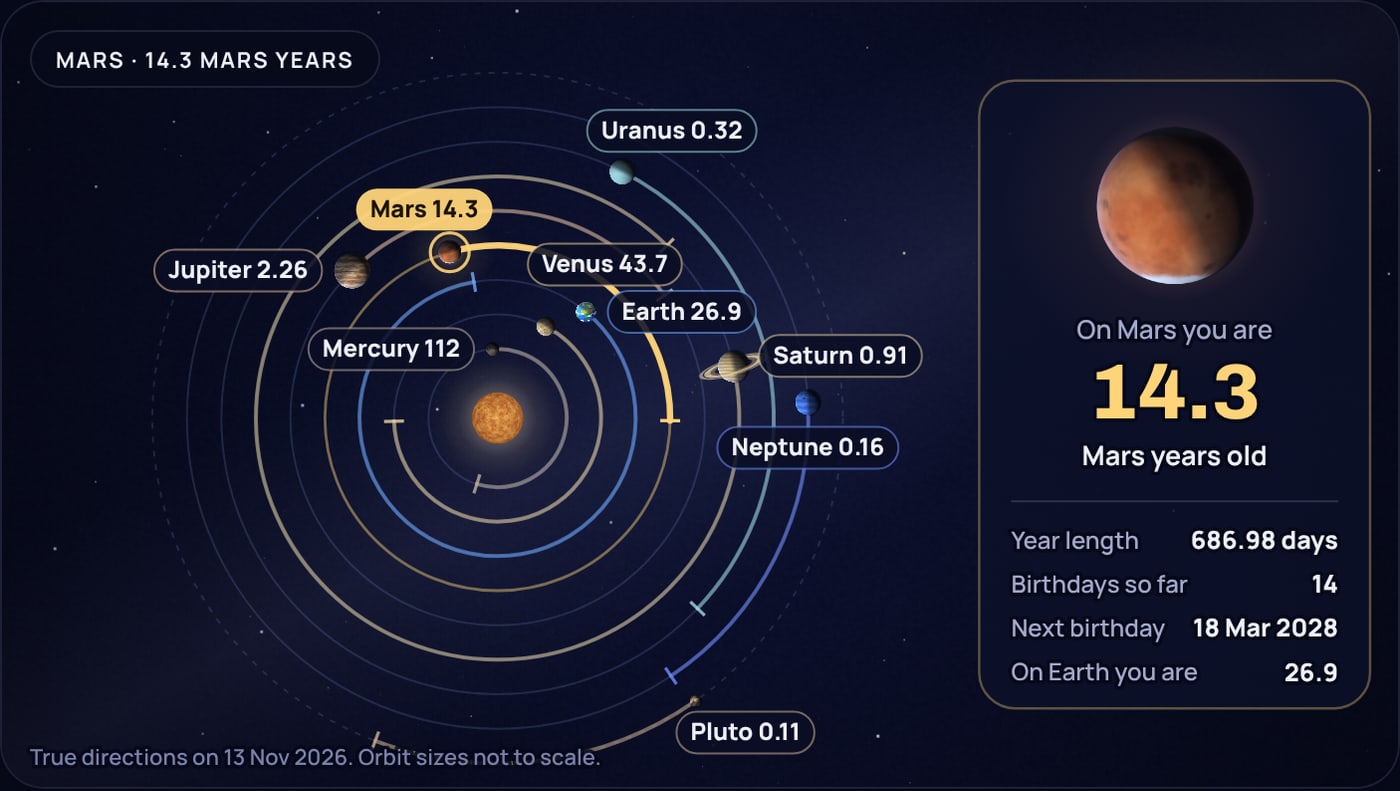
So 14 Mars birthdays so far. The 15th comes after 15 × 686.98 = 10,304.7 days, and 10,304 days after 1 January 2000 is 18 March 2028. On Earth the same person is 26.9.
Is there a quick way to convert my age to Mars years?
Yes. An average Earth year, counting leap years, is 365.25 days. Divide that by 686.98 and you get 0.5317. Multiply your age by 0.532 and you are within a few hundredths of the exact answer:
For a 30-year-old that gives 15.96, against 15.95 from counting days. A rougher version is "a bit more than half your age". The shortcut cannot tell you when the next Mars birthday is, because it throws away the date, which is why the calculator counts days.
How old would I be on Mars at 10, 18, 30, 50 and 80?
Here are common Earth ages turned into Mars years by days lived. Days depend slightly on how many leap days fall in the span, so the figures use 365.25 days per Earth year.
| Age on Earth | Days lived (about) | Age on Mars | Mars birthdays so far |
|---|---|---|---|
| 10 | 3,652 | 5.32 | 5 |
| 18 | 6,575 | 9.57 | 9 |
| 21 | 7,670 | 11.17 | 11 |
| 30 | 10,957 | 15.95 | 15 |
| 40 | 14,610 | 21.27 | 21 |
| 50 | 18,262 | 26.58 | 26 |
| 65 | 23,741 | 34.56 | 34 |
| 80 | 29,220 | 42.53 | 42 |
An 18-year-old on Earth is still a child on Mars at 9.57, and would need to reach 21 on Mars to be 39.5 on Earth. Anyone planning a crewed mission should note that a Mars round trip, with the long wait between launch windows described in how long it takes to get to Mars, lasts a little over one Mars year.
How many Mars days are in a Mars year?
This is the most common mistake in Mars age calculators. A Mars day, called a sol, is 24.6597 hours from noon to noon according to NASA's fact sheet, about 40 minutes longer than ours. So a Mars year contains fewer sols than it does Earth days:
Example 3: Earth days to sols
Your age in Mars years is the same whichever unit you count in, because a year is a year. But if you counted 687 sols as a Mars year, you would be off by more than 18 sols every year.
Mission teams count sols from landing day. A 30-year-old's 10,957 Earth days come to about 10,664 sols.
Would I age more slowly on Mars?
No. This is the misconception behind most "you'd be younger on Mars" jokes. Your cells, your heartbeat and your hair all keep the same pace. The only thing that changes is the length of the unit you count with. Saying you are 15.95 on Mars is like saying you are 360 months old instead of 30 years old.
Relativity does make clocks tick at slightly different rates in different gravity and at different speeds, and a clock on Mars does run a little differently from one on Earth. Mars sits higher in the Sun's gravity and moves more slowly, and adding up those terms gives roughly half a millisecond a day, under a fifth of a second a year. That matters for spacecraft navigation, not for your birthday. The weaker gravity, at 3.73 m/s² against 9.82 m/s² (NASA's mean surface values), would change your bones and muscles far more than it changes your age. The weight on other planets simulation shows that side of things.
When is my next birthday on Mars?
Your Mars birthdays come every 686.98 days after your birth date, not on a fixed calendar date. To find the next one, take the Mars birthdays you have had, add one, multiply by 686.98 and count that many days on from the day you were born.
Because 686.98 days is almost exactly 1 year and 322 days, each Mars birthday arrives about 43 days earlier in the calendar than the one two Earth years before. Over a lifetime they cycle through every month. That makes Mars birthdays rare enough to celebrate: you get about 42 in a long life, against 80 on Earth.
How old would I be on the other planets?
The same rule works everywhere. Divide days lived by the planet's year. Mercury makes you oldest, and the outer planets make you look very young indeed.
| World | Year in Earth days | Year in Earth years | Age of a 30-year-old |
|---|---|---|---|
| Mercury | 87.969 | 0.241 | 125 |
| Venus | 224.701 | 0.615 | 48.8 |
| Earth | 365.256 | 1.000 | 30.0 |
| Mars | 686.98 | 1.881 | 15.9 |
| Jupiter | 4,332.589 | 11.86 | 2.53 |
| Saturn | 10,755.699 | 29.45 | 1.02 |
| Uranus | 30,685.4 | 84.01 | 0.36 |
| Neptune | 60,189.018 | 164.79 | 0.18 |
| Pluto (dwarf planet) | 90,560 | 247.94 | 0.12 |
A 30-year-old has just had a first birthday on Saturn. A first Uranus birthday comes at 84, which plenty of people reach. Nobody has ever lived a Neptune year. Neptune itself only completed its first orbit since its discovery on 11 July 2011, 165 years after Johann Galle found it in 1846.
Why do the planets sit where they do in the calculator?
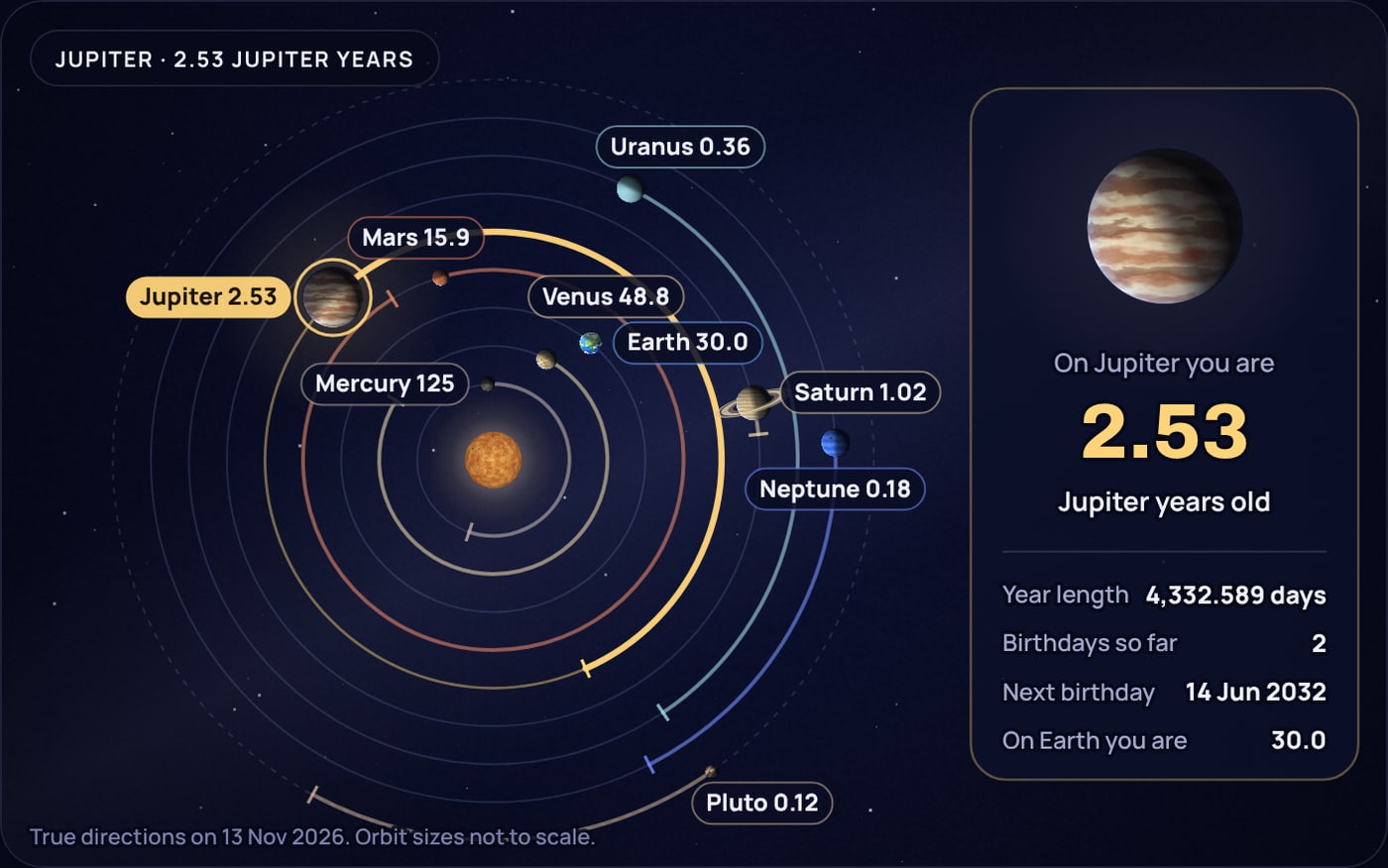
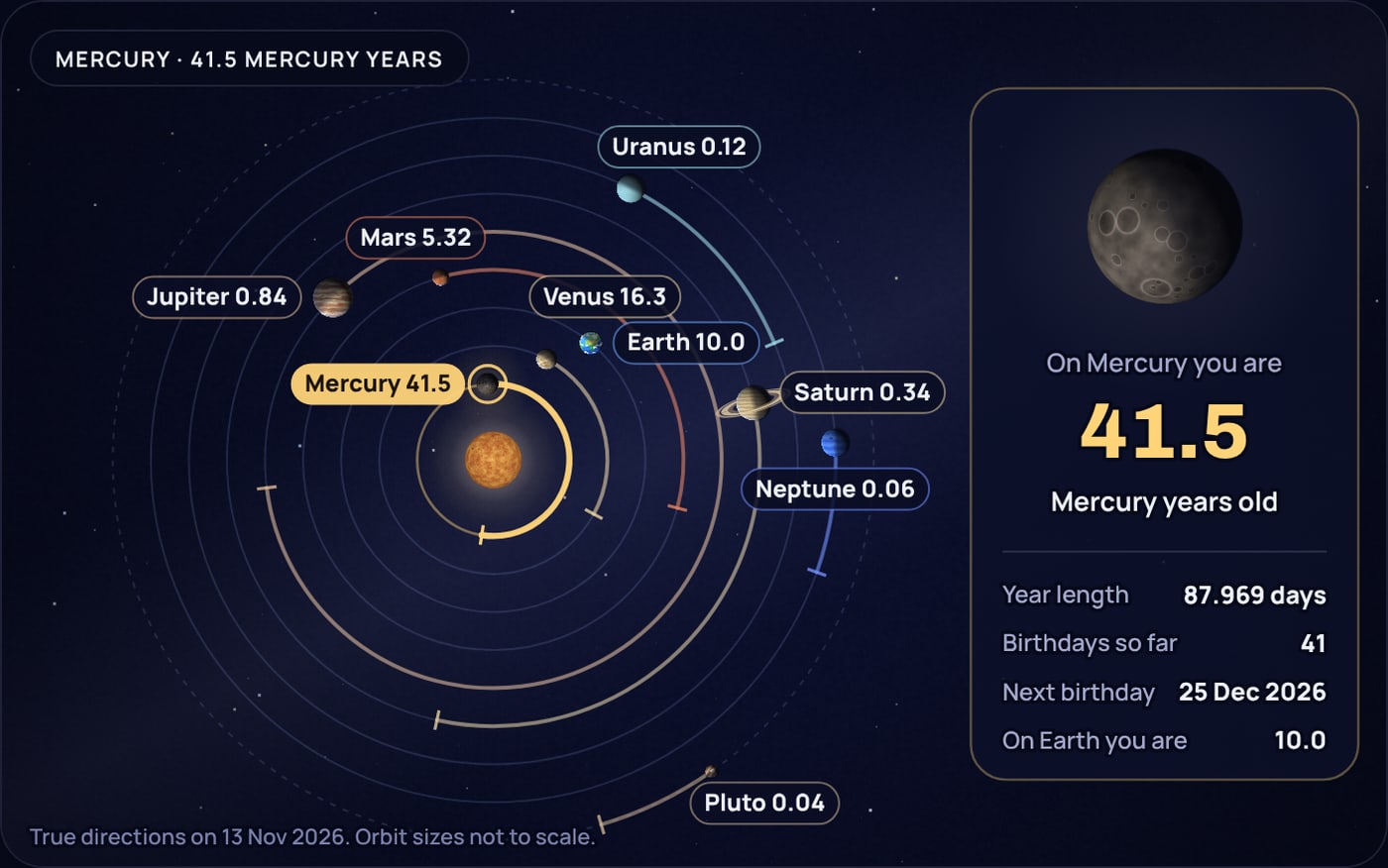
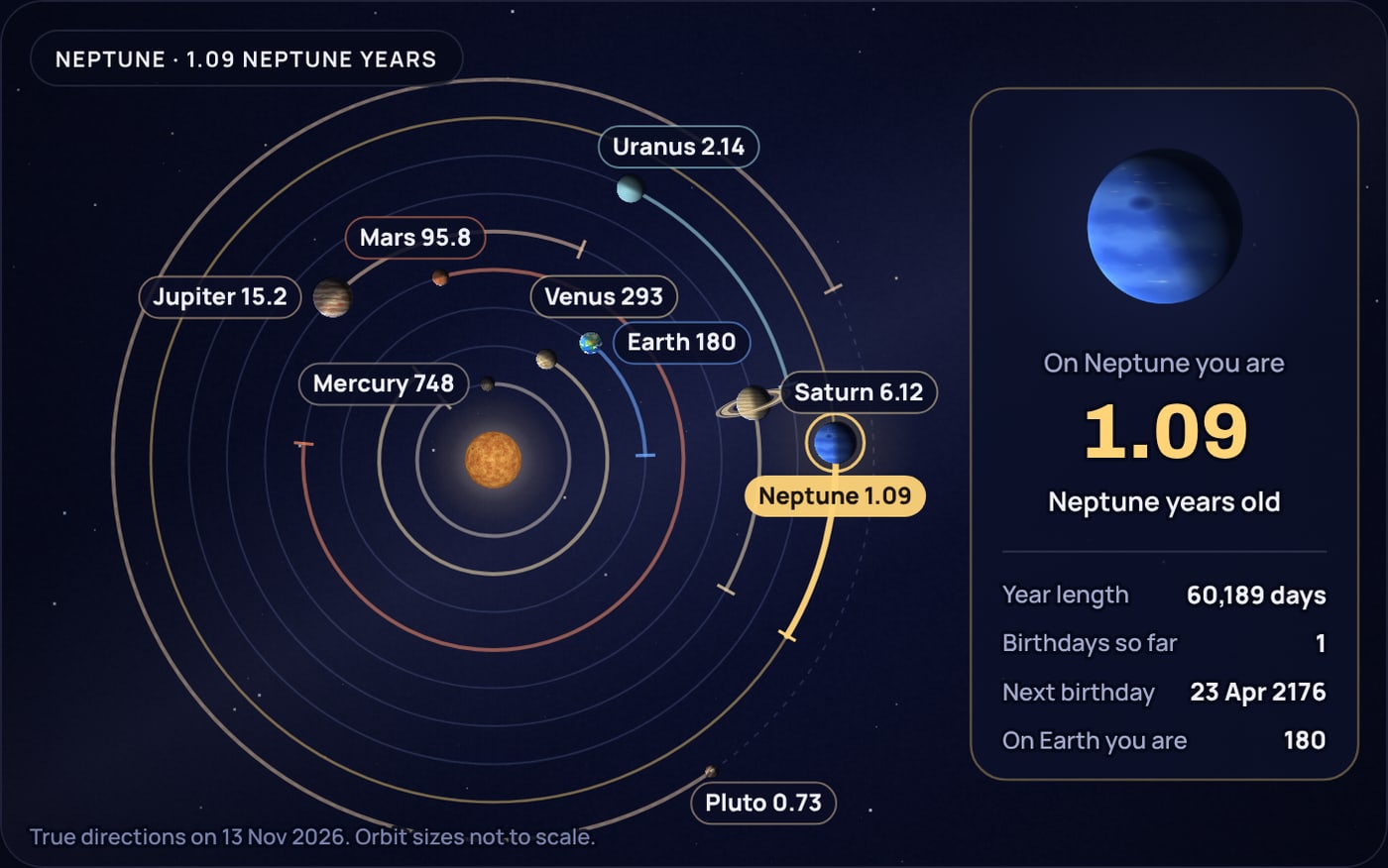
The stage is not a decoration. Each planet is placed in its real direction from the Sun on the date you choose, worked out from the orbital elements in NASA JPL's table of approximate planet positions. The orbits are evenly spaced so that all nine fit on a phone screen; in reality Neptune's orbit is 78 times wider than Mercury's. The small tick on each orbit marks where that planet was on the day you were born, and the lit arc from the tick to the planet is the part of the current planet year you have already lived. For Mars, that arc is how close you are to your next Mars birthday. If you want to see why Mars sometimes appears to move backwards against the stars as Earth overtakes it, read why planets move backward.
Try your own birth date
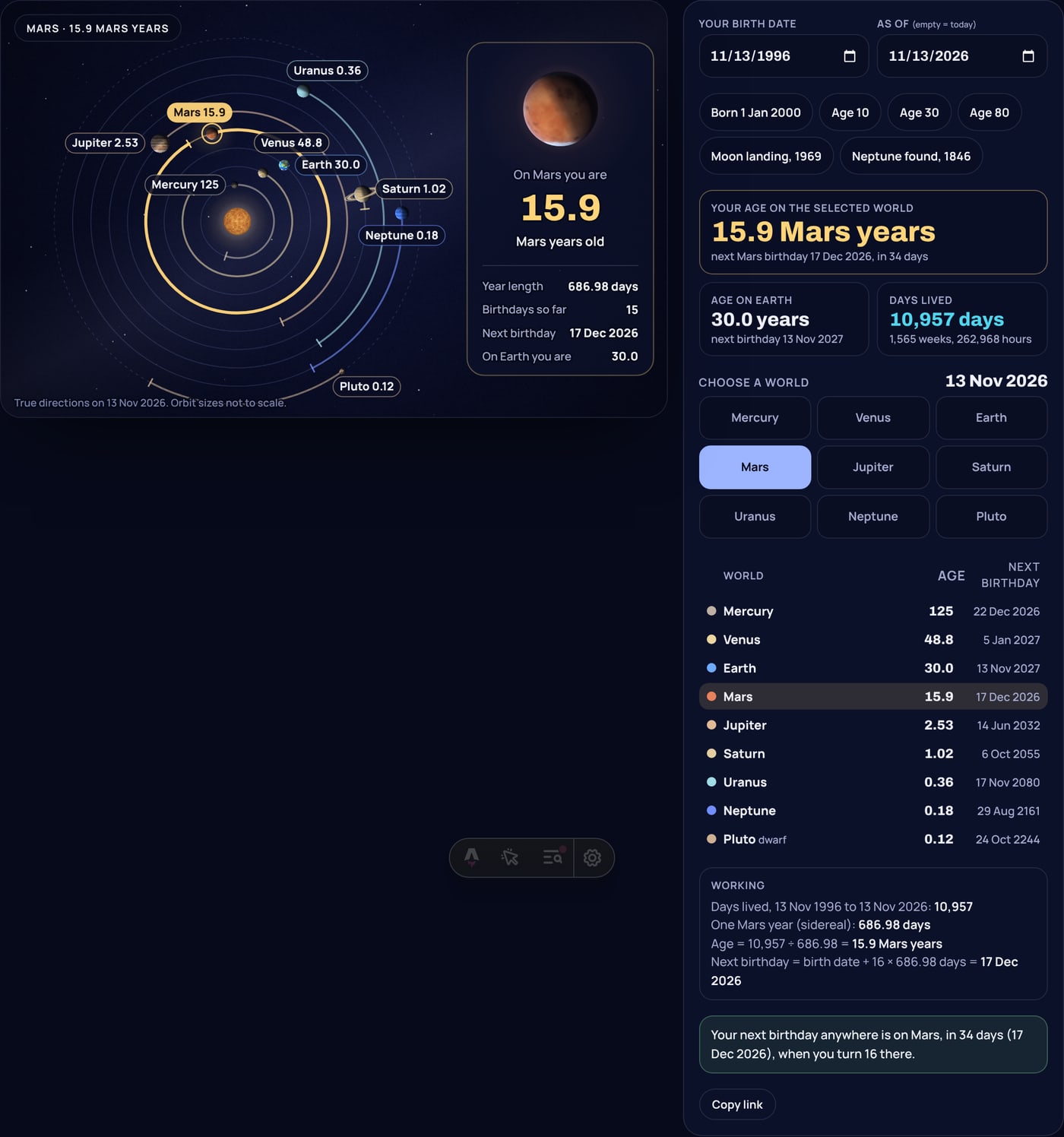
Open the age on other planets calculator, type your birth date and pick Mars. The panel shows your Mars age, the date of your next Mars birthday and the working, and the list underneath does the same for every planet and for Pluto. Set the "as of" date to a future day to find out how old you would be on Mars when you land there, and see 20 facts about our Solar System for more about the worlds on the list.
Sources
- NASA NSSDCA, Mars Fact Sheet: sidereal orbit period 686.980 days, tropical period 686.972 days, length of day 24.6597 hours, semimajor axis 227.956 million km.
- NASA NSSDCA, Planetary Fact Sheet and the individual fact sheets for each planet and Pluto: orbit periods and distances.
- NASA JPL Solar System Dynamics, Approximate Positions of the Planets: orbital elements used to place the planets.
- ESA/Hubble, Hubble celebrates Neptune’s first orbit since discovery: 11 July 2011.
Frequently asked questions
How old would I be on Mars?
Count the days you have lived and divide by 686.98, the number of Earth days in one Mars year. A 30-year-old has lived about 10,957 days, which is 15.95 Mars years. As a shortcut, multiply your Earth age by 0.532.
How long is a year on Mars?
686.98 Earth days, or 1.881 Earth years, according to NASA’s Mars fact sheet. Because a Mars day is 24.66 hours long, the same year is about 668.6 Mars days (sols).
When is my next birthday on Mars?
Take the number of Mars birthdays you have had, add one, multiply by 686.98 days and count that many days on from your birth date. Someone born on 1 January 2000 has their 15th Mars birthday on 18 March 2028.
Would I age more slowly on Mars?
No. Your body ages at the same rate. A Mars year is simply a longer unit of time, so the number you count is smaller. The relativistic effect of Mars’s weaker gravity and slower orbit is far too small to notice.
On which planet would I be the oldest?
Mercury, because it has the shortest year at 87.969 days. A 30-year-old is about 125 Mercury years old. On Neptune the same person is 0.18 years old.