On a neutron star, you would weigh 130 billion times your weight on Earth. Multiply your Earth weight by 130 billion: a 70 kg person would read 9.2 trillion kg, and a 154 lb person 20 trillion lb. That is 130 billion times as heavy as on Earth. Your mass does not change; only the pull on it does.
The surface gravity is 1.3×10¹² m/s² against 9.81 m/s² on Earth. Weight is mass times local gravity, W = m × g, so the scale reading is your Earth reading times 130 billion.
Weight on a neutron star by Earth weight
Each row is a person’s Earth weight and what the same person reads on a neutron star. The pounds column converts the kilograms (1 kg = 2.20462 lb); the ratio 130 billion is the same for any unit.
| On Earth | On a neutron star (kg) | On a neutron star (lb) |
|---|---|---|
| 40 kg (88.2 lb) | 5.3 trillion kg | 12 trillion lb |
| 50 kg (110 lb) | 6.6 trillion kg | 14 trillion lb |
| 60 kg (132 lb) | 7.9 trillion kg | 17 trillion lb |
| 70 kg (154 lb) | 9.2 trillion kg | 20 trillion lb |
| 80 kg (176 lb) | 11 trillion kg | 23 trillion lb |
| 90 kg (198 lb) | 12 trillion kg | 26 trillion lb |
| 100 kg (220 lb) | 13 trillion kg | 29 trillion lb |
Calculated as weight × 1.3×10¹² ÷ 9.81. A bathroom scale calibrated on Earth would show these values.
Why gravity is 1.3×10¹² m/s² on a neutron star
Surface gravity follows from the body’s mass M and its radius R: g = G M ÷ R². The simulation uses a radius of 12 km, which with g = 1.3×10¹² m/s² corresponds to a mass of 1.4 solar masses.
A neutron star is what is left when a massive star’s core collapses: roughly 1.4 times the Sun’s mass in a ball about 12 km in radius. Surface gravity is about 1.3 × 10¹² m/s², roughly 130 billion times Earth’s. Here the 70 kg person would weigh as much as 9.2 trillion kg.
Those numbers use Newton’s law of gravity. At this strength general relativity changes the result by tens of percent, so treat them as a good first estimate and not a measurement. Escape speed comes out at about 0.59 times the speed of light. For the physics of these stars see the mystery of neutron stars and try how small you can squeeze a star.
A jump and a fall on a neutron star
Gravity sets more than weight. The take-off speed that lifts you 50 cm on Earth would raise you 3.8 pm on a neutron star, in a jump lasting 0.00485 ns against 0.639 s on Earth. A ball dropped from 2 m takes 1.76 µs to land, compared with 0.639 s on Earth.
Escape speed, the speed at which you leave for good, is 176,000 km/s (0.59 c), against 11.2 km/s for Earth. It does not depend on your mass.
Compare with other worlds
For a 70 kg person, here is the pull and the scale reading on each body in the simulation. Select one to get its own page.
| Body | Gravity | A 70 kg person reads |
|---|---|---|
| Mercury | 3.7 m/s² | 26.4 kg |
| Venus | 8.87 m/s² | 63.3 kg |
| The Moon | 1.62 m/s² | 11.6 kg |
| Mars | 3.71 m/s² | 26.5 kg |
| Jupiter | 24.8 m/s² | 177 kg |
| Saturn | 10.4 m/s² | 74.5 kg |
| Uranus | 8.87 m/s² | 63.3 kg |
| Neptune | 11.2 m/s² | 79.6 kg |
| Pluto | 0.62 m/s² | 4.42 kg |
| The Sun | 274 m/s² | 1,960 kg |
| Neutron star | 1.3×10¹² m/s² | 9.2 trillion kg |
This page is one case from the full guide, Weight on other planets, which covers every case, the assumptions behind the model and what it leaves out.
Other cases
- Mercury 70 kg reads 26.4 kg
- Venus 70 kg reads 63.3 kg
- The Moon 70 kg reads 11.6 kg
- Mars 70 kg reads 26.5 kg
- Jupiter 70 kg reads 177 kg
- Saturn 70 kg reads 74.5 kg
- Uranus 70 kg reads 63.3 kg
- Neptune 70 kg reads 79.6 kg
- Pluto 70 kg reads 4.42 kg
- The Sun 70 kg reads 1,960 kg
Frequently asked questions
How much does a 70 kg person weigh on a neutron star?
9.2 trillion kg (20 trillion lb). The ratio to Earth is 130 billion, from g = 1.3×10¹² m/s² against 9.81 m/s².
Does my mass change on a neutron star?
No. Mass is the amount of matter in you and stays the same everywhere. Weight is the force gravity puts on that mass, so it is the weight that changes, to 130 billion times its Earth value.
How do I work out my weight on a neutron star?
Multiply your Earth weight by 130 billion. In kilograms or pounds the answer comes out in the same unit, because the ratio has no unit.
How high could I jump on a neutron star?
A jump that rises 50 cm on Earth would rise 3.8 pm on a neutron star, because height scales as 1 ÷ g for the same take-off speed.
Part of the learning path Gravity and motion, from a thrown ball to a planet.
Keep learning
Top 20 Interesting Facts About Our Solar System
Here, we'll delve into the top 10 interesting facts about our solar system that will leave you in awe of the cosmos
Could We Create Artificial Gravity in Space?
Can humans ever experience gravity-like forces in space? we delve into the science and engineering of artificial gravity, from rotating habitats to electromagnetic fields
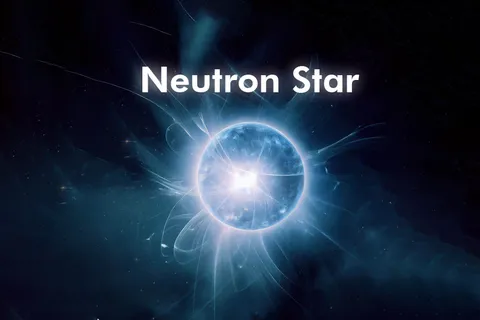
The Mystery of Neutron Stars
Neutron stars are some of the most fascinating celestial objects in the universe. Born out of the explosive death of massive stars...