How Does Carbon Dating Work, and How Far Back Can It Go?
In December 1949 Willard Libby and James Arnold published a test of a strange new clock. They had measured the carbon-14 in wood from the tombs of two Egyptian kings, Zoser and Sneferu, whose ages historians put at 2625 BC, give or take 75 years. The new method said 2800 BC, give or take 250. It was not precise, but it worked, and it earned Libby the 1960 Nobel Prize in Chemistry.
This post explains how that clock works, why labs still use a half-life everyone knows is slightly wrong, and why it stops at about 50,000 years. The carbon dating calculator turns the carbon-14 left in a sample into a radiocarbon age, with its uncertainty and the limit marked.
Where does carbon-14 come from?
Cosmic rays hitting the upper atmosphere knock neutrons loose, and some of those neutrons turn nitrogen-14 into carbon-14. The new carbon-14 joins oxygen to make carbon dioxide, which mixes through the air. It is rare: about 1.25 carbon-14 atoms for every million million atoms of ordinary carbon-12.
Plants take in carbon dioxide by photosynthesis, so they carry the same tiny share of carbon-14 as the air. Animals eat the plants, and other animals eat them, so everything alive keeps topping up its carbon-14. When an organism dies it stops exchanging carbon with its surroundings, and the clock starts.
Example 1: how radioactive is a gram of living carbon?
That is about 14 decays a minute from each gram of carbon in a living thing, using the 5,730 year half-life. It is this faint activity that Libby counted.
How do you calculate a radiocarbon age?
Radioactive decay is random for each atom but perfectly regular in bulk: in every half-life, half of whatever is left decays. The fraction left after time is an exponential, and turning it round gives the age.
Labs report the result as the fraction of modern carbon, F¹⁴C, or as percent modern carbon, pMC, which is 100 times that. The modern standard represents the carbon-14 level of 1950. The conventional radiocarbon age is then:
The 8033 years is the mean life of carbon-14 on Libby's half-life of 5,568 years: 5568 ÷ ln 2. BP means before present, with the present fixed at 1950.
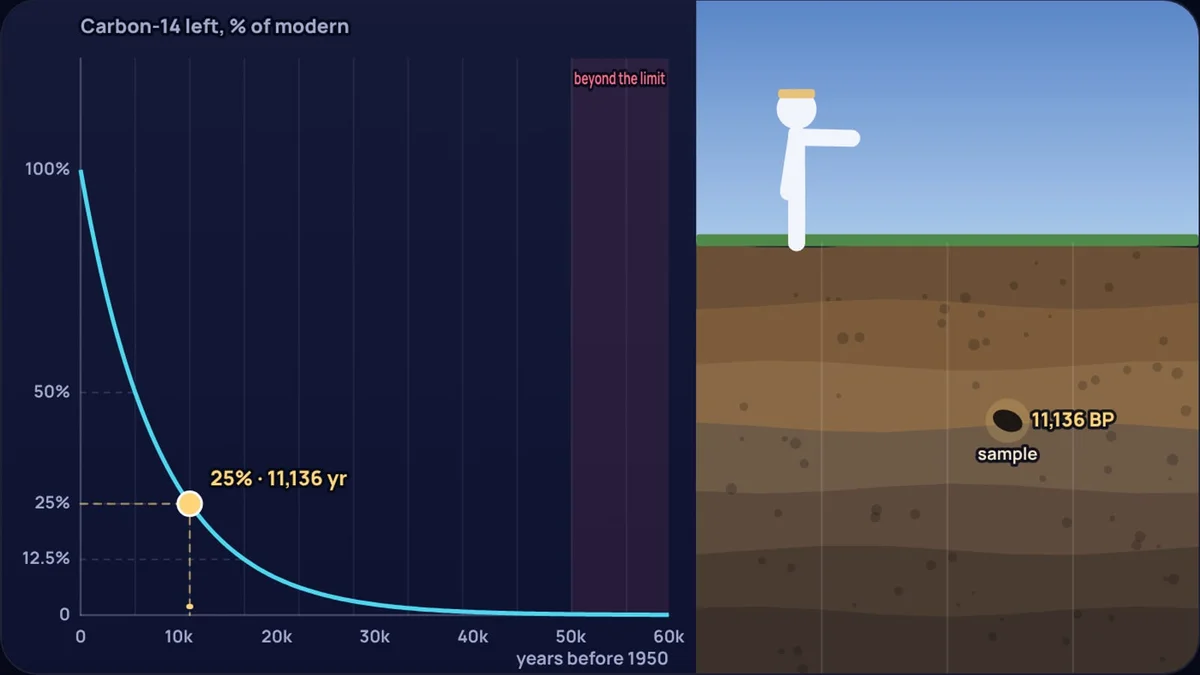
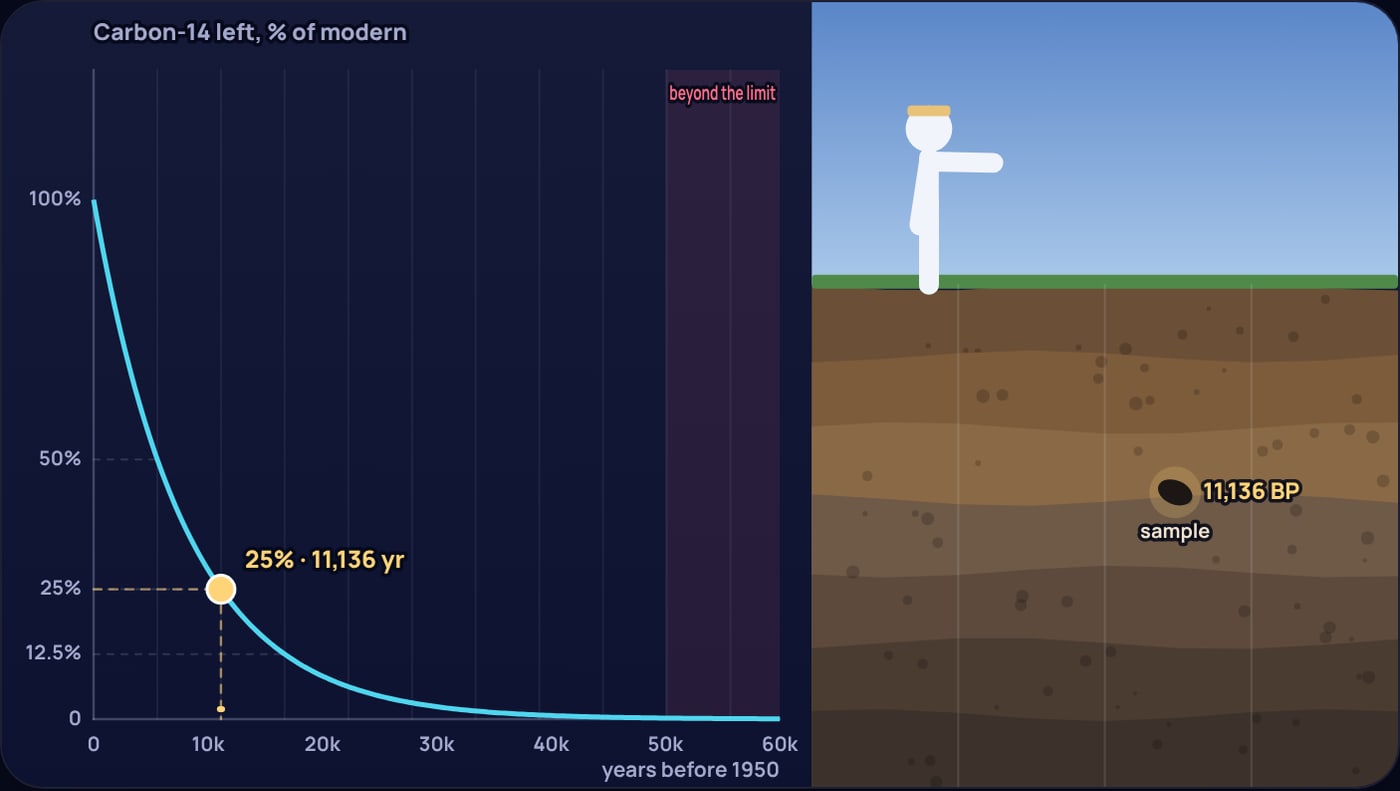
Example 2: charcoal with a quarter of its carbon-14 left
Two half-lives: 100% to 50% to 25%. If the lab gives 25 ± 0.3 pMC, the age is uncertain by 8033 × 0.003 ÷ 0.25 = ±96 years.
Why use 5,568 years when the half-life is 5,730?
Libby's first measurement of the half-life was 5,568 ± 30 years, and thousands of dates were worked out with it. In the early 1960s better measurements gave 5,730 ± 40 years, the value often called the Cambridge half-life. Rather than recalculate everything, researchers agreed in 1962 to keep Libby's figure for reporting. An age calculated that way is a conventional radiocarbon age.
Example 3: how big is the difference?
Every conventional age is about 2.9% shorter than the time the decay really took. That would matter, except that radiocarbon ages are never read as calendar years directly.
Calibration takes care of it. The calibration curves are built by radiocarbon dating material of known age, such as tree rings counted year by year, and those measurements are reported with the same Libby convention. Reading an age off the curve converts it straight to calendar years, half-life difference and all.
Why does a radiocarbon age need calibrating?
The method assumes the air always had the same share of carbon-14. It did not: the carbon-14 level of the air has fluctuated over time. Two human effects make it worse for recent centuries: burning coal and oil adds carbon with no carbon-14 at all, diluting the air, while nuclear weapons tests in the 1950s and early 1960s roughly doubled the carbon-14 in the air.
The current Northern Hemisphere calibration curve, IntCal20, published in 2020, runs from the present back to 55,000 calendar years before 1950. It is built from tree rings back to about 13,900 years, and from lake and sea sediments, cave formations and corals beyond that, with matching curves for the Southern Hemisphere and the ocean. Calibrated results come out as calendar ranges with probabilities, often lopsided where the curve wiggles.
The calculator stops at the conventional radiocarbon age and says so. For a calendar date, put the lab's result into calibration software with the right curve.
How far back can carbon dating go?
Each half-life leaves half as much carbon-14, so the clock gets harder to read as it runs down.
| Carbon-14 left | Half-lives | Radiocarbon age |
|---|---|---|
| 50% | 1 | 5,568 BP |
| 25% | 2 | 11,136 BP |
| 10% | 3.3 | 18,497 BP |
| 1% | 6.6 | 36,993 BP |
| 0.2% | 9.0 | 49,922 BP |
Two problems meet near the end of that table. The first is counting: a gram of 50,000-year-old carbon gives about 1.7 decays an hour instead of 14 a minute, so counting decays becomes hopeless. Accelerator mass spectrometry gets round that by counting the carbon-14 atoms themselves, and it needs as little as half a milligram of carbon.
The second problem is contamination, and no machine fixes it.
Example 4: a little modern carbon in a very old sample
With 1% modern carbon, F = 0.99 × 0.00198 + 0.01. One part in a hundred of modern carbon, from roots, handling or the lab, knocks 14,000 years off a 50,000-year-old sample. Even one part in a thousand removes over 3,000 years.
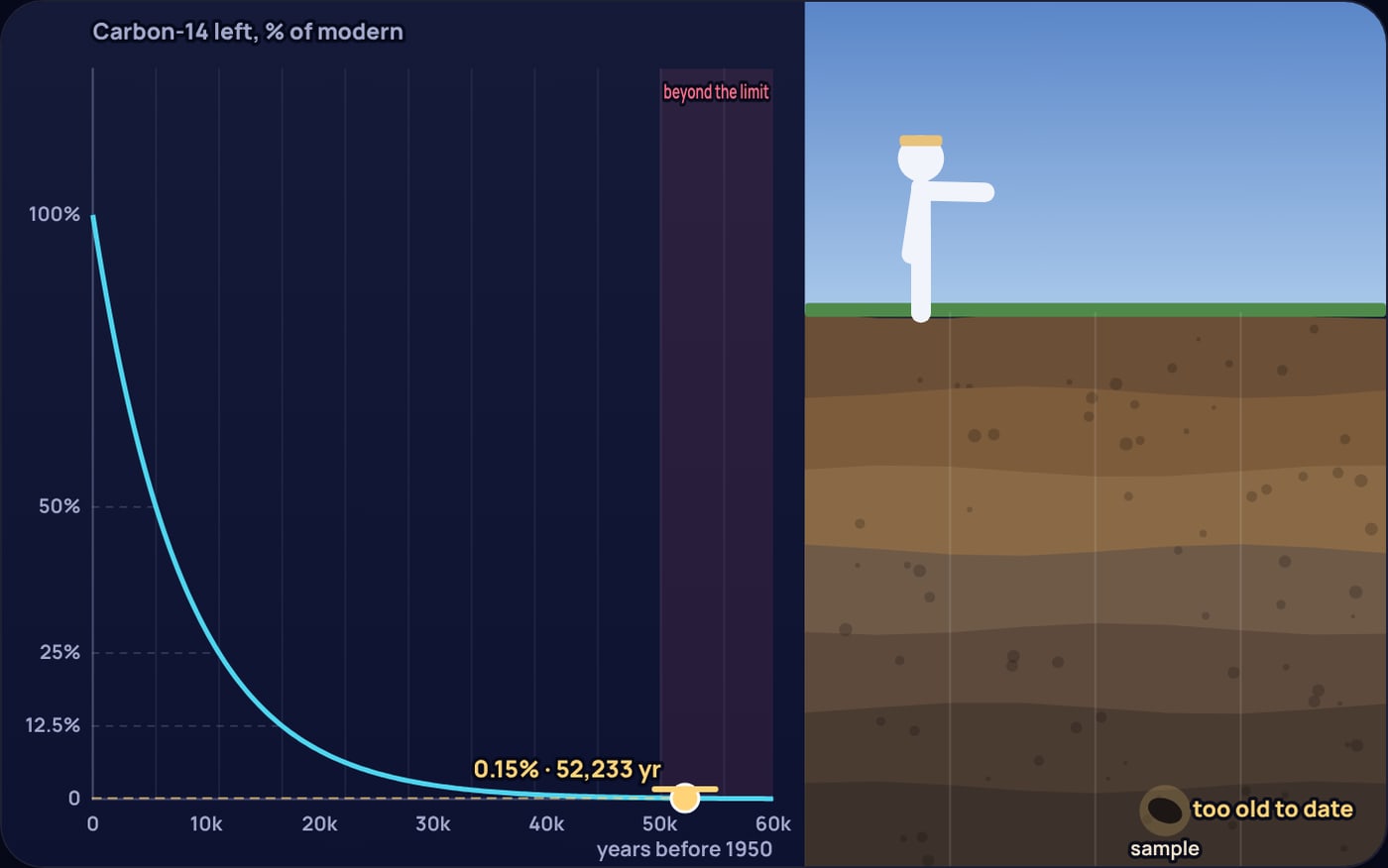
That is why the practical limit sits around 50,000 years. With special cleaning and large samples some labs reach 60,000 years or a little more, but beyond that other clocks take over, such as the decay of potassium or uranium in rocks.
Can you carbon date something too young?
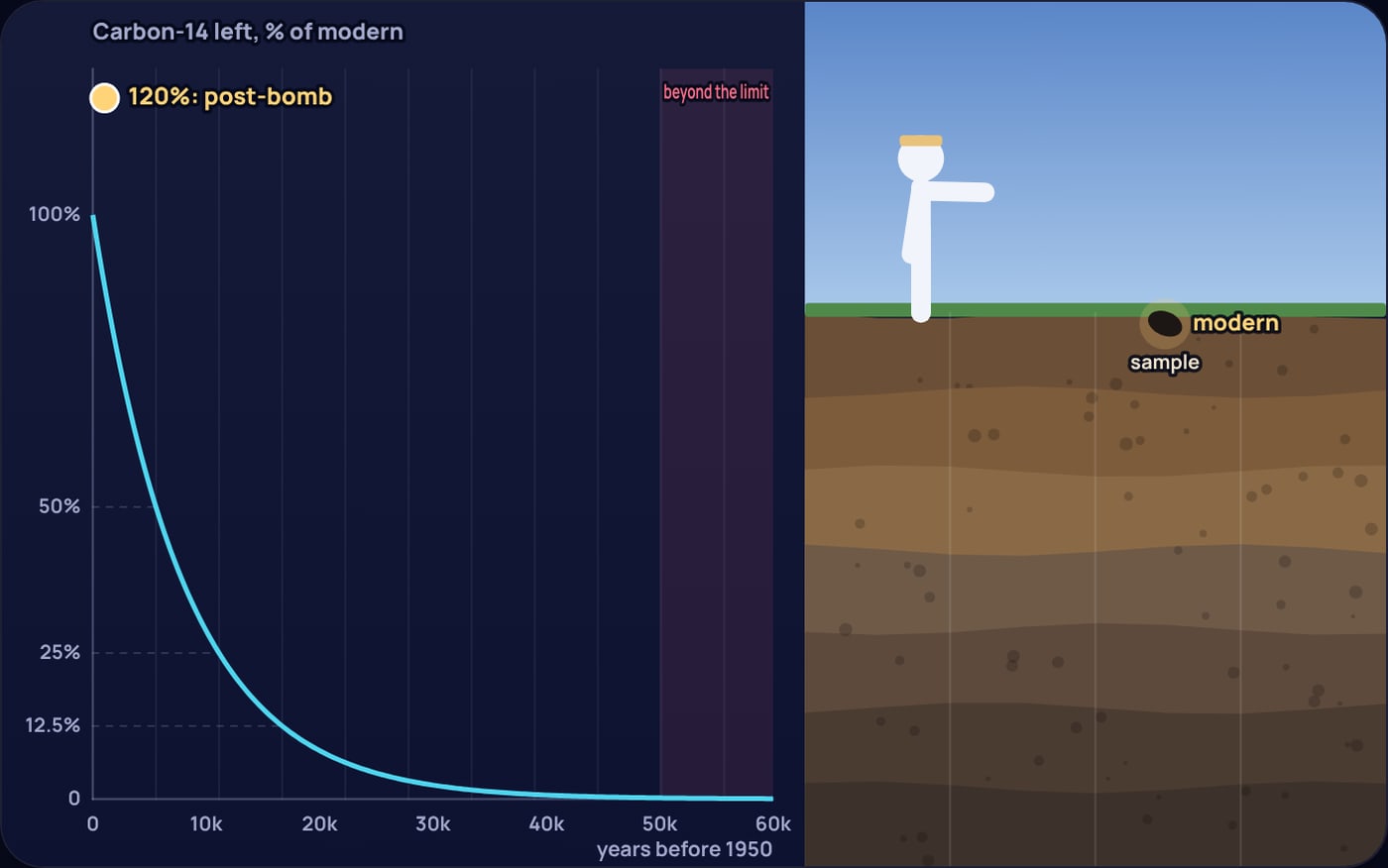
Yes, in a different way. Anything that grew after the bomb tests can contain more carbon-14 than the 1950 standard, giving more than 100% modern carbon. The formula would return a negative age, which is meaningless. Instead, post-bomb samples are matched against records of how the bomb carbon in the air rose and fell. This is now used in forensics and biology, for instance to tell when tissue formed.
Try it yourself
Open the carbon dating calculator with 2% left and add an uncertainty to see the error bar grow as the sample gets older, or switch to Age to find how much carbon-14 a 10,000-year-old sample should have. To watch atoms decaying one at a time, try the radioactive decay simulation. The same cosmic rays that make carbon-14 make the muons in the muon paradox, and the bomb tests behind the carbon spike come into the story of Oppenheimer.
Sources
- Wikipedia, Radiocarbon dating: production of carbon-14, the Libby and Cambridge half-lives and the 1962 agreement, BP and 1950, the 50,000 year limit, the Suess and bomb effects, AMS sample sizes, and Libby and Arnold’s 1949 test.
- Reimer, Brown and Reimer, Discussion: reporting and calibration of post-bomb 14C data, Radiocarbon 2004: F¹⁴C and t = −8033 ln F¹⁴C.
- Reimer and colleagues, The IntCal20 Northern Hemisphere radiocarbon age calibration curve (0 to 55 cal kBP), Radiocarbon 2020.
Frequently asked questions
How does carbon dating work?
Living things take in carbon-14 from the air while they are alive. When they die the intake stops and the carbon-14 decays, halving every few thousand years. Measuring how much is left compared with a modern standard gives the time since death.
How far back can carbon dating go?
About 50,000 years with standard methods. By then only about 0.2% of the original carbon-14 is left, and a trace of modern carbon would swamp it. Special preparation can sometimes reach 60,000 years or more.
Why do labs use a half-life of 5,568 years when the real value is about 5,730?
Early results were calculated with Libby’s 5,568 year half-life, and in 1962 researchers agreed to keep it so all radiocarbon ages stay comparable. Calibration curves are built with the same convention, so calibrated calendar dates come out right.
What does BP mean on a radiocarbon date?
Before present, with the present fixed at 1950. A radiocarbon age of 11,136 BP means 11,136 radiocarbon years before 1950.
Can carbon dating date dinosaur bones?
No. Dinosaurs died out tens of millions of years ago, which is thousands of half-lives of carbon-14. Nothing measurable would be left, so older material is dated with other radioactive isotopes in the surrounding rock.