How do you calculate a carbon dating age?
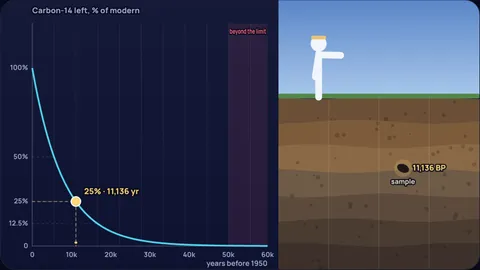
Take the natural log of the fraction of carbon-14 left compared with the modern standard and multiply by −8033 years. A sample with 25% of modern carbon is −8033 × ln 0.25 = 11,136 years old in radiocarbon years, two half-lives. The 8033 years comes from Libby's half-life of 5,568 years, which radiocarbon labs still use by convention.
A radiocarbon age counts back from 1950 (BP, before present) and is not yet a calendar date: it must be calibrated with a curve such as IntCal20. The method reaches back about 50,000 years. How it all works is in How does carbon dating work, and how far back can it go?, and you can watch decay happen atom by atom in the radioactive decay simulation.
Key results
- Conventional age: t = −8033 × ln(F¹⁴C) years before 1950, where F¹⁴C is the fraction of the modern carbon-14 level left.
- Half-lives: 50% left is 5,568 years, 25% is 11,136 years, 12.5% is 16,704 years.
- Libby or Cambridge: with the more accurate 5,730 year half-life, 25% left would take 11,460 years, about 3% longer. Labs report the Libby figure and calibration corrects for it.
- Limit: after about 50,000 years only 0.2% is left, so standard dating stops around there.
Six worked examples
Each button loads the example into the calculator. The samples are illustrations, not particular finds.
Half the carbon-14 left: 5,568 years
one half-life−8033 × ln 0.5 = 8033 × 0.693 = 5,568 years, exactly Libby's half-life. With the Cambridge half-life the same decay takes 5,730 years, which is why calibrated dates for this sample would come out older than the radiocarbon age.
90% left: 846 years
a recent sampleOnly a tenth has decayed: −8033 × ln 0.90 = 846 years BP. A measurement uncertainty of ±0.3 pMC gives ±27 years. For young samples the wiggles in the calibration curve often matter more than the measurement.
Charcoal with 25% left: 11,136 years
two half-livesTwo half-lives have passed, so −8033 × ln 0.25 = 11,136 years BP. At ±0.3 pMC the uncertainty is ±8033 × 0.003 ÷ 0.25 = ±96 years: the same absolute error matters more as less carbon-14 remains.
2% left: 31,425 years
old sampleAfter 5.64 half-lives, ±0.1 pMC becomes ±402 years. At this level a tiny amount of modern carbon from roots, handling or the lab makes a big difference, which is why old samples are cleaned so carefully.
0.15% left: past the 50,000 year limit
the limitThe arithmetic gives 52,233 years, but with ±0.05 pMC the uncertainty is ±2,678 years, and the carbon-14 left is no more than contamination could add. Labs report such samples as older than a limit instead of giving an age.
More than 100%: post-bomb carbon
modern sampleNuclear weapons tests in the 1950s and early 1960s roughly doubled the carbon-14 in the air. Anything that grew since then can carry more than the 1950 standard, so it cannot be given a radiocarbon age. Instead it is matched against records of bomb carbon in the air, a method used in forensics and biology.
Carbon-14 left and conventional radiocarbon age
| Carbon-14 left | Half-lives | Radiocarbon age (Libby) | With 5,730 y half-life |
|---|---|---|---|
| 90% | 0.152 | 846 BP | 871 years |
| 75% | 0.415 | 2,311 BP | 2,378 years |
| 50% | 1 | 5,568 BP | 5,730 years |
| 25% | 2 | 11,136 BP | 11,460 years |
| 10% | 3.32 | 18,497 BP | 19,035 years |
| 5% | 4.32 | 24,065 BP | 24,765 years |
| 1% | 6.64 | 36,993 BP | 38,069 years |
| 0.5% | 7.64 | 42,561 BP | 43,799 years |
| 0.2% | 8.97 | 49,922 BP | 51,374 years |
Conventional radiocarbon ages, t = −8033 ln F, in years before 1950. These are not calendar ages: calibrate them with IntCal20 or its Southern Hemisphere and marine counterparts.
How the calculator works
Percent modern carbon (pMC) is 100 × F¹⁴C, the sample's carbon-14 level as a fraction of the modern standard, after the lab's corrections. The tool works with F¹⁴C.
The conventional radiocarbon age is t = −8033 × ln(F¹⁴C) years BP, where 8033 is the mean life from Libby's half-life of 5,568 years and BP counts back from 1950. That convention was kept in 1962 so older results stay comparable, even though the half-life is now known to be about 5,730 years.
An uncertainty in F becomes an uncertainty in age of 8033 × σF ÷ F years. The tool also shows how long the same decay would take with the 5,730 year half-life.
Above 100% modern the sample is post-bomb and has no radiocarbon age. Below about 0.2% (around 50,000 years) the result is beyond the practical limit.
What the model leaves out
- Calibration: turning a radiocarbon age into calendar years needs a calibration curve such as IntCal20, which covers 0 to 55,000 calendar years before 1950. This tool does not calibrate.
- Reservoir effects: sea creatures and some lake samples take up older carbon, so they look older; marine samples need the marine calibration curve and a local correction.
- Isotope corrections: labs correct for the way plants take up carbon isotopes unequally (δ¹³C). Enter the lab's corrected pMC or F¹⁴C.
Common misconceptions
"Carbon dating can date dinosaurs." No. Dinosaurs died out tens of millions of years ago; after about 50,000 years there is too little carbon-14 left. Rocks are dated with other isotopes.
"A radiocarbon age is a calendar date." It needs calibrating. The amount of carbon-14 in the air has changed over time.
"Labs use the wrong half-life." They use Libby's by agreement, and calibration curves are built with the same convention, so calibrated dates come out right.
Frequently asked questions
How do you calculate a radiocarbon age?
Multiply the natural log of the fraction of modern carbon left by −8033 years. 25% left gives −8033 × ln 0.25 = 11,136 years before 1950.
What is the half-life of carbon-14?
About 5,730 years (the Cambridge value). Radiocarbon ages are still calculated with Libby's earlier value of 5,568 years by convention, and calibration curves correct for the difference.
How far back can carbon dating go?
About 50,000 years with standard methods, when only about 0.2% of the original carbon-14 is left. Special preparation can sometimes reach 60,000 years or more.
What does BP mean in radiocarbon dating?
Before present, where the present is fixed at 1950. A radiocarbon age of 1,000 BP means 1,000 radiocarbon years before 1950.
Why do radiocarbon dates need calibration?
The carbon-14 level in the air has varied, so a radiocarbon age does not map exactly onto calendar years. Calibration curves such as IntCal20, built from tree rings and other dated records, convert one into the other.
Keep learning
How Does Carbon Dating Work, and How Far Back Can It Go?
Carbon-14 halves every few thousand years, so what is left in a bone or seed gives its age. The maths, the half-life puzzle and the 50,000 year limit.

The Muon Paradox: Cosmic Rays and Relativity
The muon paradox—a captivating phenomenon where cosmic ray-generated muons defy expected decay rates, showcasing relativity in action.

Oppenheimer, father of a nuclear bomb: was he proud?
J. Robert Oppenheimer, often referred to as the "father of the atomic bomb," was a complex figure in the annals of history. was he proud?