Why Do You Feel Pushed Outward on a Bend?
Take a roundabout a little too fast and your shoulder ends up against the door. It feels exactly as if something shoved you outward. Physics teachers insist that nothing did, and that the real force on a bend points the other way, towards the centre. Both statements can be true at once, and sorting them out explains washing machines, roller coaster loops and why astronauts float.
This post explains the difference between centripetal and centrifugal force with real numbers for a car, a spin cycle, a bucket of water, a coaster and the International Space Station. The centripetal force calculator works out the force and the g-force for any mass, radius and speed, and draws the velocity and force arrows for each case.
What actually happens to you on a bend?
Newton's first law says a moving object keeps going in a straight line at the same speed unless a force acts on it. When the car starts to turn, your body has no reason to turn. It carries on along the line it was already following, which is a tangent to the bend.
The car, meanwhile, curves away from that line. From your seat it looks as if you are sliding towards the outside of the bend, but seen from above, you are going straight and the car is moving across under you. You only start turning when the door or the seat belt reaches you and pushes you sideways towards the centre of the bend.
That sideways push is the force you feel. It acts on your shoulder, from the outside in, which is why it feels like being pressed outward against the door. The door is pushing you in.
What is centripetal force?
Anything moving in a circle is changing direction all the time, so it is accelerating, even at a steady speed. The acceleration points towards the centre of the circle, and its size depends on the speed v and the radius r:
"Centripetal" means centre seeking. It is not a new kind of force, just a name for whatever real force is doing the turning: friction between tyres and road, the tension in a string, the push of a drum wall or the pull of gravity. If that force disappears, the object leaves along a straight line.
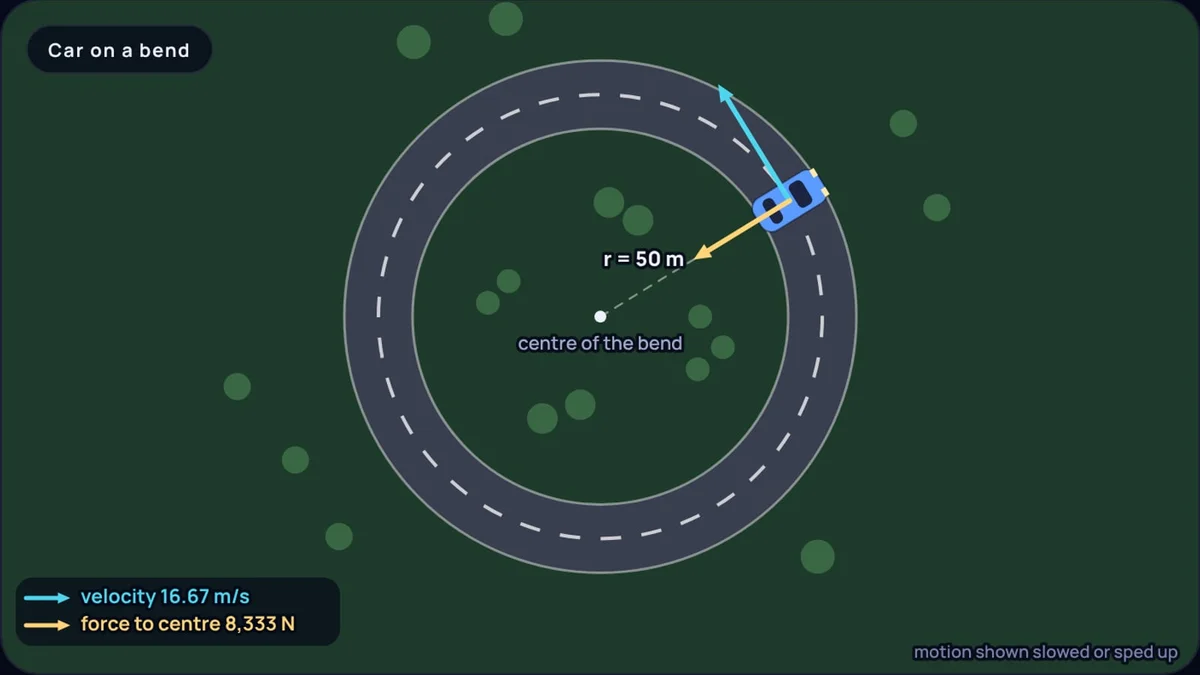
Example 1: a car on a 50 m bend at 60 km/h
For a 1,500 kg car the tyres must grip the road sideways with 8,333 N. A 70 kg passenger needs 70 × 5.556 = 389 N from the seat, belt and door, a bit over half their weight.
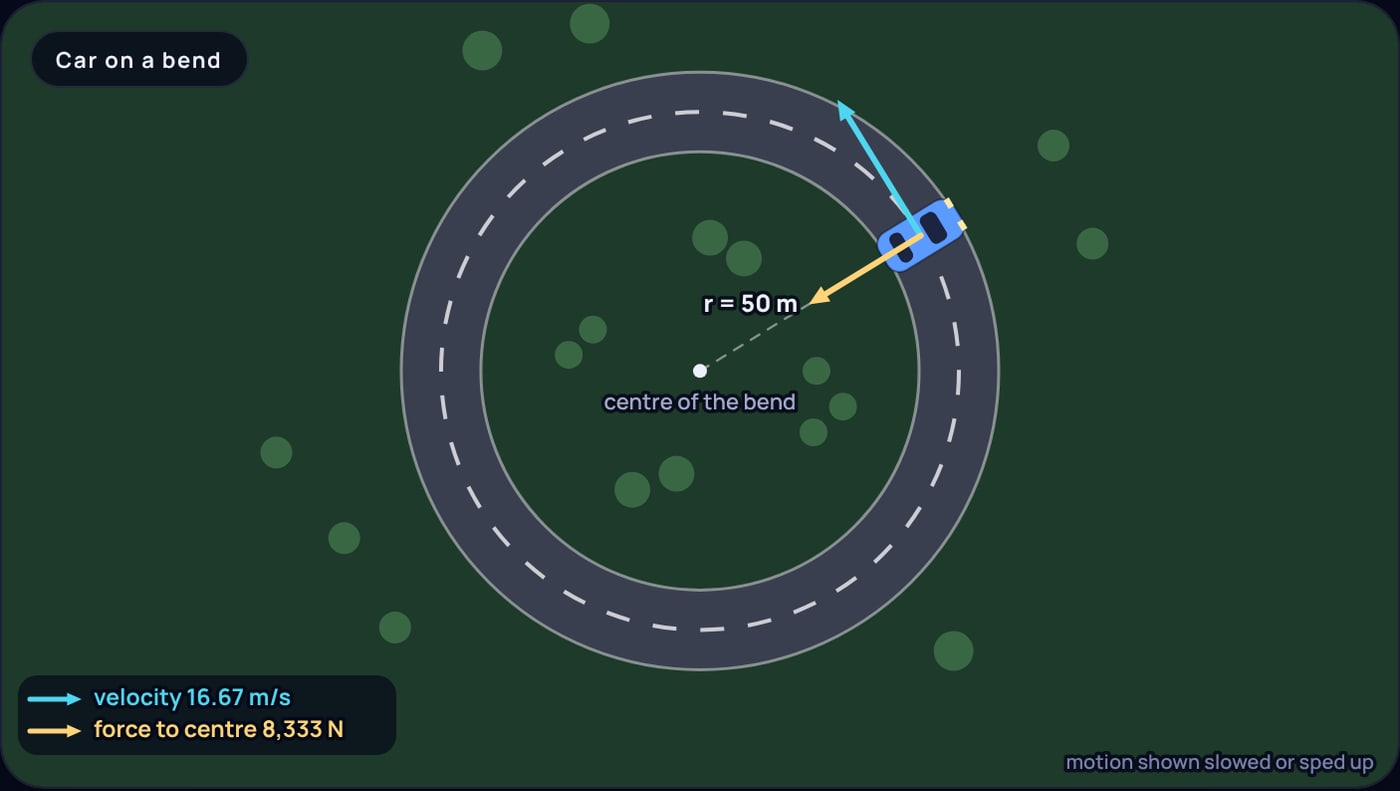
The g-force is the acceleration divided by the standard acceleration of gravity, 9.80665 m/s², the value NIST lists as exact. So 0.567 g means the sideways push on you is 0.567 times your weight.
Is centrifugal force real?
It depends on where you stand. Seen from the road, the only horizontal forces on you point inward, and there is no outward force at all. Physicists call this an inertial frame of reference, where Newton's laws work as they stand.
Inside the car, things look different. From your seat you are not moving: the dashboard stays in front of you and the door stays beside you. Yet the door is pushing you inward. To make Newton's laws balance in this turning frame, you have to add an outward force of exactly mv² ÷ r. That is the centrifugal force. It is real in the sense that it predicts what you feel and measure inside the car, but it is not a push from anything. It is a correction for describing motion from a frame that is itself accelerating.
Engineers use it all the time, because it is often easier to work in the rotating frame of a turbine or centrifuge. The mistake is to think it acts in the road's frame too. If it did, a ball let go from a spinning string would fly straight outward, away from the centre. It does not: it flies off along the tangent, in the direction it was already moving.
Why does going faster make it so much worse?
The speed is squared. Double the speed and the force is four times as large. That is why a bend that feels comfortable at 40 km/h can feel violent at 80 km/h.
Example 2: the same bend at 90 km/h
A 50% rise in speed needs 2.25 times the grip: 1.27 g instead of 0.567 g. On a flat road all of that has to come from friction between the tyres and the road. A tighter bend does the same thing more gently: halving the radius only doubles the force.
Road engineers bank fast bends so that part of the inward push comes from the road surface itself, leaving less work for friction. The calculator treats the road as flat, which is the worst case.
How does a washing machine use centripetal force?
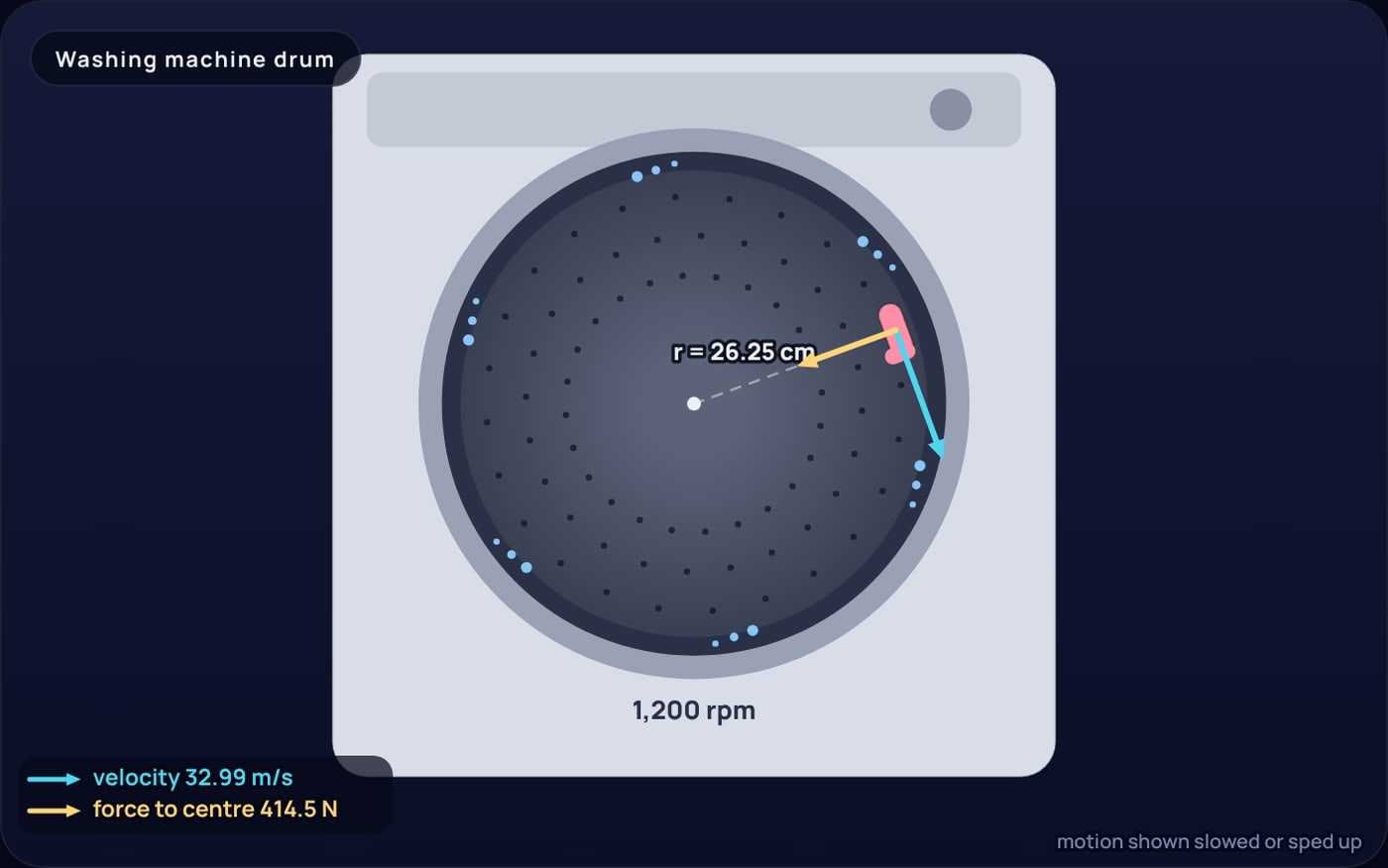
The spin cycle is the clearest example of "outward" being a straight line in disguise. The drum wall pushes the clothes round in a circle. The water in the clothes is pushed round too, until it reaches one of the holes in the drum. At a hole there is nothing to push it, so it carries straight on along the tangent, out of the drum.
Example 3: a 525 mm drum at 1200 rpm
The Haier HW120-BP12357S8 lists a 525 mm drum and a 1200 rpm spin, so r = 0.2625 m.
The drum wall moves at 33 m/s, 119 km/h, and a 100 g wet sock is pressed against it with 414.5 N, the weight of a 42 kg mass.
Why does the water stay in a bucket swung overhead?
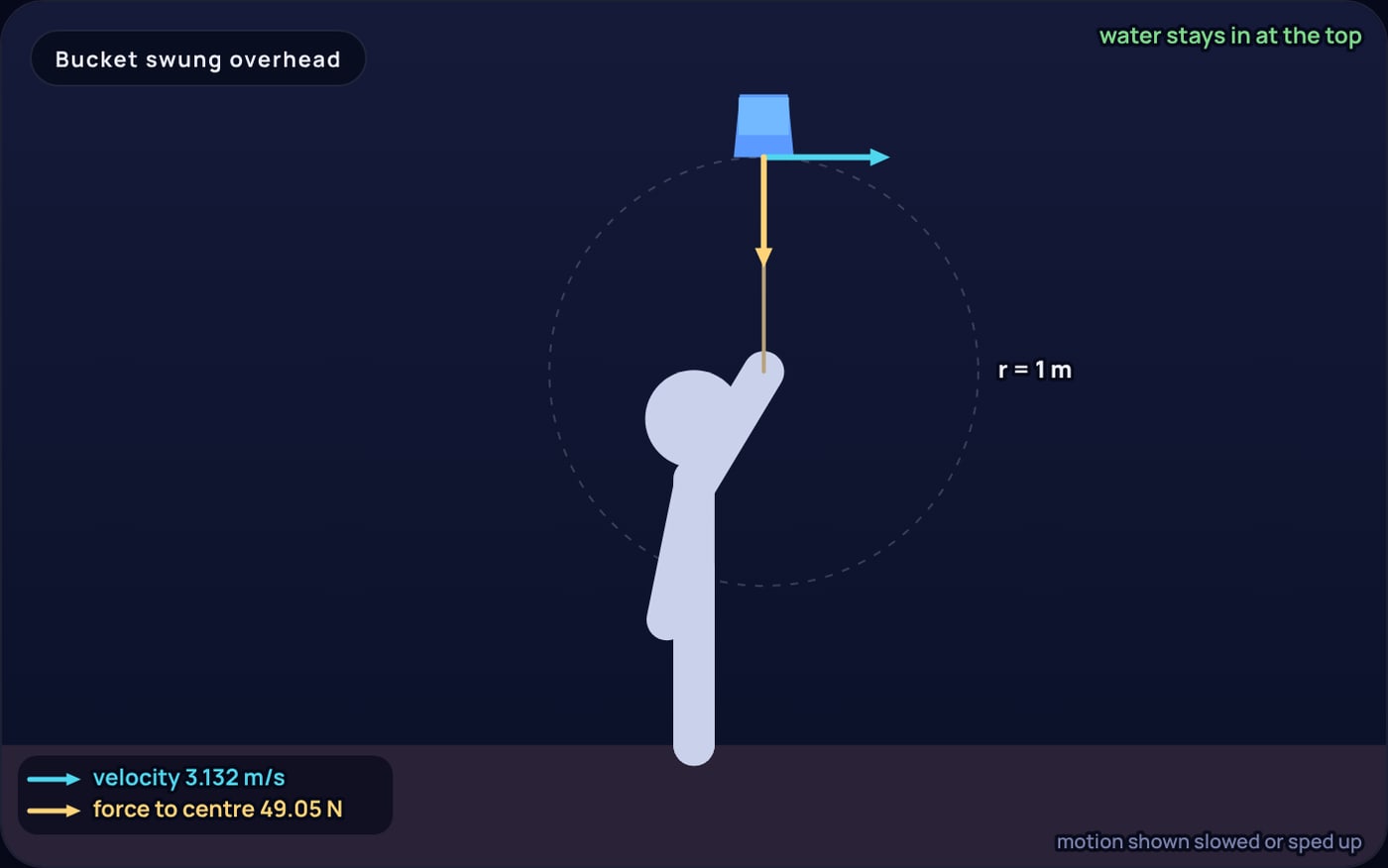
Swing a bucket of water in a vertical circle fast enough and none spills, even upside down. At the top of the circle, both gravity and the bucket's base pull the water towards the centre. If the bucket is moving fast enough, gravity alone is not enough to supply the centripetal force, so the bucket has to push the water down as well, and the water stays pressed into it.
The water falls out if gravity is more than enough on its own, which happens when v² ÷ r is less than g. The slowest safe speed is where the two are equal:
Example 4: a bucket on a 1 m swing
About one turn every two seconds is the minimum. At the bottom of the swing the bucket must push up with twice the water's weight, one g to hold it up and one g to turn it.
What do riders feel at the top of a loop?
A roller coaster loop works like the bucket. Take a loop with a radius of 10 m and a car that passes the top at 14 m/s:
Example 5: a 10 m loop at 14 m/s
Gravity supplies 1 g of the 2 g needed, and the seat pushes down on the rider with the other 1 g. Upside down at the top, a rider feels about their normal weight pressing them into the seat. The slowest speed at the top would be √(9.80665 × 10) = 9.9 m/s.
The calculator uses the speed you enter at the point you care about. A real coaster slows as it climbs the loop, so its speed at the bottom is higher and the riders feel much more there.
Why do astronauts on the ISS float?
Orbit is circular motion with gravity as the centripetal force. JPL's Horizons system gives the ISS's position and speed. On 13 November 2026, averaged over the day, it was 6,796.6 km from Earth's centre, about 418 km above the equator, moving at 7.658 km/s.
Example 6: the centripetal acceleration of the ISS
The two match: gravity at that height, still 0.88 g, is exactly the centripetal force the orbit needs. One orbit takes about 93 minutes.
Gravity has not switched off. The station and everyone in it are falling towards Earth together at 8.63 m/s², while moving sideways fast enough to keep missing it. With nothing pushing on them relative to the station, the crew float. There is more on this in why astronauts float and is there gravity on the ISS.
Turn the idea round and spinning can make weight instead of removing it. A ring shaped station that spins pushes its crew against the outer wall exactly like the drum pushes the sock, an idea worked through in artificial gravity on a spinning space station.
Try it yourself
Open the centripetal force calculator with the car on a 50 m bend and raise the speed to 90 km/h to watch the force grow by 2.25 times. Switch to the bucket and lower the speed below 3.13 m/s to see the water fall out, or give the speed in rpm for anything that spins. Each case shows the velocity and force arrows, the acceleration in g, and the full working.
Sources
- NIST, CODATA value of the standard acceleration of gravity: 9.806 65 m/s², exact.
- Haier, HW120-BP12357S8 specifications: 525 mm drum, 1200 rpm spin speed.
- NASA JPL, Horizons system: geocentric position and velocity of the ISS (target −125544), hourly on 13 November 2026.
- NASA NSSDCA, Earth fact sheet: equatorial radius 6,378.137 km, GM = 0.39860 × 10⁶ km³/s².
- NASA, International Space Station facts and figures: mass 419,725 kg, about 16 orbits a day.
Frequently asked questions
Why do you feel pushed outward when a car turns?
Your body keeps moving in a straight line, as Newton’s first law says, while the car turns under you. The seat, belt and door have to push you inward to make you turn with the car, and that inward push is what you feel.
What is the difference between centripetal and centrifugal force?
Centripetal force is the real inward force that makes something move in a circle, such as tyre grip, a string or gravity. Centrifugal force is an apparent outward force that only appears if you describe the motion from inside the turning car or drum.
Is centrifugal force real?
Not as a force from anything. Seen from the road, nothing pushes you outward. It is a useful bookkeeping force when you work in a rotating frame, and it has the same size as the centripetal force, mv² ÷ r.
How strong is the force on a bend?
F = mv² ÷ r. A car at 60 km/h on a 50 m bend accelerates towards the centre at 5.56 m/s², 0.567 g. For a 70 kg passenger the seat and door must supply about 389 N.
Why does water leave a spinning washing machine drum?
The drum wall pushes the clothes round the circle, but when water reaches a hole there is nothing to push it, so it carries straight on along the tangent and out through the hole.