Joules, Calories and kWh: Energy Units Explained
Energy is one quantity, measured in at least six units that you will meet in school and everyday life. A snack bar lists Calories, an electricity bill lists kilowatt hours, a physics textbook uses joules, a chemistry book uses kilojoules per mole, a particle physicist uses electronvolts and an air conditioner is sold in Btu. They all measure the same thing, and every one of them is a fixed number of joules.
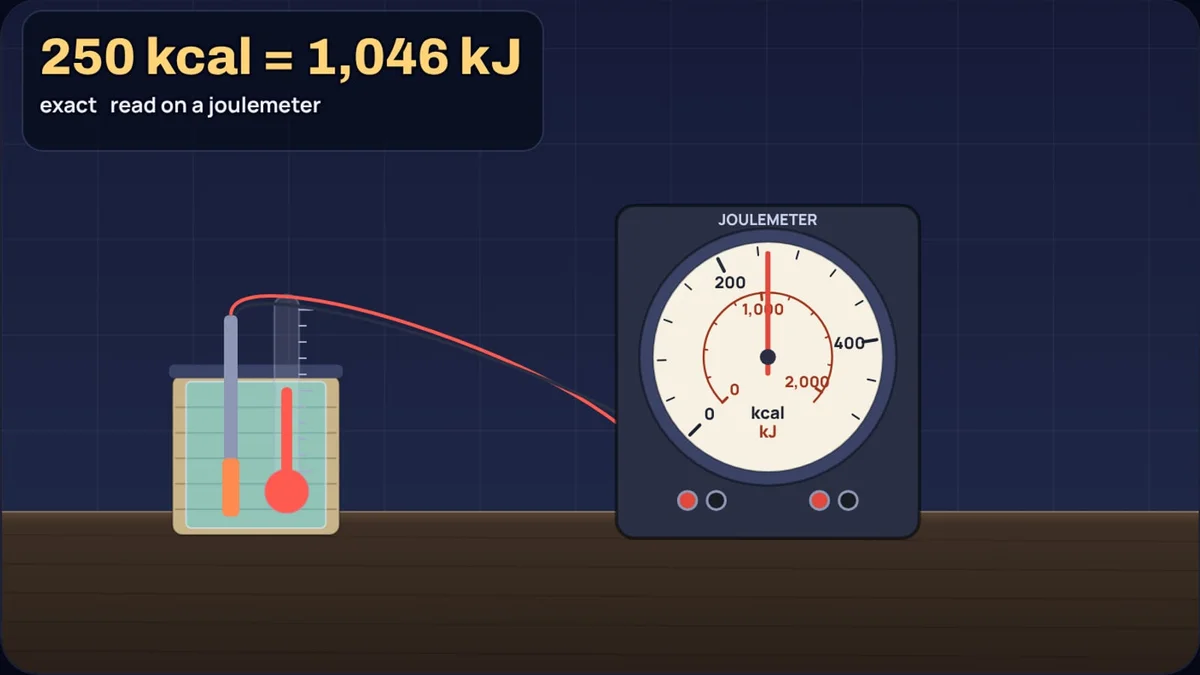
You can check every conversion here in the science unit converter, which uses the exact factors from NIST Special Publication 811 and shows the factor both ways, with the value read off a joulemeter dial printed in both units.
What is a joule?
A joule is the energy transferred when a force of one newton pushes something one metre. It is also the energy a one watt device uses in one second. Those two definitions are the same thing seen from two sides, mechanics and electricity, and they are why the joule sits at the centre of every other energy unit.
A joule is a small amount of energy by everyday standards. Lifting an apple onto a table takes about one joule; that is why food, electricity and fuel use bigger units. The other units below are all defined as a fixed number of joules, so converting between any two of them is a single multiplication and division. The kinetic and potential energy examples show joules at work in moving and lifted objects.
What is a calorie, and what is a food Calorie?
The calorie began as the heat needed to warm one gram of water by one degree Celsius. That amount depends slightly on the starting temperature, so the calorie was redefined as a fixed number of joules. Two versions survive. The thermochemical calorie, used in chemistry, is exactly 4.184 J. The International Table calorie, used in some engineering tables, is exactly 4.1868 J. The difference is less than 0.1%.
The Calorie on a food label is a different size: it is a kilocalorie, 1,000 calories. Some labels write it with a capital C, some as kcal, many just say calories. Labels in many countries print kilojoules as well.
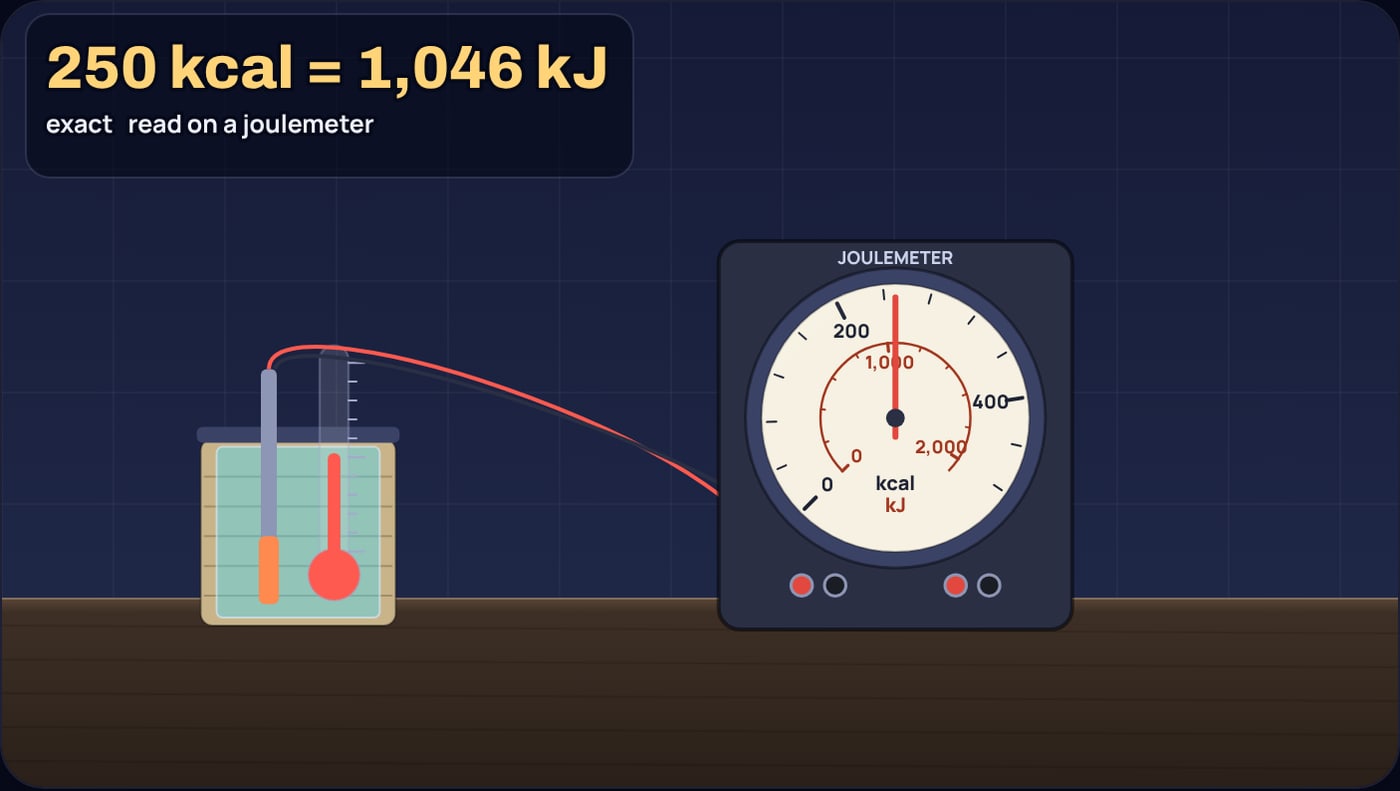
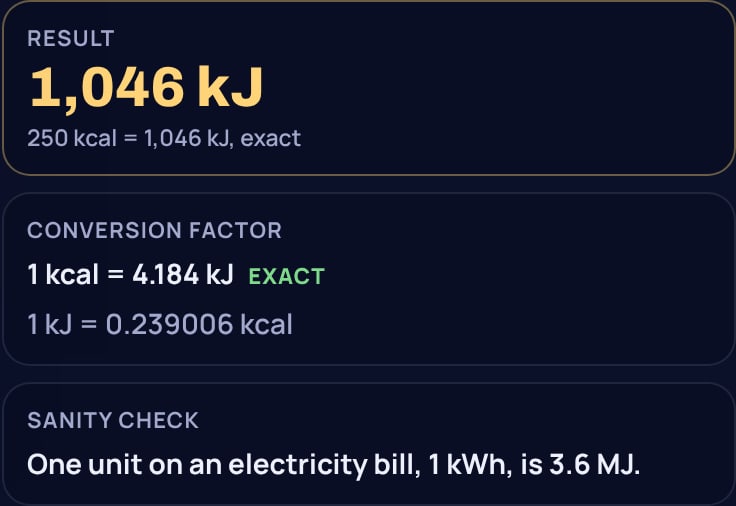
Example 1: a 250 kcal snack in kilojoules
Exact, because 4.184 is exact. Going the other way, 1 kJ is 0.239006 kcal (rounded, since the division never ends).
A daily food intake of 2,000 kcal is 8.368 MJ. The water-heating origin of the calorie is still useful: water's specific heat is about 4.18 J per gram per degree, which is why one calorie warms one gram by about one degree. The article on water's specific heat explains why that number is so large.
What is a kilowatt hour?
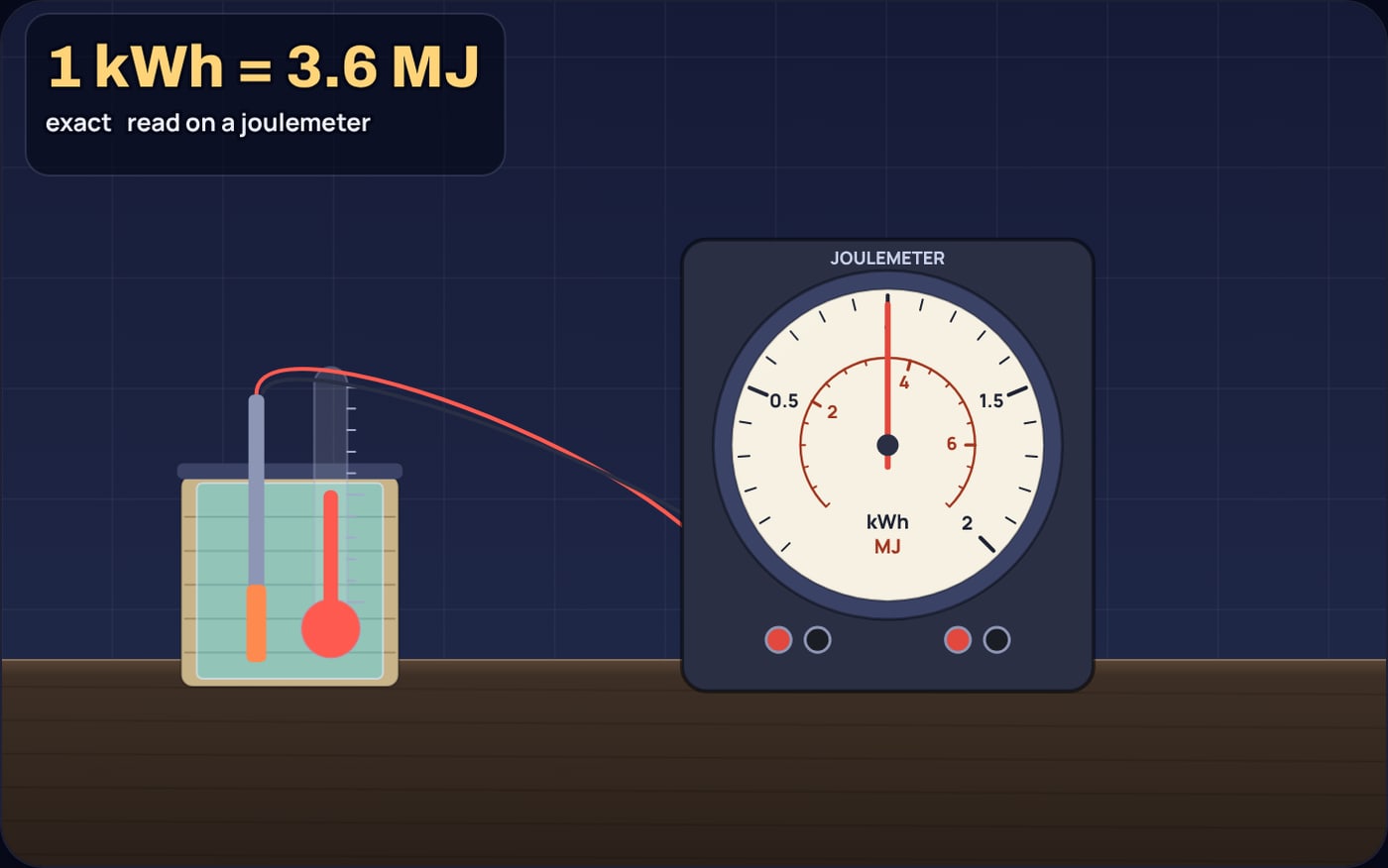
A kilowatt hour is the energy used by something drawing one kilowatt for one hour. A kilowatt is 1,000 joules every second and an hour is 3,600 seconds, so the kilowatt hour is exactly 3,600,000 J. It is the unit on electricity bills, sometimes just called a unit.
The most common mix-up is between kW and kWh. A kilowatt is a power: how fast energy is used. A kilowatt hour is an amount of energy: power multiplied by time. A 2 kW heater uses 2 kWh in an hour and 1 kWh in half an hour. Its power stays 2 kW the whole time.
Example 2: a 2 kW kettle running for 3 minutes
Three minutes is 0.05 h.
About a third of the energy in a 250 kcal snack. The kettle energy article works through where that energy goes.
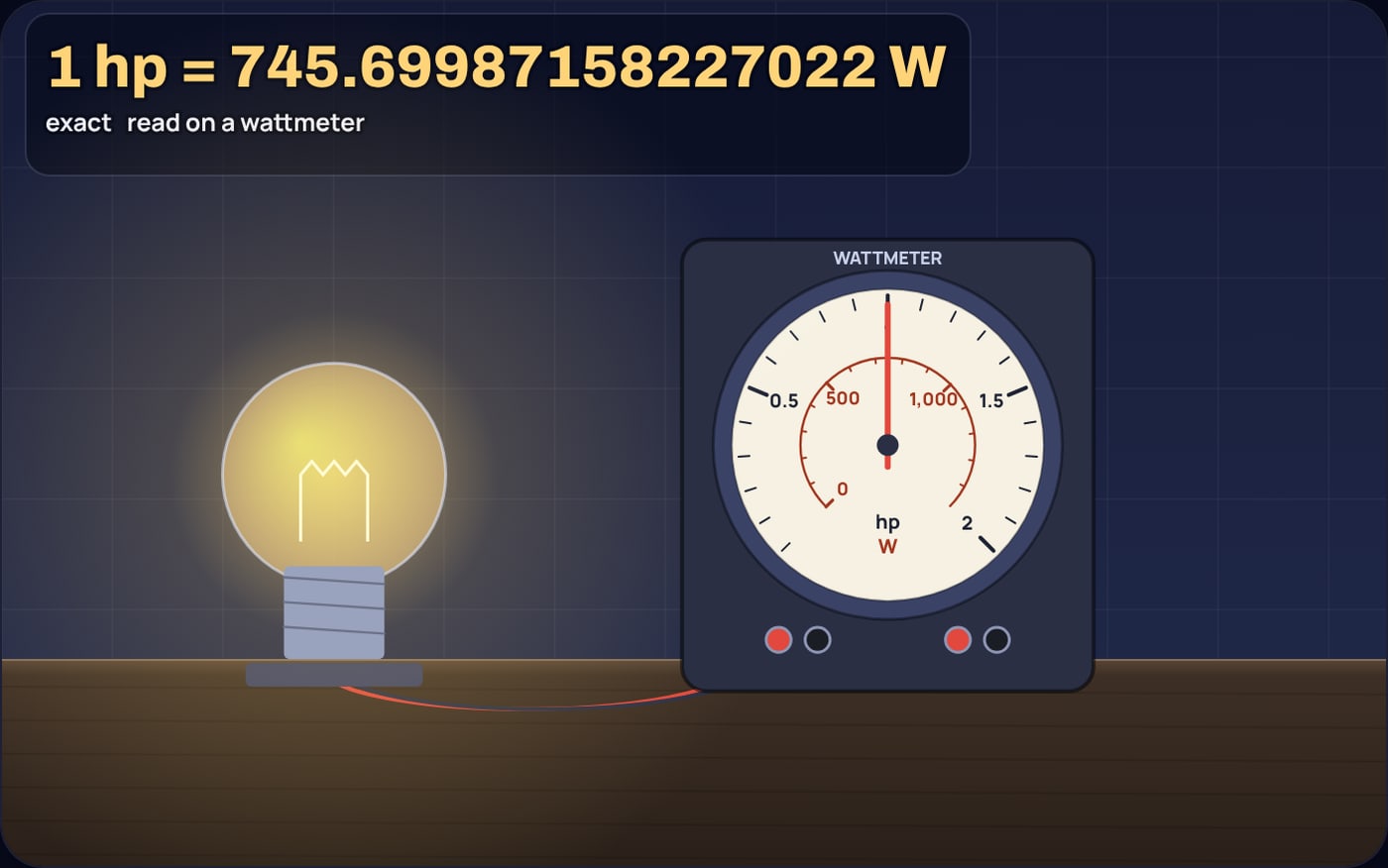
The same distinction applies to horsepower. It is a power, defined as 550 foot pound-force per second, which works out at exactly 745.69987158227022 W. A car's horsepower tells you how fast it can deliver energy, not how much fuel energy it carries.
What is an electronvolt?
An electronvolt is the energy an electron gains when it moves through a potential difference of one volt. Since 2019 the charge of the electron has been fixed exactly, so the electronvolt is now an exact number of joules.
That is tiny, which is the point. Energies of single atoms, photons and particles come out as awkward powers of ten in joules but as ordinary numbers in electronvolts: a few eV for a visible photon, about 13.6 eV to pull the electron off a hydrogen atom (the Rydberg energy, 13.605693122990 eV), millions of eV (MeV) in nuclear reactions. One joule is about 6.24151 × 10¹⁸ eV.
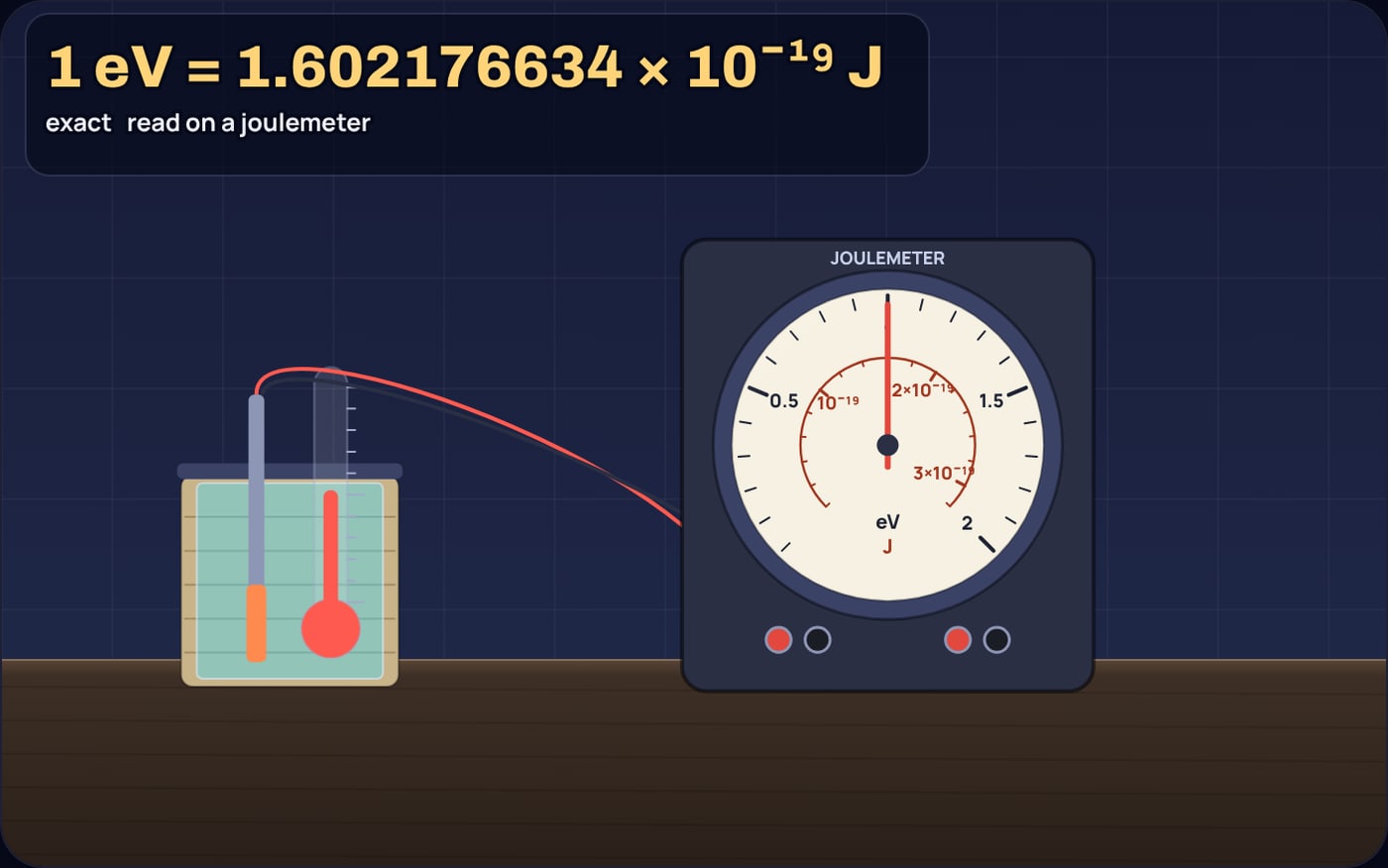
Example 3: one million electronvolts in joules
Exact, since both factors are exact. Mass and energy are linked the same way: the energy in one gram of matter is enormous in joules and in kWh.
What is a British thermal unit?
The Btu was the heat needed to warm one pound of water by one degree Fahrenheit. Like the calorie, it is now defined through joules. The International Table Btu is exactly 1,055.05585262 J, which follows from the International Table calorie of 4.1868 J and the exact pound.
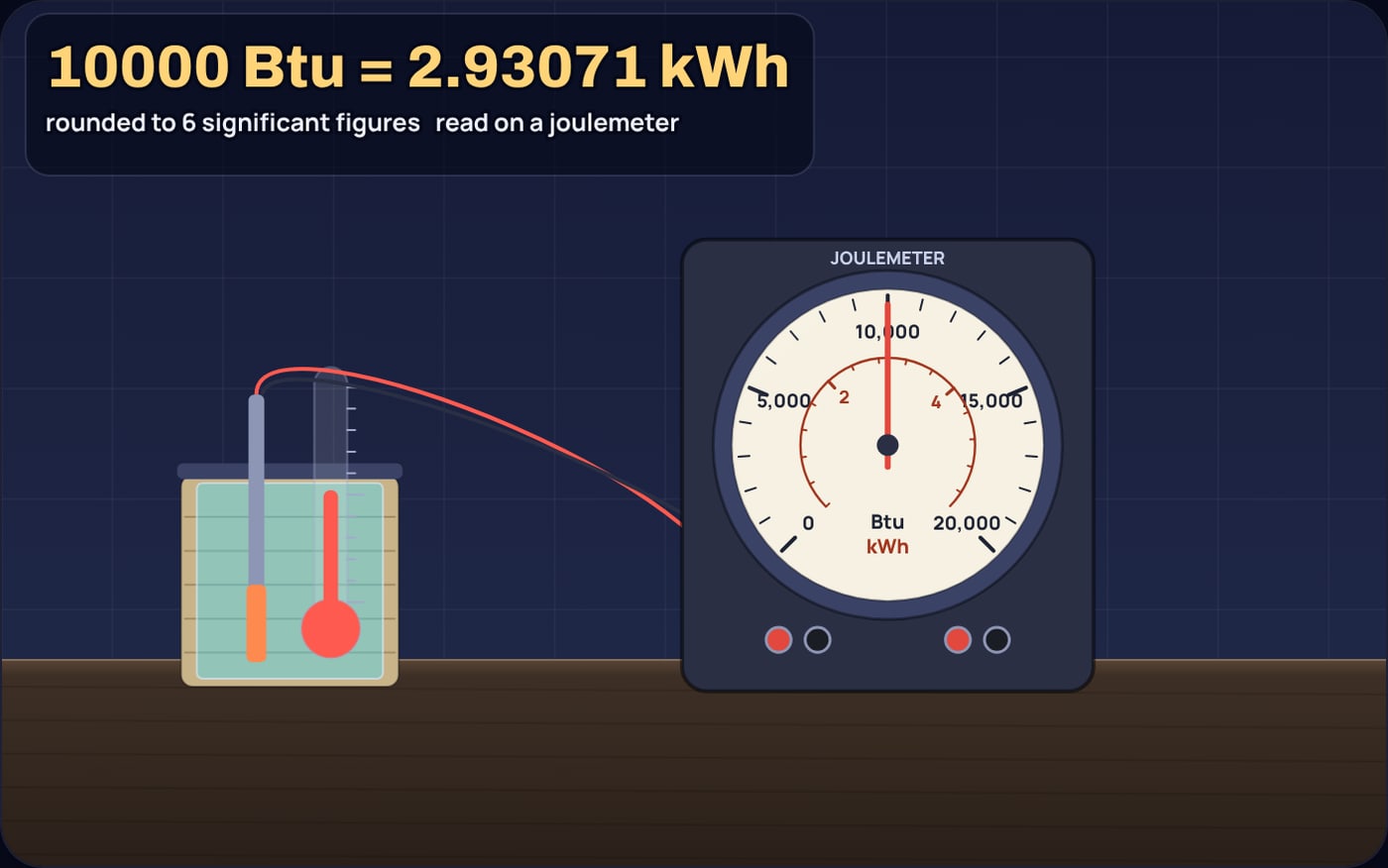
You meet it mostly in heating and air conditioning, and there is a trap. An air conditioner rated at "10,000 Btu" usually means 10,000 Btu per hour, which is a power, not an energy.
Example 4: 10,000 Btu and 10,000 Btu per hour
The same digits, because one hour cancels the other. The first is an amount of heat; the second is the rate the unit moves heat.
How do you convert between any two energy units?
Write each unit as a number of joules, multiply by the first and divide by the second. This works for every pair because every unit above is defined in joules.
| Unit | In joules | Exact? |
|---|---|---|
| calorie (thermochemical) | 4.184 | yes |
| calorie (International Table) | 4.1868 | yes |
| kilocalorie, food Calorie | 4,184 | yes |
| watt hour | 3,600 | yes |
| kilowatt hour | 3,600,000 | yes |
| electronvolt | 1.602176634 × 10⁻¹⁹ | yes |
| British thermal unit (IT) | 1,055.05585262 | yes |
| foot pound-force | 1.3558179483314004 | yes |
Example 5: one kilowatt hour in kilocalories
Rounded to six significant figures; the division does not end.
A sanity check catches most mistakes. Food energy in kilojoules is always about four times the kilocalories. A kilowatt hour is always a few million joules. An electronvolt in joules always has a power of ten around minus nineteen. If your answer breaks one of these, look for a kilo prefix gone missing.
For any of these, and for length, mass, pressure, temperature, volume and data as well, the unit converter gives the exact result, the factor and a check in one step.
Sources
- NIST Special Publication 811, Guide for the Use of the International System of Units, Appendix B.9, factors by kind of quantity (exact factors in bold): nist.gov
- NIST SP 811, Appendix B.8, factors listed alphabetically: nist.gov
- NIST SP 811 footnotes: the International Table calorie (4.1868 J) and Btu (1.055 055 852 62 kJ), the thermochemical calorie (4.184 J), the pound and the pound-force: nist.gov
- NIST, CODATA 2022 value: Rydberg constant times hc in eV, 13.605 693 122 990 eV: physics.nist.gov
- NIST, CODATA value: electron volt to joule relationship, 1.602 176 634 × 10−19 J, exact: physics.nist.gov
Frequently asked questions
How many joules are in a calorie?
A calorie, the thermochemical one used in science, is exactly 4.184 J. The Calorie on a food label is a kilocalorie, 1,000 calories, which is 4,184 J.
How many joules are in a kilowatt hour?
Exactly 3,600,000 J, or 3.6 MJ. A kilowatt is 1,000 joules per second and an hour is 3,600 seconds, so 1 kWh = 1,000 × 3,600 J.
Is a food Calorie the same as a calorie?
No. A food Calorie, often written with a capital C or as kcal, is 1,000 small calories. A 250 Calorie snack holds 250 kcal, which is 1,046 kJ.
What is the difference between kW and kWh?
A kilowatt is a power, a rate of using energy. A kilowatt hour is an amount of energy: the energy used by a 1 kW appliance running for one hour, 3.6 MJ.
Why do physicists use electronvolts?
Because energies of single atoms and particles are tiny in joules. One electronvolt is exactly 1.602176634 × 10^-19 J, the energy an electron gains crossing one volt, which makes atomic energies easy numbers like 13.6 eV.