Why Does Water Have Such a High Specific Heat?
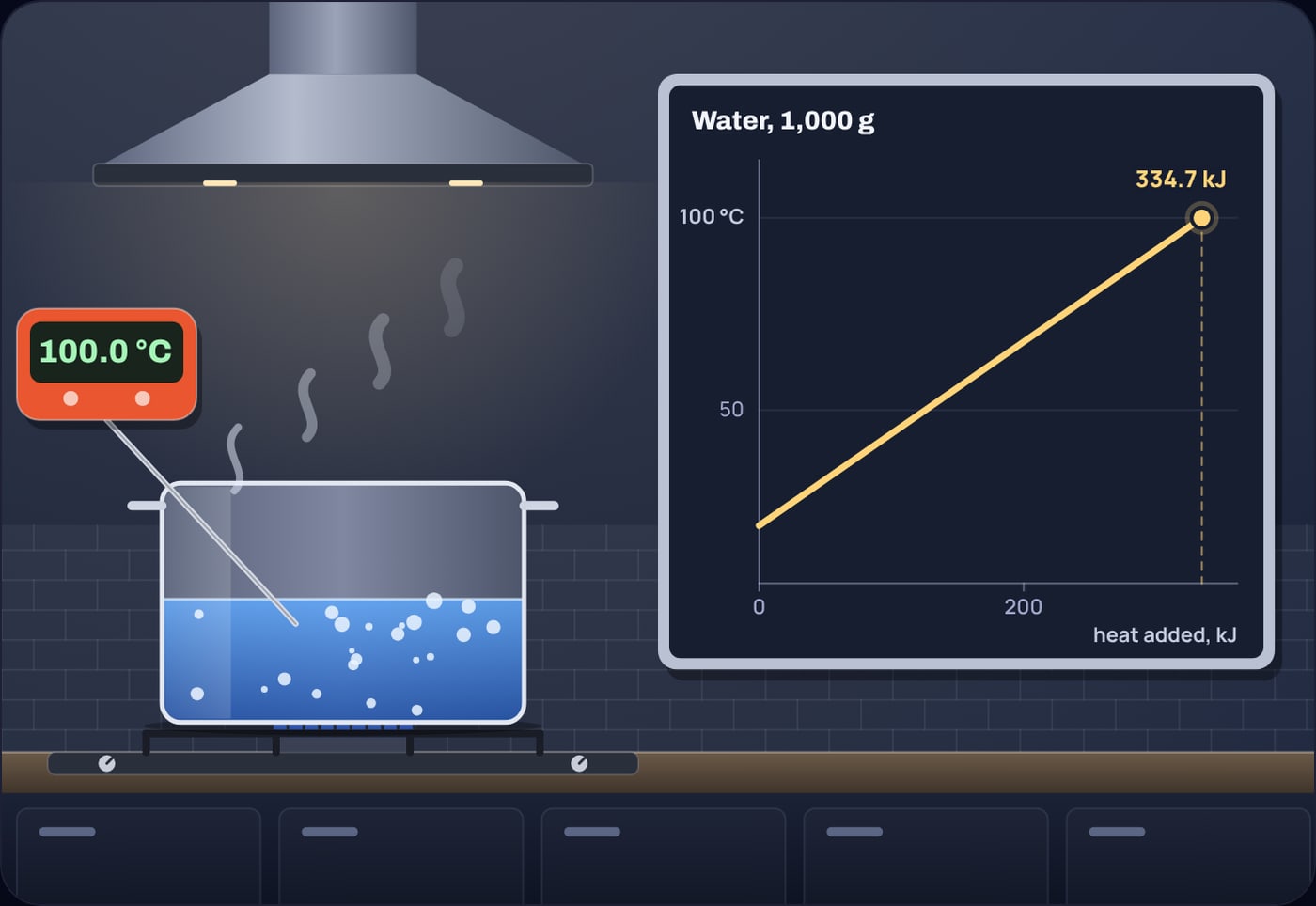
Put 1 kg of water and a 1 kg block of iron on two identical 2 kW burners, both starting at 20 °C. The iron reaches 100 °C in about 18 seconds. The water takes 167 seconds, more than nine times as long, even though the burner pours heat into both at exactly the same rate. Nothing about the pot or the flame explains the gap. It comes from the water itself, which soaks up 4.184 joules for every gram and every degree, against 0.449 joules for iron.
That number, the specific heat capacity, is why a kettle takes minutes and a frying pan takes seconds, why the sea stays cool into early summer, and why your body temperature holds steady. You can try every example below in the specific heat calculator, which solves and draws the full heating curve from ice to steam.
What does specific heat actually measure?
Specific heat capacity is the energy needed to warm one gram of a substance by one degree. Multiply by the mass and the temperature change and you have the heat for any amount:
Here is the heat in joules, the mass, the specific heat capacity and the temperature change. A change of 1 °C is the same size as 1 K, so either unit works for .
Example 1: 1 kg of water and 1 kg of iron, 20 °C to 100 °C
At 2,000 W, with every joule going into the material, that is 167 s for the water and 18 s for the iron. The ratio, 9.32, is just the ratio of the two specific heats.
Liquid water's value is high by everyday standards. Aluminium needs 0.897 J/(g·K), borosilicate glass 0.753, air 1.005 and ethanol, a liquid that looks much like water, 2.44. Martin Chaplin's survey of water's unusual properties puts it plainly: water has the highest specific heat of all liquids except ammonia.
Is water special per molecule, or only per gram?
This is where the explanation starts, and the answer is surprising. Convert each specific heat from per gram to per mole by multiplying by the molar mass, and water stops looking unusual.
| Substance | Per gram, J/(g·K) | Per mole, J/(mol·K) |
|---|---|---|
| Liquid water | 4.184 | 75.4 |
| Ethanol | 2.44 | 112.3 |
| Copper | 0.385 | 24.5 |
| Iron | 0.449 | 25.1 |
| Aluminium | 0.897 | 24.2 |
The molar masses used are 18.015 g/mol for water, 46.07 for ethanol, 63.546 for copper, 55.845 for iron and 26.982 for aluminium.
Per mole, ethanol holds about 1.5 times as much heat as water. Per gram, water holds 1.7 times as much as ethanol. The difference is the mass of the molecule: an ethanol molecule weighs 46 units and a water molecule only 18, because two of water's three atoms are hydrogen, the lightest element there is.
The metals show the same pattern from the other side. Copper, iron and aluminium all land close to 25 J/(mol·K). That is the old rule of Dulong and Petit: in a solid near room temperature, each atom can vibrate in three directions, and each direction stores energy in proportion to temperature, giving about per mole of atoms. A copper atom stores about as much heat as an aluminium atom. Copper's low value per gram is simply because its atoms are heavy, so a gram contains few of them.
Example 2: how many atoms are in a gram?
A gram of water holds 10.6 times as many atoms as a gram of copper. Divide water's 75.4 J/(mol·K) by its three atoms and you get 25.1 J/(mol·K) per mole of atoms, almost exactly what a copper atom stores. Water's tenfold lead over copper per gram is mostly a lead in atom count.
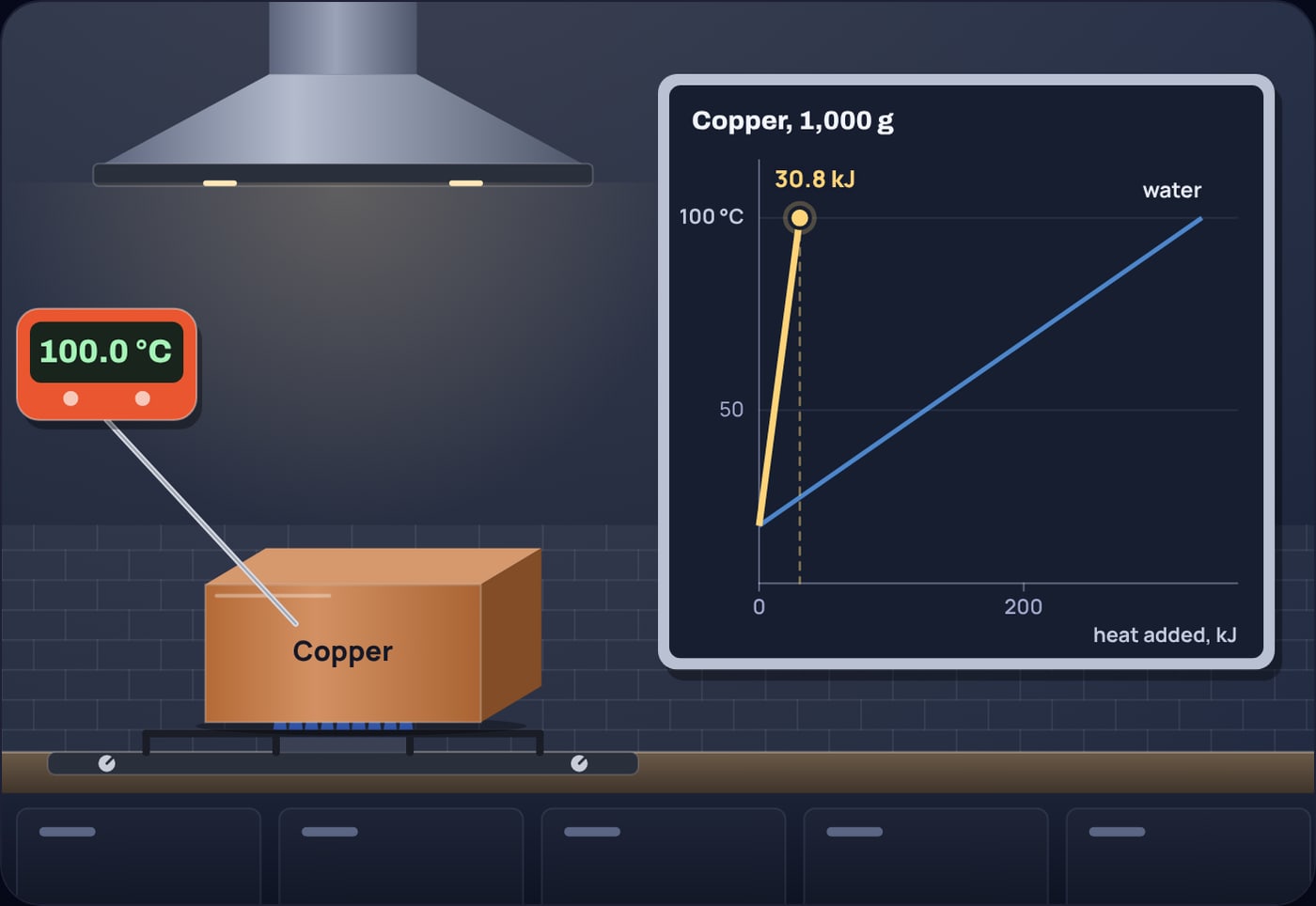
The match per atom is partly a coincidence. A water molecule does not store heat the way a copper crystal does. But the comparison shows that light atoms explain most of the per gram gap with metals. They do not explain everything, and that is where the comparison with ice and steam comes in.
Why is liquid water higher than ice and steam?
Ice, liquid water and steam are made of the same molecule, with the same mass and the same number of atoms per gram. If atom count were the whole story, all three would have the same specific heat. They do not:
- Ice at 0 °C: 2.097 J/(g·K), from the IAPWS equation of state for ice.
- Liquid water at 20 °C: 4.184 J/(g·K), from the NIST Chemistry WebBook.
- Steam at 100 °C and 1 atm: 2.08 J/(g·K), from the same NIST data.
The liquid needs twice as much heat per degree as either neighbour. Chaplin gives the same ratio at the melting point, liquid water's specific heat is 2.01 times that of ice, and at the boiling point he lists 76.0 J/(mol·K) for the liquid against 37.5 J/(mol·K) for steam.
The extra heat goes into the hydrogen bonds. Each water molecule is a bent shape with a slightly negative oxygen and two slightly positive hydrogens, and the hydrogens of one molecule are drawn to the oxygen of its neighbours. In ice, those bonds are locked into a rigid lattice. In steam, the molecules are far apart and hardly bond at all. In the liquid, the network is everywhere but constantly flexing, breaking and reforming. Warm it and some of the energy goes into bending and breaking those bonds rather than into making molecules move faster, and only faster motion shows up as a higher temperature. As Chaplin puts it, much of the energy is used to bend the hydrogen bonds, a factor not available in the solid or gaseous phase.
So there are two layers to the answer. Light molecules make water's specific heat high compared with metals and with heavier liquids. Hydrogen bonds make the liquid twice as high as ice or steam.
How much heat do melting and boiling take?
The same hydrogen bonds explain the latent heats, the energy needed to change state without any change in temperature. Melting breaks the rigid lattice of ice; boiling pulls the molecules apart completely. For water at 1 atm, from the NIST and IAPWS enthalpies:
- Melting: 333.5 J/g at 0 °C.
- Boiling: 2,256 J/g at 100 °C.
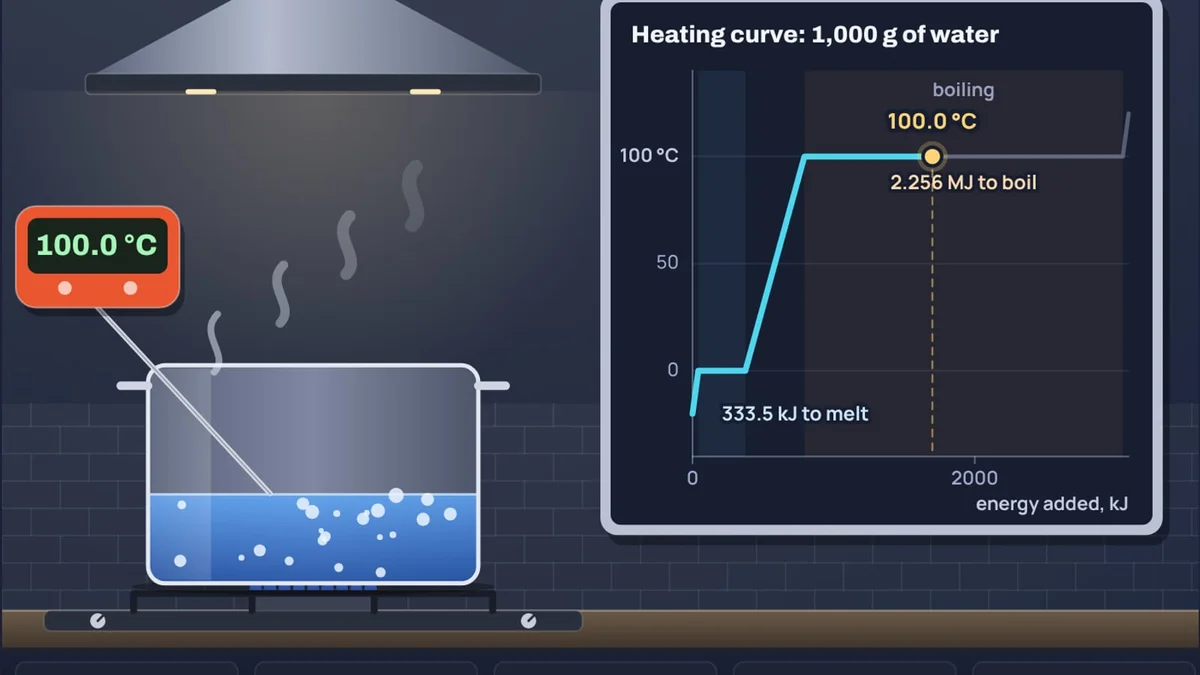
Example 3: 1 kg of water from ice at −20 °C to steam at 120 °C
The five steps are warming the ice, melting it, warming the water, boiling it and warming the steam. Boiling alone is 73% of the total, 5.4 times the heat that warms the liquid all the way from 0 °C to 100 °C. The ice step uses a specific heat that rises from 1.95 J/(g·K) at −20 °C to 2.10 at 0 °C, and the water step uses the average from 0 °C to 100 °C, 4.191 J/(g·K).
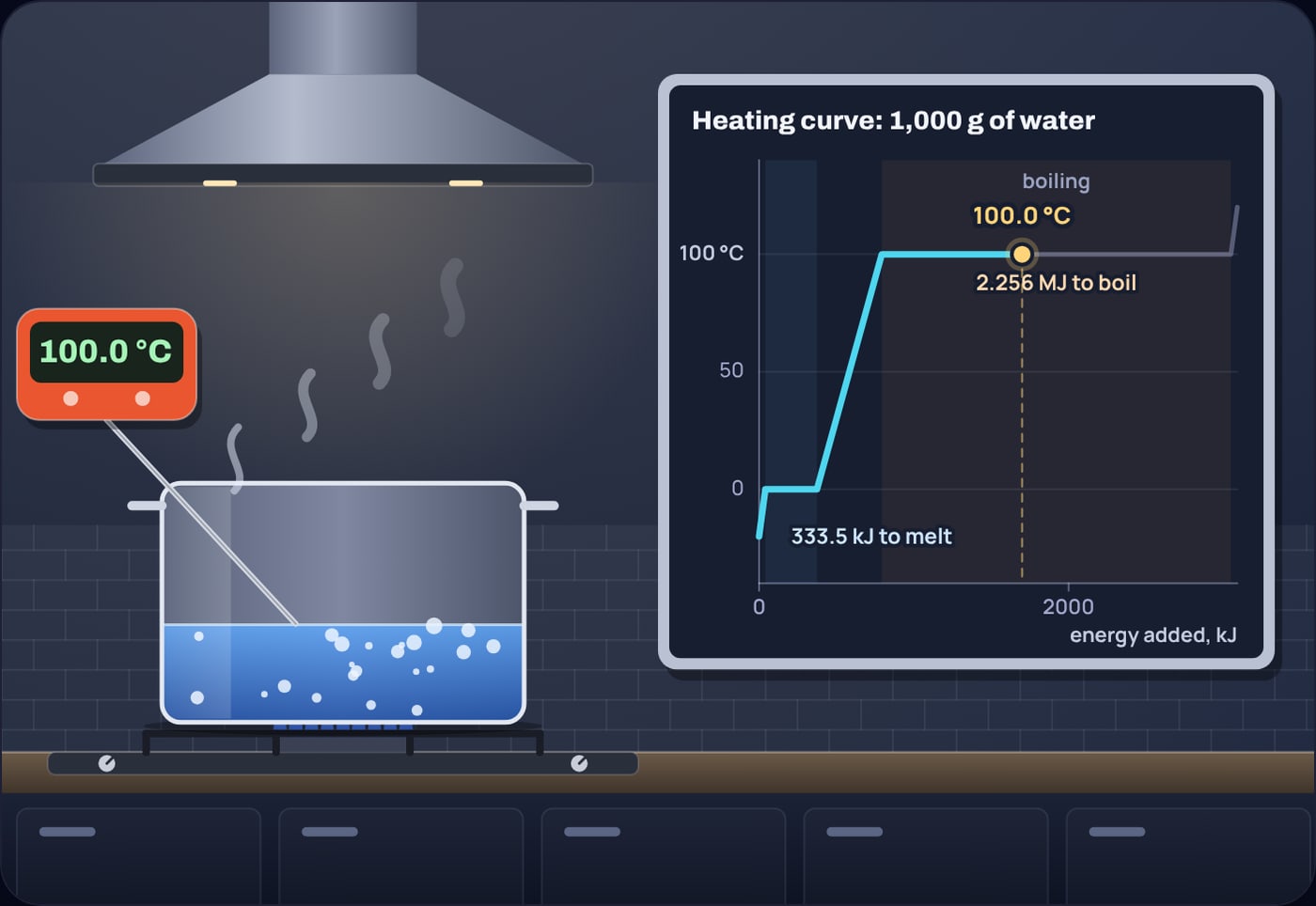
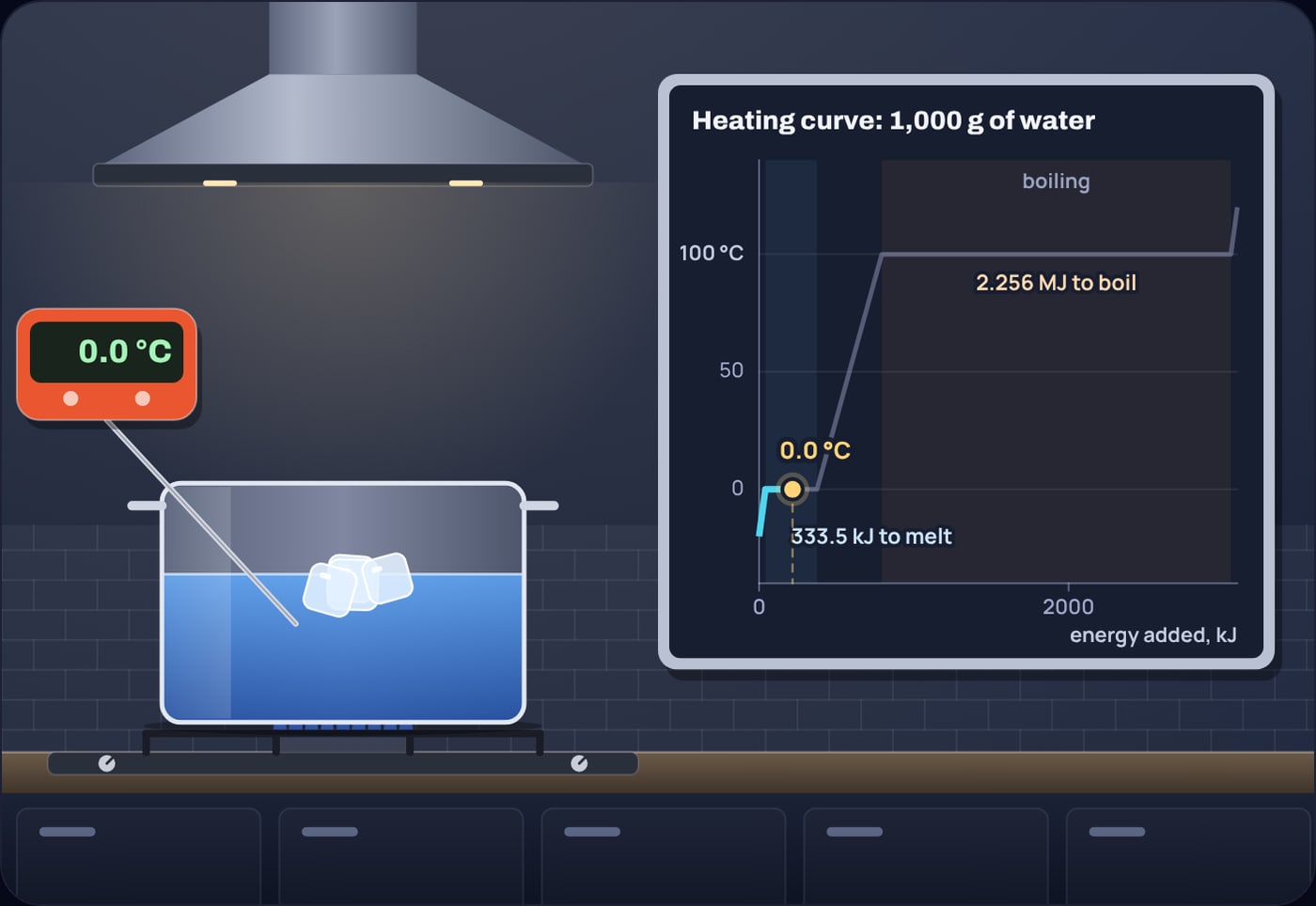
The flat parts are the visible sign of energy going into bonds instead of motion. While the pot is boiling, the thermometer sits at 100 °C no matter how high you turn the burner; the heat only makes the water boil away faster. The same happens at 0 °C, where a glass of ice water stays at 0 °C until the last cube has melted.
Why does it matter outside the kitchen?
Specific heat per gram is the right measure for a pan. For oceans, lakes and the air above them, the comparison that matters is per volume, because a cubic metre of sea sits next to a cubic metre of air.
Example 4: one cubic metre of water and of air, warmed by 1 °C
A cubic metre of water at 20 °C stores about 3,450 times as much heat per degree as a cubic metre of air at 20 °C and 1 atm. The air density here comes from the ideal gas law with the average molar mass of dry air, 28.95 g/mol.
That ratio is why water dominates temperature wherever there is a lot of it. The sea takes months to warm in spring and months to cool in autumn, so coastal towns get mild winters and cool summers compared with inland places at the same latitude. A heat wave over a lake barely changes the water temperature in a day. A hot water bottle stays warm through the night because it holds so much energy for its size. The same property is why water is used to cool car engines and power stations, and why the energy in a kettle of hot water is mostly set by how much water you heat.
Your body relies on it too. You are mostly water, so a burst of exercise that releases a lot of heat raises your core temperature only slowly, which gives sweating time to remove it.
Does water’s specific heat change with temperature?
A little. The NIST data for liquid water at 1 atm give 4.2194 J/(g·K) at 0 °C, falling to a minimum of 4.1793 J/(g·K) near 35 °C and rising again to 4.216 near the boiling point. The whole range is within 1% of 4.184, which is why one value works for nearly every everyday calculation.
What are the common misunderstandings?
The first is mixing up heat and temperature. A bath at 40 °C holds far more heat than a cup of tea at 80 °C, because it has so much more water. Specific heat links the two: it tells you how much heat a given mass needs per degree.
The second is thinking water gets hotter while it boils. At 1 atm it stays at 100 °C until it has all boiled away, and the heat goes into the latent heat of vaporisation. If a calculation with crosses 0 °C or 100 °C, it is missing that step, and the answer will be far too small. This is also why steam at 100 °C scalds much worse than water at 100 °C: each gram that condenses on your skin releases 2,256 J before it even starts to cool. For a different look at the physics of frozen water, see why ice is slippery.
The third is assuming microwaves heat water because they are tuned to it. They are not, and water heats in a microwave because its polar molecules lag behind the oscillating field, not because of any resonance, as the post on the microwave resonance myth explains.
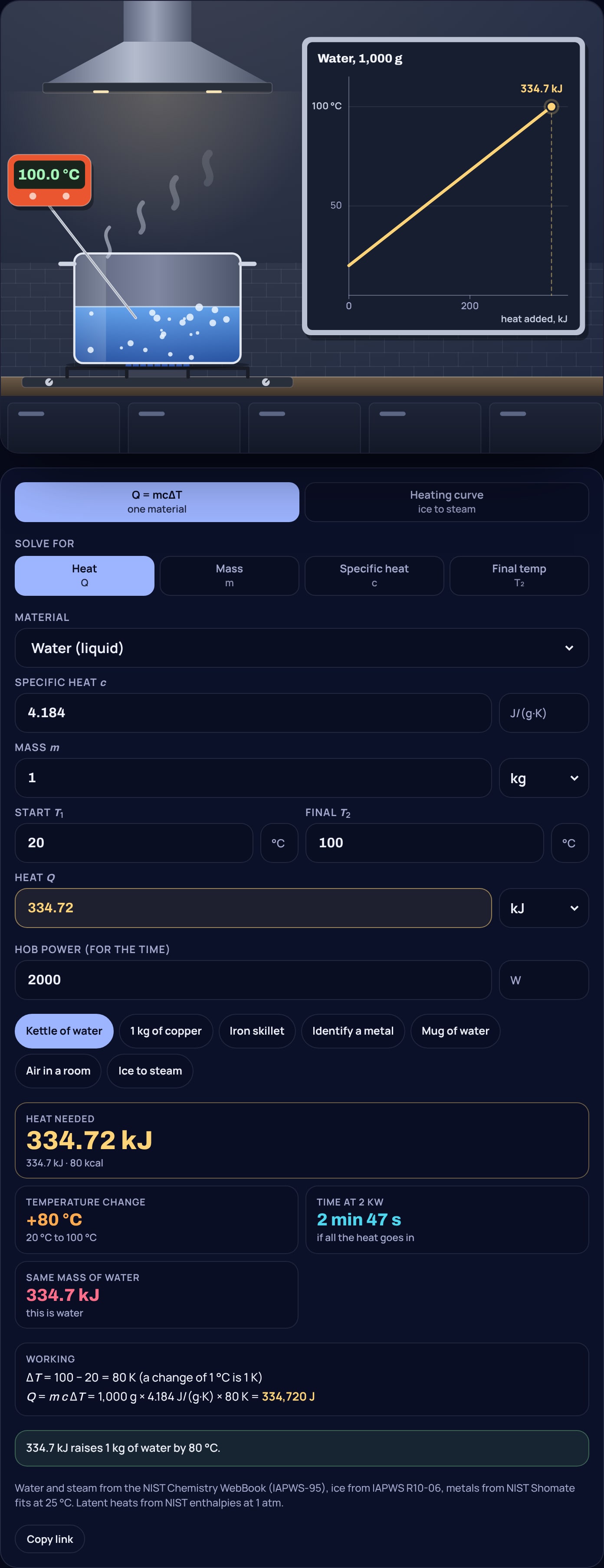
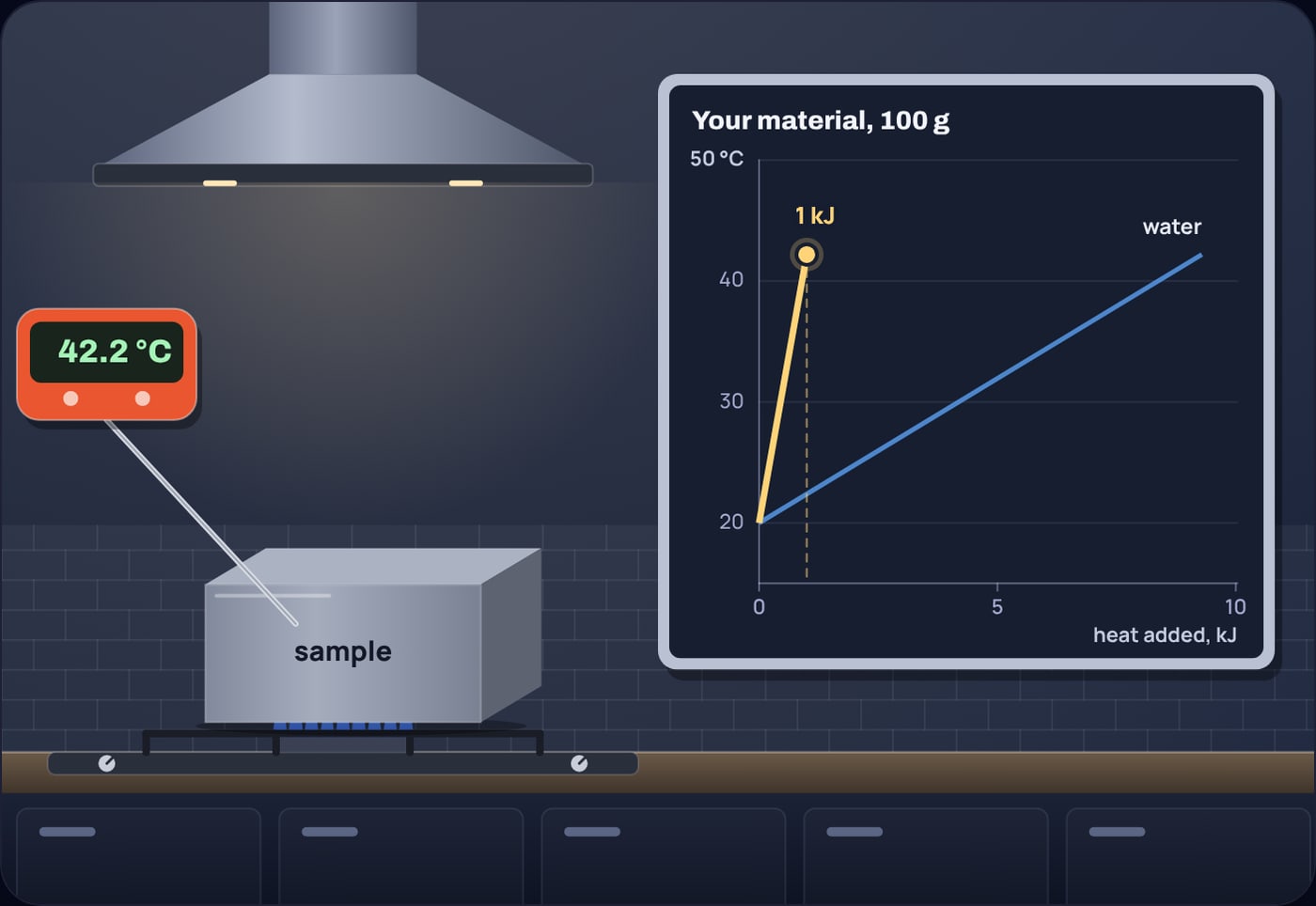
To compare any material with water yourself, open the specific heat calculator, pick a material, and watch how far its line on the chart sits from the line for water.
Sources
- NIST Chemistry WebBook, Thermophysical Properties of Fluid Systems, water at 1 atm (IAPWS-95): specific heat, density and enthalpies of liquid water and steam: webbook.nist.gov/chemistry/fluid
- IAPWS R10-06(2009), Revised Release on the Equation of State 2006 for H2O Ice Ih, Table 6 (specific heat and enthalpy of ice at the melting point and at 100 K): iapws.org Ice-2009
- NIST Chemistry WebBook, ethanol, condensed phase heat capacity of the liquid at 298.15 K (112.3 J/(mol·K)): webbook.nist.gov ethanol
- NIST Chemistry WebBook Shomate equations for aluminium, copper and iron (Chase, NIST-JANAF Thermochemical Tables, 1998): webbook.nist.gov copper
- Martin Chaplin, Water Structure and Science, thermodynamic anomalies of water (specific heat compared with other liquids, with ice and with steam): water.lsbu.ac.uk thermodynamic anomalies
- IUPAC CIAAW abridged standard atomic weights (molar masses used above): ciaaw.org/abridged-atomic-weights.htm
- NIST, CODATA value of the molar gas constant R: physics.nist.gov/cgi-bin/cuu/Value?r
Frequently asked questions
What is the specific heat of water?
4.184 J/(g·K) for liquid water at 20 °C and 1 atm, which is 4,184 J/(kg·K) or about 1 calorie per gram per degree Celsius. It dips to a minimum of 4.179 J/(g·K) near 35 °C and rises to 4.219 J/(g·K) at 0 °C.
Why does water have a higher specific heat than metals?
Mostly because its molecules are light. A gram of water contains about 10.6 times as many atoms as a gram of copper, and near room temperature each atom stores about the same amount of heat. Hydrogen bonds between water molecules add more on top.
Why is the specific heat of liquid water higher than that of ice or steam?
In the liquid, some of the heat goes into bending and breaking hydrogen bonds between molecules instead of making them move faster. Ice and steam lack that extra way to store energy, so per gram they need only about 2.1 J per degree, half the liquid value.
Does any liquid have a higher specific heat than water?
Among common liquids, liquid ammonia is the main exception. Ethanol needs 2.44 J/(g·K) and pentane 1.66 J/(g·K), well below water’s 4.18. Per mole, though, ethanol holds more heat than water because its molecules are heavier and have more atoms.
How does water’s high specific heat affect climate?
A cubic metre of water stores about 3,450 times as much heat per degree as a cubic metre of air. Oceans and lakes therefore warm and cool slowly, which is why coastal places have milder winters and cooler summers than inland places at the same latitude.