How do you calculate heat with specific heat?
Multiply the mass by the specific heat capacity and by the temperature change: Q = mcΔT. Heating 1 kg of water from 20 °C to 100 °C takes 334.72 kJ, while 1 kg of copper over the same range takes only 30.8 kJ. Use grams with c in J/(g·K), or kilograms with c in kJ/(kg·K); the numbers are the same.
The calculator solves for heat, mass, specific heat or final temperature, lists eight common materials with their sources, and has a heating curve mode that adds the latent heat of melting and boiling. For the energy a kettle uses in practice, see a bigger kettle is not the problem, and for the reason water stands out, why water has such a high specific heat.
Key results from the calculator
- A litre of water from 20 °C to 100 °C takes 334.72 kJ, about 0.093 kWh, or 167 s on a 2 kW hob if every joule went into the water.
- Water needs 9.32 times as much heat as iron for the same mass and the same rise: 4.184 against 0.449 J/(g·K).
- Boiling 1 kg of water away takes 2,256 kJ, 5.4 times the 419 kJ that warms it from 0 °C to 100 °C.
- From ice at -20 °C to steam at 120 °C, 1 kg of water takes 3,090 kJ, and 73% of that is the boiling step alone.
Seven setups people ask about
Each section gives the numbers the calculator shows and a button that loads the setup on the hob.
Heating a litre of water to boiling
Solve for QQ = mcΔT = 1,000 g × 4.184 J/(g·K) × 80 K = 334,720 J, which is 334.72 kJ. A litre of water has a mass of very close to 1 kg near room temperature.
At 2,000 W that is 167 s, a little under three minutes, if all the heat stays in the water. Real kettles lose some to the element, the body and the air, so they take longer. The value 4.184 is for water at 20 °C; between 0 °C and 100 °C the average is 4.191, so the answer shifts by under 0.2%.
Heating 1 kg of copper over the same range
Solve for QThe same 80 degree rise in 1 kg of copper needs 1,000 g × 0.385 J/(g·K) × 80 K = 30.8 kJ, about a tenth of what the water needs. Aluminium needs 71.76 kJ.
This is why a copper pan warms up in seconds while the water in it takes minutes. Per gram, metals hold little heat; per atom they hold about the same, which is the rule of Dulong and Petit, but copper atoms are heavy, so a gram contains few of them.
Preheating a 2 kg cast iron skillet to 200 °C
Solve for Q2,000 g × 0.449 J/(g·K) × 180 K = 161.6 kJ. On a 2 kW hob that is 81 s with no losses, and several minutes in practice because a skillet loses heat from its whole surface as it warms.
The tool uses the value for pure iron at 25 °C. Cast iron is iron with a few percent carbon, so treat the answer as a close estimate rather than an exact figure.
Finding the specific heat of an unknown metal
Solve for cA 100 g sample warms from 20.0 °C to 42.2 °C when it takes in 1,000 J. Then c = Q ÷ (mΔT) = 1,000 ÷ (100 × 22.2) = 0.45 J/(g·K).
The closest value in the list is iron at 0.449. In a school lab the heat usually comes from dropping the hot sample into water and measuring how much the water warms, which is the method of mixtures; the heat the water gains is the Q to use here.
The final temperature of a mug of water
Solve for T₂Put 50 kJ into 250 g of water at 20 °C. The rise is Q ÷ (mc) = 50,000 ÷ (250 × 4.184) = 47.8 K, so the water ends at 67.8 °C.
A 1,000 W microwave delivers that 50 kJ to the water in under a minute in the ideal case. If the answer passes 100 °C, the extra heat would boil water instead, and the heating curve mode is the one to use.
Warming the air in a room by 10 °C
Solve for QA room 4 m by 4 m by 2.5 m holds 40 m³ of air. At 20 °C and 1 atm that is 48.1 kg, from the ideal gas law. Warming it from 10 °C to 20 °C takes 48.1 kg × 1.005 kJ/(kg·K) × 10 K = 483 kJ.
That is only 242 s of a 2 kW heater. Rooms take far longer because the walls, floor and furniture have to warm too, and they hold much more heat than the air.
From ice at -20 °C to steam at 120 °C
Heating curveFor 1 kg the five steps are: warm the ice 40.52 kJ, melt it 333.46 kJ, warm the water 418.99 kJ, boil it 2,256.4 kJ, and warm the steam 40.98 kJ, a total of 3,090.4 kJ.
The flat parts of the curve are where the temperature stops rising. Melting takes 80% as much heat as warming the water through 100 degrees, and boiling takes 5.4 times as much.
Specific heat capacity of common materials
| Material | c, J/(g·K) | Heat to warm 1 kg by 10 °C | Conditions |
|---|---|---|---|
| Water | 4.184 | 41.84 kJ | liquid, 20 °C |
| Ice | 2.097 | 20.97 kJ | at 0 °C |
| Steam | 2.08 | 20.8 kJ | at 100 °C, 1 atm |
| Aluminium | 0.897 | 8.97 kJ | 25 °C |
| Copper | 0.385 | 3.85 kJ | 25 °C |
| Iron | 0.449 | 4.49 kJ | 25 °C |
| Glass (borosilicate) | 0.753 | 7.53 kJ | Pyrex 7740, room temperature |
| Air | 1.005 | 10.05 kJ | dry, constant pressure, 25 °C |
Water and steam from the NIST Chemistry WebBook (IAPWS-95) at 1 atm, ice from IAPWS R10-06, metals and the gases in air from NIST Shomate fits at 25 °C, borosilicate glass from a Corning 7740 property sheet. J/(g·K) and kJ/(kg·K) are the same number.
How the calculator works
Mass is converted to grams and heat to joules (1 kJ = 1,000 J, 1 kcal = 4,184 J, 1 Wh = 3,600 J, 1 kWh = 3,600,000 J), so Q = mcΔT can be used with c in J/(g·K). A temperature difference of 1 °C is the same as 1 K, so no offset is needed.
The chosen unknown is found by rearranging: Q = mcΔT, m = Q ÷ (cΔT), c = Q ÷ (mΔT) or T₂ = T₁ + Q ÷ (mc). A negative Q means heat taken out, and the temperature falls.
The heating curve adds five steps at 1 atm: ice warmed from -20 °C with its specific heat rising from 1.95 to 2.10 J/(g·K) (IAPWS), melting with 333.46 J/g, water warmed with an average 4.191 J/(g·K), boiling at 99.974 °C with 2256.4 J/g, and steam warmed with 2.046 J/(g·K). The latent heats are differences between the NIST enthalpies of each phase.
The time readout divides the heat by the hob power you enter. It assumes every joule goes into the material, so a real pan or kettle takes longer.
What the model leaves out
- Heat losses. The calculator gives the heat the material itself absorbs. A pot, a kettle body or the surrounding air takes some of the heat too.
- Specific heat changing with temperature. Each material uses one value near room temperature. For liquid water this is within 1% from 0 °C to 100 °C; metals hold a little more heat per gram as they get hotter.
- Phase changes in Q = mcΔT mode. If the range crosses melting or boiling, the latent heat is missing. The calculator warns you and the heating curve mode includes it for water.
- Pressure. Water boils at 100 °C only at 1 atm. At altitude it boils lower, and the latent heat is slightly larger.
Common misconceptions
"Heat and temperature are the same thing." Temperature is how hot something is; heat is the energy that flows. A bath at 40 °C holds far more heat than a cup of tea at 80 °C.
"The water gets hotter while it boils." At 1 atm it stays at 100 °C until it has all boiled away. The heat goes into turning liquid into vapour.
"Metal feels colder, so it is colder." A metal rail and a wooden bench in the same shade are at the same temperature. Metal conducts heat away from your hand faster, which is a different property from specific heat.
Frequently asked questions
What is the formula for specific heat?
Q = mcΔT, where Q is the heat in joules, m the mass, c the specific heat capacity and ΔT the change in temperature. Rearranged, c = Q ÷ (mΔT).
What is the specific heat of water?
4.184 J/(g·K) for liquid water at 20 °C, which is the same as 4,184 J/(kg·K) or 1 cal/(g·°C). Ice is about 2.097 and steam about 2.08 J/(g·K).
How much energy does it take to boil 1 litre of water?
Heating it from 20 °C to 100 °C takes 334.72 kJ. Boiling it all away takes another 2,256 kJ, almost seven times as much.
Do I use Celsius or kelvin in Q = mcΔT?
Either. ΔT is a difference, and a change of 1 °C is the same size as a change of 1 K, so 20 °C to 100 °C is a rise of 80 K.
Why does the temperature stop rising when water boils?
The heat goes into separating the molecules into vapour instead of making them move faster. At 1 atm each gram needs 2256.4 J to boil, with no change in temperature.
Keep learning
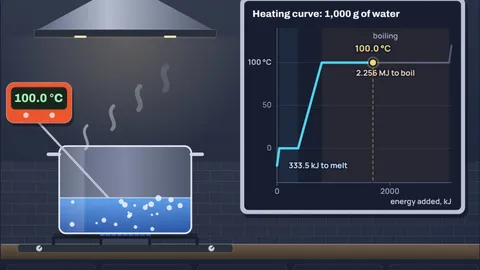
Why Does Water Have Such a High Specific Heat?
Water needs 4.184 J to warm one gram by 1 °C, over nine times as much as iron. Light molecules and hydrogen bonds explain why, with worked numbers.
A bigger kettle is not the problem. Heating extra water is
A reproducible Python model separates water volume, kettle power and assumed efficiency to show what changes the energy used for a cup of hot water.
Why Is Ice Slippery? Not Pressure Melting, Here's the Math
Skate pressure lowers ice's melting point by about 1 °C, and no pressure melts ice below −22 °C. What really makes ice slippery, with numbers and plots.
Do Microwaves Resonate With Water? No, and Here's Why
2.45 GHz is not water's resonant frequency. We plot water's dielectric loss, compute penetration depth, show why ice won't heat and why WiFi is harmless.