How do you calculate density?
Density is mass divided by volume: ρ = m ÷ V. A block of oak with a mass of 518 g and a volume of 720 cm³ has a density of 0.7194 g/cm³, so it floats with 72% of itself under water. Water at 20 °C is 0.9982 g/cm³, and anything less dense floats in it. The calculator solves for whichever of the three you do not know and converts between g/cm³, kg/m³, g/mL and lb/ft³.
For the volume you can type a number, give the sides of a cube or box, the radius and height of a cylinder, the radius of a sphere, or read the water level before and after dropping the object into a measuring cylinder. The materials list gives each density with the source it came from. For a worked explanation of floating, read Why does ice float?.
Key results
- Formula: ρ = m ÷ V, m = ρ × V, V = m ÷ ρ. Keep the units matched: grams with cm³, or kilograms with m³.
- Water: 0.9982 g/cm³ at 20 °C and 0.99997 g/cm³ near 4 °C (NIST). Sea water is about 1.025 g/cm³.
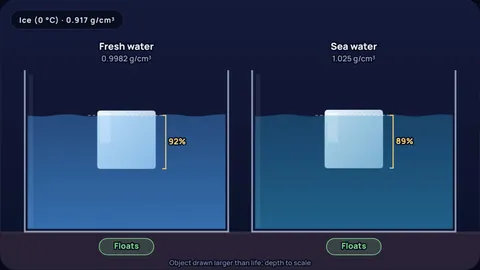
- Floating: an object floats if it is less dense than the liquid, with the fraction ρ_object ÷ ρ_liquid below the surface. Ice (0.917) floats 92% under in fresh water.
- Unit conversions: 1 g/cm³ = 1 g/mL = 1,000 kg/m³ = 62.43 lb/ft³.
Six worked examples
Each button loads the example into the calculator.
A 3 cm ice cube: 24.76 g
mass from density and volumeA cube 3 cm on each side has a volume of 3³ = 27 cm³. Ice is 0.917 g/cm³ at 0 °C, so the cube has a mass of 0.917 × 27 = 24.76 g.
In fresh water it floats with 92% of its volume below the surface, and in sea water 89%. That is where the "tip of the iceberg" comes from: only about a tenth shows.
Related reading: Why does ice float?
1 kg of gold: 51.86 cm³
volume from mass and densityGold is 19.28 g/cm³ (PubChem). A kilogram therefore takes up 1,000 ÷ 19.28 = 51.86 cm³, the volume of a cube 3.7 cm on a side.
The same kilogram of aluminium, at 2.70 g/cm³, would be 370.4 cm³, seven times bigger. That is why a gold bar feels so heavy for its size.
A steel ball 2 cm across: 32.76 g
sphere volumeA ball of radius 1 cm has a volume of 4/3 × π × 1³ = 4.189 cm³. At 7.82 g/cm³ for steel it has a mass of 32.76 g.
It sinks in fresh and sea water alike: steel is 7.83 times as dense as water. Steel ships float because their hull encloses a great deal of air, so the ship's average density is far lower than steel's.
A ring by displacement: 10.5 g/cm³
volume from the water levelA ring weighing 5.25 g lifts the water in a 10 mL measuring cylinder from 10.0 to 10.5 mL, so its volume is 0.5 cm³ and its density 5.25 ÷ 0.5 = 10.5 g/cm³. The nearest match is silver (10.5 g/cm³).
The weak point is the volume: misread the level by 0.1 mL and the answer swings from 8.75 to 13.1 g/cm³, from below copper to above lead. Use the narrowest cylinder that fits, and several rings at once if you can.
A wooden block: 0.719 g/cm³
box volumeA block 10 × 10 × 7.2 cm has a volume of 720 cm³. If it weighs 518 g its density is 0.7194 g/cm³, close to the 0.72 listed for oak.
It floats with 72% under in fresh water: put 7.2 cm of its height upright and about 5.2 cm sits below the surface.
A litre of olive oil: 911 g
liquidsOlive oil is about 0.911 g/cm³ at 20 °C, so a litre (1,000 cm³) has a mass of 911 g, about 9% less than a litre of water. That is why oil floats on vinegar in a salad dressing.
Ethanol is lighter still at 0.7893 g/cm³ and glycerol heavier at 1.2613, both from PubChem; a layered "density tower" in a glass uses exactly these differences.
Densities of common materials
| Material | g/cm³ | kg/m³ | In water | Source |
|---|---|---|---|---|
| Air (20 °C) | 0.001204 | 1.204 | floats | ideal gas, 20 °C |
| Balsa wood | 0.11 to 0.14 | 110 to 140 | floats | Engineering ToolBox |
| Cork | 0.2 to 0.25 | 200 to 250 | floats | Engineering ToolBox |
| Pine | 0.53 | 530 | floats | Engineering ToolBox |
| Oak | 0.72 | 720 | floats | Engineering ToolBox |
| Ethanol (20 °C) | 0.7893 | 789.3 | floats | PubChem (HSDB) |
| Paraffin wax | 0.9 | 900 | floats | Engineering ToolBox |
| Olive oil (20 °C) | 0.911 | 911 | floats | Engineering ToolBox |
| Ice (0 °C) | 0.917 | 917 | floats | PubChem (HSDB) |
| Rubber, pure gum | 0.91 to 0.93 | 910 to 930 | floats | Engineering ToolBox |
| Water (20 °C) | 0.9982 | 998.2 | NIST WebBook | |
| Sea water | 1.025 | 1,025 | sinks | PubChem (HSDB) |
| Nylon 6,6 | 1.13 to 1.15 | 1,130 to 1,150 | sinks | Engineering ToolBox |
| Acrylic | 1.19 | 1,190 | sinks | Engineering ToolBox |
| Glycerol (20 °C) | 1.261 | 1,261 | sinks | PubChem (HSDB) |
| PVC | 1.39 to 1.42 | 1,390 to 1,420 | sinks | Engineering ToolBox |
| Magnesium | 1.74 | 1,740 | sinks | PubChem periodic table |
| Concrete, dense | 2 to 2.4 | 2,000 to 2,400 | sinks | Engineering ToolBox |
| Glass, common | 2.4 to 2.8 | 2,400 to 2,800 | sinks | Engineering ToolBox |
| Granite | 2.6 to 2.8 | 2,600 to 2,800 | sinks | Engineering ToolBox |
| Aluminium | 2.7 | 2,700 | sinks | PubChem periodic table |
| Titanium | 4.5 | 4,500 | sinks | PubChem periodic table |
| Zinc | 7.134 | 7,134 | sinks | PubChem periodic table |
| Tin | 7.287 | 7,287 | sinks | PubChem periodic table |
| Steel | 7.82 | 7,820 | sinks | Engineering ToolBox |
| Iron | 7.874 | 7,874 | sinks | PubChem periodic table |
| Copper | 8.933 | 8,933 | sinks | PubChem periodic table |
| Silver | 10.5 | 10,501 | sinks | PubChem periodic table |
| Lead | 11.34 | 11,342 | sinks | PubChem periodic table |
| Mercury (liquid) | 13.53 | 13,534 | sinks | PubChem periodic table |
| Gold | 19.28 | 19,282 | sinks | PubChem periodic table |
| Platinum | 21.46 | 21,460 | sinks | PubChem periodic table |
| Osmium | 22.57 | 22,570 | sinks | PubChem periodic table |
Element densities from the PubChem periodic table; ethanol, glycerol, ice and sea water from PubChem compound records; water from the NIST Chemistry WebBook at 20 °C and 1 atm; air worked out from the ideal gas law at 20 °C. Engineering ToolBox values are typical ranges for materials that vary from sample to sample; the calculator uses the middle of the range.
How the calculator works
Everything is converted to grams and cubic centimetres first, then ρ = m ÷ V is rearranged for the unknown. 1 kg = 1,000 g, 1 lb = 453.59237 g, 1 L = 1,000 cm³, 1 m³ = 1,000,000 cm³, 1 in³ = 16.387064 cm³ and 1 ft³ = 28,316.85 cm³, all exact.
Volume helpers: cube a³, box l × w × h, cylinder πr²h, sphere 4/3 πr³, and displacement as the rise in water level (1 mL = 1 cm³).
Float or sink compares the density with fresh water at 20 °C (0.9982 g/cm³) and sea water (about 1.025 g/cm³). A floating object settles with the fraction ρ ÷ ρ_water of its volume below the surface, which is what the tanks on the stage show.
What the model leaves out
- Temperature: most materials expand when warmed, so their density falls. Water changes by about 0.2% between 4 °C and 20 °C; metals much less.
- Hollow objects: the calculator gives the average density of whatever you weigh and measure. A hollow steel ball or a ship can float though steel sinks.
- Surface tension: a steel needle or paper clip can rest on water without sinking, held up by surface tension rather than buoyancy.
- Mixtures and alloys: brass, steel, wood, glass and concrete vary with composition. Use your own measured density where it matters.
Common misconceptions
"Heavy things sink." Density decides, not weight. A 10 tonne log floats; a 1 g pebble sinks.
"Ice floats because of the air in it." Clear ice with no bubbles floats too. Water molecules in ice lock into an open hexagonal pattern that takes more room than liquid water.
"Salt water is much denser." Sea water is only about 2.7% denser than fresh water, enough to lift a floating body slightly but not to float most things that sink in fresh water.
Frequently asked questions
What is the formula for density?
Density equals mass divided by volume, ρ = m ÷ V. In grams and cubic centimetres the answer is in g/cm³; in kilograms and cubic metres it is in kg/m³.
How do you convert g/cm³ to kg/m³?
Multiply by 1,000. Water at 20 °C is 0.998 g/cm³, which is 998.2 kg/m³. To get lb/ft³, multiply g/cm³ by 62.43.
What is the density of water?
0.9982 g/cm³ (998.2 kg/m³) at 20 °C, rising to a maximum of about 0.99997 g/cm³ near 4 °C, from the NIST Chemistry WebBook. Sea water is about 1.025 g/cm³.
How do you find the volume of an irregular object?
Use water displacement: read a measuring cylinder, lower the object in completely, and read it again. The rise in mL is the volume in cm³.
Will it float?
If its density is less than the liquid it is in, yes. In fresh water anything under about 0.998 g/cm³ floats; the fraction below the surface equals its density divided by the water density.
Keep learning
Why Does Ice Float? Density Explained With Numbers
Ice floats because it is about 8% less dense than water: 0.917 vs 0.9998 g/cm³. Why that is, how much of an iceberg sits under, and how to measure it.

Why Is Ice Slippery? Not Pressure Melting, Here's the Math
Skate pressure lowers ice's melting point by about 1 °C, and no pressure melts ice below −22 °C. What really makes ice slippery, with numbers and plots.
Why Does Water Have Such a High Specific Heat?
Water needs 4.184 J to warm one gram by 1 °C, over nine times as much as iron. Light molecules and hydrogen bonds explain why, with worked numbers.

How Much Does a Teaspoon of Neutron Star Weigh?
A 5 mL teaspoon of average neutron star weighs about 1.9 billion tonnes, not the 10 million often quoted. The density math, and what it would do on Earth.