How do you use the ideal gas law?
Write PV = nRT, put every quantity in SI units (pascals, cubic metres, moles, kelvin) and rearrange for the one you do not know. One mole of any ideal gas at 0 °C and 1 atm fills 22.414 L; at 25 °C it fills 24.465 L. The gas constant R is 8.314462618 J/(mol·K), an exact value since the 2019 SI.
The calculator accepts pressure in Pa, kPa, atm, bar, mmHg or psi, volume in L, mL or m³ and temperature in °C, °F or K, converts everything for you and shows each step. Its combined gas law mode handles the classic before-and-after problems, including gauge pressures, which is the trap behind why tyre pressure rises on a hot day.
Key results from the calculator
- Molar volume: 22.414 L/mol at 0 °C and 1 atm, 22.711 L/mol at the IUPAC standard of 0 °C and 100 kPa, and 24.465 L/mol at 25 °C and 1 atm.
- A tyre at 32 psi on a 15 °C morning reads 35.2 psi at 35 °C, about 0.9 psi for every 10 °F, because the law works on the absolute pressure of 46.7 psi.
- A 12 L scuba cylinder at 200 bar holds 98.5 mol of gas, enough to fill about 2,370 L at sea-level pressure.
- Temperature must be in kelvin. Doubling 10 °C to 20 °C raises the absolute temperature by only 3.5%, and the volume of a gas at constant pressure rises by the same 3.5%, not 100%.
Eight setups people ask about
Each section gives the numbers the calculator shows and a button that loads the setup on the cylinder.
The volume of one mole of gas at 0 °C and 1 atm
Solve for VV = nRT ÷ P = 1 × 8.3145 × 273.15 ÷ 101,325 = 0.022414 m³, which is 22.414 L. That is the famous 22.4 L per mole, the same for nitrogen, helium or carbon dioxide as long as the gas behaves ideally.
Be careful with "STP". IUPAC now uses 100 kPa (1 bar) as standard pressure, not 1 atm, which gives 22.711 L/mol. Many textbooks still use 1 atm. The calculator lets you pick either by typing the pressure in the unit you need.
The volume of one mole at room temperature
Solve for VWarming the same mole from 0 °C to 25 °C raises the absolute temperature from 273.15 K to 298.15 K, a 9.15% increase, so the volume grows to 24.465 L.
Chemists use 24.5 L/mol as the quick room-temperature figure for gas stoichiometry. Note how a 25 degree change on the Celsius scale is only a 9% change in what the gas actually responds to.
How many moles of helium in a party balloon?
Solve for nAn 11 inch latex balloon holds roughly 14 L. At 1 atm and 20 °C, n = PV ÷ RT = 101,325 × 0.014 ÷ (8.3145 × 293.15) = 0.582 mol. At 4.0026 g/mol for helium that is 2.3 g of gas.
The rubber squeezes the gas a little above atmospheric pressure, by a few percent at most, so the true amount is slightly higher. That is well inside the uncertainty of the balloon's size.
How much air is in a scuba tank?
Solve for nA common 12 L steel cylinder is filled to 200 bar. At 20 °C the ideal gas law gives 98.5 mol. Released at 1 atm and the same temperature it would fill about 2,370 L, which is why divers describe tanks by "free air" volume.
At 200 bar, air is no longer quite ideal: its molecules take up space and attract each other, and the real amount differs from the ideal estimate by a few percent. The calculator flags anything above 10 atm for this reason.
A car tyre on a hot afternoon
Combined law, gauge pressureSet to 32 psi on a 15 °C morning, a tyre that warms to 35 °C reads 35.2 psi, if its volume stays the same. The calculation must use absolute pressure: 32 psi on the gauge is 46.7 psi absolute, scaled by 308.15 ÷ 288.15, minus the atmosphere again.
Using the gauge reading directly would give 34.2 psi, and using Celsius would give 74.7 psi, both wrong. The full explanation is in why tyre pressure rises on a hot day.
Why the tyre warning light comes on in the first frost
Combined law, gauge pressureA tyre filled to 32 psi in a 25 °C garage reads 27.3 psi at −5 °C. Nothing leaked; the gas simply has less thermal energy, so it pushes less on the walls.
US rules (FMVSS 138) make tyre pressure monitors warn when a tyre is 25% below the recommended cold pressure, so a tyre already a little low goes over the edge on the first cold morning. Check pressures cold, before driving, and set them to the placard on the door frame.
Boyle's law: squeezing a sealed syringe
Combined law, constant TSeal 60 mL of air at 1 atm in a syringe and push the plunger to 20 mL without letting it warm up. With T unchanged, P₁V₁ = P₂V₂, so the pressure triples to 3 atm.
That is Boyle's law, the constant temperature case of the combined law. Push fast and the gas warms as you compress it, so the pressure briefly goes higher than three atmospheres until the heat leaks away.
Charles's law: a balloon dipped in liquid nitrogen
Combined law, constant PA 5 L balloon at 20 °C cooled to −196 °C (77.15 K) at constant pressure shrinks to 1.32 L by the ideal law. Temperature falls by a factor of 3.8, and so does the volume.
In the real demonstration the balloon goes flatter still, because oxygen in the air condenses to a liquid at that temperature (it boils at 90 K), and the ideal law no longer describes a gas that has turned into liquid.
Molar volume of an ideal gas at common conditions
| Temperature | Pressure | Volume of 1 mol | Where it is used |
|---|---|---|---|
| 0 °C | 1 atm | 22.41 L | Older textbooks, "STP" |
| 0 °C | 100 kPa | 22.71 L | IUPAC standard pressure |
| 20 °C | 1 atm | 24.06 L | NTP, lab conditions |
| 25 °C | 1 atm | 24.47 L | Room temperature (SATP is 25 °C, 100 kPa) |
| 25 °C | 100 kPa | 24.79 L | SATP |
| 37 °C | 1 atm | 25.45 L | Body temperature |
| 100 °C | 1 atm | 30.62 L | Boiling water |
| -196 °C | 1 atm | 6.331 L | Liquid nitrogen temperature (most gases condense) |
V = RT ÷ P for one mole, with R = 8.314462618 J/(mol·K). Real gases at these conditions are within about 1% of these values, except near condensation.
How the calculator works
Every input is converted to SI: pressure to pascals (1 atm = 101,325 Pa, 1 bar = 100,000 Pa, 1 mmHg = 133.3224 Pa, 1 psi = 6,894.757 Pa, from NIST Special Publication 811), volume to cubic metres, and temperature to kelvin (K = °C + 273.15).
If you tick gauge readings, one standard atmosphere is added to each pressure before solving and taken off the answer. Tyre gauges, compressor gauges and most cylinder gauges read pressure above the atmosphere, but the gas law needs the absolute pressure.
In PV = nRT mode the chosen unknown is found by rearranging: P = nRT ÷ V, V = nRT ÷ P, n = PV ÷ RT or T = PV ÷ nR. In combined mode the amount of gas is fixed, so nR cancels and P₁V₁ ÷ T₁ = P₂V₂ ÷ T₂ is solved for the final pressure, volume or temperature.
The cylinder draws the piston at the solved volume against a graduated scale, the gauge shows the pressure, and the particles move at a speed proportional to the square root of the absolute temperature, as the root mean square molecular speed √(3RT ÷ M) does. The nitrogen speed readout uses M = 28.014 g/mol.
What the model leaves out
- Real gas behaviour. The ideal law ignores the size of molecules and the attraction between them. It is within about 1% for air near room conditions but drifts by several percent at hundreds of bar or near the temperature where a gas condenses.
- Vapour and condensation. Below its boiling point a substance is partly liquid, and the law applies only to the part that is still gas.
- Changing containers. A tyre or balloon stretches a little as the pressure changes. The combined mode assumes you know the final volume; for a tyre, keeping it constant is a good approximation.
- Gas mixtures. The law works for a mixture as a whole using the total number of moles, which is why air behaves like a single gas here.
Common misconceptions
"Double the Celsius temperature, double the volume." Only absolute temperature counts. Going from 10 °C to 20 °C is 283.15 K to 293.15 K, a 3.5% rise.
"A tyre at 32 psi has 32 psi of air pushing on it." The gauge shows pressure above the atmosphere. The gas inside is at about 46.7 psi absolute, and that is the number the law uses.
"Heavier gases take up more room." At the same temperature and pressure, a mole of any ideal gas occupies the same volume. A mole of hydrogen and a mole of carbon dioxide both fill about 24.5 L at 25 °C.
Frequently asked questions
What is the value of R in PV = nRT?
R = 8.314462618 J/(mol·K), exact since 2019. In other units it is 0.082057 L·atm/(mol·K) or 8.314 L·kPa/(mol·K). Use the version that matches your pressure and volume units, or convert everything to SI.
What volume does one mole of gas occupy at STP?
22.414 L at 0 °C and 1 atm, the classic 22.4 L. With the current IUPAC standard pressure of 100 kPa it is 22.711 L, and at 25 °C and 1 atm it is 24.465 L.
Do I have to use kelvin in the ideal gas law?
Yes. The law is proportional to absolute temperature, so 0 °C must be entered as 273.15 K. The calculator accepts °C and °F and converts them for you, and it rejects anything at or below absolute zero.
What is the combined gas law?
For a fixed amount of gas, P₁V₁ ÷ T₁ = P₂V₂ ÷ T₂. It comes from PV = nRT with n and R constant. Boyle’s law (constant temperature), Charles’s law (constant pressure) and Gay-Lussac’s law (constant volume) are its special cases.
Should I use gauge or absolute pressure?
Absolute. A tyre gauge reading of 32 psi means 46.7 psi absolute. Tick the gauge box in the calculator and it adds one atmosphere before solving and removes it from the answer.
Keep learning
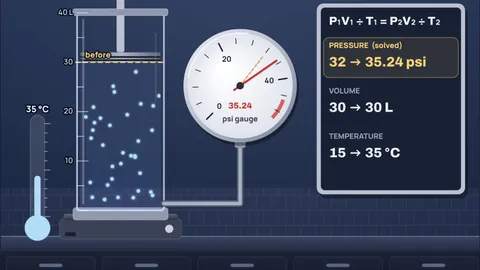
Why Does Tyre Pressure Rise on a Hot Day?
A tyre set to 32 psi at 15 °C reads 35.2 psi at 35 °C. The ideal gas law explains why, and why you must use absolute pressure and kelvin to get it right.
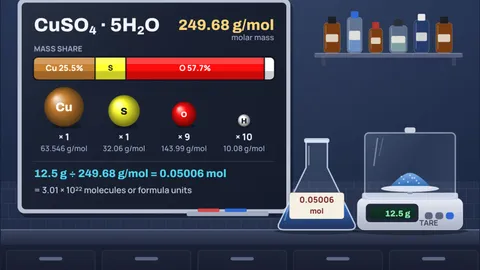
How to Calculate Molar Mass Step by Step
Calculate molar mass from any chemical formula: count atoms, multiply by atomic weights, add. Worked examples for water, Ca(OH)2, glucose and a hydrate.
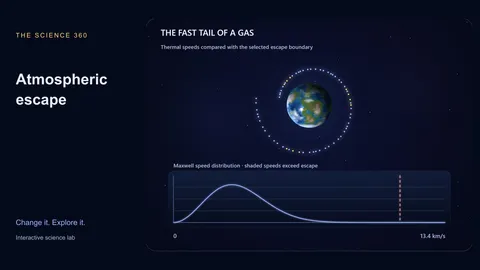
Why planets lose atmospheres: gravity, temperature and molecular speed
Compare escape velocity with a thermal gas distribution, and learn why a fast molecular tail does not directly give an atmospheric lifetime.

Why is there a tiny hole in an airplane window?
The small hole in some airplane window panes connects a gap to the cabin—not the outside. Here is how that changes the pressure across the layers.