Why Does Tyre Pressure Rise on a Hot Day?
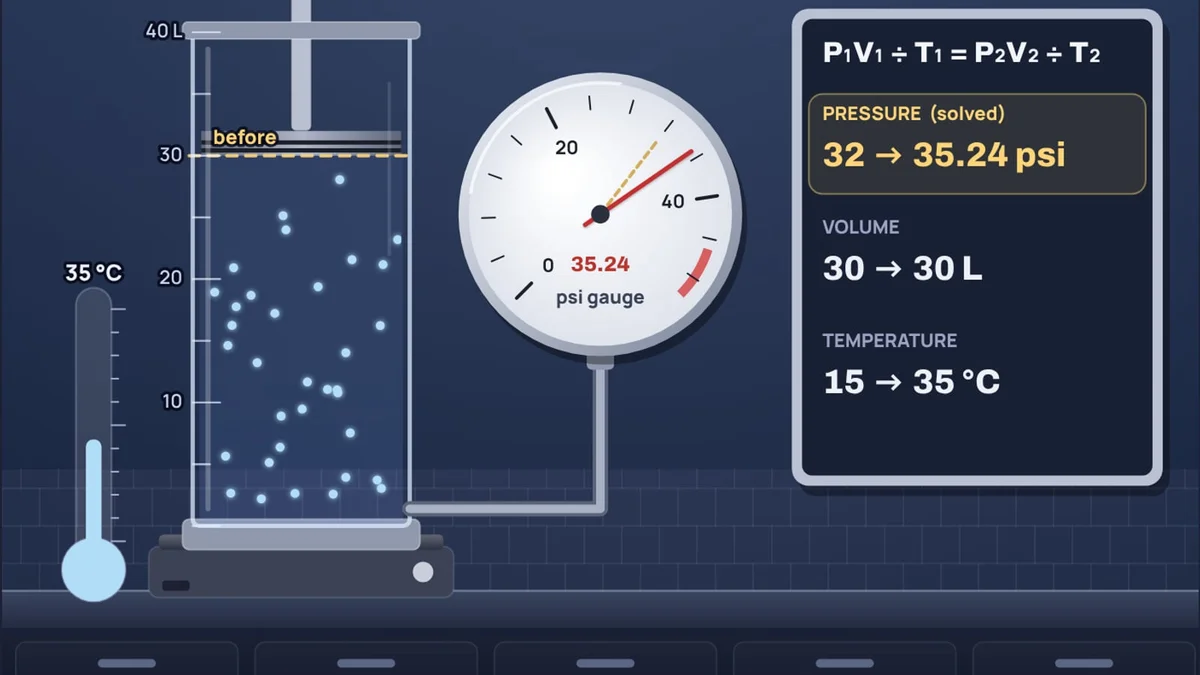
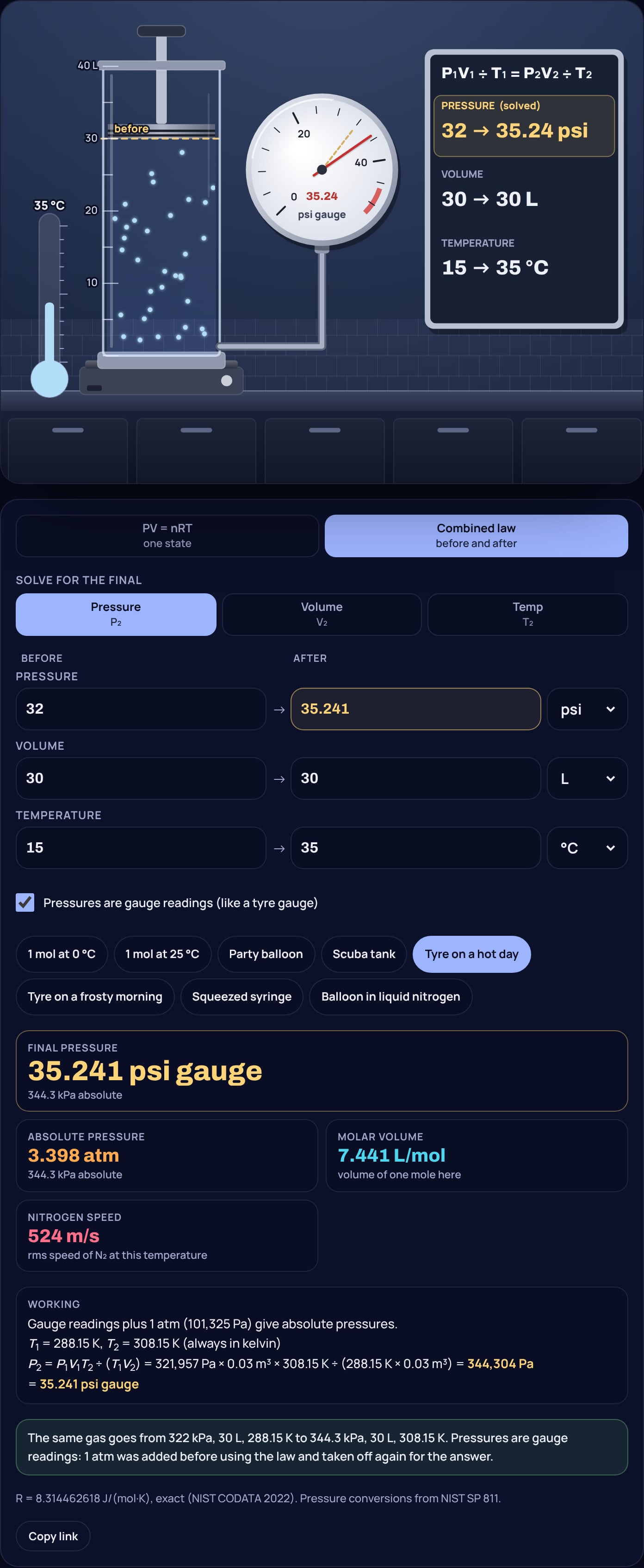
Set your tyres to 32 psi on a cool 15 °C morning, park in the sun, and by mid afternoon, with the air inside the tyre at 35 °C, the same gauge reads 35.2 psi. No one added air. Nothing leaked. The gas inside simply got warmer, and warm gas pushes harder. On the first frosty morning of winter the opposite happens, and that is when tyre pressure warning lights come on across a whole city at once.
The physics is one equation, the ideal gas law, applied with two corrections that most quick explanations get wrong. You can try every number in this post in the ideal gas law calculator, which has the hot tyre and cold tyre loaded as presets.
What happens to the air inside a tyre when it warms up?
The air in a car tyre is about 4 mol of gas, a little over 100 g, made of molecules moving at around 500 m/s. Nitrogen molecules at 15 °C have a root mean square speed of 507 m/s. At 35 °C they average 524 m/s, 3.4% faster.
Pressure is the push of those molecules hitting the inside of the tyre. A faster molecule hits harder, by 3.4% here, and it also crosses the tyre and comes back sooner, so it hits 3.4% more often. The two effects multiply, which is why pressure goes with the square of molecular speed and therefore with absolute temperature: 1.034 × 1.034 = 1.069, a 6.9% rise in absolute pressure.
Written as an equation, that is the ideal gas law:
Here is the absolute pressure, the volume, the amount of gas in moles, the gas constant and the absolute temperature in kelvin. In a sealed tyre the amount of gas does not change and the volume barely does, so the pressure is simply proportional to the temperature.
How do you calculate the new tyre pressure?
For the same gas before and after, cancels and you get the combined gas law. With the volume constant it reduces to a single ratio:
Both corrections live in that ratio. The pressures must be absolute, and the temperatures must be in kelvin.
Example 1: 32 psi at 15 °C, warmed to 35 °C
The gauge reading rises by 3.24 psi, about 10%, even though the absolute pressure rose by only 6.9%. The gauge exaggerates the change because it leaves out the 14.7 psi of atmosphere that does not change.
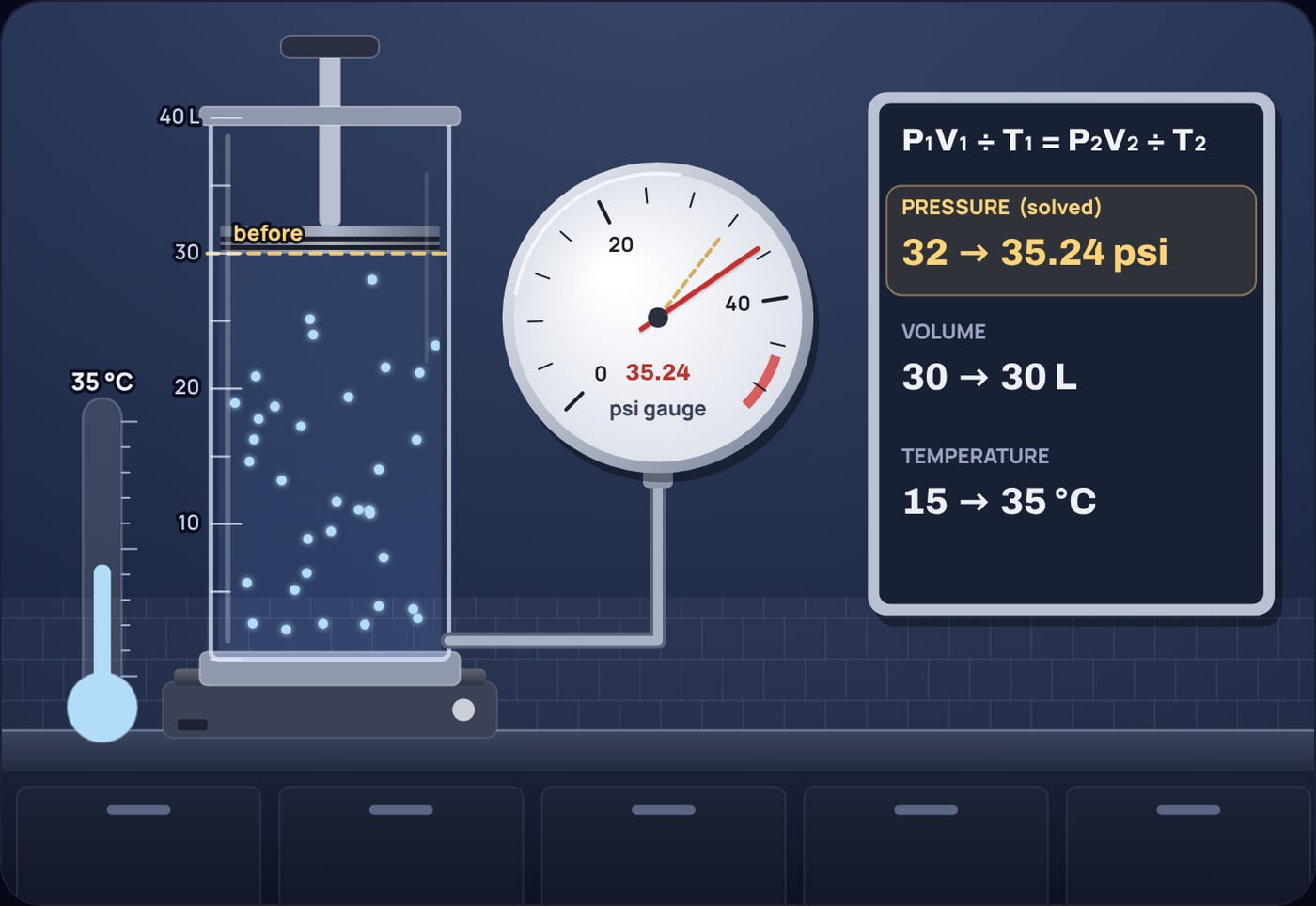
In metric units the same tyre is 220 kPa on the gauge. Warmed from 15 °C to 35 °C it reads 242.3 kPa. Either way the rate works out at about 0.16 psi or 1.1 kPa per degree Celsius, which is the familiar rule of thumb of roughly 1 psi per 10 °F. The calculation above gives 0.9 psi per 10 °F at this pressure.
What goes wrong if you skip absolute pressure or kelvin?
Both shortcuts give believable looking numbers, which is what makes them dangerous in an exam or a workshop.
| Method | Calculation | Answer at 35 °C |
|---|---|---|
| Correct: absolute pressure, kelvin | 46.696 × 308.15 ÷ 288.15 − 14.696 | 35.24 psi |
| Gauge pressure, kelvin | 32 × 308.15 ÷ 288.15 | 34.22 psi |
| Gauge pressure, Celsius | 32 × 35 ÷ 15 | 74.7 psi |
Using Celsius is the worse mistake. It claims that warming from 15 °C to 35 °C more than doubles the pressure, because 35 is more than twice 15. But 0 °C is not zero temperature; the zero of temperature is −273.15 °C, where molecular motion bottoms out. On the kelvin scale the change from 288 K to 308 K is under 7%.
Using the gauge reading in the ratio is subtler. It underestimates the rise by about 1 psi here, because the atmosphere's 14.7 psi is part of what the gas pushes with. Tick the gauge box in the calculator and it handles both corrections for you, showing the working in kelvin and pascals.
Why does the tyre warning light come on in the cold?
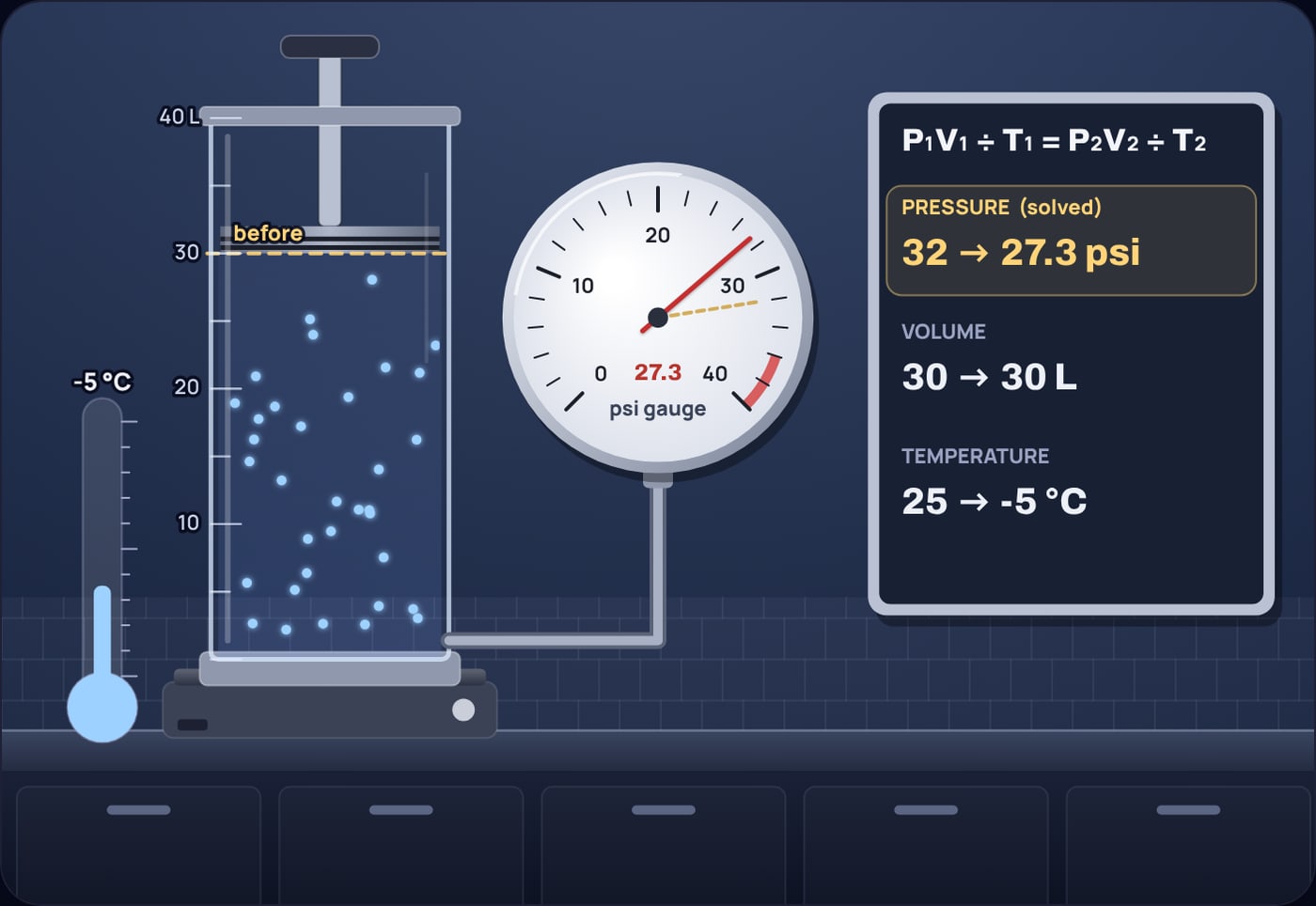
Run the same calculation the other way. A tyre filled to 32 psi in a 25 °C garage and parked outside overnight at −5 °C cools by 30 degrees.
Example 2: 32 psi at 25 °C, cooled to −5 °C
A drop of 4.7 psi, 15% of the gauge reading, with no air lost.
In the US, the federal standard for tyre pressure monitoring (FMVSS 138) requires the warning light within 20 minutes of a tyre falling 25% below the vehicle maker's recommended cold pressure. For a 32 psi placard that is 24 psi. A tyre that slowly lost a couple of psi over the summer and is then hit by a 30 degree overnight drop crosses that line, which is why the lights all come on together in the first cold snap.
Should you let air out of a hot tyre?
No. The pressure on the placard inside the driver's door is a cold inflation pressure, meaning the tyre at the outdoor temperature before you drive. Tyre and car makers expect the pressure to rise as the tyre warms in use; after a long fast drive the air inside a tyre can be tens of degrees warmer than when it was parked. If the air warms from 20 °C to 50 °C, a tyre set to 32 psi cold reads about 36.8 psi hot, and that is normal.
Let air out to bring it back to 32 psi while hot, and when it cools the pressure falls well below the placard. An underinflated tyre flexes more, runs hotter and wears faster at the shoulders. Check and set pressures cold, ideally in the morning or after the car has stood for a few hours.
Does nitrogen stop the pressure changing?
This is the most common misconception about tyres and temperature. Nitrogen is sold as a fix for pressure changes, but the ideal gas law has no term for which gas it is. One mole of nitrogen and one mole of air at the same temperature and volume exert the same pressure, and both change by the same 6.9% between 15 °C and 35 °C. At tyre pressures both are ideal to well under 1%.
The one real difference is water. Compressed air from a garage line can carry water vapour, and liquid water in a tyre evaporates as it warms, adding gas and a little extra pressure. Dry nitrogen avoids that. Air is already 78% nitrogen, so the benefit is small, and a nitrogen tyre still gains about 0.9 psi per 10 °F.
What does the ideal gas law leave out for a real tyre?
The calculation above assumes the tyre's volume stays fixed. A real tyre stretches very slightly as the pressure rises, so the true rise is a little smaller. The air also does not warm evenly: the tread and sidewalls heat from flexing and road friction, and a tyre in the sun is warmer on one side. Gauge accuracy matters too; a cheap pencil gauge can be off by a psi, about the same as the effect of a 10 °F change.
None of that changes the conclusion. The gas behaves almost exactly as says, and the size of the effect follows from absolute temperature. The same law explains why a sealed bag of crisps puffs up on a mountain road and why aircraft windows have a tiny breather hole. At the scale of a planet, the speed of gas molecules sets which planets can keep their atmospheres.
Tyre pressure at different temperatures
For a tyre set to 32 psi at 20 °C (68 °F), with the volume fixed:
| Air temperature in the tyre | Gauge reading |
|---|---|
| −10 °C (14 °F) | 27.2 psi |
| 0 °C (32 °F) | 28.8 psi |
| 10 °C (50 °F) | 30.4 psi |
| 20 °C (68 °F) | 32.0 psi |
| 30 °C (86 °F) | 33.6 psi |
| 40 °C (104 °F) | 35.2 psi |
| 50 °C (122 °F) | 36.8 psi |
To see how the gauge moves as you change the temperature yourself, load the frosty morning tyre in the ideal gas law calculator and type your own placard pressure and the temperatures where you live.
Sources
- NIST, CODATA value of the molar gas constant R, 8.314462618 J mol−1 K−1 (exact): physics.nist.gov/cgi-bin/cuu/Value?r
- NIST Special Publication 811, Appendix B.9, conversion factors for pressure (1 atm = 101,325 Pa, 1 psi = 6,894.757 Pa): nist.gov SP 811 Appendix B.9
- US Code of Federal Regulations, 49 CFR 571.138, FMVSS No. 138 Tire pressure monitoring systems, S4.2: ecfr.gov 49 CFR 571.138
- IUPAC CIAAW abridged standard atomic weights (nitrogen 14.007, used for the molecular speeds): ciaaw.org/abridged-atomic-weights.htm
Frequently asked questions
How much does tyre pressure increase with temperature?
About 0.16 psi per degree Celsius, or roughly 0.9 psi for every 10 °F, for a car tyre near 32 psi. In metric units it is about 1.1 kPa per degree. A tyre set to 32 psi at 15 °C reads about 35.2 psi at 35 °C.
Should I let air out of my tyres on a hot day?
No. The placard pressure on the door frame is a cold pressure, and the makers expect the reading to rise as the tyre warms. Letting air out of a hot tyre leaves it underinflated once it cools.
Why does my tyre pressure warning come on when it is cold?
Cold air inside the tyre presses less on the walls. A tyre filled to 32 psi at 25 °C reads about 27.3 psi at minus 5 °C. In the US, monitors must warn at 25% below the recommended cold pressure, so a tyre that was already a little low crosses the line on a frosty morning.
Does filling tyres with nitrogen stop pressure changing with temperature?
No. At tyre pressures nitrogen and air both behave as ideal gases, and the pressure change depends only on the absolute temperature change. Dry nitrogen avoids the small extra effect of water vapour, but a nitrogen tyre still gains about 0.9 psi per 10 °F.
Why do I have to add 14.7 psi to the gauge reading?
A tyre gauge reads pressure above the atmosphere. The gas law needs the total, absolute pressure, which is the gauge reading plus about 14.7 psi at sea level. A tyre at 32 psi on the gauge is at 46.7 psi absolute.