Why Does Ice Float? Density Explained With Numbers
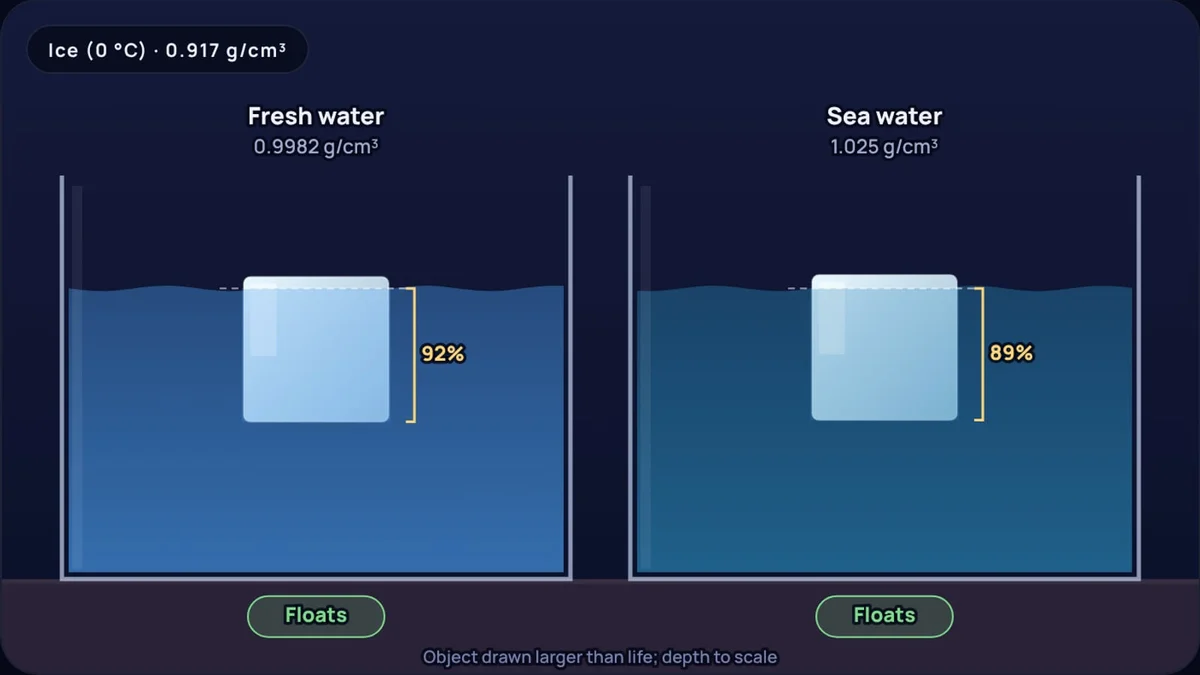
Drop an ice cube into a glass of water and it bobs straight back up, with a small square of ice showing above the surface. That is odd. For nearly every familiar substance, the solid is heavier for its size than the liquid, so a lump of solid wax or solid butter would sink in its own melt. Water does the opposite, and the reason comes down to one number: density.
This post works through why ice floats, how much of an ice cube or an iceberg hides under the surface, and how you can measure density in a kitchen with a scale and a measuring jug. The density calculator does the same sums for any material, and shows the object floating or sinking in fresh water and in sea water at the right depth.
What is density?
Density is how much mass is packed into each unit of volume. Divide the mass of an object by its volume and you have it:
The Greek letter ρ (rho) is the usual symbol. In the kitchen the handiest unit is grams per cubic centimetre, g/cm³, which is the same as grams per millilitre. Engineers often use kilograms per cubic metre: 1 g/cm³ is exactly 1,000 kg/m³. In the United States you will also meet pounds per cubic foot, where 1 g/cm³ is about 62.43 lb/ft³.
Water is the natural reference. The NIST Chemistry WebBook gives pure water at normal pressure a density of 998.21 kg/m³ at 20 °C, or 0.99821 g/cm³. That is why a litre of water has a mass of almost exactly one kilogram.
Example 1: the density of a wooden block
A block of wood measures 10 cm by 10 cm by 7.2 cm and has a mass of 518 g on a kitchen scale.
That is close to the 0.72 g/cm³ listed for oak, and well below water, so the block floats.
Why does ice float on water?
An object in water is pushed up by a force equal to the weight of the water it displaces. This is Archimedes' principle. If you held an ice cube completely under water, it would push aside a volume of water equal to its own volume. Because water is denser, that water weighs more than the ice. The upward push beats the ice's weight, and the cube rises.
It keeps rising until only part of it is under the surface. At that point the water it displaces weighs exactly as much as the whole cube, and the forces balance. Setting the two weights equal gives a neat rule:
The fraction of a floating object below the surface is simply its density divided by the liquid's density. If the object is denser than the liquid, the fraction would be more than 1, which means it cannot float at all and sinks to the bottom.
Example 2: how much of an ice cube is under water
PubChem lists ice at 0.917 g/cm³ at 0 °C. NIST gives water at 0.01 °C as 999.84 kg/m³, or 0.99984 g/cm³.
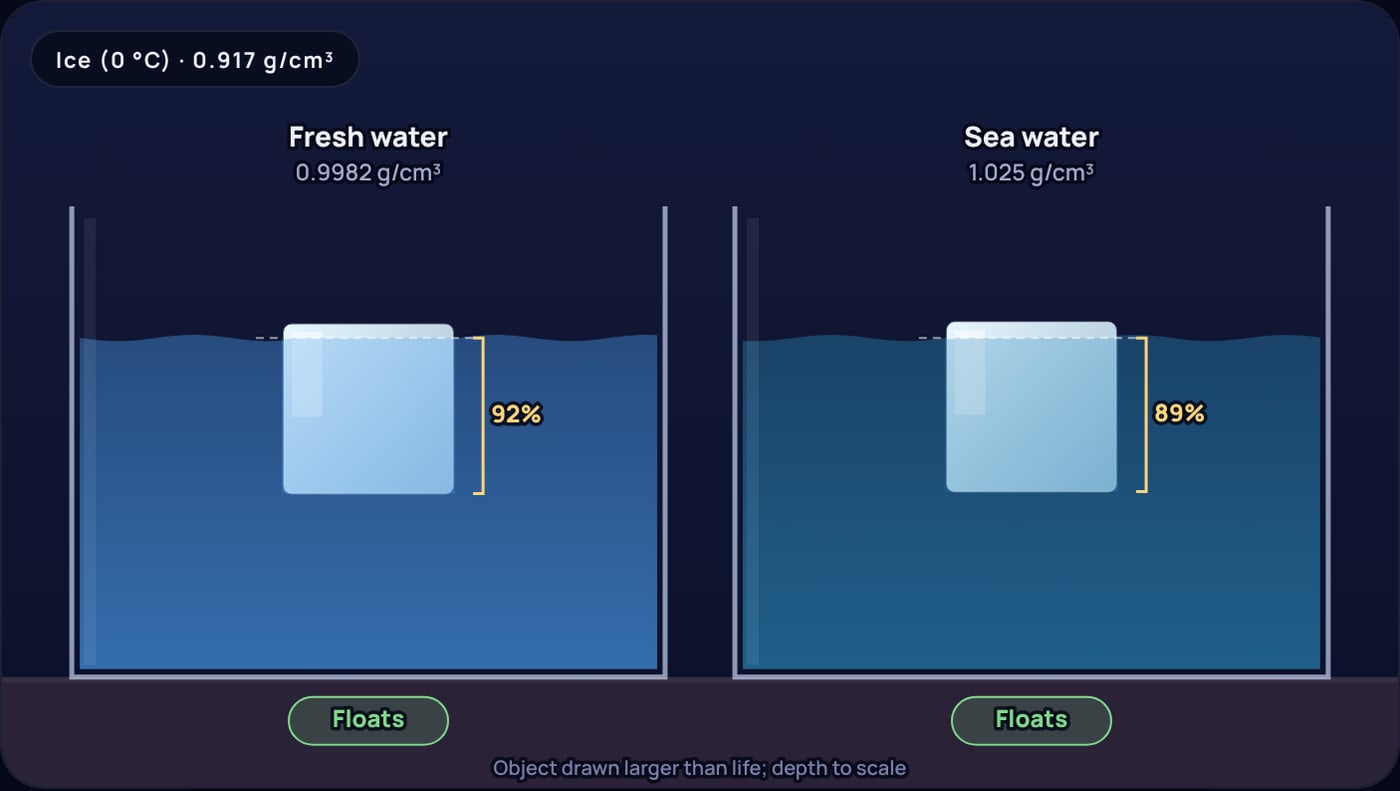
About 91.7% of the cube sits below the surface and 8.3% pokes out. In water at room temperature, 0.99821 g/cm³, the fraction is 91.9%.
Why is ice less dense than water?
The answer sits in the shape of the water molecule. Each molecule has one oxygen atom and two hydrogen atoms, set at an angle. The oxygen end carries a slight negative charge and the hydrogen ends a slight positive charge, so neighbouring molecules attract one another through hydrogen bonds.
In liquid water those bonds form and break constantly, and molecules can crowd fairly close together. When water freezes into ordinary ice, each molecule locks into hydrogen bonds with four neighbours, arranged in a regular hexagonal pattern. That pattern is surprisingly open: it holds the molecules a fixed distance apart with gaps between them, so the same number of molecules takes up more room than they did as a liquid.
Example 3: how much water expands when it freezes
Take one gram of water at 0.01 °C and freeze it. The volume before and after is mass divided by density:
Freezing makes water about 9% bigger. That is why a full glass bottle left in the freezer can crack, and why a frozen water pipe can split.
Most substances behave the other way round. Their molecules pack more tightly as a solid than as a liquid, so the solid sinks in its own melt. You can see this with a candle: as the pool of melted wax around the wick cools and sets, its surface sinks in the middle because the solid wax takes up less room. Ice is the everyday exception, and it is the reason ponds have ice on top rather than at the bottom.
How much of an iceberg is under water?
Sea water is denser than fresh water because of the salt dissolved in it. PubChem gives the density of sea water as approximately 1.025 g/cm³ at 25 °C. A denser liquid pushes up harder for the same submerged volume, so ice rides a little higher in the sea.
Example 4: the tip of the iceberg
Roughly 89% of solid ice floating in the sea is hidden and about one tenth shows, which is where the phrase "the tip of the iceberg" comes from.
Real icebergs are not perfectly solid ice. Glacier ice traps air bubbles as old snow is squeezed into ice, which lowers its average density, and sea water density changes with temperature and saltiness. So the exact share above the surface varies from one berg to the next. The one tenth figure is a good rule of thumb, not a fixed law. It also says nothing about shape: an iceberg can be tall and thin above the water and spread out wide below.
What happens to water near 4 °C?
Liquid water has one more quirk. As it cools, it gets denser, as most liquids do, but only down to about 4 °C. Below that it starts to expand again on its way to freezing. PubChem puts the temperature of maximum density at 3.98 °C. The NIST data show the change clearly:
- Water at 20 °C: 998.21 kg/m³
- Water at 4 °C: 999.97 kg/m³
- Water at 0.01 °C: 999.84 kg/m³
The differences are small, about 0.01% between 4 °C and 0 °C, but they matter for lakes. In autumn, surface water cools, becomes denser and sinks, letting warmer water rise to be cooled in turn. Once the whole lake reaches about 4 °C, further cooling makes the surface water lighter, not heavier, so it stays on top. The surface then freezes first, and the ice floats and acts as a lid, while the water at the bottom stays near 4 °C. Fish and other life can survive the winter under the ice.
How do you measure density at home?
You need two things: the mass and the volume. A kitchen scale gives the mass. The volume depends on the shape.
- Regular shapes: measure with a ruler and use a formula. A cube is a³, a box is length × width × height, a cylinder is πr²h and a sphere is 4/3 πr³.
- Irregular shapes: use water displacement. Half fill a measuring cylinder, read the level, lower the object in until it is just covered, and read the level again. The rise in millilitres is the object's volume in cubic centimetres.
- Liquids: weigh an empty jug, pour in a known volume, weigh it again and take the difference.
Displacement is the method in the old story of Archimedes and the king's crown: a crown with silver mixed into the gold would take up more room than pure gold of the same mass.
Example 5: is this ring silver?
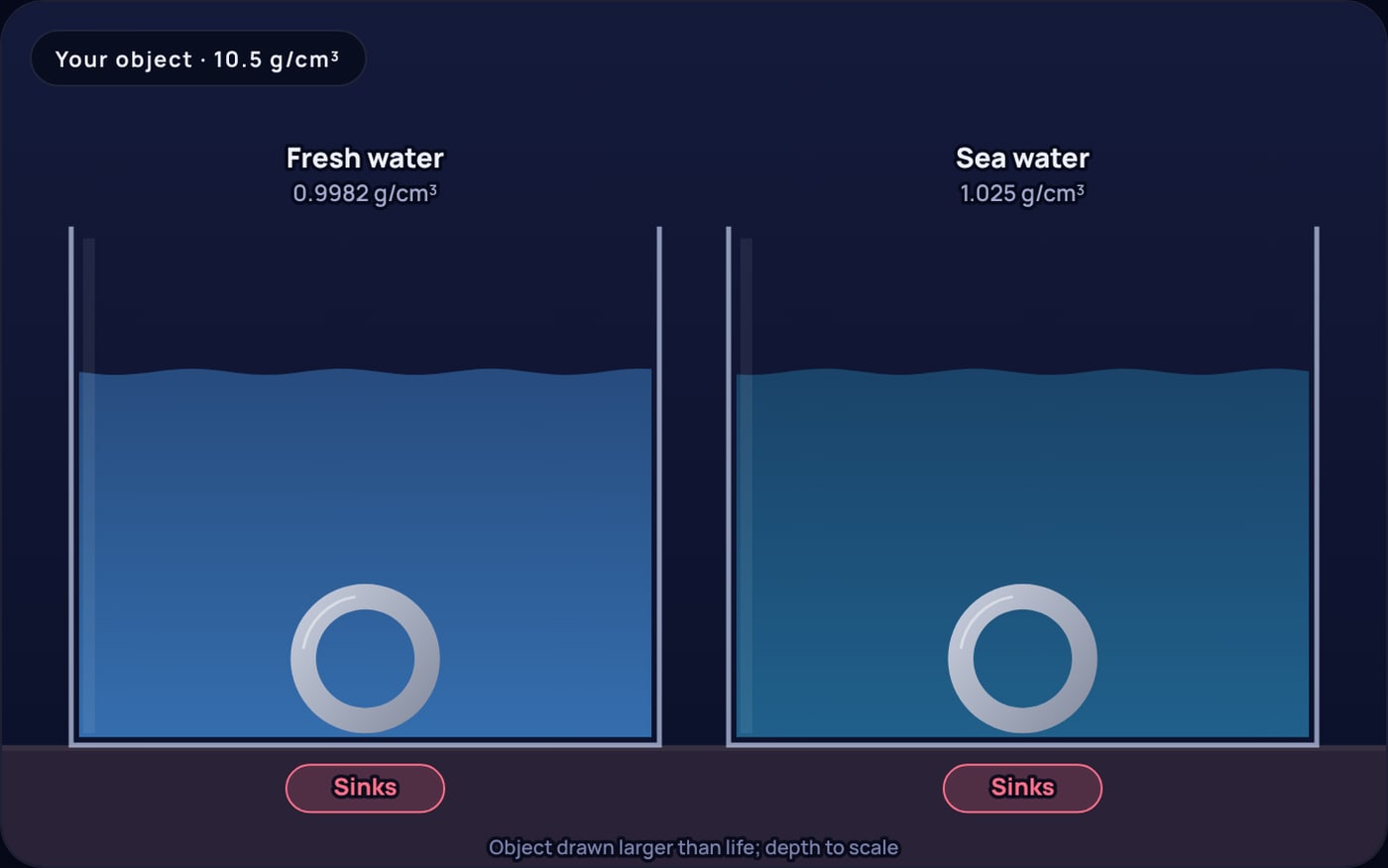
A ring has a mass of 5.25 g. Dropped into a 10 mL measuring cylinder of water, it raises the level to 10.5 mL.
Silver is 10.501 g/cm³ and gold is 19.282 g/cm³, both from PubChem's periodic table, so this ring is consistent with silver. A real kitchen test is much rougher: reading a level to the nearest 0.1 mL on a 0.5 mL change leaves an uncertainty of about 20%, so it can tell silver from gold but not fine silver from a silver alloy.
What floats and what sinks?
Anything less dense than water floats, and the density ratio tells you how high it rides. A few examples from the calculator's table, against fresh water at 0.998 g/cm³:
- Cork, 0.20 to 0.25 g/cm³: floats high, with only about a fifth to a quarter under the surface.
- Oak, 0.72 g/cm³: floats with about 72% under.
- Olive oil, 0.911 g/cm³: floats as a layer on top of water, which is why salad dressing separates.
- Ice, 0.917 g/cm³: floats with about 92% under.
- Glycerol, 1.2613 g/cm³: sinks below water.
- Steel, 7.82 g/cm³: sinks, at nearly eight times the density of water.
- Gold, 19.282 g/cm³: sinks, and a 1 kg bar is only 51.86 cm³, the volume of a cube 3.7 cm on a side.
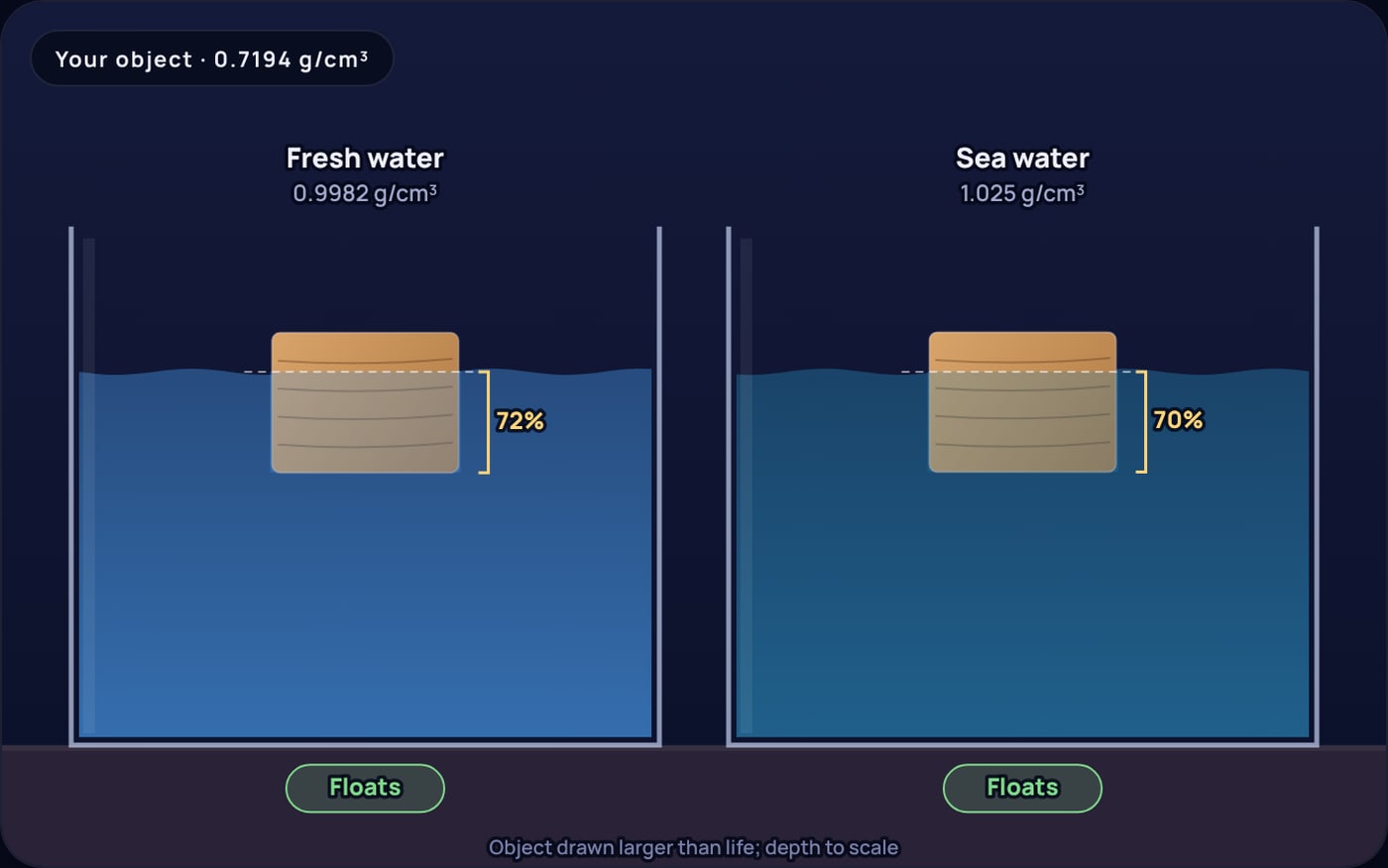
If steel sinks, how does a steel ship float? What matters is the average density of everything inside the hull's outline, including all the air. A hull is a thin steel shell around a large volume of air, so the ship as a whole is far less dense than water. Fill it with water through a hole and the average density shoots up, which is why a holed ship sinks.
The same rule explains why you feel lighter in the sea than in a swimming pool. Your body's density is close to that of water, so a small increase in the water's density from dissolved salt makes a noticeable difference to how high you float. For the related idea of floating with no water at all, see why astronauts float in orbit, which is a very different effect.
Does ice floating matter beyond the drinks glass?
It does. Because ice floats, lakes and the Arctic Ocean freeze from the top down, and the ice layer slows further heat loss from the water below. If ice sank, each winter's ice would pile up on lake beds, where summer sunlight would struggle to reach and melt it.
Ice that floats also does not raise the water level when it melts. A floating ice cube already displaces its own weight of water, and when it melts it becomes exactly that weight of water, filling the hole it made. Your drink does not overflow as the ice melts. Land ice is different: a glacier sliding off land into the sea adds water that was not there before. Water's other unusual properties, such as its high specific heat and why ice is slippery, come from the same hydrogen bonds.
Try it yourself
Open the density calculator with an ice cube and switch the material to cork, oak or steel to watch the object rise or drop in the two tanks. Pick "Displacement" to work out the density of a ring or a stone from a measuring jug, or choose "Volume" to see how much space a kilogram of gold takes up. Results come in g/cm³, kg/m³, g/mL or lb/ft³.
For a sense of how far density can go, a teaspoon of neutron star material makes even osmium, the densest element in the table at 22.57 g/cm³, look like foam.
Sources
- PubChem (NIH), water, CID 962: ice 0.917 g/cm³ at 0 °C, sea water approximately 1.025 g/cm³ at 25 °C, temperature of maximum density 3.98 °C.
- NIST Chemistry WebBook, thermophysical properties of water: density at 0.101325 MPa of 999.84 kg/m³ at 0.01 °C, 999.97 kg/m³ at 4 °C and 998.21 kg/m³ at 20 °C.
- PubChem (NIH), periodic table: densities of silver 10.501, gold 19.282 and osmium 22.57 g/cm³.
- PubChem (NIH), glycerol, CID 753: 1.2613 g/cm³ at 20 °C.
- Engineering ToolBox, wood densities, solids and liquids: cork, oak, olive oil and steel.
Frequently asked questions
Why does ice float on water?
Ice is less dense than liquid water. Ice at 0 °C is about 0.917 g/cm³ and water at the same temperature is about 0.9998 g/cm³, so a block of ice weighs less than the water it would push aside if fully submerged, and the water holds it up.
How much of an ice cube is under water?
About 92%. A floating object sinks until the fraction under the surface equals its density divided by the liquid’s density, and 0.917 ÷ 0.9998 is 0.917.
How much of an iceberg is under water?
About 89% in sea water of 1.025 g/cm³, using 0.917 g/cm³ for solid ice. Real glacier ice holds air bubbles, so its density and the exact share vary from berg to berg.
Why is ice less dense than water?
When water freezes, hydrogen bonds lock each molecule to four neighbours in an open, hexagonal pattern with more empty space than the jostling liquid. The same mass takes up about 9% more room.
Do other solids float on their own liquid?
Most do not. For most familiar substances the solid is denser than the liquid, which is why a pool of melted candle wax dips in the middle as it sets. Water is the everyday exception.