How do you convert between units?
Multiply by the number of new units in one old unit. One kilocalorie is 4,184 joules, so a 250 kcal snack holds 1,046 kJ; one kilowatt hour is 3.6 MJ; one mile is 1.609344 km exactly. Temperature is the exception, because the scales have different zeros: °F = °C × 1.8 + 32.
Most of these factors are exact by definition: the inch has been 2.54 cm exactly since 1959, the pound 0.453 592 37 kg, the calorie 4.184 J. The converter uses those definitions and exact decimal arithmetic, so it never prints 0.30000000000000004. For energy units in depth, see joules, calories and kWh explained.
Key results from the converter
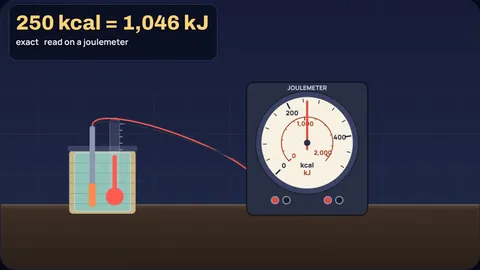
- Food energy: 1 food Calorie = 1 kcal = 4,184 J, so 250 kcal = 1,046 kJ.
- Electricity: 1 kWh = 3,600,000 J = 3.6 MJ exactly, and 860.421 kcal.
- Pressure: 32 psi in a tyre is 2.20632 bar, and 1 atm is 14.6959 psi.
- Storage: a 1 TB drive holds 931.323 GiB, because the drive counts in powers of ten and the computer in powers of two.
Six conversions people look up
Each button loads the conversion in the converter and shows it on the instrument that would print both scales.
A 250 kcal snack in kilojoules
EnergyFood labels print Calories, which are kilocalories, and many also print kilojoules. One kilocalorie is 4,184 J exactly, so 250 kcal is 1,046 kJ.
The calorie used here is the thermochemical calorie, 4.184 J. An older International Table calorie of 4.1868 J also exists; the difference is less than 0.1%.
One kilowatt hour in megajoules
EnergyA kilowatt hour is a power of 1,000 W kept up for 3,600 s, so it is 3,600,000 J, or 3.6 MJ exactly. It is the unit on an electricity bill.
In food terms it is 860.421 kcal, which is why energy from the grid and energy from a meal look so different on paper.
32 psi in bar
PressureA psi is one pound-force on a square inch. Both are defined exactly, so 1 psi is 6,894.757… Pa and 32 psi is 2.20632 bar.
Tyre gauges read pressure above the air around them, not absolute pressure. Add about one atmosphere, 1.01325 bar, for the absolute value.
20 °C in Fahrenheit
TemperatureMultiply by 1.8 and add 32: 20 °C is 68 °F. In kelvin it is 293.15 K.
A temperature difference converts without the offset: a rise of 20 °C is a rise of 36 °F, not 68 °F.
One US cup in millilitres
VolumeThe US gallon is 231 cubic inches, and a cup is a sixteenth of it, so 1 cup is 236.5882365 mL exactly. Recipes round it to 240 mL.
The UK gallon is a different, larger unit (4.54609 L), so UK and US fluid ounces differ too.
Why a 1 TB drive shows 931 GB
DataDrive makers use SI prefixes: 1 TB is 10¹² bytes. Many operating systems count in powers of two, 1 GiB = 2³⁰ bytes, and label the result GB. So 1 TB appears as 931.323.
Nothing is missing. The binary prefixes kibi, mebi, gibi and tebi exist precisely to avoid this confusion.
Common factors, exact unless marked
| From | To | Multiply by |
|---|---|---|
| inch | centimetre | 2.54 |
| mile | kilometre | 1.609344 |
| pound | kilogram | 0.45359237 |
| kilocalorie | joule | 4184 |
| kilowatt hour | megajoule | 3.6 |
| electronvolt | joule | 1.602176634 × 10⁻¹⁹ |
| British thermal unit | joule | 1055.05585262 |
| standard atmosphere | pascal | 101,325 |
| psi | pascal | 6,894.757293 (never ends) |
| US gallon | litre | 3.785411784 |
| mile per hour | metre per second | 0.44704 |
| horsepower | watt | 745.69987158227022 |
The millimetre and inch of mercury are defined through the density of mercury and standard gravity; the converter uses the 7-figure factors NIST lists for them (133.3224 Pa and 3,386.389 Pa).
How the converter works
Each unit is stored as an exact ratio to the SI unit of its quantity, taken from NIST Special Publication 811, Appendix B, or from the defining relation where NIST prints a rounded value: the pound is 0.453 592 37 kg, the pound-force 4.448 221 615 260 5 N, the International Table Btu 1055.055 852 62 J, the US gallon 231 cubic inches. The electronvolt uses its exact 2019 SI value, 1.602 176 634 × 10⁻¹⁹ J.
Converting multiplies your value by the first unit and divides by the second, in exact decimal arithmetic. When the answer ends, you get every digit and the word exact. When it never ends, as for psi or km/h to m/s, it is rounded once to the significant figures you choose.
Temperature converts through kelvin with an offset: K = °C + 273.15, and K = (°F + 459.67) ÷ 1.8. The factor box then shows the rule and the size of one degree.
The instrument on the stage is drawn with both scales so you can see the factor as a stretch between them.
What the model leaves out
- Prefix arithmetic beyond the list: it lists the common prefixed units. For others, use the scientific notation converter for the power of ten.
- Compound units: it does not build new units such as kg·m/s² from parts.
- Survey and historic units: the acre is the international one, 43,560 international square feet; the old US survey acre is about 4 parts per million larger.
- Significant figures of your input: it converts exactly. Round the result to the precision of your measurement yourself.
Common misconceptions
"A Calorie and a calorie are the same." The food Calorie is a kilocalorie, 1,000 small calories.
"To convert °C to °F, multiply by 1.8." Only for a temperature difference. A temperature needs the + 32 as well.
"A kilobyte is 1,024 bytes." In SI it is 1,000 bytes. 1,024 bytes is a kibibyte.
Frequently asked questions
How many joules are in a calorie?
A calorie (thermochemical) is exactly 4.184 J. The food Calorie on a label is a kilocalorie, 4,184 J.
How many joules are in a kilowatt hour?
Exactly 3,600,000 J, or 3.6 MJ: one kilowatt (1,000 J each second) for one hour (3,600 s).
How do you convert psi to bar?
Multiply by 0.0689476 (rounded). 1 psi = 6,894.757 Pa and 1 bar = 100,000 Pa, so 32 psi = 2.20632 bar.
Why is a 1 TB drive shown as 931 GB?
The drive counts 10¹² bytes. The computer divides by 2³⁰ (a gibibyte) and calls it GB, which gives 931.323.
Are these conversion factors exact?
Most are exact by definition, such as 1 in = 2.54 cm and 1 lb = 0.453 592 37 kg. The converter marks a result exact when both factors are exact and the division ends; mercury pressure units use NIST’s 7-figure values.
Keep learning
Joules, Calories and kWh: Energy Units Explained
What a joule, a calorie, a food Calorie, a kilowatt hour, an electronvolt and a Btu are, the exact factors between them, and worked conversions.
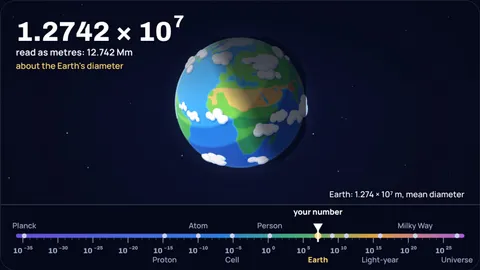
How to Write Numbers in Scientific Notation (With Steps)
Write any number in scientific notation: move the point, count the places, read the sign. Worked examples, E notation, engineering notation and multiplying.
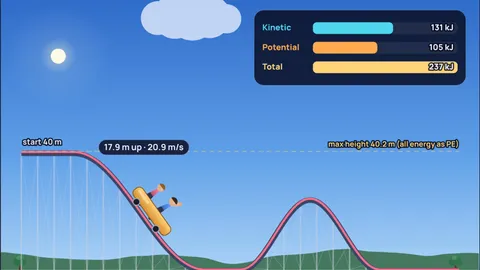
Kinetic Energy vs Potential Energy: Examples With Numbers
Kinetic and potential energy worked through with real numbers: a skater, a roller coaster, a car at 50 and 100 km/h, a runner and the Moon.