What can you do with a tone generator?
Test speakers and headphones, check left and right channels, tune an instrument to A4 = 440 Hz, find a rattle with a slow sweep, or see how high you can still hear. Sound only starts when you press Play, and the volume starts low.
For the hearing side of it, read what is the highest frequency humans can hear?. For loudness and decibels, see why 3 dB is double the power.
Useful numbers
- Audible range: roughly 20 Hz to 20 kHz (HyperPhysics), shrinking at the top with age.
- Hearing by age: at 16 kHz, 100 % of ears aged 21 to 30 responded and 16.1 % aged 61 to 70; at 20 kHz, 52.2 % and none (Wang et al. 2021).
- Tuning: A4 = 440 Hz (ISO 16), and each equal-tempered semitone multiplies the frequency by 2^(1/12).
- Wavelength: at 344 m/s, 20 Hz is 17.2 m long and 20 kHz is 1.72 cm.
- Safe listening: WHO suggests keeping a device under 60 % of its maximum volume.
Nine tones to try
Each loads the tone silently; press Play to hear it.
A4, 440 Hz
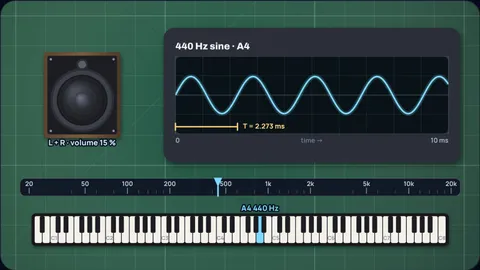
tuningThe standard tuning pitch. Its period is 2.273 ms and its wavelength in air 78 cm.
Middle C
C4Nine semitones below A4: 440 × 2^(−9/12) = 261.63 Hz.
1 kHz test tone
B5The usual reference tone for audio levels. It is not a note: it sits 21 cents above B5.
50 Hz mains hum
G1The frequency of mains electricity in much of the world. Small speakers barely reproduce it, so you may hear its harmonics more than the tone.
440 Hz square wave
harmonicsSame pitch as A4, a much brighter sound: a square wave adds odd harmonics at 1320, 2200, 3080 Hz and so on.
15 kHz
highNear the top of hearing for many adults. In Wang et al., 45.2 % of ears aged 61 to 70 responded at 14 kHz and 16.1 % at 16 kHz.
Sweep 20 Hz to 20 kHz
20 sAn exponential sweep spends the same time on every octave, two seconds each over ten octaves. Listen for rattles, dips and the point where it fades.
The hearing test
8 to 20 kHzThe tone rises from 8 kHz at 400 Hz a second. Press the button when it fades. Keep the volume low; a tone you cannot hear is not a reason to turn it up.
A result of 17 kHz
by age17 kHz is above the 16 kHz test tone, where 100 % of 21 to 30, 64 % of 31 to 40, 38.6 % of 41 to 50, 30.8 % of 51 to 60, 16.1 % of 61 to 70 year-old ears responded; at 18 kHz the figures fall to 78.3, 20, 2.3, 2.6, 0 %.
Percentage of ears that responded, by age (Wang et al. 2021)
| Tone | 21 to 30 | 31 to 40 | 41 to 50 | 51 to 60 | 61 to 70 |
|---|---|---|---|---|---|
| 8 kHz | 100 % | 100 % | 100 % | 100 % | 100 % |
| 9 kHz | 100 % | 100 % | 100 % | 100 % | 97.4 % |
| 10 kHz | 100 % | 100 % | 100 % | 100 % | 97.4 % |
| 11.5 kHz | 100 % | 100 % | 100 % | 92.3 % | 90.3 % |
| 12.5 kHz | 100 % | 100 % | 93.2 % | 82.1 % | 74.2 % |
| 14 kHz | 100 % | 96 % | 79.5 % | 59 % | 45.2 % |
| 16 kHz | 100 % | 64 % | 38.6 % | 30.8 % | 16.1 % |
| 18 kHz | 78.3 % | 20 % | 2.3 % | 2.6 % | 0 % |
| 20 kHz | 52.2 % | 8 % | 2.3 % | 0 % | 0 % |
162 adults with normal standard audiograms, tested with calibrated high-frequency audiometer earphones.
How the tone generator works
The browser's Web Audio API makes the tone with an oscillator, a gain stage for volume and a stereo panner for the channel. Nothing plays until you press Play, and it stops when you leave or hide the page.
The slider is logarithmic, so each octave takes the same width. The nearest note uses n = 69 + 12 log₂(f / 440).
The waveform is drawn to scale: the screen spans a 1, 2, 5 step of time so that a few cycles fit, and one period is bracketed.
What the model leaves out
- Calibration. The tool cannot know how loud your speakers are, so it cannot measure a hearing threshold in dB.
- Speaker limits. Many laptop and phone speakers play little below about a hundred hertz or above the top of the hearing range; headphones do better.
- Medical use. It is not a hearing test in the clinical sense. See an audiologist if you are worried.
Common misconceptions
"If I cannot hear it, nothing is playing." The speaker may still be producing it. Do not turn the volume up to chase a silent tone.
"Everyone hears 20 Hz to 20 kHz." In Wang et al. only about half the ears aged 21 to 30 responded at 20 kHz.
"A square wave is louder." At the same peak it carries more power and harmonics, so it does sound louder and brighter.
Frequently asked questions
What frequency range can humans hear?
Roughly 20 Hz to 20 kHz, though the top falls with age. In Wang et al. 2021, 52.2 % of ears aged 21 to 30 responded at 20 kHz and none aged 51 to 70.
Is it safe to play tones through headphones?
At a low volume, yes. Start quiet, never raise the volume to find a tone you cannot hear, and keep your device below 60 % of maximum as WHO suggests.
What frequency is A4?
440 Hz, the standard tuning frequency set by ISO 16. Middle C is 261.63 Hz in equal temperament.
Why can I not hear the highest tones?
Age-related hearing loss takes the top frequencies first, but your speakers may also not play them. Try headphones at a low volume.
How do I test left and right speakers?
Choose Left or Right under the waveform buttons and press Play. The tone should come from one side only.
Keep learning
What Is the Highest Frequency Humans Can Hear?
The textbook says 20 kHz, but in a 2021 study only 52 % of ears under 30 heard it and none over 50 did. Here is what ages each band and how to test yours.
Why 3 dB Is Double the Power (and 6 dB Double the Voltage)
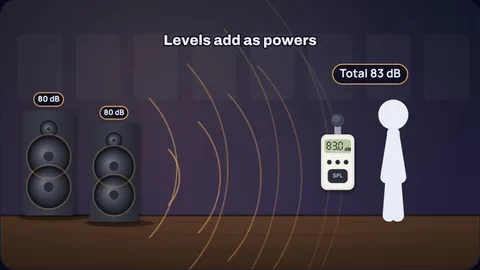
3 dB is double the power because 10 log 2 = 3.01. Why voltage needs 20 log, why two 80 dB speakers make 83 dB, and how dBm, dBu and distance work.

Why Does Sound Travel Faster in Water and Steel?
Sound is 4 times faster in water and 17 times faster in steel than in air, because stiffness matters more than density. The numbers, worked through.