What Is the Highest Frequency Humans Can Hear?
Every physics textbook gives the same range for human hearing: 20 Hz to 20 kHz. Then a hearing study tests 162 adults with normal standard audiograms, and only 52.2 % of the ears under 30 respond at 20 kHz. In the 51 to 60 group, none do. The textbook figure describes a young ear at its best, and most people reading this have lost the top of that range without ever noticing.
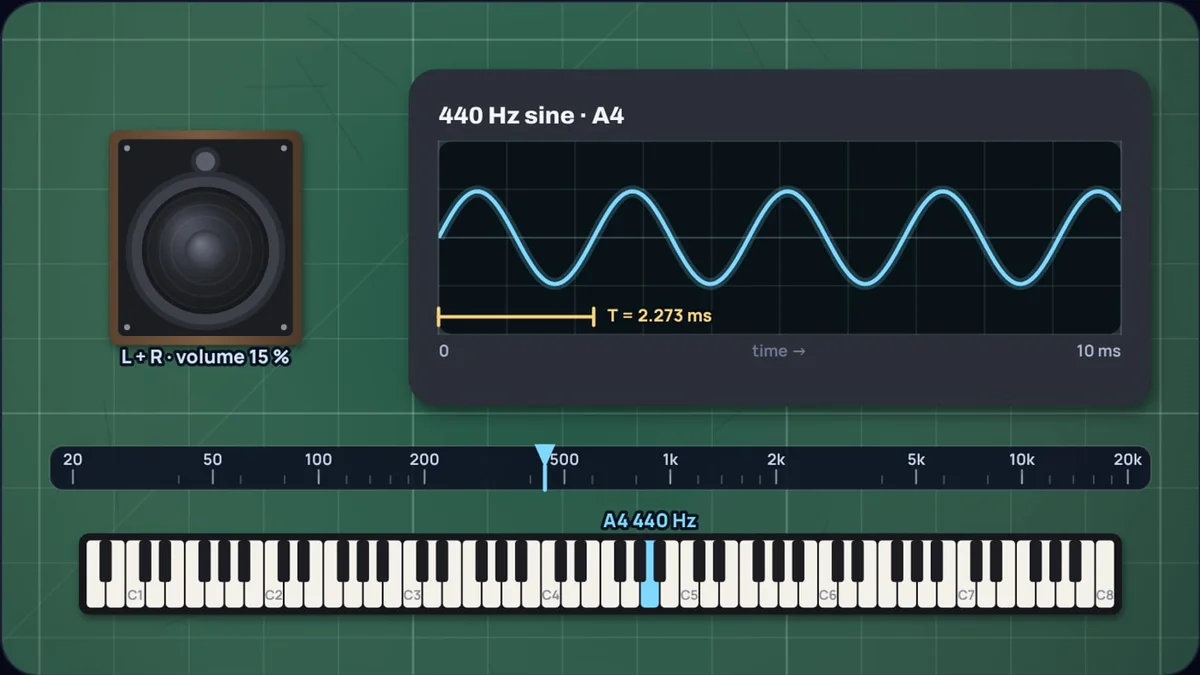
This article goes through where the 20 kHz figure comes from, what the study measured age group by age group, why the top octave goes first, and how to find your own limit. Our free online tone generator plays any frequency from 20 Hz to 20 kHz, runs a rising hearing test and compares your answer with the study by age. Read the section on speakers before you trust your result.
Where does “20 Hz to 20 kHz” come from?
HyperPhysics, the reference site run by Georgia State University, gives the human audible range as roughly 20 Hz to 20 kHz, and the word roughly matters. It is a round pair of numbers for a young, healthy ear, not a measurement of the average adult.
The range is wide. In air at 20 °C, where HyperPhysics gives the speed of sound as 344 m/s, wavelength is the speed divided by the frequency:
At 20 Hz: λ = 344 ÷ 20 = 17.2 m.
At 20 kHz: λ = 344 ÷ 20,000 = 0.0172 m = 1.72 cm.
So the same pair of ears handles waves from 17 metres long down to under 2 centimetres, a factor of 1,000. That is ten octaves, and it is why the frequency slider in the tone generator is logarithmic: an octave takes the same distance anywhere on it, so 20 to 40 Hz is as wide as 10 to 20 kHz.
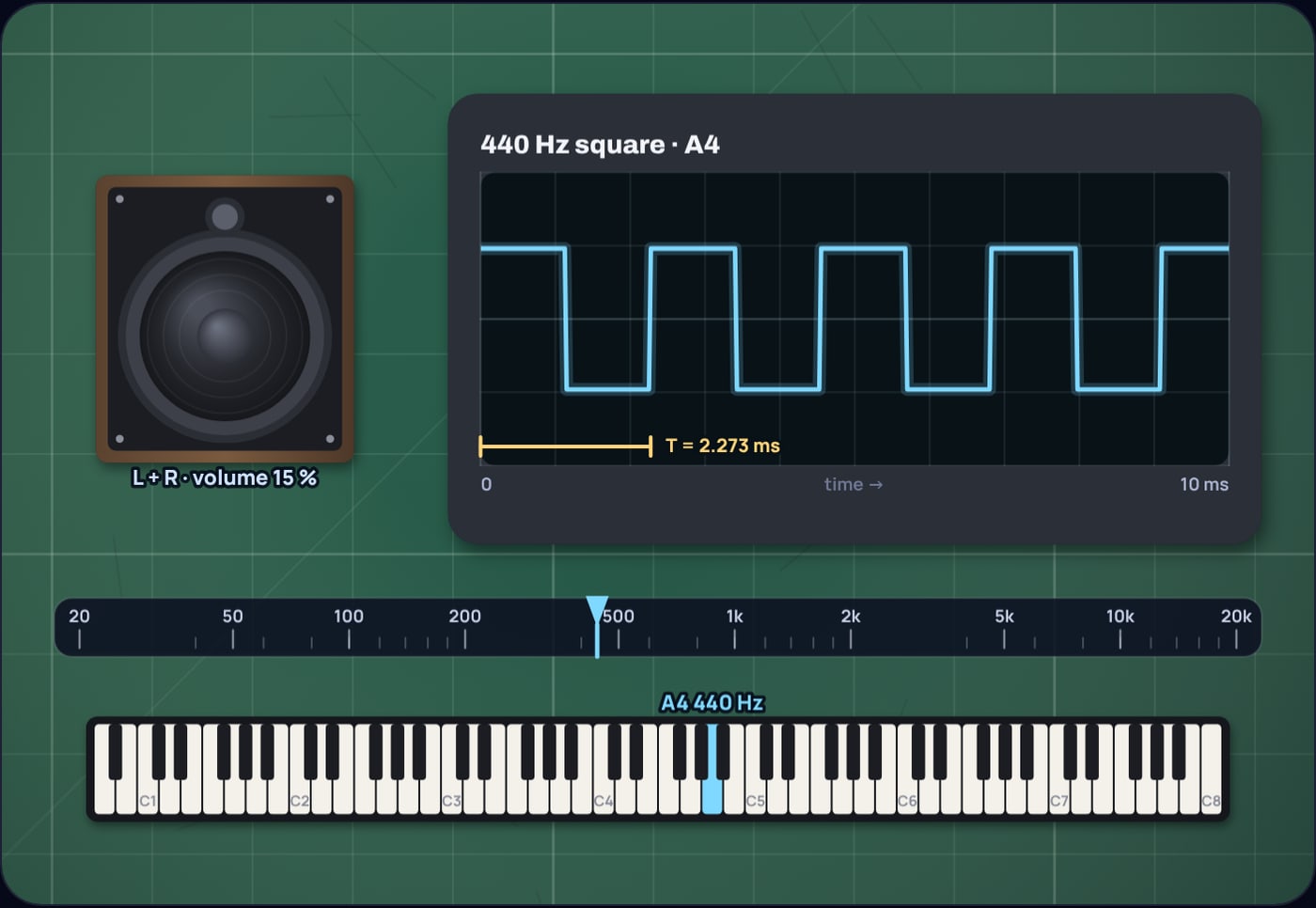
The period is 1 ÷ f. A 440 Hz tone, the A above middle C, repeats every 2.273 ms and has a wavelength of 78 cm.
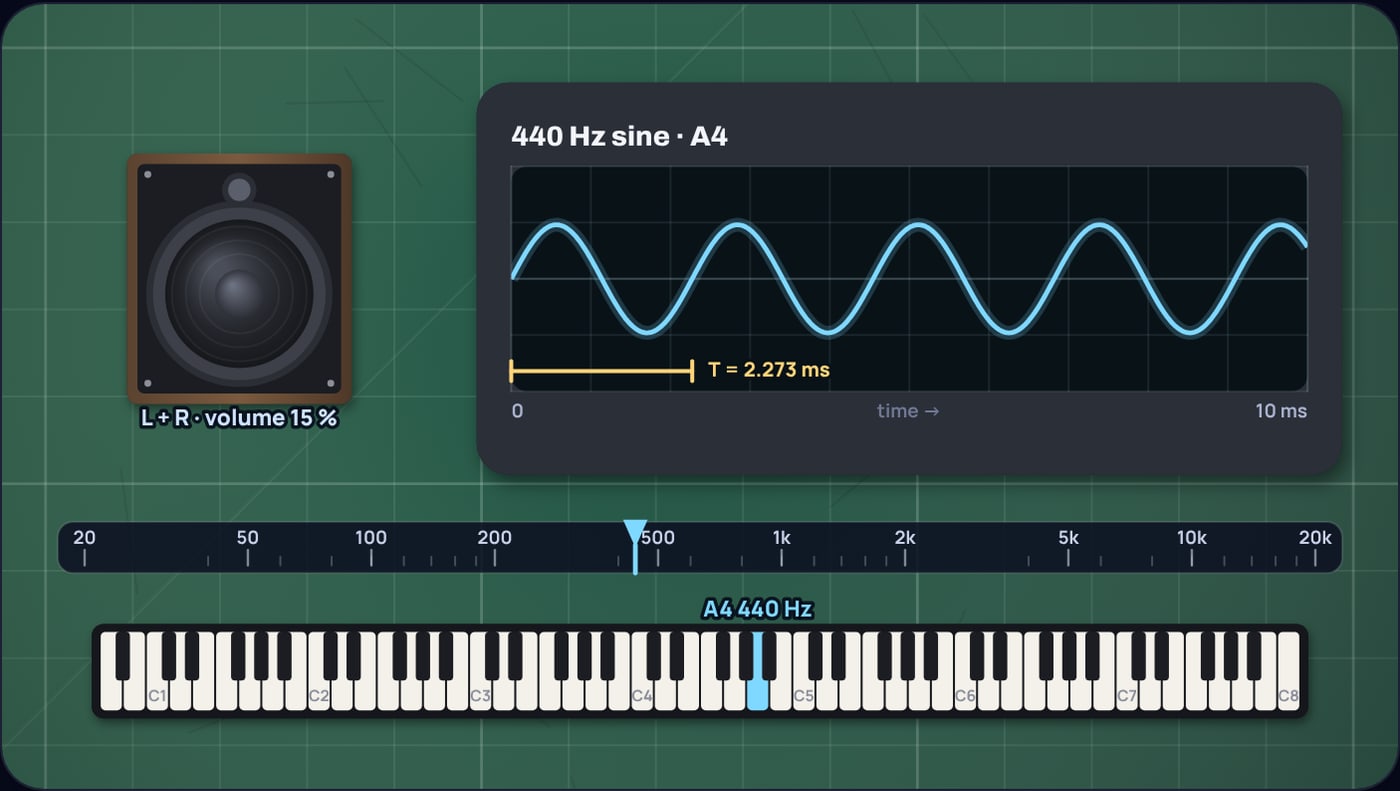
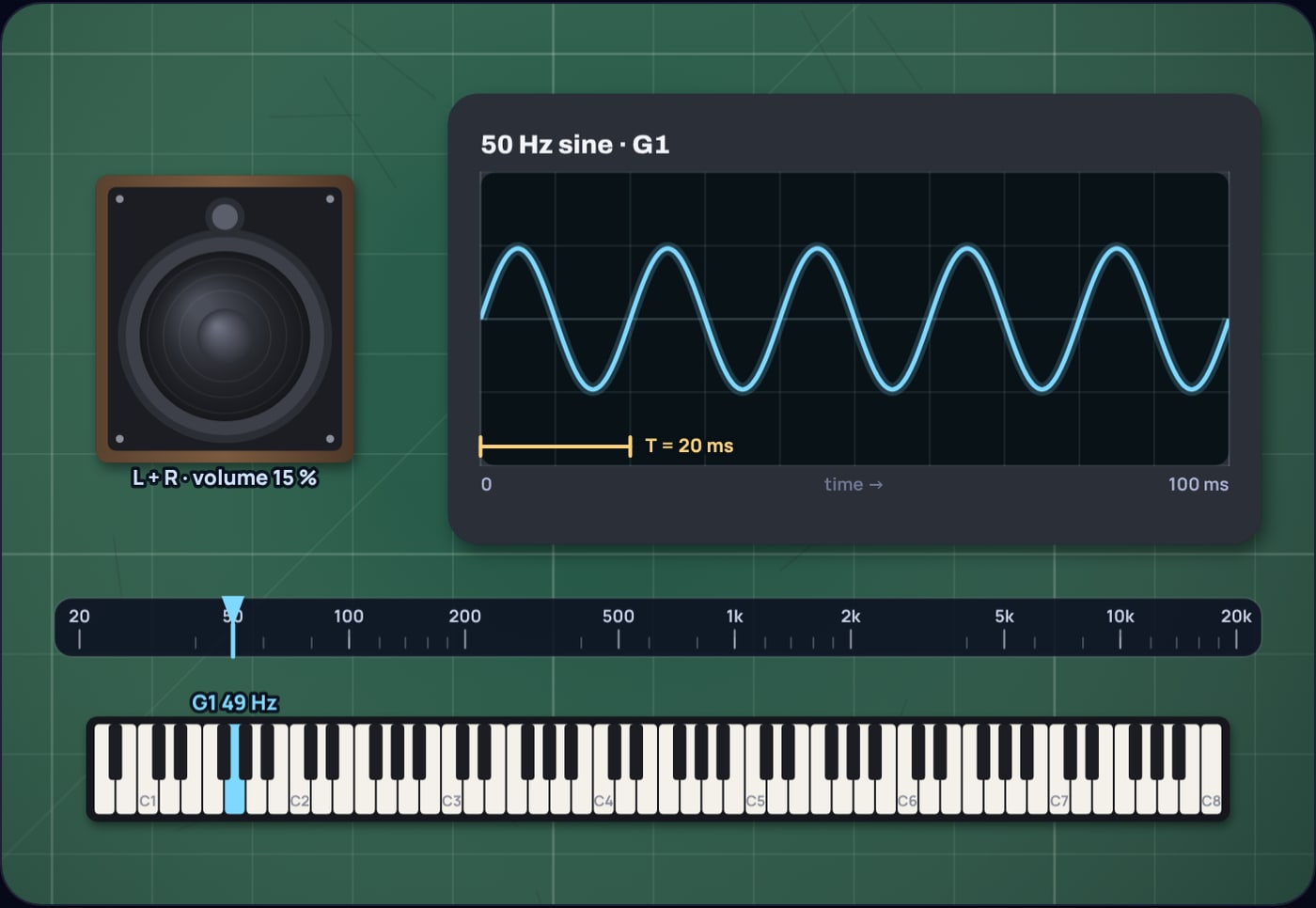
At the bottom of the range, 50 Hz is the mains hum heard from transformers in countries with a 50 Hz grid. Its period is 20 ms and its wavelength 6.88 m. On a piano it falls between G1 and G♯1, 35 cents sharp of G1 at 49.0 Hz.
What did the 2021 study measure?
Mingming Wang and colleagues at Shandong Provincial ENT Hospital tested 162 adults aged 21 to 70, published in the Journal of Otolaryngology, Head and Neck Surgery in 2021. Everyone had normal conventional audiograms, the standard hearing test that stops at 8 kHz. None reported noise exposure from work, the military or recreation, smoking, ototoxic drugs, diabetes, high blood pressure or hearing loss in the family. These were people with good hearing by the usual measure.
The team then tested the "extended high frequencies" above 8 kHz, up to 20 kHz, with a calibrated audiometer and Sennheiser HDA-200 high-frequency earphones. For each age group and frequency they reported the percentage of ears that gave any response at all. Here is a selection from their Table 2:
| Tone | Age 21 to 30 | Age 41 to 50 | Age 61 to 70 |
|---|---|---|---|
| 12.5 kHz | 100 % | 93.2 % | 74.2 % |
| 14 kHz | 100 % | 79.5 % | 45.2 % |
| 16 kHz | 100 % | 38.6 % | 16.1 % |
| 18 kHz | 78.3 % | 2.3 % | 0 % |
| 20 kHz | 52.2 % | 2.3 % | 0 % |
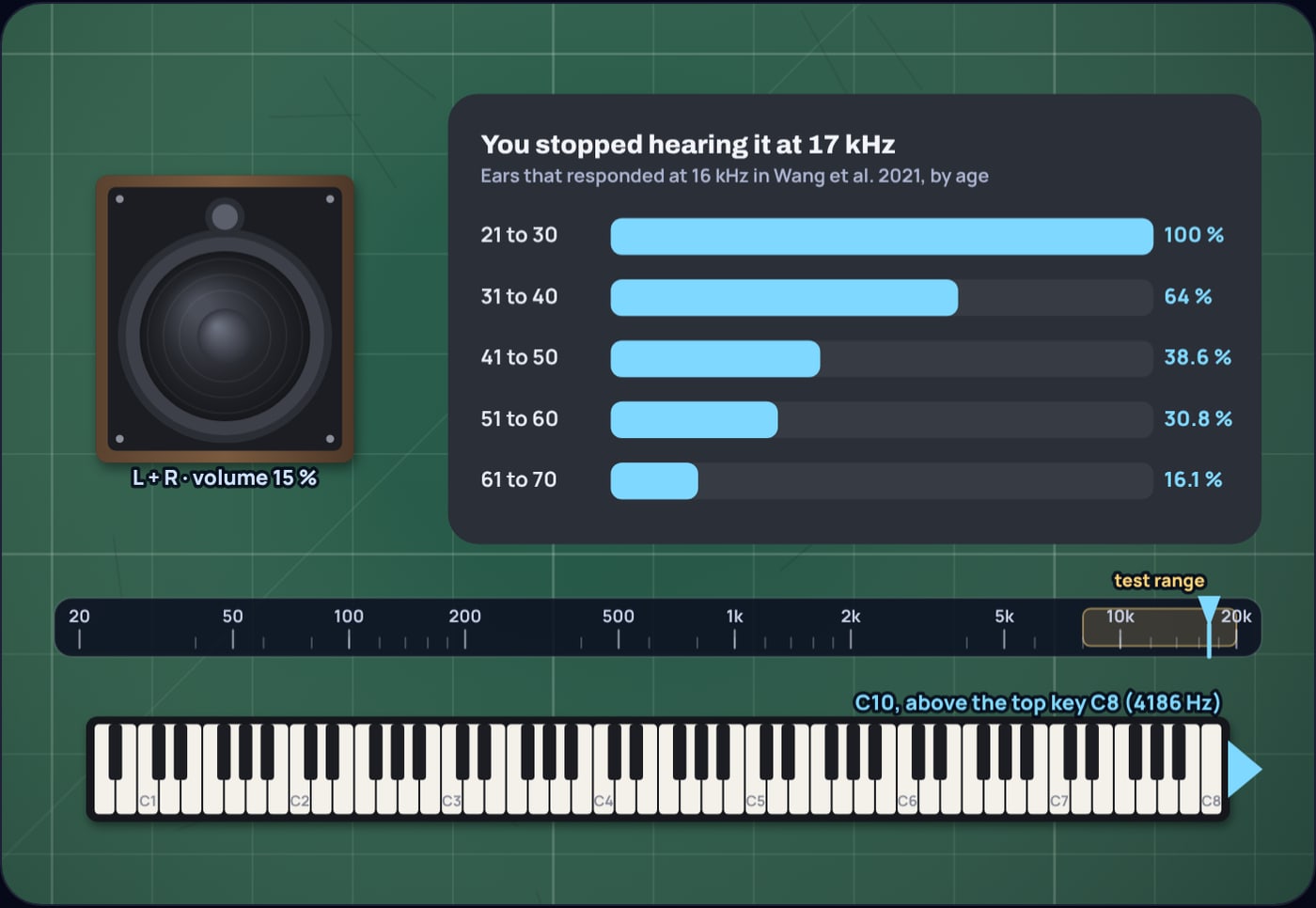
The middle groups fall between. Ears aged 31 to 40 responded 96 % of the time at 14 kHz, 64 % at 16 kHz, 20 % at 18 kHz and 8 % at 20 kHz. Ears aged 51 to 60 managed 59 %, 30.8 %, 2.6 % and 0 %. The authors summarise it plainly: "Subjects under 30 years old were totally responsive up to 16 kHz, and 52.2% could respond to 20 kHz", while "no responsiveness was recorded to 20 kHz in the 51 ~ 60 group and even to 18 kHz in the 61 ~ 70 group."
Responding is not the same as hearing easily. Where the ears did respond, the threshold climbed with age. At 16 kHz the average threshold was 25 dB HL in the 21 to 30 group, 50 dB HL in the 31 to 40 group and 55 dB HL from 41 to 60. On average, a 16 kHz tone had to be 25 to 30 dB louder for people in their forties than for people in their twenties before they heard it.
The groups were small, 23 to 44 people each, all from one hospital. Treat the percentages as the shape of the decline, not exact figures for any population.
Why does the top octave go first?
The US National Institute on Deafness and Other Communication Disorders (NIDCD) describes age-related hearing loss, presbycusis, as "hearing loss that occurs gradually for many of us as we grow older". It usually affects both ears, mostly through changes in the inner ear, with changes in the middle ear and the nerve pathways to the brain playing a part. Long-term noise and some medical conditions add to it. NIDCD puts the scale at about one in three people in the US aged 65 to 74, and nearly half of those over 75.
Wang and colleagues cite earlier work showing that "the age-related hearing change appeared first at EHF rather than at the lower frequencies". Their own data show the same thing from the other side: in their groups, hearing from 4 to 8 kHz only began to decline from age 51, while 16 kHz had already dropped sharply by the thirties.
NIDCD notes that "because the loss is gradual, you may not realize that you've lost some of your ability to hear." This is why the authors argue for testing above 8 kHz: a conventional audiogram can be normal while the top octave is mostly gone.
How do you find your own limit?
The tone generator's hearing test starts a sine wave at 8 kHz, which every ear in the study could hear, and raises it by 400 Hz every second. It reaches 20 kHz after 30 seconds. You press "I can no longer hear it" the moment the tone fades, and the tool records the frequency and compares it with the nearest tested row of the study at or below your answer.
- Use headphones if you have them, and set the device volume low before you press anything.
- Run the test once to learn what the fade sounds like.
- Run it three times and take the middle answer. Reaction time adds about 400 Hz per second of delay, so do not overthink the press.
- Use the Left and Right channel buttons to test each ear on its own.
To search by hand, type a frequency or use the ±1 Hz, ±10 Hz and octave buttons.
Is the limit your ears or your speakers?
Often your speakers. Three things get in the way.
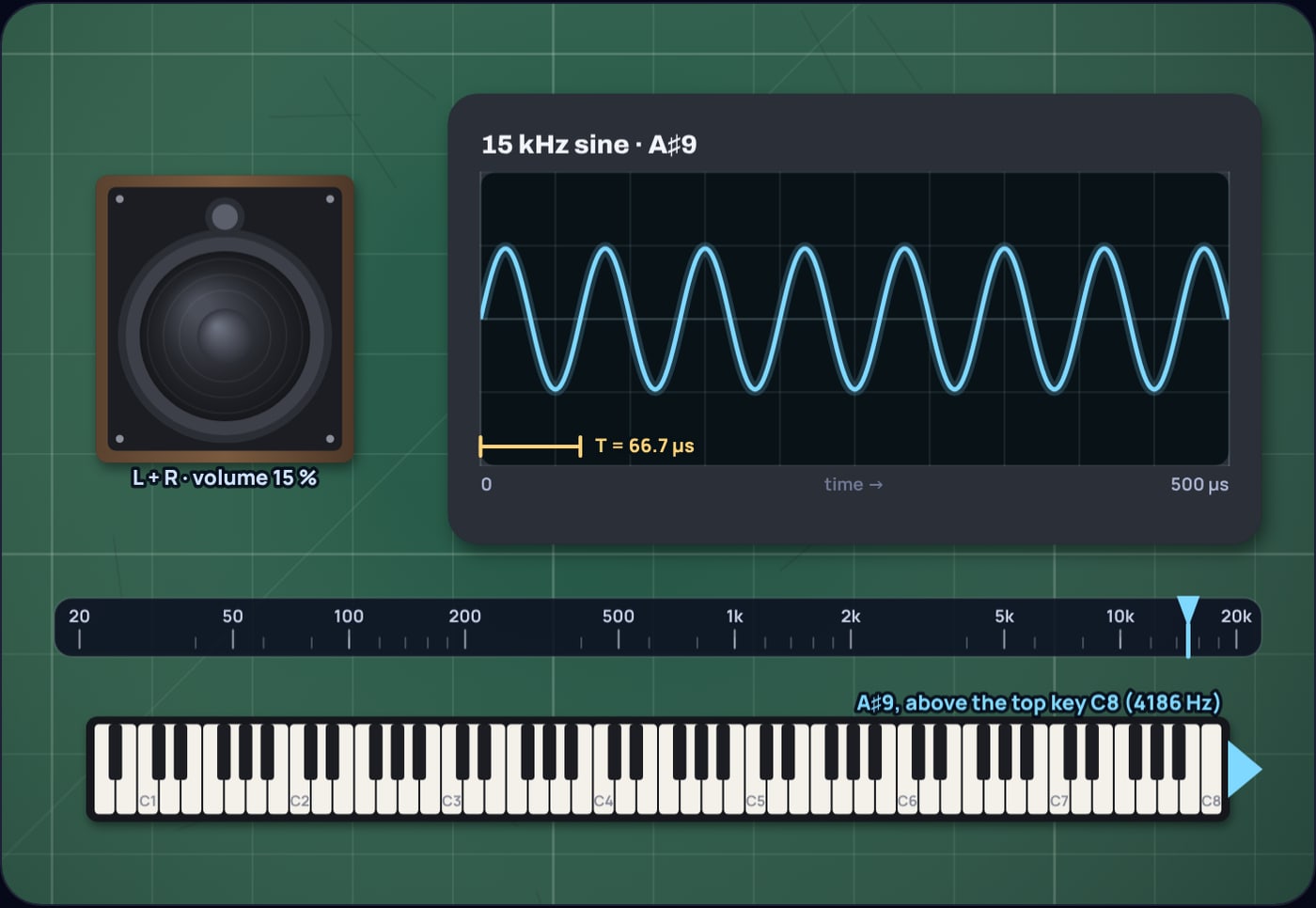
The speaker itself. Many small laptop and phone speakers play very little at the top of the range. If everyone in the room loses the tone at the same point, suspect the speaker and try headphones.
The digital audio path. A digital signal sampled at rate fs can only carry frequencies below fs ÷ 2. Browsers usually run audio at 44.1 kHz or 48 kHz, which allows up to 22.05 kHz or 24 kHz, so 20 kHz fits.
The volume. The study measured thresholds with a calibrated audiometer that knows exactly how loud each tone is. Your computer does not. A tone you cannot hear at a quiet setting may be audible at a louder one, which is why the result is a comparison on your own equipment, not a measurement of your hearing threshold.
So your result depends on your speakers or headphones and the volume, and it is not a medical test. If you notice a real change in your hearing, see an audiologist.
How loud is safe?
The tone generator starts at 15 % on its own volume slider, which it maps to 45 dB below full scale before your device volume. That is quiet on purpose. High tones are a particular trap: a tone above your range can be loud enough to harm your ears without sounding loud, because you hear little or nothing of it. Never turn the volume up to chase a tone you cannot hear.
The World Health Organization's safe listening guidance gives the trade between level and time: 80 dB is safe for up to 40 hours a week, but 90 dB only for 4 hours. Its practical advice is to keep "your device's volume level to no more than 60% of maximum" and to use well-fitted headphones so you do not need to turn things up in noisy places.
What does a square wave change?
A sine wave is a single frequency. A square wave at the same pitch adds odd harmonics, at 3, 5, 7 and more times the fundamental, which is why a 440 Hz square sounds buzzy next to a 440 Hz sine.
For a hearing test, use the sine. Above about 6.7 kHz, the third harmonic of any square wave is already above 20 kHz, so at the top of the range a square sounds like a sine anyway. At the bottom, the harmonics work the other way. A 50 Hz sine on a laptop speaker may be almost silent, while a 50 Hz square is clearly audible, because you are hearing its harmonics at 150 Hz, 250 Hz and up rather than the fundamental.
Where does 20 kHz sit on a piano?
The piano strip in the tool marks the nearest note in equal temperament, with A4 at 440 Hz, the standard tuning pitch set in ISO 16. Each semitone is a factor of 21/12, so the note number n has frequency:
with n = 69 for A4 and 60 for middle C, which comes out at 261.63 Hz. A standard 88-key piano runs from A0 at 27.5 Hz to C8 at 4186 Hz. Everything above C8, which includes the whole range the hearing study tested, is off the keyboard. A 17 kHz tone is C10 plus 26 cents, two octaves above the last key.
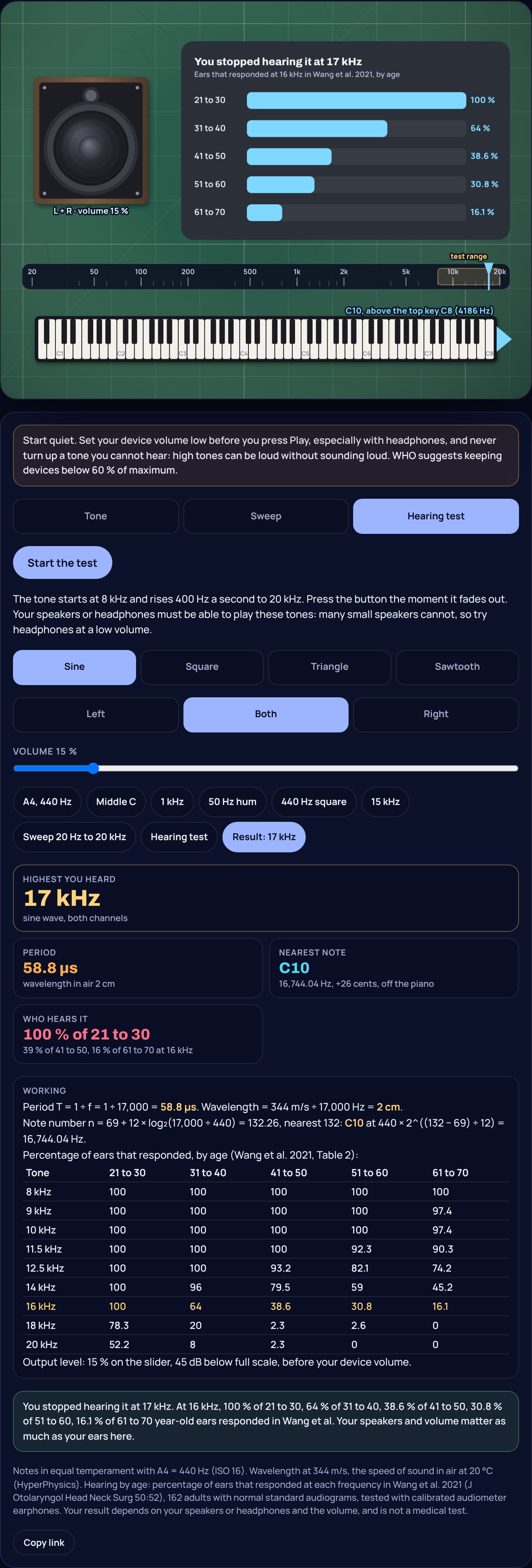
To try it yourself, open the tone generator, turn your device volume down, and start the hearing test. For more on how sound levels add up, read why 3 dB is double the power. For the speed of sound in other materials, see why sound travels faster in water, and for the link between frequency and wavelength in general, how to convert wavelength to frequency.
Sources
- Wang M, Ai Y, Han Y, Fan Z, Shi P, Wang H. Extended high-frequency audiometry in healthy adults with different age groups. Journal of Otolaryngology, Head and Neck Surgery, 2021, 50:52. doi:10.1186/s40463-021-00534-w (162 adults aged 21 to 70, Table 2 response rates from 8 to 20 kHz, thresholds at 16 kHz, HDA-200 earphones).
- HyperPhysics, Georgia State University, Sensitivity of Human Ear and Speed of Sound (audible range of roughly 20 Hz to 20 kHz, 344 m/s at 20 °C).
- HyperPhysics, Georgia State University, Equal Temperament (twelve equal semitones per octave).
- National Institute on Deafness and Other Communication Disorders, Age-Related Hearing Loss (Presbycusis), last updated March 17, 2023.
- World Health Organization, Deafness and hearing loss: Safe listening, questions and answers, March 2026 (80 dB for 40 hours a week, 90 dB for 4 hours, volume no more than 60 % of maximum).
- ISO 16:1975, Acoustics: Standard tuning frequency (standard musical pitch), A in the treble stave at 440 Hz.
Frequently asked questions
What is the highest frequency a human can hear?
About 20 kHz for a young adult with healthy ears, and less with age. In a 2021 study of 162 adults with normal standard hearing tests, 52.2 % of ears aged 21 to 30 responded at 20 kHz, 8 % at 31 to 40, and none at 51 to 60.
What frequency can only young people hear?
There is no sharp cut-off, but tones above about 16 kHz separate the age groups clearly. In the same study every ear aged 21 to 30 heard 16 kHz, against 64 % at 31 to 40, 38.6 % at 41 to 50 and 16.1 % at 61 to 70.
Why can I not hear high frequencies as I get older?
Age-related hearing loss, called presbycusis, comes mostly from gradual changes in the inner ear and usually affects both ears. It shows up first at the highest frequencies, which is why a standard test that stops at 8 kHz can look normal while the top octave is already going.
Is an online hearing test accurate?
Not as a medical test. Your result depends on your speakers or headphones, the sound card and the volume as much as on your ears, and many small speakers cannot play 18 kHz at all. Use it to compare ears or to track yourself on the same equipment, and see an audiologist about any concern.
Is it safe to play high-frequency tones through headphones?
At a low volume, yes. Start with the device volume low and never raise it to chase a tone you cannot hear, because a tone above your range can still be loud. WHO advises keeping the volume at no more than 60 % of the maximum.