How to Convert Wavelength to Frequency (With Examples)

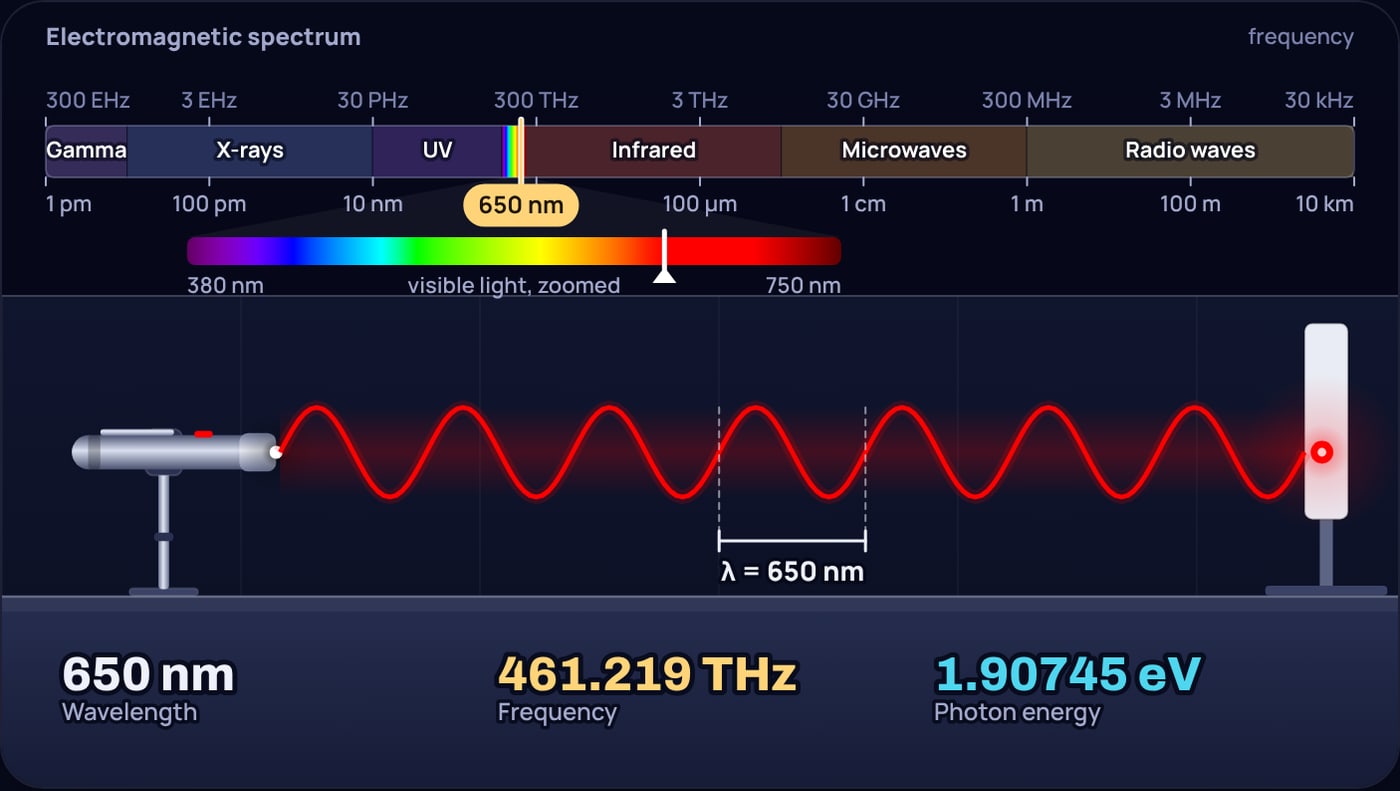
Pick up a cheap red laser pointer and read the label: 650 nm. That number is the distance from one crest of the light wave to the next, about a hundredth of the width of a human hair. The same light wave passes any point 461 million million times every second. Getting from the first number to the second takes one division, and almost every mistake people make with it is a unit slip, not physics.
This post shows the conversion step by step for light, radio and sound, with the unit handling written out in full. All the numbers here come from the wavelength and frequency calculator, which does wavelength, frequency, period and photon energy at once and marks where your wave sits on the spectrum.
What is the formula for wavelength and frequency?
A wave moves forward by one wavelength in the time it takes to make one full oscillation, its period . Speed is distance over time, so
where is the frequency in hertz (cycles per second). Rearranged, that gives the two conversions you actually use:
The only thing that changes between light, radio and sound is . Light and every other electromagnetic wave in vacuum travel at . That value is exact: since 1983 the metre has been defined from it, so there is no uncertainty to worry about. Sound is far slower and depends on what it is travelling through.
How do you convert wavelength to frequency for light?
Three steps: convert the wavelength to metres, divide 299,792,458 by it, and then pick a sensible prefix for the answer.
Example 1: a 650 nm red laser
One terahertz is Hz, so Hz is 461.219 THz. The period is the reciprocal, femtoseconds.
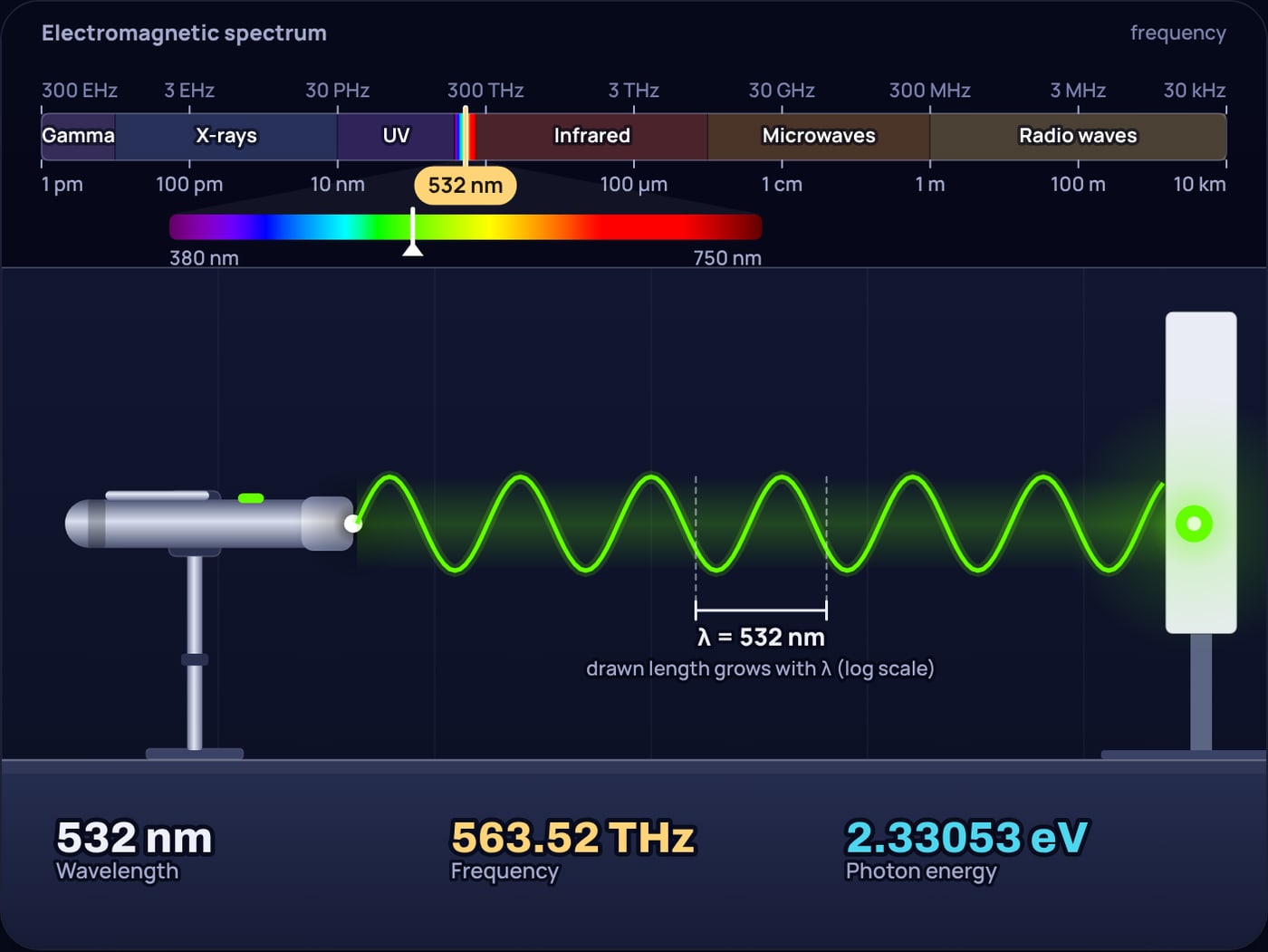
A green laser pointer at 532 nm works the same way: 299,792,458 ÷ (5.32 × 10⁻⁷) = 563.52 THz. Shorter wavelength, higher frequency. The two always move in opposite directions because their product is fixed at the wave speed.
How do you convert frequency to wavelength for radio?
Radio stations, Wi-Fi channels and microwave ovens are labelled by frequency, so you usually go the other way. Convert the frequency to hertz and divide it into the speed of light.
Example 2: an FM station at 100 MHz
A handy shortcut falls out of this: wavelength in metres is about 300 divided by the frequency in MHz. 300 ÷ 100 = 3 m. A quarter of that, about 75 cm, is why car FM aerials are the length they are; the quarter wave antenna guide works out how much shorter a real whip has to be.

Wi-Fi at 2.4 GHz: 299,792,458 ÷ (2.4 × 10⁹) = 0.124914 m, or 12.4914 cm. A microwave oven at 2.45 GHz is 12.2364 cm. They sit in the same band, which is why a leaky oven can upset 2.4 GHz Wi-Fi in the next room. That band was chosen for licensing reasons, not because water resonates there, as the microwave resonance myth post explains.

How do you convert wavelength and frequency for sound?
Same formula, different speed. Sound is a pressure wave in a material, and its speed depends on how stiff and how dense that material is. For dry air it depends mainly on temperature. The ideal gas result, with the constants used by the U.S. Standard Atmosphere 1976, is
with , , and in kelvin. It reproduces that standard's 340.294 m/s at 15 °C.
Example 3: the note A at 440 Hz, in air at 20 °C
At 0 °C the air is slower, 331.32 m/s, and the same note is 75.2997 cm long. A musician tuning by ear never notices, because the pitch you hear is the frequency, and that stays at 440 Hz.
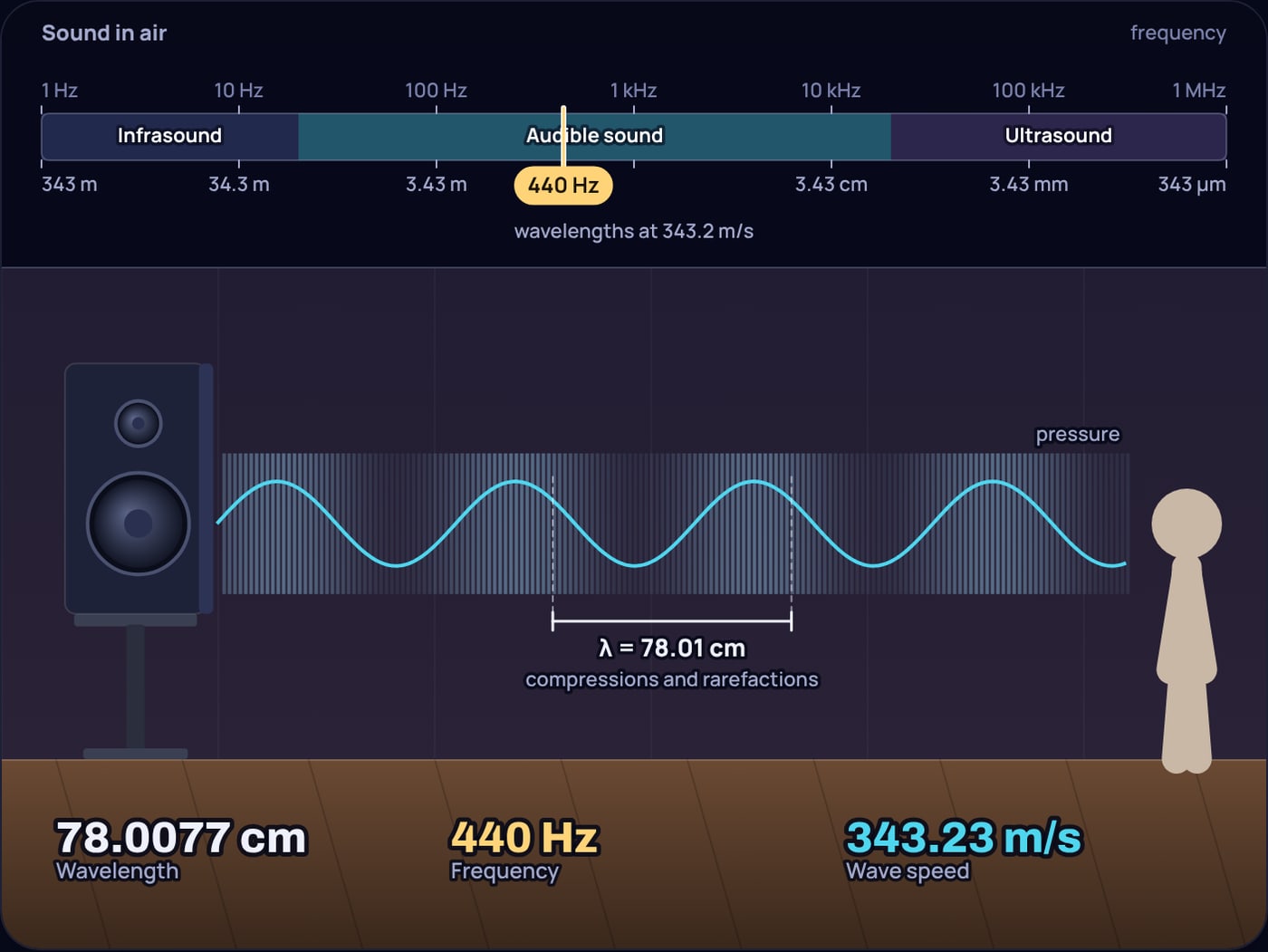
Underwater, sound is about 4.3 times faster: 1,482.38 m/s in pure water at 20 °C, from the Marczak equation that metrology labs use for pure water. A 440 Hz note there is 3.36904 m long. Sea water is faster again, because of the salt and pressure.
Common wavelengths and frequencies
Here is the spectrum in one table, every row computed with and . It spans roughly 18 powers of ten in frequency.
| Wave | Wavelength | Frequency | Photon energy |
|---|---|---|---|
| AM radio | 299.792 m | 1 MHz | 4.13567 × 10⁻⁹ eV |
| FM radio | 2.99792 m | 100 MHz | 4.13567 × 10⁻⁷ eV |
| Wi-Fi | 12.4914 cm | 2.4 GHz | 9.9256 × 10⁻⁶ eV |
| Thermal infrared | 10 µm | 29.9792 THz | 0.123984 eV |
| TV remote | 940 nm | 318.928 THz | 1.31898 eV |
| Red laser | 650 nm | 461.219 THz | 1.90745 eV |
| Green laser | 532 nm | 563.52 THz | 2.33053 eV |
| UVC lamp | 254 nm | 1.18029 PHz | 4.88127 eV |
| X-ray | 0.1 nm | 2.99792 EHz | 12.3984 keV |
| Gamma ray | 1 pm | 299.792 EHz | 1.23984 MeV |
Visible light is the narrow strip from about 380 nm to 750 nm, which is 789 THz down to 400 THz. On a log scale covering the whole spectrum it is barely a sliver, which the calculator makes plain with its zoomed bar. Where a colour sits in that strip is what decides, for example, what colour the Sun really is and why auroras glow green and red.
How do you get photon energy from wavelength?
Light comes in photons, and each one carries an energy set by its frequency through Planck's constant, J s, exact since the 2019 redefinition of the SI:
Example 4: photon energy of the 650 nm laser
The shortcut most physicists carry around: . 1239.84 ÷ 650 = 1.90745 eV.
Photon energy is what decides whether light can do chemistry. Red and green photons, at 2 eV or so, can excite the pigments in your eye. Ultraviolet at 254 nm carries 4.9 eV, enough to break bonds in DNA, which is why that wavelength is used for germicidal lamps. A 100 MHz radio photon carries 4 × 10⁻⁷ eV, millions of times too little to break anything, however powerful the transmitter.
Does the frequency change in water or glass?
No, and this is the most common misconception about the formula. When light enters glass or water it slows down, by the refractive index . The frequency stays the same because it is set by the source: the wave crests arrive at the boundary at a fixed rate, and they cannot pile up or vanish there. So the wavelength must shrink instead:
Red 650 nm light in water () is about 489 nm long, the vacuum wavelength of blue light, yet a red laser still looks red underwater. Colour follows frequency, not wavelength. That is why laser and LED wavelengths are quoted in vacuum (or in air, which changes only the fourth significant figure).
What are the usual unit traps?
Nearly every wrong answer comes from one of these:
- Prefixes: nano is , micro , milli ; kilo, mega, giga and tera are , , and . 650 nm is m, not m.
- Using c for sound: 299,792,458 m/s is only for electromagnetic waves. A 440 Hz tone with c gives 681 km, a radio wavelength.
- Angular frequency: some textbooks use in radians per second. If a result is off by 6.28, that is why.
- Rounding noise: a computer multiplying 650 by 0.000000001 gets 6.500000000000001 × 10⁻⁷. The calculator applies prefixes in decimal and rounds to 6 significant figures, so it prints clean numbers.
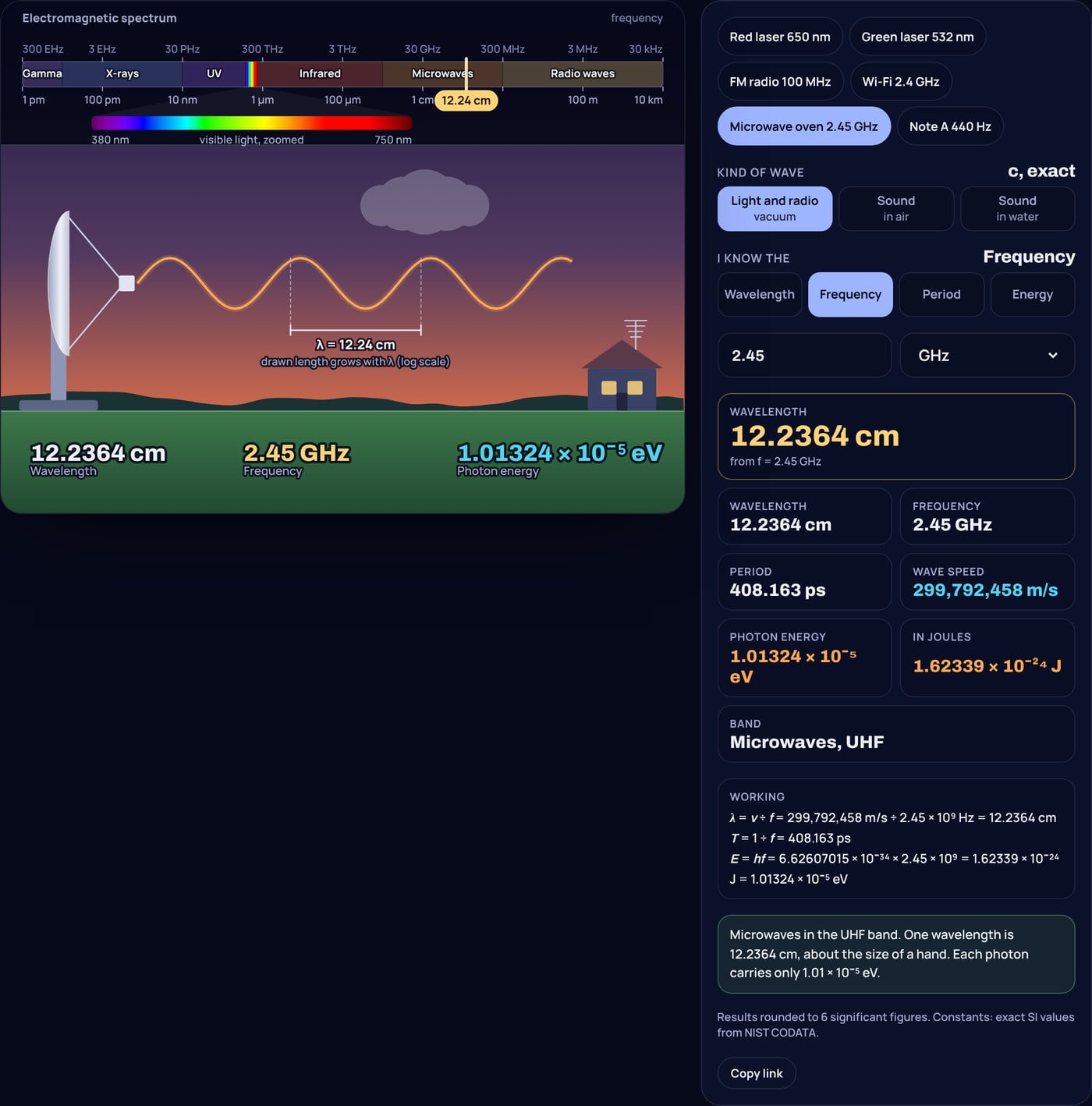
To check your own homework, open the calculator with the 532 nm green laser, press Period, and watch it convert the same wave to 1.77456 femtoseconds; then switch to Sound in water and type your own frequency.
Sources
- NIST CODATA, speed of light in vacuum: physics.nist.gov/cgi-bin/cuu/Value?c
- NIST CODATA, Planck constant: physics.nist.gov/cgi-bin/cuu/Value?h
- NIST CODATA, elementary charge: physics.nist.gov/cgi-bin/cuu/Value?e
- U.S. Standard Atmosphere 1976 constants and sea-level speed of sound, as implemented by Public Domain Aeronautical Software: pdas.com/programs/atmos76.f90
- Marczak (1997), J. Acoust. Soc. Am. 102(5) 2776, pure water sound speed coefficients: SonarDocs, Marczak equation and sonar package reference
Frequently asked questions
What is the formula to convert wavelength to frequency?
Frequency equals wave speed divided by wavelength, f = v / λ. For light and radio in vacuum the speed is c = 299,792,458 m/s exactly. Put the wavelength in metres and the answer comes out in hertz.
What is the frequency of 500 nm light?
299,792,458 divided by 0.0000005 m is 599.585 THz, or about 6.0 × 10^14 Hz. Each photon of 500 nm light carries 2.48 eV.
How do you convert frequency to wavelength for sound?
Divide the speed of sound by the frequency. In dry air at 20 °C sound travels at 343.23 m/s, so a 440 Hz note has a wavelength of 343.23 / 440 = 78.0 cm. In water at 20 °C the speed is 1,482.4 m/s and the same note is 3.37 m long.
Does frequency change when light goes into water or glass?
No. The frequency is fixed by the source. The light slows down in the material, so its wavelength shrinks by the same factor, the refractive index. Red 650 nm light is about 489 nm long inside water but it is still red and still 461 THz.
Why do I get the wrong answer by a factor of a billion?
Almost always a unit slip. Nanometres must be multiplied by 10^-9 to get metres, and megahertz by 10^6 to get hertz. 650 nm is 6.5 × 10^-7 m, not 650 m and not 6.5 × 10^-9 m.