How do you convert wavelength to frequency?
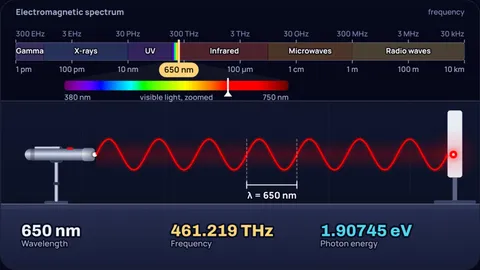
Divide the wave's speed by its wavelength. For light and radio in vacuum the speed is exactly 299,792,458 m/s, so a 650 nm red laser has a frequency of 299,792,458 ÷ 0.000000650 = 461.219 THz, and a 100 MHz FM station has a wavelength of 2.99792 m. Going the other way, divide the speed by the frequency. For sound, use the speed of sound instead: about 343.23 m/s in air at 20 °C, so concert A at 440 Hz is 78.0077 cm long.
The calculator does all four quantities at once (wavelength, frequency, period and photon energy) and shows the working with the numbers substituted. Every result is rounded in decimal to 6 significant figures, so you never see float noise like 0.30000000000000004. For the method with worked examples, read how to convert wavelength to frequency.
Key results from the calculator
- Visible light runs from about 380 nm (violet, 788.928 THz) to 750 nm (red, 399.723 THz). That is less than one doubling of frequency out of the roughly 16 powers of ten the spectrum bar covers.
- Photon energy in eV is 1,239.84 divided by the wavelength in nm: 1.90745 eV for 650 nm red and 2.33053 eV for 532 nm green.
- Wi-Fi at 2.4 GHz has a 12.4914 cm wavelength and the microwave oven's 2.45 GHz is 12.2364 cm: the same band, about the width of your hand.
- Sound is slow, so audible wavelengths are human-sized: 440 Hz is 78.0077 cm in air at 20 °C, 75.2997 cm at 0 °C, and 3.36904 m in water.
Six waves people look up
Each one loads in the calculator with a button. The numbers below are what it shows.
A red laser pointer at 650 nm
Visible lightCheap red laser pointers use diode lasers between about 635 and 670 nm; 650 nm is the common figure on the label. Its frequency is 299,792,458 ÷ (650 × 10⁻⁹) = 461.219 THz, so the light field swings back and forth once every 2.16817 fs.
Each photon carries 1.90745 eV (3.05607 × 10⁻¹⁹ J). That is the number that matters for anything chemical: it is enough to excite the pigments in your cone cells, but far below the roughly 10 eV it takes to ionise atoms.
A green laser pointer at 532 nm
Visible lightGreen pointers usually make 1064 nm infrared light in a crystal laser and then double its frequency in a second crystal, which halves the wavelength to 532 nm. The calculator gives 563.52 THz, exactly twice the frequency of 1064 nm light (281.76 THz).
Its photons carry 2.33053 eV, more than red because the wavelength is shorter. Green also looks far brighter than red at the same power, because the eye is most sensitive near 555 nm.
An FM radio station at 100 MHz
Radio, VHFFM broadcasting sits between 87.5 and 108 MHz in most countries. At 100 MHz the wavelength is 299,792,458 ÷ 100,000,000 = 2.99792 m, about the height of a ceiling. That is why a car's FM whip is roughly 75 cm, a quarter of a wavelength.
Each radio photon carries only 4.13567 × 10⁻⁷ eV, more than four million times less than a red photon, which is why radio waves cannot break chemical bonds however strong the transmitter is. The quarter wave antenna guide works out the antenna lengths in detail.
Wi-Fi at 2.4 GHz
Microwaves, UHFThe 2.4 GHz Wi-Fi band runs from about 2.4 to 2.4835 GHz. At 2.4 GHz the wavelength is 12.4914 cm, and the period is 416.667 ps. The 5 GHz band has wavelengths near 6 cm, which is part of why it gets through walls less well.
By the ITU band names this is still UHF (300 MHz to 3 GHz), while by the usual spectrum diagram it counts as a microwave, because microwaves are conventionally the 1 mm to 1 m range. Both labels are correct: band edges are naming conventions, not physics.
A microwave oven at 2.45 GHz
MicrowavesDomestic microwave ovens run at 2.45 GHz, a band set aside for industrial and household heating. The wavelength is 12.2364 cm. Standing waves in the box put hot spots about half a wavelength apart, roughly 6.12 cm, which is why ovens have turntables.
2.45 GHz is not a special resonance of water: water absorbs microwaves over a very wide range of frequencies. The microwave oven resonance myth explains why this frequency was chosen.
The note A at 440 Hz in air
Sound in airA4, the A above middle C, is tuned to 440 Hz. Sound in dry air at 20 °C travels at 343.23 m/s, so the wavelength is 343.23 ÷ 440 = 78.0077 cm. At 0 °C the air is slower (331.32 m/s) and the same note is 75.2997 cm long.
Underwater the speed is 1,482.38 m/s at 20 °C, so 440 Hz stretches to 3.36904 m. The pitch does not change between media; the frequency is set by the source, and only the wavelength adjusts to the speed.
Wavelength, frequency and photon energy across the spectrum
| Wave | Wavelength | Frequency | Photon energy | Band |
|---|---|---|---|---|
| AM radio | 299.792 m | 1 MHz | 4.13567 × 10⁻⁹ eV | Radio waves, MF |
| FM radio | 2.99792 m | 100 MHz | 4.13567 × 10⁻⁷ eV | Radio waves, VHF |
| Wi-Fi | 12.4914 cm | 2.4 GHz | 9.9256 × 10⁻⁶ eV | Microwaves, UHF |
| Microwave oven | 12.2364 cm | 2.45 GHz | 1.01324 × 10⁻⁵ eV | Microwaves, UHF |
| Thermal infrared | 10 µm | 29.9792 THz | 0.123984 eV | Infrared, thermal infrared |
| TV remote | 940 nm | 318.928 THz | 1.31898 eV | Infrared, near infrared |
| Red laser | 650 nm | 461.219 THz | 1.90745 eV | Visible light, red |
| Green laser | 532 nm | 563.52 THz | 2.33053 eV | Visible light, green |
| Violet edge of vision | 380 nm | 788.928 THz | 3.26274 eV | Visible light, violet |
| UVC germicidal lamp | 254 nm | 1.18029 PHz | 4.88127 eV | Ultraviolet, UVC |
| X-ray, 0.1 nm | 100 pm | 2.99792 EHz | 12.3984 keV | X-rays |
| Gamma ray, 1 pm | 1 pm | 299.792 EHz | 1.23984 MeV | Gamma rays |
Light and radio in vacuum, rounded to 6 significant figures. In air the wavelength of light is shorter by the refractive index, about 1.0003, so a 650 nm vacuum wavelength is about 649.8 nm in air. Band edges are conventions: neighbouring bands overlap in practice.
How the calculator works
A wave moves one wavelength in one period, so its speed is v = λ × f. The calculator takes whichever of wavelength, frequency, period (T = 1 ÷ f) or photon energy (E = h × f) you type, converts it to a frequency, then works out the rest.
For light and radio it uses c = 299,792,458 m/s, the speed of light in vacuum, which has been exact by definition since 1983. Planck's constant h = 6.62607015 × 10⁻³⁴ J s and the electronvolt, 1.602176634 × 10⁻¹⁹ J, have been exact since the 2019 SI revision. All three are taken from NIST's CODATA tables.
For sound in air it uses the ideal gas speed v = √(γRT ÷ M) with the constants of the U.S. Standard Atmosphere 1976 (γ = 1.4, M = 28.9644 kg/kmol), which gives 343.23 m/s at 20 °C. For water it uses the Marczak (1997) equation for pure water at atmospheric pressure, valid from 0 to 95 °C, which gives 1,482.38 m/s at 20 °C.
Unit prefixes are applied in decimal (650 nm becomes 6.5 × 10⁻⁷ m exactly, not 6.500000000000001 × 10⁻⁷), and every result is rounded to 6 significant figures before it is printed.
What the model leaves out
- Light in materials: light slows down in glass and water (by the refractive index, about 1.5 and 1.33), which shortens the wavelength. The calculator works in vacuum; air changes the third decimal place at most.
- Humidity and pressure in air: the sound speed is for dry air. Humid air is slightly faster, by a few tenths of a percent at room temperature. Pressure alone has almost no effect.
- Sea water: salt raises the speed of sound to about 1,450 to 1,570 m/s depending on temperature, salinity and depth. The calculator uses pure water.
- Colours on screen: a monitor cannot display pure spectral colours, so the drawn colour is the nearest displayable look, not a colourimetric measurement.
Common misconceptions
"Frequency changes when light enters glass." It does not. The frequency is set by the source; the speed and wavelength drop together. That is why the colour of a laser does not change underwater.
"Higher frequency radio waves are more dangerous because they carry more energy." Each photon carries more energy, but even 5 GHz Wi-Fi photons hold about 20 micro electronvolts, roughly a hundred thousand times too little to break a chemical bond. Heating depends on power, not on photon energy.
"Microwave ovens work at the resonant frequency of water." Water absorbs strongly across a wide range; 2.45 GHz is a licensing choice that balances absorption against how deep the waves reach into food.
Frequently asked questions
How do you convert wavelength to frequency?
Divide the wave speed by the wavelength: f = v ÷ λ. For light, v = 299,792,458 m/s, so 650 nm gives 461.219 THz. Convert the wavelength to metres first, then the answer is in hertz.
How do you convert frequency to wavelength?
Divide the wave speed by the frequency: λ = v ÷ f. For a 100 MHz radio wave, 299,792,458 ÷ 100,000,000 = 2.99792 m. For sound at 440 Hz in air at 20 °C, 343.23 ÷ 440 = 78.0077 cm.
How do you find photon energy from wavelength?
Use E = hc ÷ λ. In convenient units, E in electronvolts is 1,239.84 divided by the wavelength in nanometres, so 650 nm red light is 1.90745 eV and 532 nm green is 2.33053 eV. Multiply eV by 1.602176634 × 10⁻¹⁹ to get joules.
What is the frequency of visible light?
From about 399.723 THz at the red end (750 nm) to about 788.928 THz at the violet end (380 nm). The edges vary a little from person to person.
Why is the wavelength of sound so much longer than light?
Because sound is almost a million times slower. At the same frequency, wavelength is proportional to speed: 343.23 m/s for sound in air against 299,792,458 m/s for light. Audible sound runs from about 17 m (20 Hz) down to about 1.7 cm (20 kHz).
Keep learning
How to Convert Wavelength to Frequency (With Examples)
Convert wavelength to frequency with f = v/λ: worked examples for a red laser, FM radio, Wi-Fi and a 440 Hz note, plus photon energy and the unit traps.

Quarter Wave Antenna Length: 234/f, 246/f and Why
A quarter wave is 246/f feet (74.95/f m), but a resonant whip is 2 to 7% shorter, depending on wire thickness. Worked 433 MHz and 2.4 GHz lengths.
Do Microwaves Resonate With Water? No, and Here's Why
2.45 GHz is not water's resonant frequency. We plot water's dielectric loss, compute penetration depth, show why ice won't heat and why WiFi is harmless.

What Color Is the Sun Really? White, and Here's Why
The Sun is white: a 5772 K spectrum excites all three cone types almost equally. Why it peaks near green but never looks green, and why it turns orange.

Why Are Auroras Different Colors? Green, Red and Purple
Green and red auroras come from the same oxygen atom. A 0.75 s vs 134 s lifetime and air density decide which colour wins. The physics, with worked numbers.