Why 3 dB Is Double the Power (and 6 dB Double the Voltage)
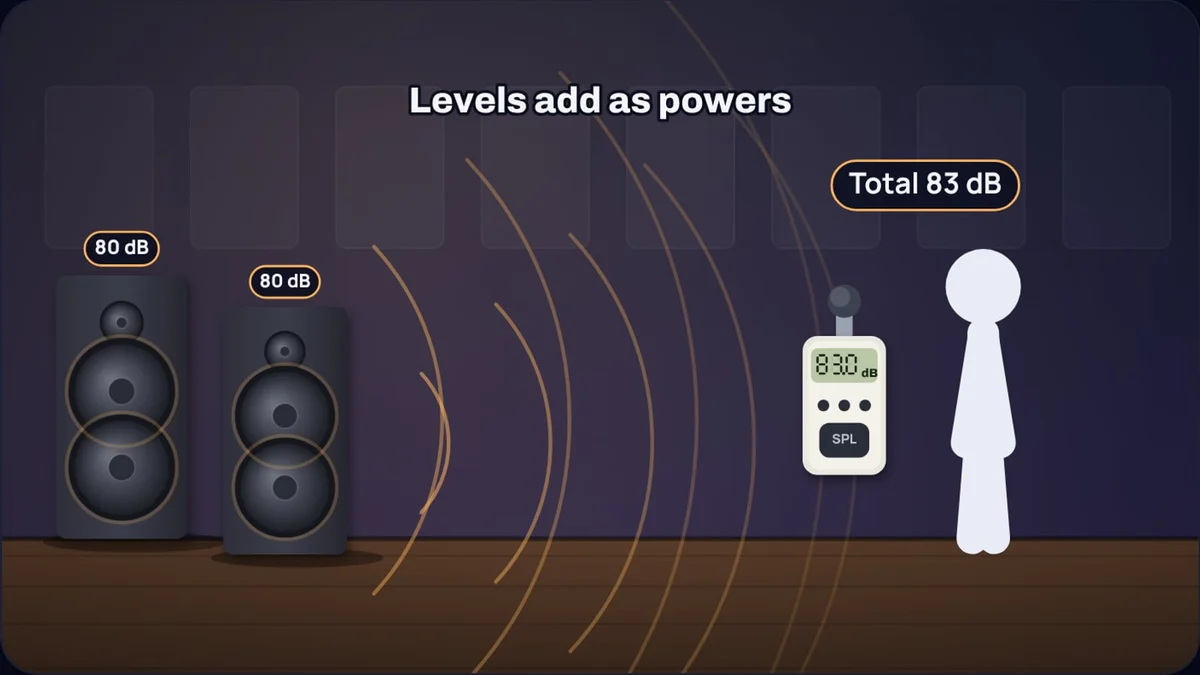
Put two identical loudspeakers side by side, play a different recording through each, and hold a sound level meter where each one alone read 80 dB. The meter does not show 160 dB. It shows 83. Turn one speaker up until its own reading doubles in the electrical sense, twice the amplifier power, and it rises by the same 3 dB. Double the voltage instead and the reading goes up by 6. These numbers look arbitrary until you see that every one of them is the same logarithm.
This guide shows where 3 dB comes from, why voltage gets 20 log where power gets 10 log, and how the same rule adds sound levels, converts dBm to watts and predicts how quickly a sound fades with distance. Our decibel calculator does each of these in one step.
What is a decibel, exactly?
The decibel is a way of writing ratios as logarithms. ITU-R Recommendation V.574 defines the bel as "the ratio of two powers by the decimal logarithm of this ratio", and the decibel as one tenth of a bel. A factor of 10 in power is 1 bel, or 10 dB. NIST's Guide for the Use of the SI states the same thing as a formula for a level of a power quantity:
Because it is a logarithm, multiplying powers turns into adding decibels. Two amplifiers of 10 dB each in a row give 20 dB, a factor of 100. A cable that loses 3 dB and an amplifier that gains 13 dB net out at 10 dB. That bookkeeping is the whole reason engineers use decibels.
Why is 3 dB double the power?
Put a ratio of 2 into the formula:
Example 1: doubling the power
Going back the other way:
So "3 dB" is a rounding. The exact doubling is 3.0103 dB, and 3 dB itself is a power ratio of 1.995, within a quarter of a percent of 2. The difference rarely matters in practice, so 3 dB and "double" have become interchangeable.
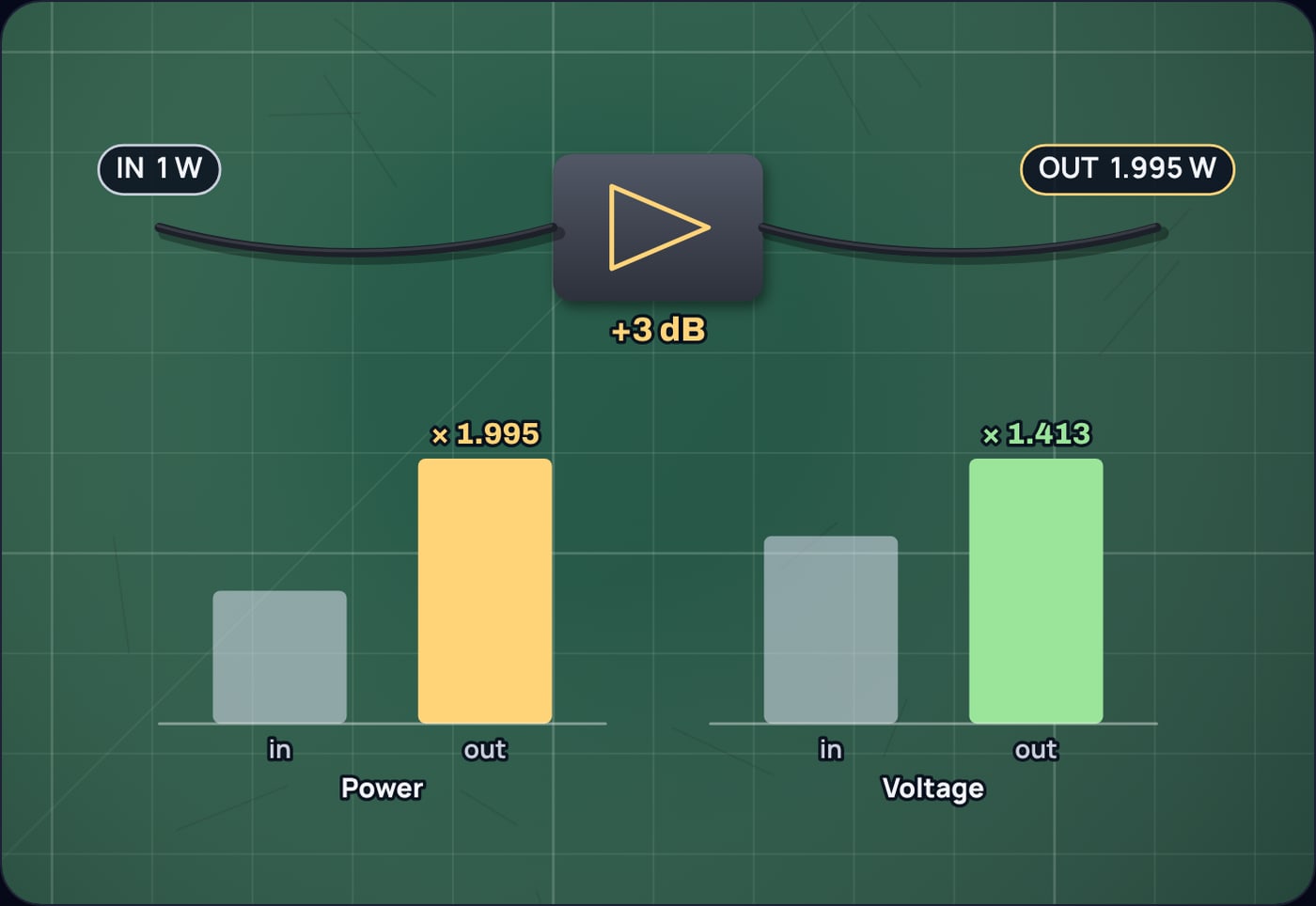
The same arithmetic runs in reverse. Half the power is 10 log10(0.5) = −3.01 dB, which is why the edge of a filter's passband is called both the −3 dB point and the half-power point. Our guide to the RC low-pass filter cutoff works through that case.
A handful of other values are worth knowing by heart, because everything else can be built from them by adding:
| dB | Power ratio | Voltage ratio |
|---|---|---|
| +1 | 1.26 | 1.122 |
| +3 | 2.00 | 1.413 |
| +6 | 3.98 | 1.995 |
| +10 | 10 | 3.162 |
| +20 | 100 | 10 |
| −3 | 0.501 | 0.708 |
| −10 | 0.1 | 0.316 |
13 dB, for example, is 10 dB plus 3 dB: ten times two, a factor of 20 in power.
Why does voltage use 20 log?
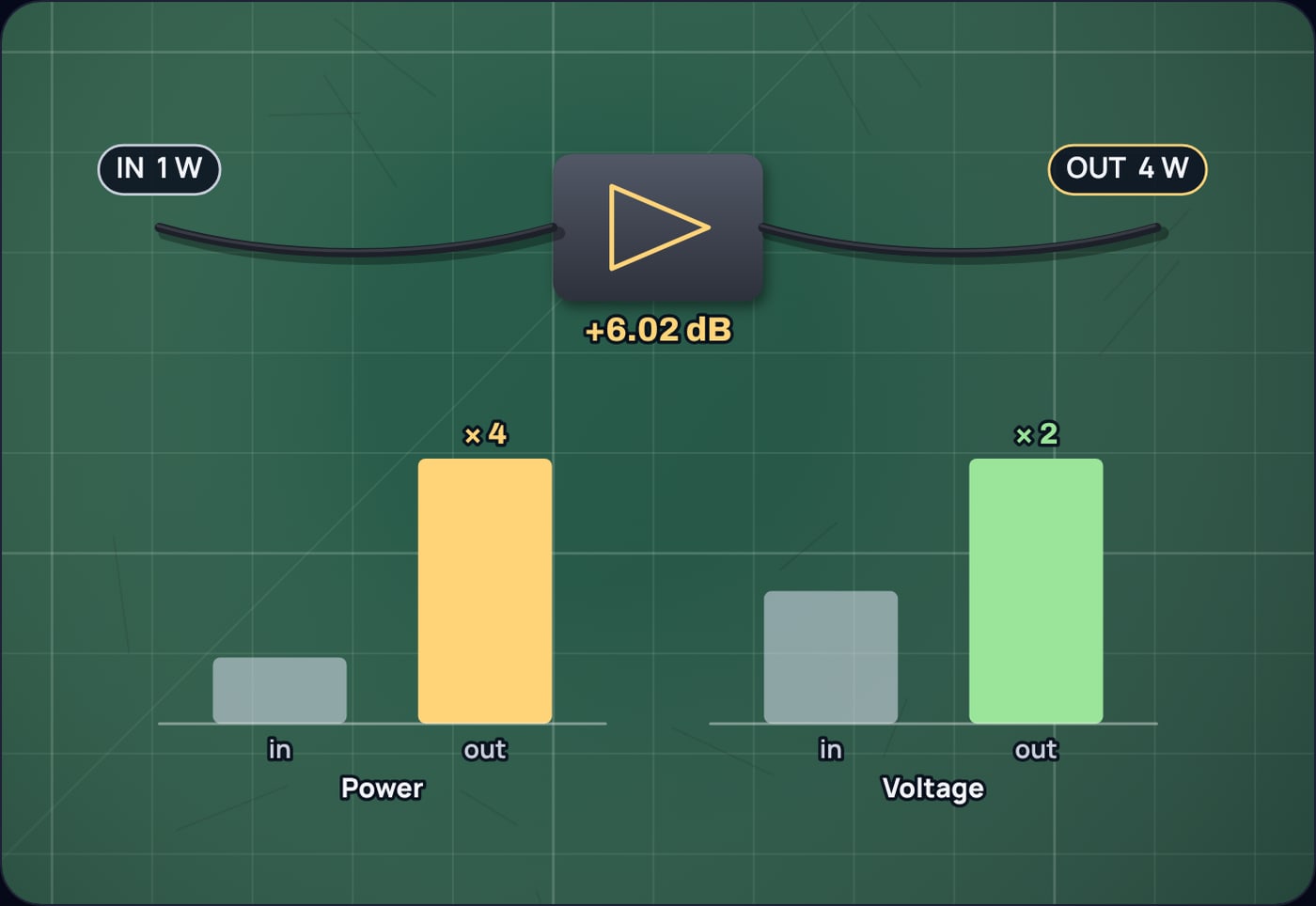
Voltage is not power. Across a resistance R, the power is , so a voltage ratio has to be squared before it becomes a power ratio. Squaring inside a logarithm becomes a factor of 2 outside it:
ITU-R V.574 gives the same rule for "field quantities, such as voltage, current, sound pressure, electric field", whose squares are proportional to power: multiply the logarithm by 20, "assuming that the impedances are equal". That condition matters. If the two voltages sit across different resistances, the ratio of voltages no longer tells you the ratio of powers, and the 20 log figure is not a power level.
Example 2: doubling the voltage
So 6 dB is double the voltage and four times the power. Both statements describe the same change, which is why decibels avoid the "do you mean voltage or power" confusion: the dB figure is the same either way.
Why do two 80 dB speakers make 83 dB?
A sound level is a decibel figure for sound pressure, , with a reference pressure that ITU-R V.574 gives as "often 20 µPa". Like voltage, pressure squared is proportional to power, so 20 log of pressure is the same number as 10 log of acoustic power.
Two unrelated sources, such as two machines or two speakers playing different material, do not add their pressures wave by wave in a fixed way; on average their powers add. So you convert each level back to a power ratio, add, and take the logarithm again:
Example 3: two 80 dB sources
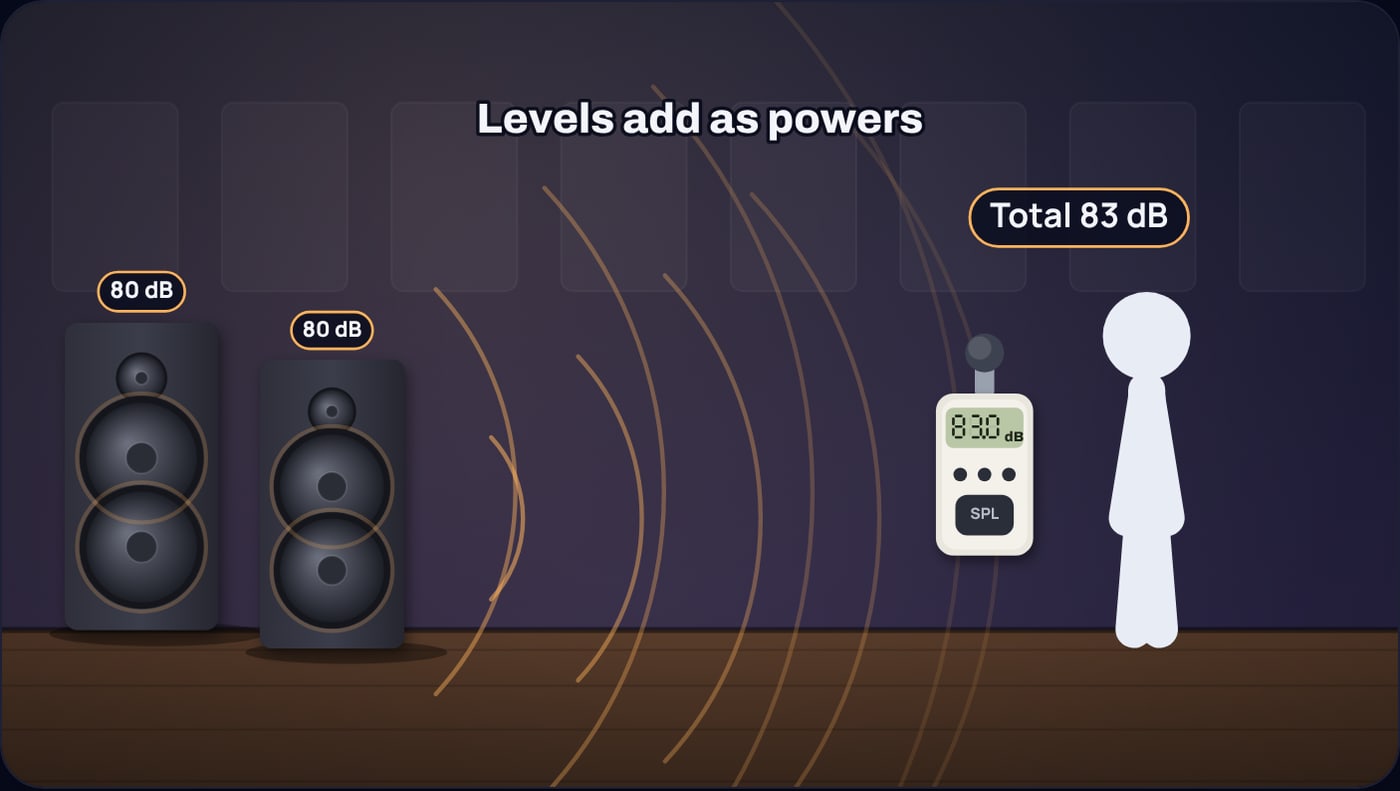
The same rule says that four equal sources add 6 dB and ten add 10 dB. Four machines at 85 dB each make 91.0 dB together.
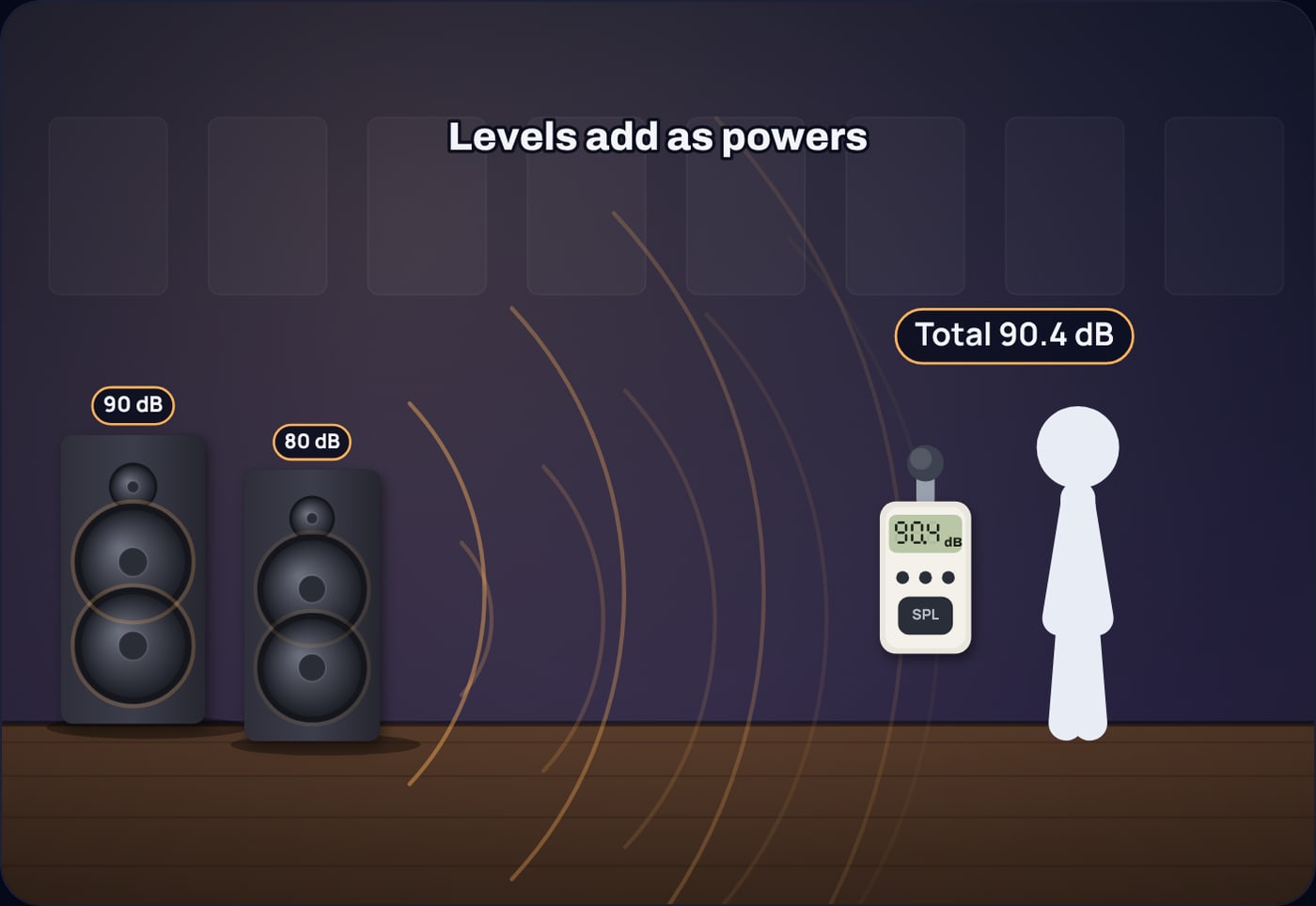
It also says that a much quieter source hardly counts. An 80 dB source next to a 90 dB one carries a tenth of the power, and the pair make 90.41 dB. Switching off the quieter one changes the reading by less than half a decibel. When you are trying to make a noisy room quieter, the loudest source is the only one worth chasing first.
One caution. Two speakers playing the same signal are not unrelated. Where their waves arrive in step the pressures add, which can give up to 6 dB; where they arrive out of step they cancel. That is the principle behind noise cancelling headphones, and it is why the 3 dB rule is stated for unrelated sources.
How fast does sound fade with distance?
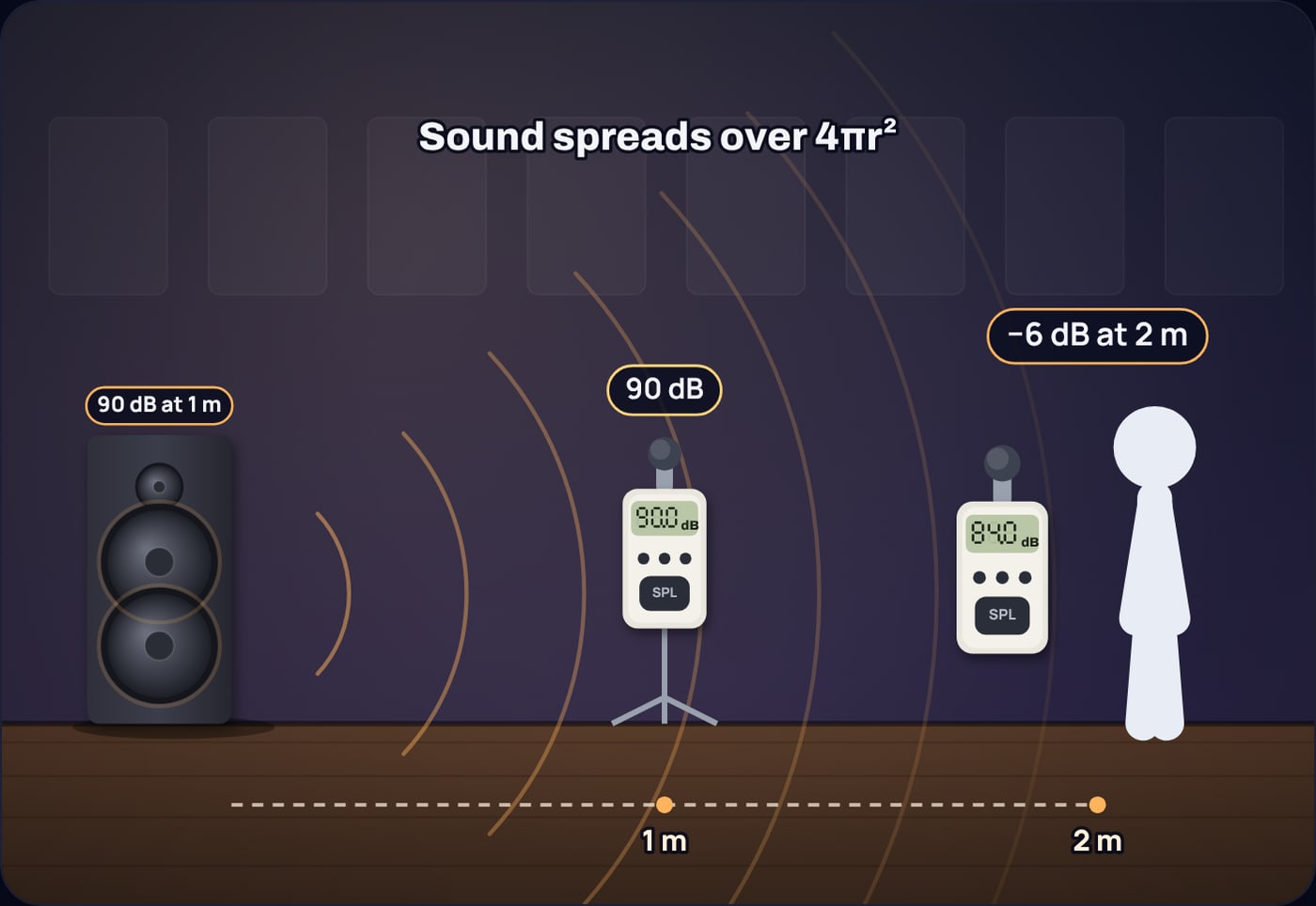
Here the factor of 2 inside the logarithm appears again. HyperPhysics puts it simply: the intensity from a point source obeys the inverse square law "if there are no reflections or reverberation". The same acoustic power spreads over a sphere of area , so doubling the distance spreads it over four times the area:
Example 4: twice as far from a 90 dB source
Ten times the distance is 20 log10(10) = 20 dB less, so 100 dB at 1 m is 80 dB at 10 m outdoors. Indoors the walls send sound back, and far from the source the level stops falling at this rate.
What about dBm, dBW, dBV and dBu?
A decibel figure on its own is only a ratio. To state an absolute amount you fix the denominator, and the letters after "dB" tell you what it is. NIST asks for the reference to be given with every level; the short names below are the ones ITU-R V.574 lists.
- dBm: power relative to 1 milliwatt. 0 dBm is 1 mW, 20 dBm is 100 mW, 30 dBm is 1 W.
- dBW: power relative to 1 watt. 30 dBm is 0 dBW.
- dBV: rms voltage relative to 1 volt.
- dBu: rms voltage relative to 0.775 V, which ITU-R V.574 explains is the voltage that dissipates 1 milliwatt in 600 ohms. More exactly it is √0.6 = 0.7746 V.
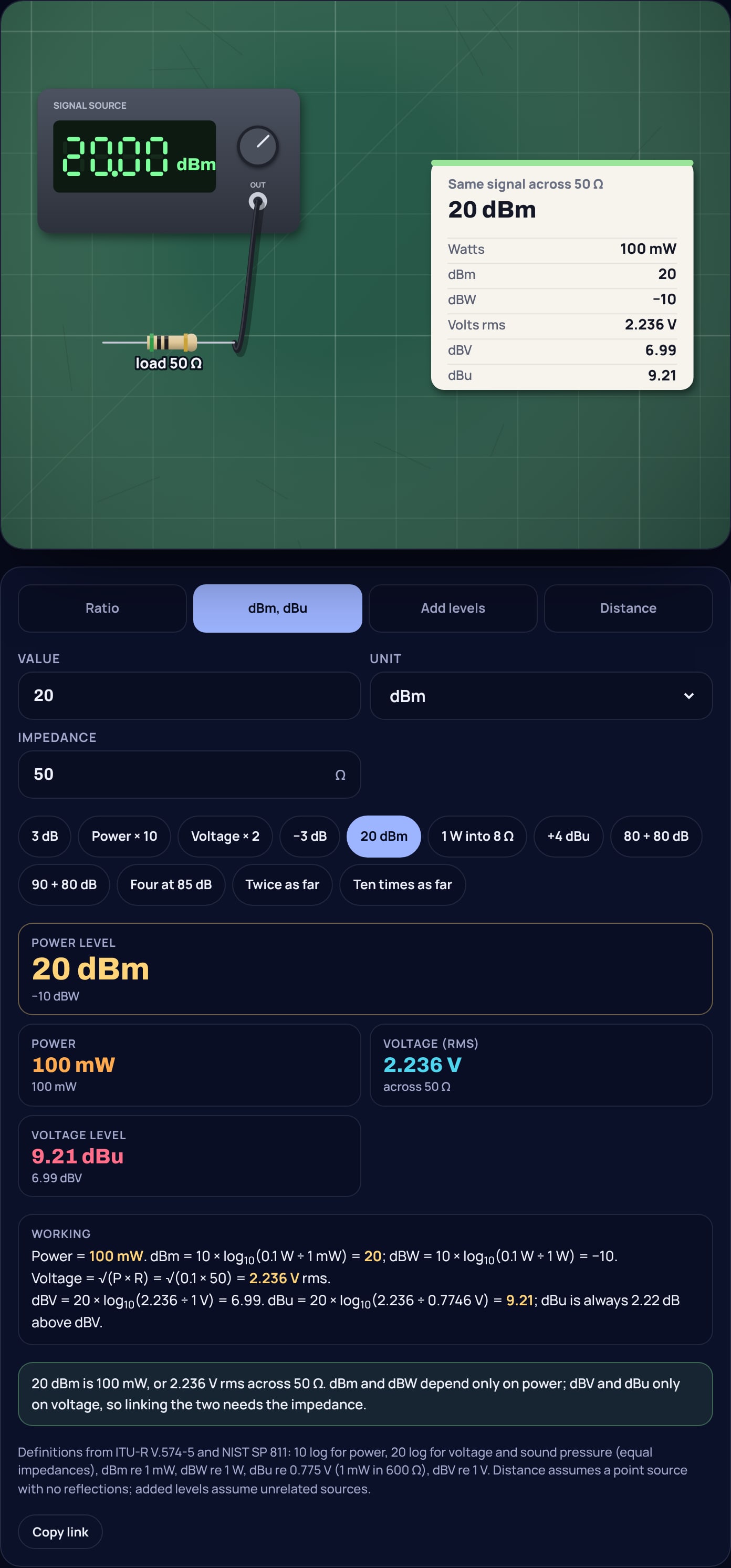
Example 5: 20 dBm across 50 Ω
dBm is a power and dBu is a voltage, so turning one into the other needs the impedance. Across 600 Ω they happen to match, which is where the 0.775 V came from. Between the two voltage scales the gap is fixed: 20 log10(1 / 0.7746) = 2.22 dB, so any voltage reads 2.22 dB higher in dBu than in dBV.
Is 3 dB twice as loud?
No, and this is the most common mix-up. 3 dB is twice the power, a physical quantity a meter can measure. How loud a sound seems is a question about hearing, not about physics, and a power ratio does not answer it. The decibel was built for physics and engineering bookkeeping, and it does that job exactly; this guide and the calculator stay on that side of the line.
The same caution applies to amplifier gain. An op amp stage with a voltage gain of 10 is a 20 dB stage, as our inverting vs non-inverting amplifier guide shows, because 20 log10(10) = 20. The power gain into the same load is 100, also 20 dB. That is the convenience of decibels: once the impedance is fixed, one number covers both.
Try it
The decibel calculator converts any dB figure to power and voltage ratios and back, translates between watts, dBm, dBW, volts, dBV and dBu for a given impedance, adds up to four sound levels, and works out the level at a new distance. Each mode shows the working, so you can see the same 10 log and 20 log doing all the jobs above.
Sources
- ITU-R Recommendation V.574-5 (08/2015), Use of the decibel and the neper in telecommunications (definition of the bel and decibel, 10 lg for power and 20 lg for field quantities with equal impedances, dBW and dBm, dBu relative to 0.775 V from 1 mW in 600 Ω, sound pressure level with a 20 µPa reference): itu.int/rec/R-REC-V.574
- NIST Special Publication 811 (2008 edition), Guide for the Use of the International System of Units, section 8.7, Logarithmic quantities and units: level, neper, bel: nist.gov/pml/special-publication-811
- R. Nave, HyperPhysics, Georgia State University, Inverse Square Law for Sound: hyperphysics.phy-astr.gsu.edu
Frequently asked questions
Why is 3 dB double the power?
A decibel level is 10 times the base-10 logarithm of a power ratio. Doubling the power is a ratio of 2, and 10 × log10(2) = 3.0103, which everyone rounds to 3 dB. Going the other way, 10^(3/10) = 1.995, within a quarter of a percent of 2.
Why is doubling the voltage 6 dB and not 3 dB?
Power goes with the square of voltage across the same resistance, so doubling the voltage quadruples the power. 10 × log10(4) = 6.02 dB. The shortcut is 20 × log10 of the voltage ratio, which ITU-R V.574 gives for field quantities such as voltage, current and sound pressure, assuming the impedances are equal.
What do two 80 dB speakers add up to?
About 83 dB, if they play unrelated sound. Each level stands for a power; two equal powers make twice the power, which is 3.01 dB more. Ten speakers at 80 dB make 90 dB.
How many dB is half the power?
Minus 3 dB, more exactly −3.01 dB. At −3 dB the voltage is 0.708 of the original, which is why the −3 dB point of a filter is also called the half-power point.
What is the difference between dB, dBm and dBu?
dB on its own is a ratio between two things. dBm is a level relative to 1 milliwatt, dBW relative to 1 watt, dBV relative to 1 volt rms, and dBu relative to 0.775 V rms, the voltage that puts 1 mW into 600 Ω.