How to Read SMD Resistor Codes (EIA-96 Explained)
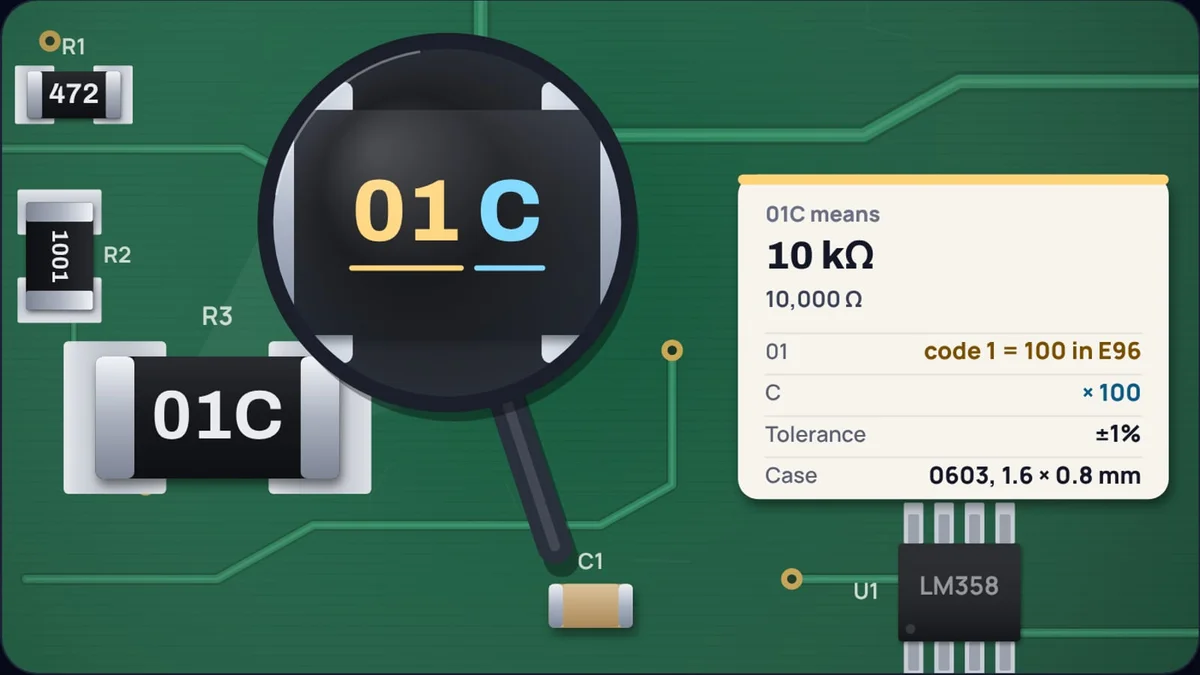
Three resistors on the same board read 103, 1002 and 01C. They are all 10 kΩ. The first is a ±5% part, the second a ±1% part in an 0805 case, and the third a ±1% part in the smaller 0603 case, where there was only room for three characters. Same value, three codes, because the code style depends on the tolerance and on how much space the part has.
Once you can tell the styles apart, every one of them takes a few seconds to read. This guide walks through each, with the examples manufacturers print in their own datasheets. Our SMD resistor code calculator reads them all, includes the full EIA-96 table and works backwards from a value to its code.
How do you read a three-digit code?
The first two digits are the significant figures and the last one is how many zeros to write after them. The result is in ohms:
Example 1: 103 and 472
Two significant figures are enough for the E24 series, the 24 values per decade (10, 11, 12, 13, 15 and so on up to 91) that ±5% resistors come in. That is why YAGEO's RC series datasheet specifies three digits for its 5% parts. Vishay's marking guide lists the range of the style: 100 for 10 Ω up to 917 for 910 MΩ.
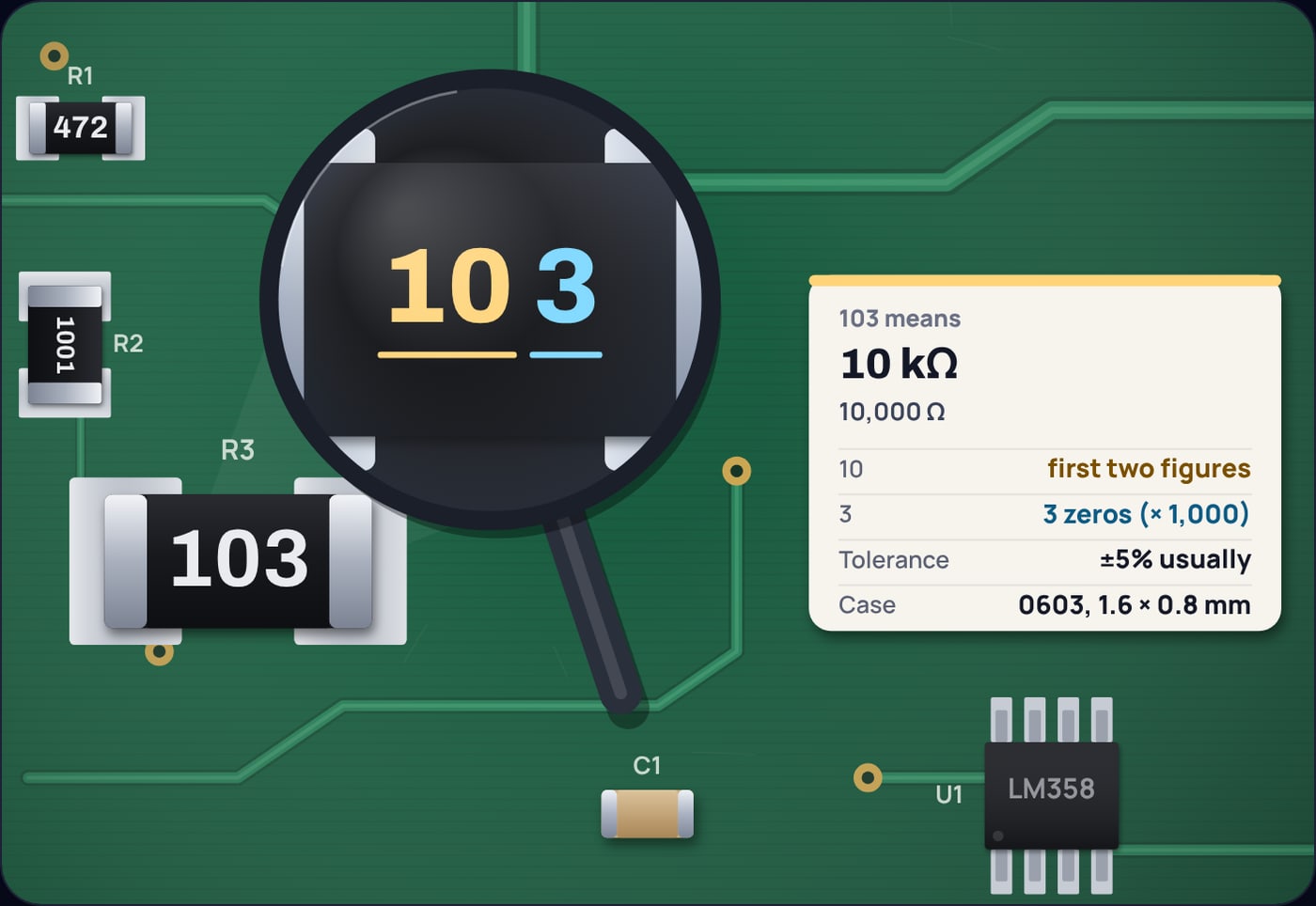
Watch the small values. 100 is 10 Ω, not 100 Ω, because the last digit says no zeros follow the 10. 101 is 100 Ω. The same rule runs through ceramic capacitor codes, where 104 is 100 nF; see what 104 means on a capacitor.
Why do some resistors have four digits?
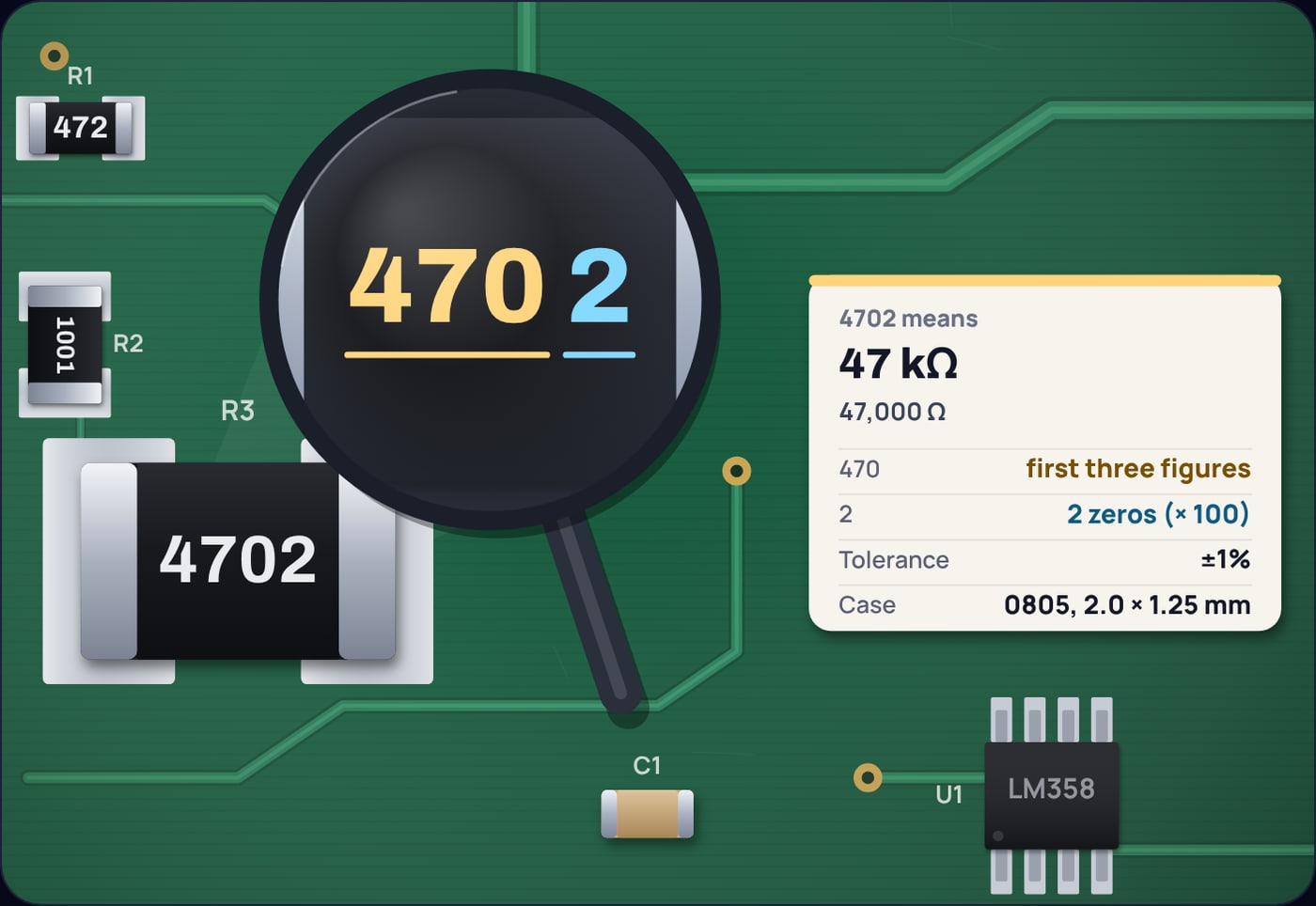
Resistors with ±1% tolerance come in the E96 series, 96 values per decade, and many of them need three significant figures: 499, 4.99 k, 12.4 k. So the code grows by one digit. The first three are the figures and the fourth is the count of zeros.
Example 2: 4702 and 4991
YAGEO's RC datasheet uses four digits for its 1% and 0.5% parts from the 0805 size up, and Vishay's guide gives the range from 1000 (100 Ω) to 9766 (976 MΩ). A four-digit code is a good sign that you are looking at a precision part even when nothing else says so.
What is the EIA-96 code?
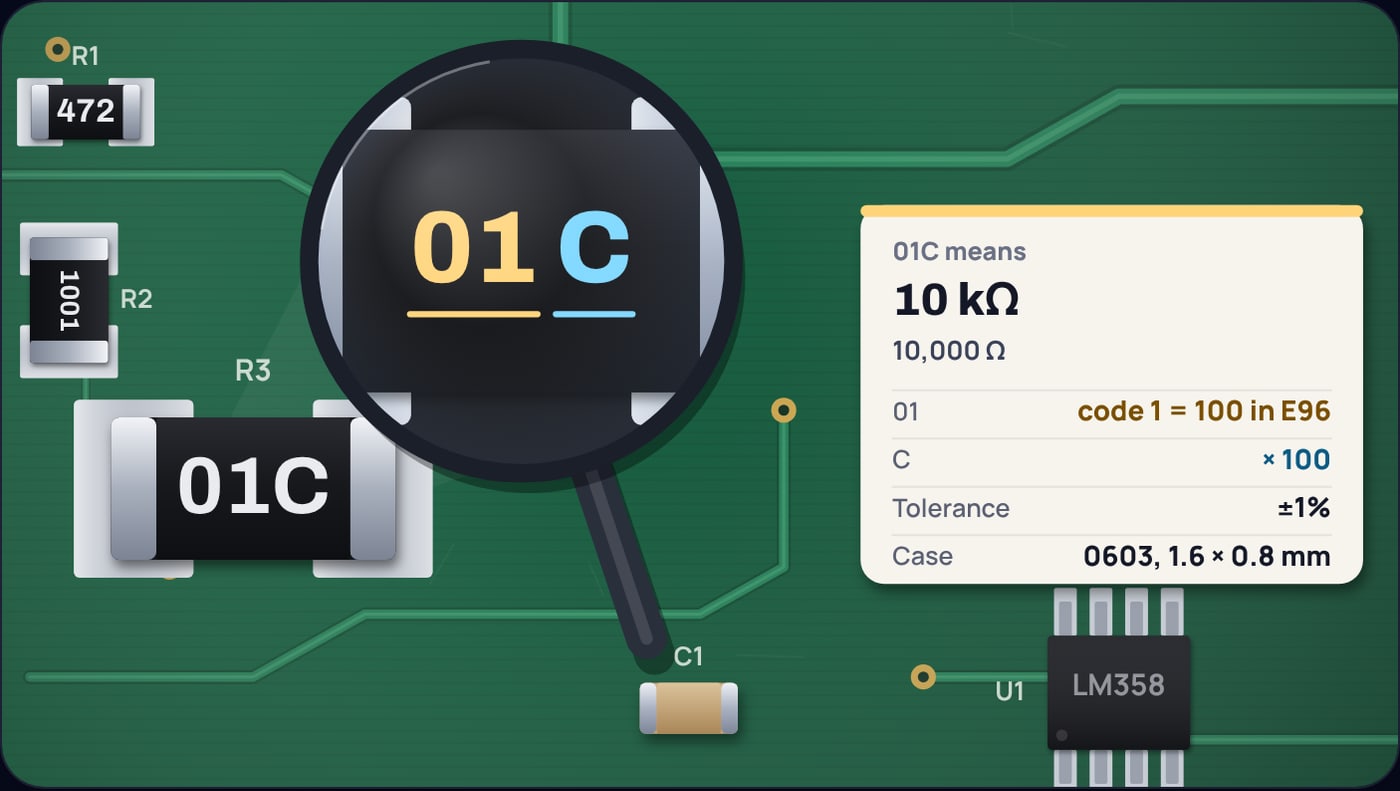
An 0603 resistor is 1.6 by 0.8 mm, according to YAGEO's dimension table, and there is only room for three characters on it. Three figures plus a multiplier would need four. EIA-96 gets around this with a lookup: the 96 values of the E96 series are numbered 01 to 96, and the code prints the number instead of the value, followed by a letter for the multiplier.
YAGEO's AC series datasheet describes it as "first two digits for E-96 marking rule and 3rd letter for number of zeros". A adds no zeros, B adds one, C two, D three, E four and F five.
Example 3: YAGEO's own examples, 88A and 10C
Both are printed as figures in YAGEO's RC and AC series datasheets. The trap is reading the number as a value. 10C looks like it should be 10 something, but entry 10 in the table is 124. And 01C, the code in the hero image, is entry 1 (100) with two zeros: 10 kΩ.
Here is the table. The values come from Vishay's list of E-series values according to IEC 60063; the code is simply each value's position in it.
| Code | Value | Code | Value | Code | Value | Code | Value |
|---|---|---|---|---|---|---|---|
| 01 | 100 | 25 | 178 | 49 | 316 | 73 | 562 |
| 02 | 102 | 26 | 182 | 50 | 324 | 74 | 576 |
| 03 | 105 | 27 | 187 | 51 | 332 | 75 | 590 |
| 04 | 107 | 28 | 191 | 52 | 340 | 76 | 604 |
| 05 | 110 | 29 | 196 | 53 | 348 | 77 | 619 |
| 06 | 113 | 30 | 200 | 54 | 357 | 78 | 634 |
| 07 | 115 | 31 | 205 | 55 | 365 | 79 | 649 |
| 08 | 118 | 32 | 210 | 56 | 374 | 80 | 665 |
| 09 | 121 | 33 | 215 | 57 | 383 | 81 | 681 |
| 10 | 124 | 34 | 221 | 58 | 392 | 82 | 698 |
| 11 | 127 | 35 | 226 | 59 | 402 | 83 | 715 |
| 12 | 130 | 36 | 232 | 60 | 412 | 84 | 732 |
| 13 | 133 | 37 | 237 | 61 | 422 | 85 | 750 |
| 14 | 137 | 38 | 243 | 62 | 432 | 86 | 768 |
| 15 | 140 | 39 | 249 | 63 | 442 | 87 | 787 |
| 16 | 143 | 40 | 255 | 64 | 453 | 88 | 806 |
| 17 | 147 | 41 | 261 | 65 | 464 | 89 | 825 |
| 18 | 150 | 42 | 267 | 66 | 475 | 90 | 845 |
| 19 | 154 | 43 | 274 | 67 | 487 | 91 | 866 |
| 20 | 158 | 44 | 280 | 68 | 499 | 92 | 887 |
| 21 | 162 | 45 | 287 | 69 | 511 | 93 | 909 |
| 22 | 165 | 46 | 294 | 70 | 523 | 94 | 931 |
| 23 | 169 | 47 | 301 | 71 | 536 | 95 | 953 |
| 24 | 174 | 48 | 309 | 72 | 549 | 96 | 976 |
For values under 100 Ω the letters X, Y and Z (multiply by 0.1, 0.01 and 0.001) are in general use, so 68X would be 49.9 Ω. We could not find those three letters in a manufacturer document we were able to open, so treat them with a little more caution than A to F, and check a datasheet if a low value matters.
What does a bar under the code mean?
The E96 series contains only six of the E24 values: 10, 11, 13, 15, 20 and 75. YAGEO marks those as EIA-96 too. The other E24 values, such as 24 or 47, have no E96 position, so a 1% 0603 resistor of 24 Ω cannot use EIA-96. YAGEO prints it as a normal three-digit code with one short bar under the middle digit: 240 with a bar is 24 Ω at ±1%.
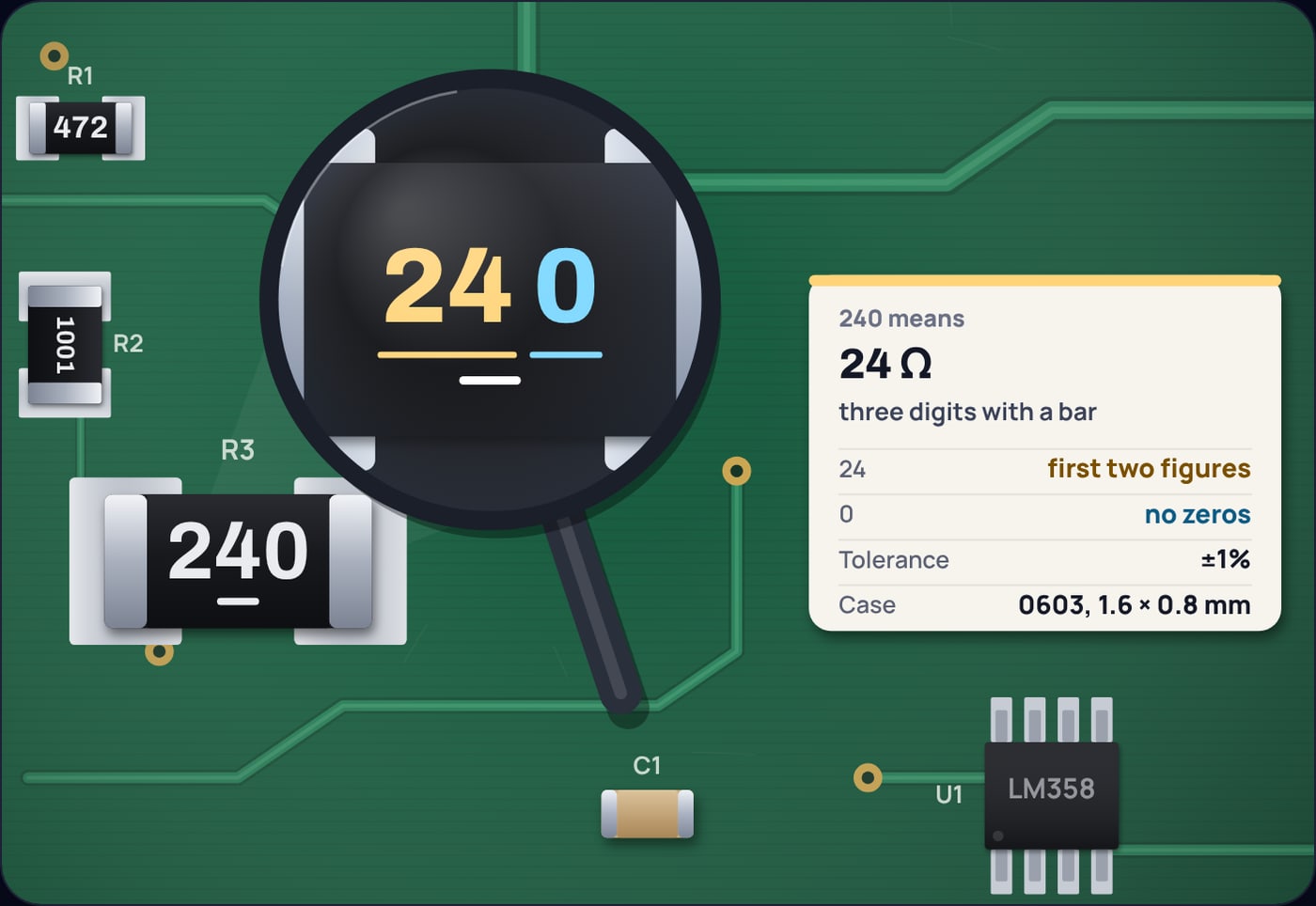
It is easy to miss under a magnifier, and missing it only costs you the tolerance, not the value. Tick the bar box in the calculator if you see one.
How are values below 10 Ω written?
Neither digit code can go below 10 Ω, since the smallest multiplier adds no zeros. So small values put the letter R where the decimal point goes. Vishay's guide lists R10 to R91 and 1R0 to 9R1 for 5% parts, and R100 to R976, 1R00 to 9R76 and 10R0 to 97R6 for 1% parts, where the extra figure again marks the tighter tolerance.
Example 4: R notation
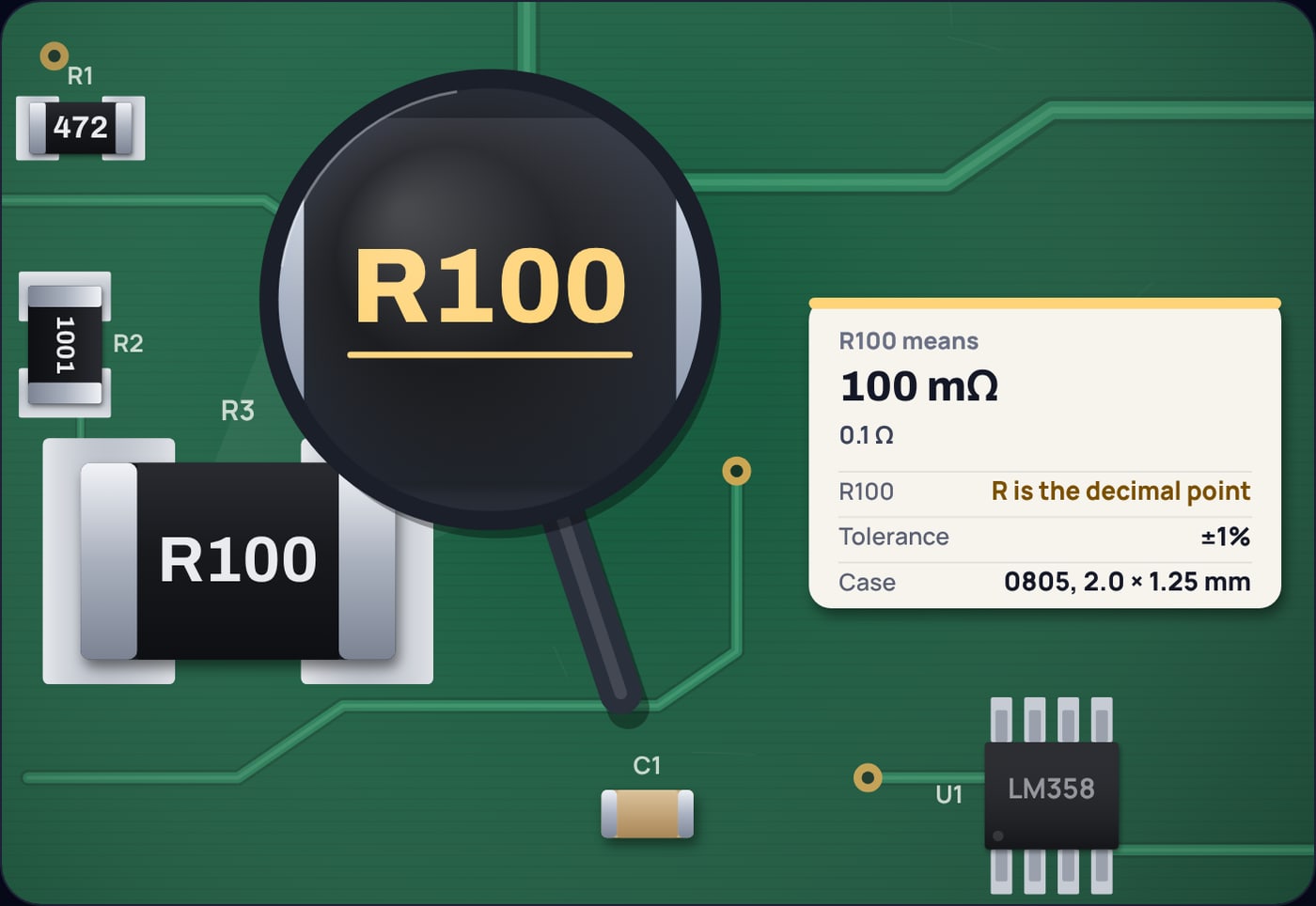
Below 0.1 Ω, Vishay switches to L as the decimal point in milliohms: 10L0 to 91L0 cover 10 to 91 mΩ. At these values the resistance of ordinary meter leads is no longer negligible, so measure them with a four-wire connection. Low values like 4R7 also turn up in series with LEDs; our guide on why LEDs need a resistor shows how to work out what value you need.
How do you go from a value to a code?
Write the value in ohms and count its significant figures. With two, there is a three-digit code: 2.2 kΩ is 22 and two zeros, 222. With three, there is a four-digit code and, if the figures are in the E96 table, an EIA-96 code as well. 4.99 kΩ is 499 and one zero, so 4991, and 499 is entry 68, so 68B on an 0603 part. It has no three-digit code at all.
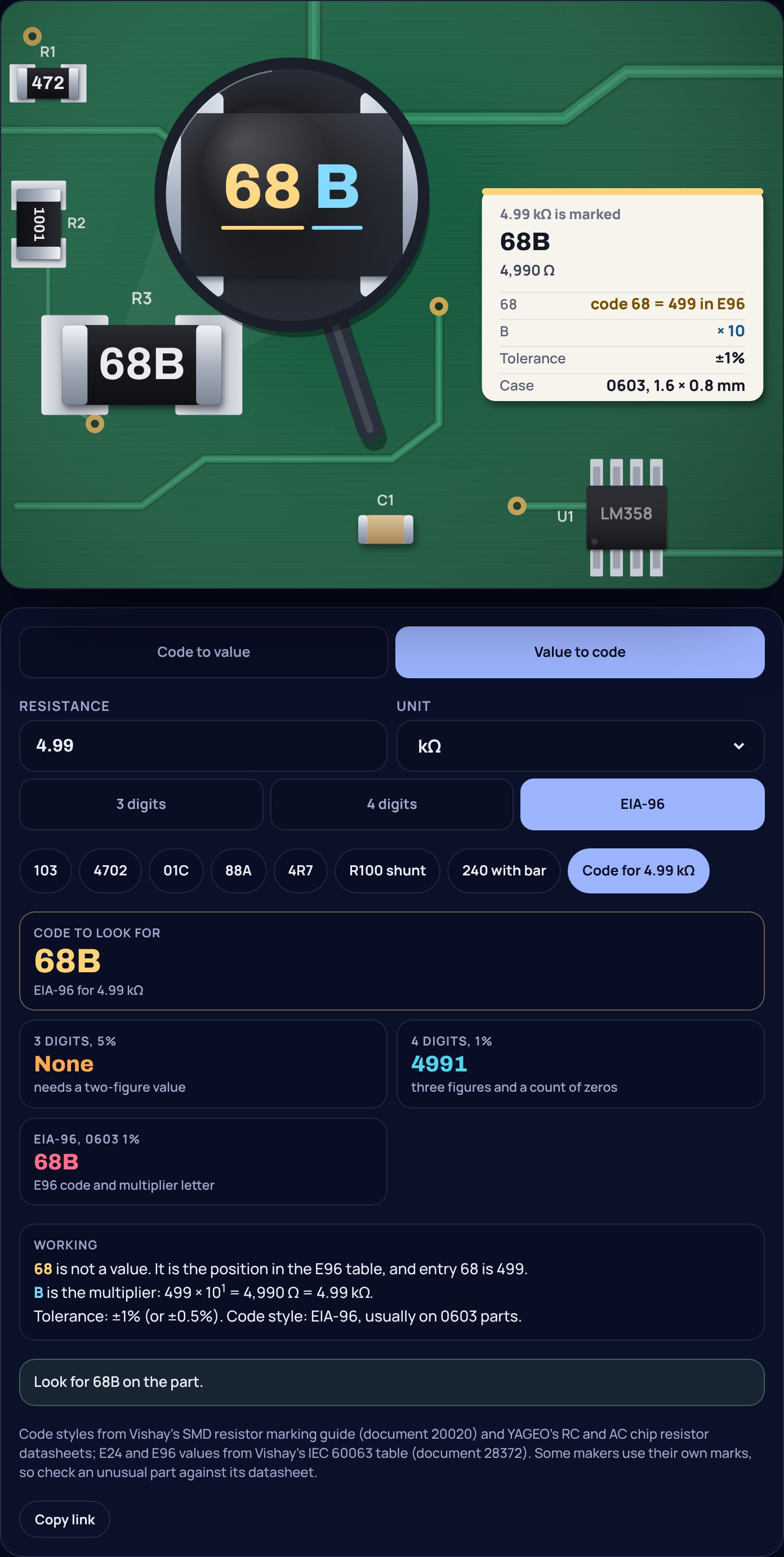
When you are choosing a value rather than reading one, stick to the series: E24 for general parts, E96 when you need precision. A pull-up resistor, for example, rarely needs better than 5%; our pull-up resistor guide explains how to pick one.
Why do some resistors have no code at all?
YAGEO's RC series datasheet states it plainly: sizes 0075, 0100, 0201 and 0402 carry no marking. An 0402 part is 1.0 by 0.5 mm, and there is no practical way to print a legible code on it. Many compact modern boards use parts this small, so code reading matters most on older, larger or hand-assembled boards. For an unmarked part the reel label is the only record, and a meter is the only check.
For everything else, type the code into the SMD resistor code calculator and it will name the style, give the value and tolerance, and list the other codes the same value could carry.
Sources
- Vishay Draloric, Surface Mount Resistor Marking, document 20020 (three- and four-digit ranges, R and L notation): vishay.com/docs/20020
- Vishay, Standard Series Values in a Decade for Resistances and Capacitances, E3 to E192 according to IEC 60063, document 28372 (the E24 and E96 values): vishay.com/docs/28372
- YAGEO, RC_L series general purpose chip resistors datasheet (marking by size and tolerance, the 88A example, the bar marking, dimensions): PYu-RC_Group_51_RoHS_L
- YAGEO, AC series automotive chip resistors datasheet (EIA-96 rule wording and the 10C example): PYu-AC_51_RoHS_L
Frequently asked questions
How do you read a 3-digit SMD resistor code?
The first two digits are the significant figures and the third is how many zeros follow, in ohms. 103 is 10 followed by three zeros, 10,000 Ω or 10 kΩ. 472 is 4.7 kΩ and 100 is 10 Ω.
What is EIA-96 on a resistor?
A three-character code for 1% resistors on small 0603 parts. The two digits, 01 to 96, are a position in the E96 table of standard values, and the letter is the multiplier: A adds no zeros, B one, C two, up to F for five. 01C is 100 × 100 = 10 kΩ.
What does 01C mean on a resistor?
01C is an EIA-96 code. Entry 01 in the E96 table is 100 and C multiplies by 100, so the resistor is 10 kΩ with ±1% tolerance.
What does R mean in a resistor code?
R is the decimal point. 4R7 is 4.7 Ω, 1R0 is 1 Ω and R100 is 0.1 Ω. It is used because the three-digit code cannot write values below 10 Ω.
Why does my SMD resistor have no code?
Resistors of size 0402 and smaller are too small to print on, so makers such as YAGEO leave them unmarked. The value is on the reel label; a loose part can only be checked with a meter.