How do you read an SMD resistor code?
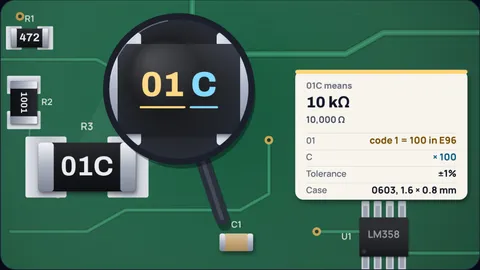
Count the characters. Three digits: the first two are the value and the third is how many zeros follow, so 103 is 10 followed by three zeros, 10,000 Ω or 10 kΩ. Four digits work the same way with three figures: 4702 is 47 kΩ. Two digits and a letter, such as 01C, is an EIA-96 code: the number picks a value from the E96 table and the letter is the multiplier, so 01C is also 10 kΩ.
An R anywhere in the code is a decimal point: 4R7 is 4.7 Ω and R100 is 100 mΩ. For the reasoning behind each style and how to tell them apart on a crowded board, read how to read SMD resistor codes.
Key facts about SMD resistor codes
- Three digits usually mean a ±5% part from the E24 series: 102 is 1 kΩ, 103 is 10 kΩ, 104 is 100 kΩ.
- Four digits mean ±1% or better on 0805 and larger parts: 1001 is 1 kΩ, 1002 is 10 kΩ, 4991 is 4.99 kΩ.
- EIA-96 squeezes 1% values onto 0603 parts: 01 is 100, 68 is 499 and 96 is 976; the letter A adds no zeros, B one, C two, up to F for five.
- Parts of size 0402 and smaller are not marked at all. The value is only on the reel label, so a meter is the only way to check a loose one.
Eight markings decoded
Each example puts the resistor on the board, magnifies its code and loads it into the calculator.
What does 103 mean on an SMD resistor?
10 kΩ10 are the significant figures and 3 is the number of zeros, so 103 is 10,000 Ω, 10 kΩ. It is the same rule as on ceramic capacitors, except the unit is ohms instead of picofarads.
A three-digit code normally means a ±5% resistor from the E24 series. The same 10 kΩ at 1% would read 1002 on an 0805 part, or 01C on an 0603.
4702 is 47 kΩ at 1%
47 kΩWith four digits, three are the value and the fourth is the count of zeros: 470 followed by two zeros is 47,000 Ω, 47 kΩ.
The extra figure exists because 1% resistors come in the E96 series, where values such as 475 and 487 need three significant figures. YAGEO marks its 1% and 0.5% resistors this way from 0805 upwards.
EIA-96: why 01C is 10 kΩ
10 kΩAn 0603 resistor has room for three characters, too few for three figures and a multiplier. EIA-96 solves it with a lookup: 01 is the first value in the E96 table, 100, and C means two zeros, so 01C is 10,000 Ω.
The number is never the value itself. 10C is not 10 of anything: entry 10 in the table is 124, so 10C is 12.4 kΩ, the example YAGEO prints in its AC series datasheet.
88A, YAGEO's own example
806 ΩEntry 88 in the E96 table is 806 and A adds no zeros, so 88A is 806 Ω. This is the example in YAGEO's RC series datasheet.
Tolerance is not printed in EIA-96. The code itself tells you the part is a 1% or 0.5% resistor, because only those are marked this way.
4R7: small values with R
4.7 ΩThe three-digit rule cannot go below 10 Ω (100 is 10 Ω), so smaller values put an R where the decimal point goes. 4R7 is 4.7 Ω, 1R0 is 1 Ω and 10R0 is 10 Ω on a 1% part.
You will see these in series with LEDs, gate drive lines and power rails, where a few ohms limit current or damp ringing.
R100: a current sense resistor
100 mΩA leading R means the value is below one ohm: R100 is 0.1 Ω, 100 mΩ. Values like this sit in the path of a supply current so a circuit can measure it from the small voltage across them.
For values below 0.1 Ω, Vishay's marking guide uses L as the decimal point in milliohms: 10L0 is 10 mΩ.
A bar under 240: 24 Ω at 1%
24 Ω24 is an E24 value with no E96 twin, so it has no EIA-96 code. YAGEO marks 1% 0603 resistors of such values with three digits and a short bar underneath: 240 with a bar is 24 Ω at ±1%.
Without the bar, the same 240 would be a 5% part. The six E24 values that are also in E96 (10, 11, 13, 15, 20 and 75) use EIA-96 instead.
What is the code for 4.99 kΩ?
68B4.99 kΩ is 499 × 10, three significant figures, so there is no three-digit code. On an 0805 part it reads 4991. On an 0603 part, 499 is entry 68 in the E96 table and B adds one zero, so the code is 68B.
Value to code mode lists all three styles for any value and warns when a style cannot write it.
The EIA-96 code table
| Code | Value | Code | Value |
|---|---|---|---|
| 01 | 100 | 49 | 316 |
| 02 | 102 | 50 | 324 |
| 03 | 105 | 51 | 332 |
| 04 | 107 | 52 | 340 |
| 05 | 110 | 53 | 348 |
| 06 | 113 | 54 | 357 |
| 07 | 115 | 55 | 365 |
| 08 | 118 | 56 | 374 |
| 09 | 121 | 57 | 383 |
| 10 | 124 | 58 | 392 |
| 11 | 127 | 59 | 402 |
| 12 | 130 | 60 | 412 |
| 13 | 133 | 61 | 422 |
| 14 | 137 | 62 | 432 |
| 15 | 140 | 63 | 442 |
| 16 | 143 | 64 | 453 |
| 17 | 147 | 65 | 464 |
| 18 | 150 | 66 | 475 |
| 19 | 154 | 67 | 487 |
| 20 | 158 | 68 | 499 |
| 21 | 162 | 69 | 511 |
| 22 | 165 | 70 | 523 |
| 23 | 169 | 71 | 536 |
| 24 | 174 | 72 | 549 |
| 25 | 178 | 73 | 562 |
| 26 | 182 | 74 | 576 |
| 27 | 187 | 75 | 590 |
| 28 | 191 | 76 | 604 |
| 29 | 196 | 77 | 619 |
| 30 | 200 | 78 | 634 |
| 31 | 205 | 79 | 649 |
| 32 | 210 | 80 | 665 |
| 33 | 215 | 81 | 681 |
| 34 | 221 | 82 | 698 |
| 35 | 226 | 83 | 715 |
| 36 | 232 | 84 | 732 |
| 37 | 237 | 85 | 750 |
| 38 | 243 | 86 | 768 |
| 39 | 249 | 87 | 787 |
| 40 | 255 | 88 | 806 |
| 41 | 261 | 89 | 825 |
| 42 | 267 | 90 | 845 |
| 43 | 274 | 91 | 866 |
| 44 | 280 | 92 | 887 |
| 45 | 287 | 93 | 909 |
| 46 | 294 | 94 | 931 |
| 47 | 301 | 95 | 953 |
| 48 | 309 | 96 | 976 |
Multiply the value by the letter: A × 1, B × 10, C × 100, D × 1,000, E × 10,000, F × 100,000. X, Y and Z (× 0.1, 0.01 and 0.001) are used for values below 100 Ω.
How the calculator works
The code is matched by its shape: three digits, four digits, two digits and a letter (EIA-96), digits around an R or an L, or all zeros for a jumper.
Three and four digit codes are the significant figures times ten to the power of the last digit, in ohms. Codes with a last digit above 7 (three digits) or 6 (four digits) are rejected, matching the ranges in Vishay's marking guide.
EIA-96 codes look up the E96 value from Vishay's copy of the IEC 60063 table and multiply by the letter. A to F follow YAGEO's rule that the letter gives the number of zeros.
Value to code mode splits the value into two and three significant figures, writes each code style that can hold it, and shows the nearest standard values when none can.
What the model leaves out
- Colour bands. Through-hole resistors use bands, not printed codes.
- Maker-specific marks. A few makers use letters of their own, especially for multipliers below 100 Ω. When a code does not fit any style here, the part's datasheet is the only reliable key.
- Unmarked parts. 0402 and smaller resistors carry no code. The calculator cannot help; a meter can.
- Power and voltage ratings. These depend on the case size and series, not the code. YAGEO's RC0603 is rated 1/10 W and RC0805 1/8 W in their standard versions.
Common misconceptions
"01C is 1 kΩ." 01 is a table position, not a value. 01C is 100 × 100 = 10 kΩ.
"103 means 103 Ω." The last digit is a count of zeros: 10 and three zeros is 10,000 Ω.
"The code tells you the tolerance exactly." It only hints: three digits suggest 5%, four digits or EIA-96 suggest 1% or better. The datasheet is definitive.
Frequently asked questions
What does 103 mean on an SMD resistor?
103 means 10 followed by three zeros: 10,000 Ω, or 10 kΩ. Three-digit codes are usually on ±5% resistors.
What is 01C on a resistor?
01C is an EIA-96 code. 01 is the first value in the E96 table, 100, and C multiplies by 100, so the resistor is 10 kΩ with ±1% tolerance.
What does R mean in an SMD resistor code?
R marks the decimal point. 4R7 is 4.7 Ω, 1R0 is 1 Ω and R100 is 100 mΩ.
Why do some SMD resistors have four digits?
Four digits are used on ±1% and ±0.5% resistors, whose E96 values need three significant figures. 1002 is 10 kΩ and 4991 is 4.99 kΩ.
What does 000 mean on a resistor?
A code of all zeros marks a zero-ohm jumper, a part that works as a wire link. YAGEO specifies its jumpers at under 50 mΩ.
Keep learning
How to Read SMD Resistor Codes (EIA-96 Explained)
103 is 10 kΩ, 1002 is 10 kΩ and 01C is 10 kΩ too. How three-digit, four-digit, R notation and EIA-96 codes on chip resistors work, with the full table.

How to Choose a Pull-Up Resistor Value (With I2C Math)
Pull-up resistors have a minimum set by sink current and a maximum set by rise time and leakage. Worked I2C example at 400 kHz, plus MCU internal pull-ups.

Why Do LEDs Need a Resistor? The I-V Curve Explained
An LED's current rises exponentially with voltage: 0.1 V extra takes a red LED from 20 mA to 56 mA. Here is the physics, the resistor math and the fixes.
What Does 104 Mean on a Capacitor? Codes Explained
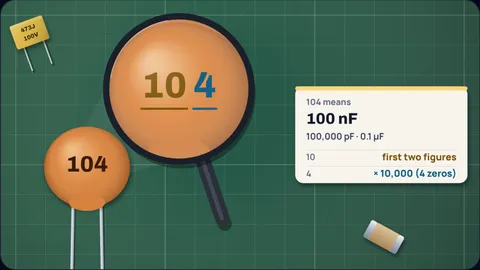
104 on a capacitor means 100,000 pF, which is 100 nF or 0.1 µF. How to read the three-digit code, tolerance letters, voltage codes and X7R or C0G.