How do you convert decibels to a ratio?
For power, divide the dB by 10 and raise 10 to that: ratio = 10^(dB/10). For voltage, current or sound pressure, divide by 20 instead. So 3 dB is a power ratio of 1.995 and a voltage ratio of 1.413; 10 dB is ×10 in power and ×3.162 in voltage.
Absolute levels add a reference: dBm is relative to 1 mW, dBW to 1 W, dBV to 1 V and dBu to 0.7746 V. For the reason 3 dB means double, read why 3 dB is double the power.
Decibel rules worth remembering
- +3 dB doubles the power (3.0103 dB exactly), and −3 dB halves it.
- +6 dB doubles the voltage or sound pressure (6.0206 dB), which is four times the power.
- +10 dB is ten times the power, and +20 dB ten times the voltage.
- 0 dBm is 1 mW, 0.7746 V rms across 600 Ω, which is why that voltage became 0 dBu.
Twelve decibel examples
Each loads the calculator with the values and shows the result on the bench or in the hall.
Why 3 dB means double
× 1.99510^(3/10) = 1.9953, within a quarter of a percent of 2. Exact doubling is 10 log 2 = 3.0103 dB, so "3 dB" is a rounding everyone agrees to.
The voltage goes up by 1.413, the square root of 2, because power goes with voltage squared.
Ten times the power is 10 dB
10 dB10 log 10 = 10 dB, the definition of the decibel: a bel is a factor of 10 in power and a decibel a tenth of that. The voltage rises by √10 = 3.162.
Double the voltage is 6 dB
6.02 dB20 log 2 = 6.021 dB. Doubling the voltage across the same load quadruples the power, and 10 log 4 gives the same 6.021 dB.
−3 dB is half the power
× 0.501A loss of 3 dB leaves 50.1% of the power and 70.8% of the voltage. That is the "−3 dB point" used to define the edge of a filter's passband.
20 dBm in watts
100 mW20 dBm is 20 dB above 1 mW, a factor of 100: 100 mW, or −10 dBW. Across 50 Ω that is 2.236 V rms.
1 W into an 8 Ω speaker
2.83 V1 W is 30 dBm or 0 dBW. Across 8 Ω, V = √(1 × 8) = 2.828 V rms, which is 9.03 dBV or 11.25 dBu.
+4 dBu in volts
1.228 VdBu is relative to 0.7746 V, so +4 dBu is 0.7746 × 10^(4/20) = 1.228 V rms, or 1.78 dBV. The impedance only matters if you also want the power.
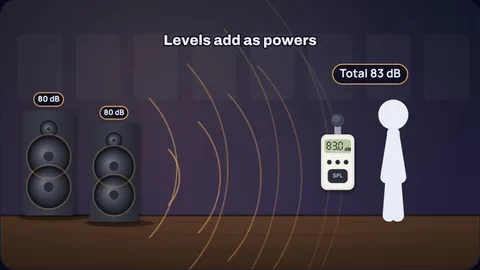
Two 80 dB sources make 83 dB
83.01 dBTwo unrelated sources of equal level double the sound power, so the total is 80 + 3.01 = 83.01 dB, not 160 dB.
A quieter source barely counts
90.41 dBAn 80 dB source has a tenth of the power of a 90 dB one, so together they make 90.41 dB. Turning off the quieter one would hardly be noticed.
Four equal sources add 6 dB
91.02 dBFour times the power is 10 log 4 = 6.02 dB more, so four 85 dB machines make 91.02 dB.
Twice as far is 6 dB quieter
83.98 dBFrom a point source with no reflections, the same power spreads over four times the area at twice the distance: 20 log 2 = 6.02 dB less. 90 dB at 1 m becomes 83.98 dB at 2 m.
Ten times as far is 20 dB quieter
80 dB20 log 10 = 20 dB, so 100 dB at 1 m is 80 dB at 10 m in free field. Indoors, reflections hold the level higher than this far from the source.
Decibels and the ratios they stand for
| dB | Power ratio | Voltage ratio |
|---|---|---|
| −20 | 0.01 | 0.1 |
| −10 | 0.1 | 0.316 |
| −6 | 0.25 | 0.501 |
| −3 | 0.5 | 0.708 |
| −1 | 0.79 | 0.891 |
| 0 | 1 | 1 |
| +1 | 1.26 | 1.122 |
| +3 | 2 | 1.413 |
| +6 | 3.98 | 1.995 |
| +10 | 10 | 3.162 |
| +20 | 100 | 10 |
| +30 | 1,000 | 31.623 |
Power ratio = 10^(dB/10), voltage ratio = 10^(dB/20). The voltage column assumes the same impedance on both sides.
How the calculator works
Ratio mode converts between decibels and power or voltage ratios with 10 log and 20 log, the definitions in ITU-R V.574 and NIST SP 811.
Level mode turns the value into watts or volts rms using its reference (1 mW, 1 W, 1 V or 0.7746 V), then links power and voltage with P = V² / R for the impedance you give.
Adding levels converts each to a power ratio, adds them, and takes 10 log of the sum. This is right for unrelated sources such as separate machines or speakers playing different material.
Distance mode subtracts 20 log of the distance ratio, the inverse square law for a point source in free field.
What the model leaves out
- Coherent sources. Two speakers playing the same signal can add up to 6 dB at points where they arrive in step, and cancel where they do not.
- Weighting. Sound level meters usually apply A or C weighting; the calculator works with whatever levels you give it.
- Rooms. Reflections and reverberation keep the level from falling 6 dB per doubling of distance far from the source.
- Peak and rms. dBV and dBu here are rms voltages; the peak of a sine is √2 times higher.
Common misconceptions
"Two 80 dB sounds make 160 dB." Decibels are logarithms; two equal unrelated sources make 83 dB.
"6 dB is four times louder." It is four times the power. How loud it sounds is a separate question of perception.
"dBu and dBm are the same thing." They match only across 600 Ω. dBu is a voltage level and dBm a power level.
Frequently asked questions
How many dB is double the power?
10 log 2 = 3.01 dB, which everyone rounds to 3 dB. Double the voltage is 6 dB.
How do I convert dBm to watts?
Watts = 0.001 × 10^(dBm/10). 0 dBm is 1 mW, 20 dBm 100 mW and 30 dBm 1 W.
What is the difference between dBu and dBV?
dBV is relative to 1 V rms and dBu to 0.7746 V rms, so a level in dBu is 2.22 dB higher than the same voltage in dBV.
How do you add decibels?
Convert each to power with 10^(L/10), add, then take 10 log of the sum. 80 dB plus 80 dB is 83 dB.
How much does sound drop with distance?
About 6 dB each time the distance doubles, for a point source with no reflections. Ten times the distance is 20 dB.
Keep learning
Why 3 dB Is Double the Power (and 6 dB Double the Voltage)
3 dB is double the power because 10 log 2 = 3.01. Why voltage needs 20 log, why two 80 dB speakers make 83 dB, and how dBm, dBu and distance work.

RC Low Pass Filter Cutoff Frequency: What −3 dB Means
fc = 1/(2πRC) is where the output is 0.707 of the input, half power and −45°. Why the slope there is only 10 dB/decade, and how loading moves it.

Op Amp Gain Bandwidth Product Explained (Noise Gain)
Op amp bandwidth is GBW divided by the noise gain, not the signal gain. Worked LM358 and TL072 numbers, gain accuracy, slew rate and computed Bode plots.

How Do Noise Cancelling Headphones Work? The Timing Math
Noise cancelling headphones play inverted sound, but a 20° phase error leaves a third of the noise. Why ANC kills engine drone and not voices, with plots.