Why Does Sound Travel Faster in Water and Steel?
Put your ear to a long metal railing while a friend taps the far end and you hear the tap twice: once through the metal, then a moment later through the air. Swimmers notice something similar underwater, where a boat's engine seems to come from everywhere at once. Sound is a lot faster in water and metal than in air, which surprises people who think of air as the thing sound "lives" in.
This post explains why, with the numbers. The short version is that sound speed is a contest between how stiff a material is and how heavy it is, and stiffness wins by a mile in liquids and solids. The speed of sound calculator gives the speed in air at any temperature and in 16 other materials, with sources, and turns it into an echo distance or a Mach number.
How fast is sound in air, water and steel?
Here are the speeds at 20 °C from the sources used by the calculator:
- Carbon dioxide: 266.6 m/s (NIST)
- Air, dry: 343.2 m/s (ideal gas formula, matching published tables)
- Helium: 1,008 m/s (NIST)
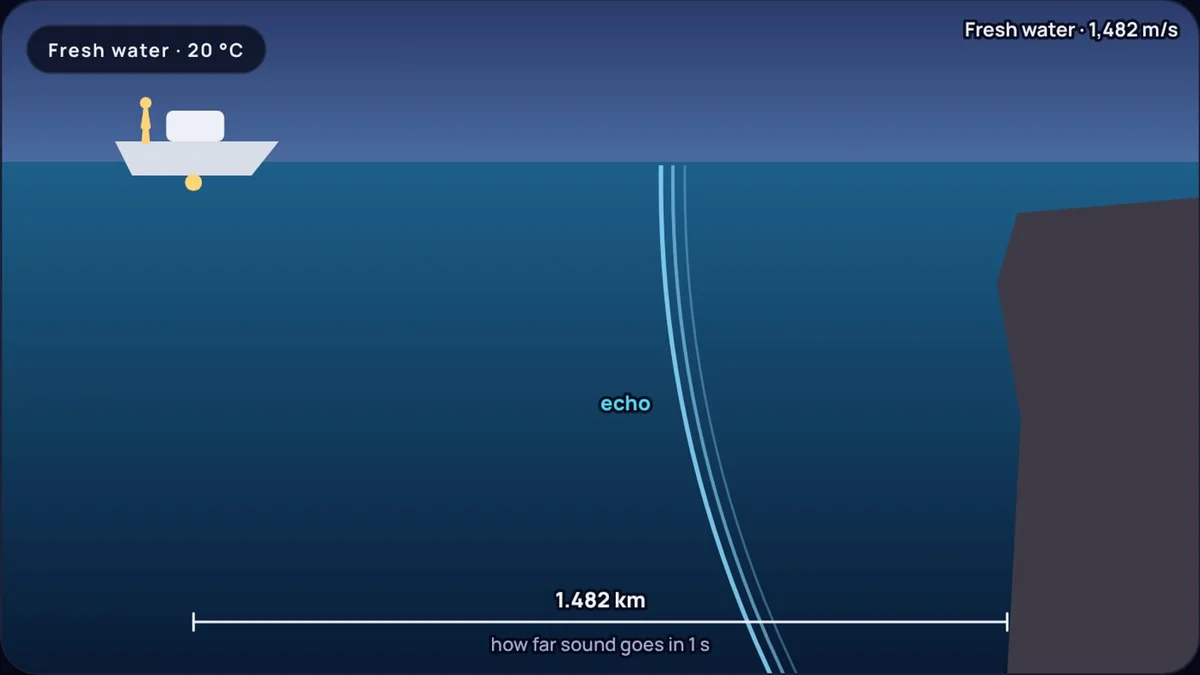
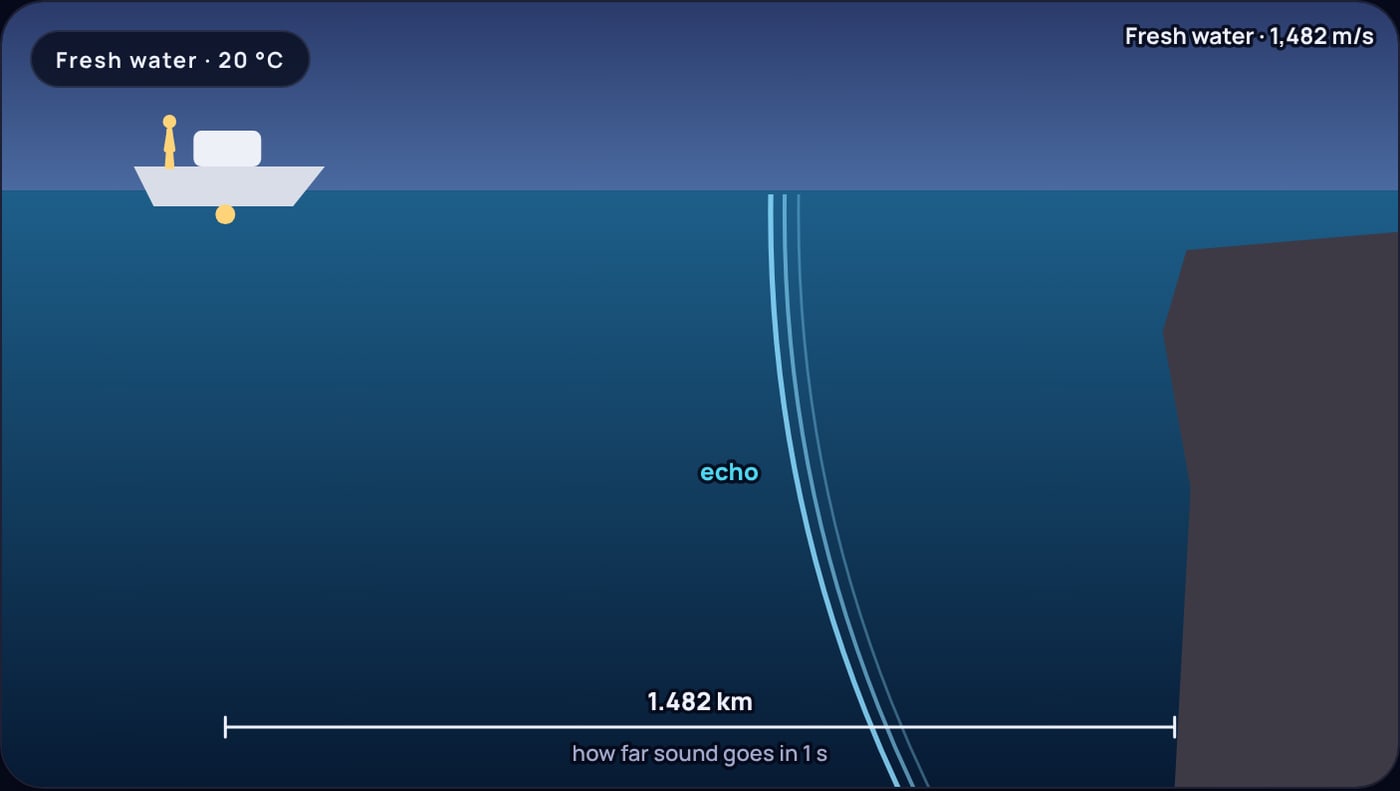
- Fresh water: 1,482 m/s (NIST)
- Sea water, 3.5% salt: 1,522 m/s (Engineering ToolBox)
- Hardwood, along the grain: 3,960 m/s
- Glass (Pyrex): 5,640 m/s
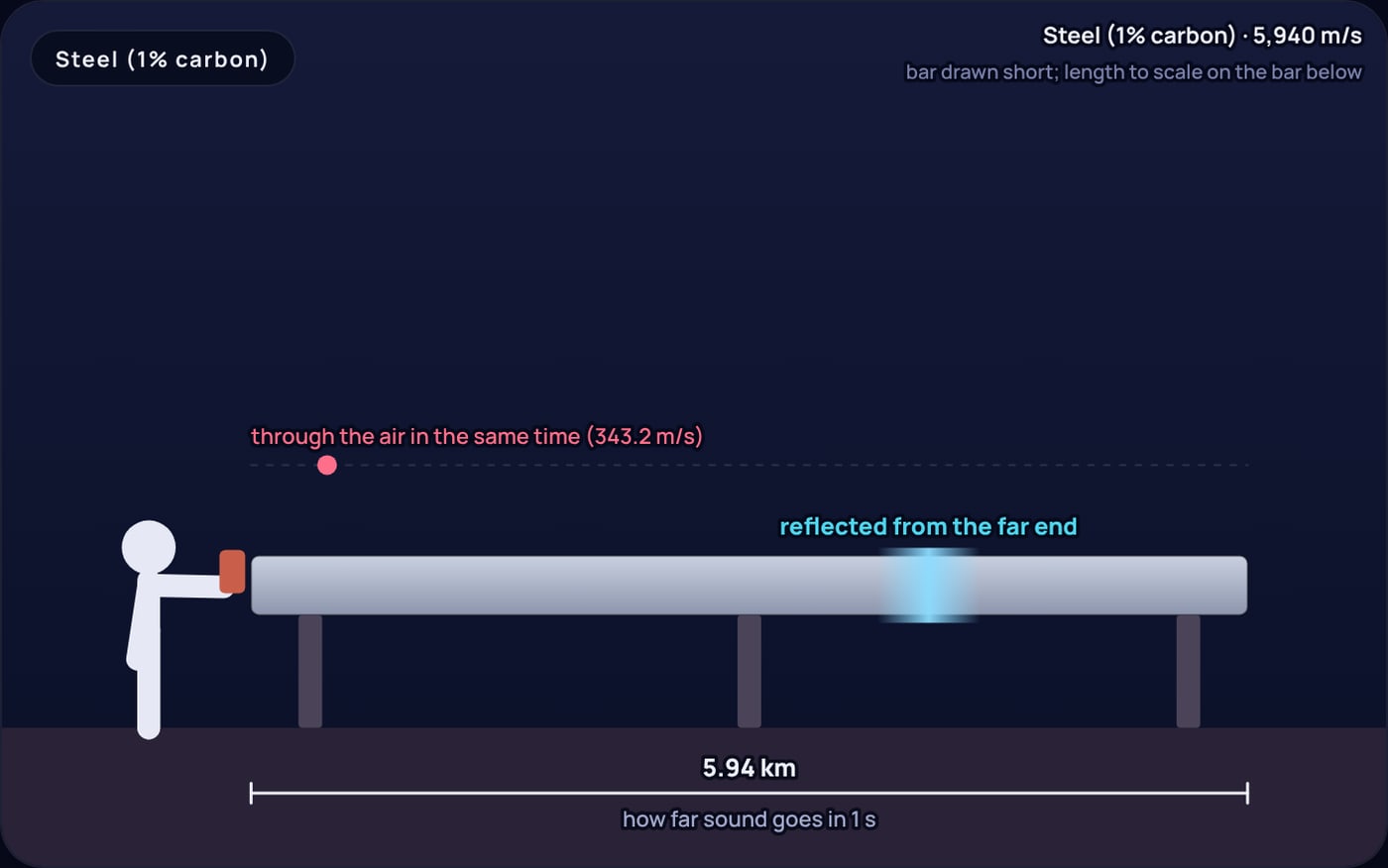
- Steel, 1% carbon: 5,940 m/s
- Aluminium, rolled: 6,420 m/s
Example 1: how much faster?
A kilometre takes sound 2.91 s in air, 0.675 s in water and 0.168 s in steel.
What sets the speed of sound in a material?
A sound wave is a travelling squeeze. One layer of the material is pushed, it pushes the next, and so on. Two properties decide how fast that happens:
- Stiffness: how hard the material pushes back when you squash it. A stiff material passes the push on quickly.
- Density: how much mass each layer has. Heavier layers take longer to get moving.
For a liquid or a gas, the stiffness is the bulk modulus K, and the speed is:
Stiffness speeds sound up, density slows it down, and the square root softens both. So the question "why is sound faster in water?" becomes "how much stiffer is water, compared with how much denser it is?"
Example 2: air's stiffness and density
For a gas squeezed by a sound wave, K = γp, with γ = 1.4 for air and p = 101,325 Pa at sea level. Dry air at 20 °C has a density of pM ÷ RT = 1.204 kg/m³.
This matches the Engineering ToolBox table value of 343.3 m/s for air at 20 °C.
Why is water faster than air if it is so much denser?
Water at 20 °C has a density of 998.21 kg/m³ according to the NIST Chemistry WebBook, which also gives its sound speed as 1,482.4 m/s. Working the formula backwards gives water's stiffness.
Example 3: stiffness against density
Water is about 15,500 times stiffer and 829 times denser. The speed ratio is √(15,500 ÷ 829) = √18.7 = 4.32.
The reason is in the molecules. Gas molecules are far apart, and squashing air just pushes them a little closer, which is easy. Water molecules are already packed tightly together, and squeezing them closer means fighting the repulsion between them. That makes water very hard to compress, so a push travels through it quickly.
Why is steel faster still?
Solids are stiffer again. Their atoms are locked in place by strong bonds, so a squeeze at one end is passed along almost like pushing one end of a stiff rod. For a solid, the stiffness that matters for a pressure wave in a large block is called the longitudinal (or P-wave) modulus, and the same square root rule applies.
Example 4: steel's stiffness
Engineering ToolBox gives 5,940 m/s for steel with 1% carbon and 7.82 g/cm³ (7,820 kg/m³) for steel's density.
That is about 126 times stiffer than water, while steel is only about 7.8 times denser. √(126 ÷ 7.8) = 4.0, which is the ratio of 5,940 to 1,482 m/s.
Shape matters in solids. In a thin rod the material can bulge sideways as it is squeezed, so the rod is effectively softer and the wave slower: the same table lists 5,180 m/s for steel along a thin rod. Wood is a good example of direction mattering too: sound along the grain is several times faster than across it.
Why is sound faster in helium and in warm air?
Gases follow a slightly different rule, because their stiffness comes from the motion of their molecules. Combining c = √(γp ÷ ρ) with the ideal gas law gives:
Here R = 8.314462618 J/(mol·K), T is the temperature in kelvin and M is the molar mass. Pressure has dropped out: at a fixed temperature, sound in thin mountain air is no slower than at sea level. Temperature is what counts, along with how heavy the molecules are.
Example 5: helium at 20 °C
Helium has M = 4.0026 g/mol (PubChem) and, as a gas of single atoms, γ = 5/3.
NIST's value is 1,007.9 m/s. Air's molecules are about seven times heavier, so air is about 2.9 times slower.
That is why a breath of helium makes a voice sound squeaky. Your vocal folds vibrate at the same rate, but the resonances of your throat and mouth, which shape the sound, move up in frequency because sound crosses them faster. Heavy carbon dioxide does the opposite, at 266.6 m/s.
In air, warming from 0 °C to 20 °C raises the speed from 331.3 to 343.2 m/s, about 0.6 m/s per degree. Humidity makes a much smaller difference: Engineering ToolBox lists 343.5 m/s at 10% humidity and 344.5 m/s at 90% at 20 °C.
Does temperature change the speed of sound in water?
Yes, and in an unusual way. The NIST data show sound in water speeding up from 1,402 m/s at 0 °C to 1,482 m/s at 20 °C and a peak of about 1,555 m/s near 75 °C, after which it slows down again as the water nears boiling. Salt water is faster than fresh at the same temperature: 1,522 m/s at 20 °C for sea water with 3.5% salt. The real ocean is more complicated still, because pressure rises with depth and temperature falls, which bends sound paths and lets whale calls travel very long distances.
Can you hear the difference yourself?
The railing trick works because the gap between the two arrivals grows with distance.
Example 6: a knock on a 1 km steel pipe
The knock arrives through the metal 2.75 s before it arrives through the air, easily long enough to hear as two separate sounds.
On a shorter railing the gap is smaller: at 50 m it is 50 ÷ 343.2 − 50 ÷ 5940 = 0.14 s.
Why is it hard to hear the world above when you are underwater?
Speed is only half the story. Each material has an acoustic impedance, density times sound speed, and when sound meets a boundary between two very different impedances, most of it bounces back. For sound hitting water straight on from air, the share of energy that gets through is 4Z₁Z₂ ÷ (Z₁ + Z₂)².
Example 7: sound from air into water
About 0.11% of the energy crosses the surface, a loss of about 30 decibels. Voices from the poolside sound faint and muffled for the same reason that underwater noises are hard to hear from the bank.
Try it yourself
Open the speed of sound calculator with steel and switch between air, water, helium and the solids to see the pulse race along the bar or the ping cross the water. Choose Echo to turn an echo time into a distance, or Delay for a one-way trip such as thunder after a flash. For storms there is a dedicated lightning distance calculator, and how far away is lightning explains the 3 seconds per kilometre rule. For the density side of the story, see why ice floats.
Sources
- NIST Chemistry WebBook, thermophysical properties of fluid systems: sound speed and density of water from 0 to 95 °C, and sound speed of helium, carbon dioxide, nitrogen, oxygen and methane, all at 0.101325 MPa.
- Engineering ToolBox, air, speed of sound vs temperature (including the humidity table) and molecular mass of air, 28.9647 g/mol.
- Engineering ToolBox, solids and metals, speed of sound, liquids, speed of sound (sea water) and density of solids (steel).
- NIST, CODATA value of the molar gas constant: 8.314 462 618 J/(mol·K), exact.
- PubChem, periodic table: helium 4.00260 g/mol.
Frequently asked questions
Why does sound travel faster in water than in air?
Water is about 830 times denser than air, which slows sound, but it is about 15,000 times harder to compress, which speeds it up far more. The result is about 1,482 m/s in water at 20 °C against 343 m/s in air.
How fast is sound in steel?
About 5,940 m/s for longitudinal waves in a large block of carbon steel, roughly 17 times the speed in air at 20 °C. Along a thin rod it is lower, about 5,200 m/s.
Does denser mean faster for sound?
No. On its own, extra density slows sound down. Solids and liquids are faster than gases because they are much stiffer, and stiffness wins by a wide margin.
Why is sound faster in warm air and in helium?
In a gas the speed depends on how fast the molecules move. Warmer molecules move faster, and light helium atoms move much faster than heavy air molecules at the same temperature, giving about 1,008 m/s in helium at 20 °C.
Why can’t you hear people talking above water when you are underwater?
Air and water carry sound so differently that almost all of it reflects at the surface. Only about 0.1% of the sound energy hitting the water at right angles goes in, a loss of about 30 decibels.