How fast does sound travel?
In dry air at 20 °C sound travels at 343.2 m/s, about 1,236 km/h or 1 km every 2.91 seconds. It is faster in warm air, about four times faster in water (1,482 m/s at 20 °C) and about 17 times faster in steel (5,940 m/s). Pick a material and a temperature to get the speed, then use it for an echo, a delay or a Mach number.
Air speeds come from the ideal gas formula, which matches published tables to within 0.1 m/s. Water and the other gases come from the NIST Chemistry WebBook, and solids and sea water from Engineering ToolBox tables. Why sound is faster in water and steel is explained in Why does sound travel faster in water and steel?.
Key results
- Air: c = √(γRT ÷ M) = 331.3 m/s at 0 °C and 343.2 m/s at 20 °C, about 0.6 m/s more per degree.
- Echo: distance = speed × time ÷ 2. A 2 second echo in air at 20 °C puts the wall 343.2 m away.
- Delay: distance = speed × time. Thunder 3 seconds after the flash is 1.03 km away.
- Mach number: speed ÷ speed of sound. Sound is slower in cold air, so the same speed is a higher Mach number at altitude.
Six worked examples
Each button loads the example into the calculator.
Air at 20 °C: 343.2 m/s
speed of sound in airFor dry air, γ = 1.4 and M = 28.9647 g/mol, so c = √(1.4 × 8.3145 × 293.15 ÷ 0.0289647) = 343.2 m/s. At 0 °C it is 331.3 m/s and at 40 °C 354.8 m/s. Humidity makes a small difference: Engineering ToolBox lists 343.5 m/s at 10% and 344.5 m/s at 90% relative humidity at 20 °C.
A 2 second echo: the cliff is 343.2 m away
echo distanceThe sound goes to the cliff and back, so halve the round trip: d = 343.2 × 2 ÷ 2 = 343.2 m. To hear a separate echo you need a reflecting surface far enough away that the echo does not overlap the original sound.
Thunder 3 s after the flash: 1.03 km
one-way delayLight from the flash arrives almost at once, so the gap is the sound's travel time: d = 343.2 × 3 = 1.03 km. That is where the rule of thumb of about 3 seconds per kilometre comes from. The lightning distance calculator does this with a count.
Water at 20 °C: 1,482 m/s
liquidNIST gives 1,402 m/s at 0 °C, 1,482 m/s at 20 °C and a peak of 1,555 m/s near 75 °C, after which it falls again. Sea water with 3.5% salt is faster, 1,522 m/s at 20 °C (Engineering ToolBox), which is what sonar and whale song travel at.
Steel: 5,940 m/s
solidLongitudinal waves in steel with 1% carbon run at 5,940 m/s, 17.3 times the speed in air. A knock on one end of a 1 km steel pipe arrives in 0.168 s through the metal and 2.91 s through the air, so you hear it twice.
Related reading: Why sound is faster in steel
900 km/h in −50 °C air: Mach 0.835
Mach numberIn air at −50 °C sound travels at 299.5 m/s, 1,078 km/h, so an aircraft at 900 km/h flies at Mach 0.835. The same 900 km/h at 20 °C near the ground would be only Mach 0.728. These are example inputs, not a particular flight.
Speed of sound in common materials
| Material | Speed (m/s) | km/h | vs air | Source |
|---|---|---|---|---|
| Air (dry), 20 °C | 343.2 | 1,236 | 1× | ideal gas, γ = 1.4 |
| Helium, 20 °C | 1,008 | 3,628 | 2.94× | NIST WebBook |
| Methane, 20 °C | 445 | 1,602 | 1.3× | NIST WebBook |
| Nitrogen, 20 °C | 349.1 | 1,257 | 1.02× | NIST WebBook |
| Oxygen, 20 °C | 326 | 1,174 | 0.95× | NIST WebBook |
| Carbon dioxide, 20 °C | 266.6 | 959.6 | 0.777× | NIST WebBook |
| Fresh water, 20 °C | 1,482 | 5,336 | 4.32× | NIST WebBook |
| Sea water (3.5% salt), 20 °C | 1,522 | 5,479 | 4.43× | Engineering ToolBox |
| Rubber, gum | 1,550 | 5,580 | 4.52× | Engineering ToolBox |
| Concrete | 3,700 | 13,320 | 10.8× | Engineering ToolBox |
| Hardwood, along the grain | 3,960 | 14,256 | 11.5× | Engineering ToolBox |
| Copper, annealed | 4,760 | 17,136 | 13.9× | Engineering ToolBox |
| Glass, Pyrex | 5,640 | 20,304 | 16.4× | Engineering ToolBox |
| Stainless steel | 5,790 | 20,844 | 16.9× | Engineering ToolBox |
| Steel (1% carbon) | 5,940 | 21,384 | 17.3× | Engineering ToolBox |
| Granite | 5,950 | 21,420 | 17.3× | Engineering ToolBox |
| Aluminium, rolled | 6,420 | 23,112 | 18.7× | Engineering ToolBox |
Gases and liquids at 20 °C and 1 atm. Air from the ideal gas formula for dry air; water, helium, methane, nitrogen, oxygen and carbon dioxide from the NIST Chemistry WebBook; sea water (3.5% salinity) and solids from Engineering ToolBox. Solid values are longitudinal waves in a large block; along a thin rod the speed is lower.
How the calculator works
For dry air, c = √(γRT ÷ M) with γ = 1.4, R = 8.314462618 J/(mol·K), M = 0.0289647 kg/mol and T in kelvin. For water, sea water and the other gases it reads between the points of a table, so the temperature must lie inside the table range; outside it the nearest edge is used and the tool says so.
Echo distance is c × t ÷ 2, because the sound goes there and back. A one-way delay, such as thunder after lightning, gives c × t. The Mach number is the object speed divided by the speed of sound in the chosen material at that temperature.
The 1 kHz wavelength is c ÷ 1000 Hz, handy for seeing why low notes bend round corners and high notes do not.
What the model leaves out
- Humidity in air: the formula is for dry air. Moist air is slightly faster, about 1 m/s more at 90% than at 10% humidity at 20 °C.
- Wind: sound is carried along by the wind, so speed over the ground is the sound speed plus or minus the wind speed.
- Pressure and depth: at a fixed temperature, air pressure barely matters; in the sea, depth and salinity add to the speed, which this tool does not model.
- Shape of solids: thin rods and plates carry slower waves than a large block; shear waves are slower still.
Common misconceptions
"Sound is faster in denser materials." Not on density alone. Stiffness matters more: sound in steel is fast because steel is so hard to squash, even though it is dense.
"Sound is faster at high altitude because the air is thin." It is slower up high, because the air is colder.
"Mach 1 is a fixed speed." It depends on the temperature of the air you fly through.
Frequently asked questions
What is the speed of sound in air?
343.2 m/s in dry air at 20 °C, 331.3 m/s at 0 °C. That is about 1,236 km/h or 767.8 mph.
How does temperature change the speed of sound?
In air it rises with the square root of the absolute temperature, about 0.6 m/s for each degree Celsius near room temperature.
How fast is sound in water?
1,482 m/s in fresh water at 20 °C (NIST), and about 1,522 m/s in sea water at 20 °C.
How do I work out distance from an echo?
Multiply the speed of sound by the echo time and halve it, because the sound travels there and back. A 2 second echo in air at 20 °C means the wall is 343 m away.
Why is sound faster in steel than in air?
Steel is far stiffer than air. Its atoms are tightly bound, so a push is passed on almost at once. Its stiffness outweighs its higher density, giving about 5,900 m/s against 343 m/s.
Keep learning

Why Does Sound Travel Faster in Water and Steel?
Sound is 4 times faster in water and 17 times faster in steel than in air, because stiffness matters more than density. The numbers, worked through.
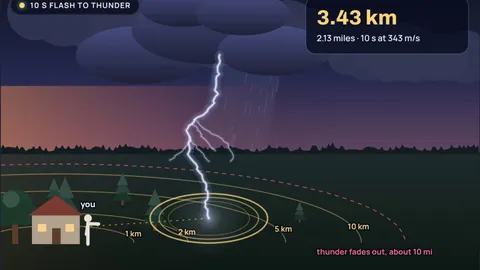
How Far Away Is Lightning? The Counting Rule Explained
Count from flash to thunder and divide by 3 for km or 5 for miles. Why it works, how temperature changes it, and why any thunder means go indoors.